

- Introduction
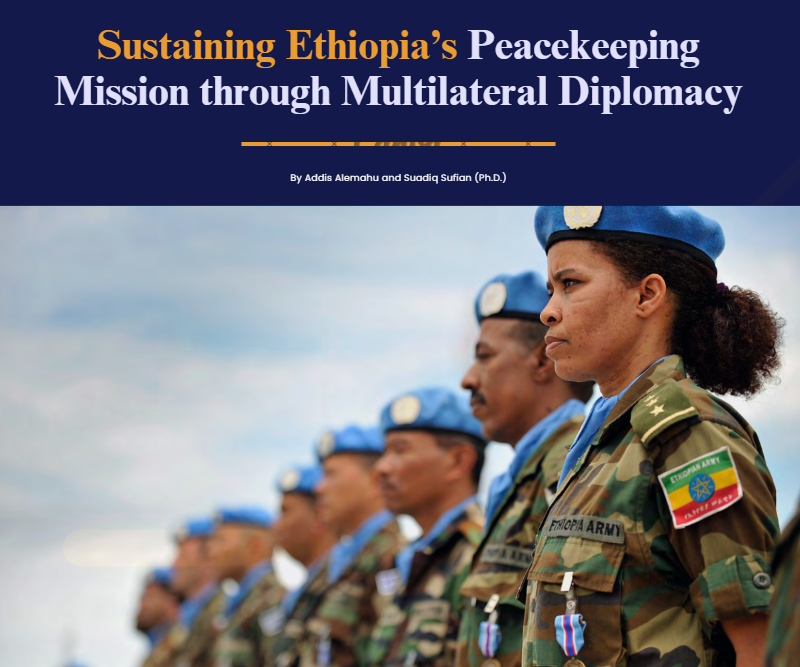
Ethiopia’s engagement in multilateral diplomacy and its participation in collective security underwent a significant change following the Second World War. Historically, under the auspices of the United Nations (UN), Ethiopia has played a tremendous role beyond a symbolic contribution to multilateral peace operations. Its involvement in peacekeeping mission was started in the early 1950s when UN’s peacekeeping was in its infancy, and has been sustained to the present. Hence, for more than 70 years, Ethiopia has proven its unwavering commitment to advancing security throughout the world. Ethiopia has deployed over hundred thousand peacekeeping personnel across the world in this long-term engagement (Yeshiwas, 2024). Ethiopia’s participation in peace keeping mission originated from its military and foreign policies orientation, aiming to maintain peace and stability.
Ethiopia’s engagement in peacekeeping or peace-building efforts could be epitomized by a wide-range of commitments. Among others, Ethiopia is leading the fight against terrorism in Somalia, supporting its state-building efforts. It also actively participated in the creation of the East African Standby Force. In addition, it is playing a key mediating role in the conflict of South Sudan within the framework of IGAD and the African Union. Strikingly, Ethiopia has graciously taken up all these roles at a time when global migration is at an all-time high, accommodating hundred thousands of refugees largely from neighboring countries.
Importantly, all Ethiopia’s commitments in peace keeping missions were governed by multilateral organization such as UN and AU principles, signaling the contribution of its multilateral diplomacy. Ethiopia’s success in multilateral diplomacy enabled its troops to be seen as harbingers of peace and cooperation. In this regard, the UN Under-Secretary-General Jean-Pierre Lacroix said: “Ethiopia is one of UN peacekeeping’s strongest partners. Truly, Ethiopia has been a beacon of peacekeeping across the world’s conflict zones. Its long tradition of sacrifice and service in the cause of peace will inspire generations to come.”
The aforementioned realities underscored Ethiopia’s significant potential to sustain its role in peacekeeping missions. Despite its influencing position in peacekeeping mission, it is apparently facing challenges due to multiple factors. Ethiopia can reclaim its strategic posture by revitalizing its commitment to multilateral diplomacy – a path well supported by its historical legacy. This policy paper, therefore, raises a critical question: How can Ethiopia effectively sustain and strengthen its peacekeeping role through multilateral diplomatic engagement?
- Ethiopia and Peacekeeping Mission in History
Ethiopia’s involvement in peacekeeping mission can be discussed in distinct historical phases. As mentioned in the introductory section, its involvement in peace keeping mission was commenced during the 1950s, as Ethiopian soldiers were fighting alongside UN forces in the Korean War.
Between the early the 1950s and the late 1960s, the Imperial regime pursued an activist internationalist foreign policy, underpinned by a collective security narrative. Then, from the late 1960s to the early 1990s, Ethiopia’s commitment to UN collective security became symbolic. The Derg regime was critical of peacekeeping interventions, especially after it adopted a pro-Soviet and socialist ideology in the mid-1970s. On the other hand, the EPRDF government took a new initiative towards peacekeeping operations. Yet, the involvement of the EPRDF regime in peacekeeping was limited due to domestic political instability and the war with Eritrea (1998–2000). Notwithstanding, the adoption of the 2002 foreign policy by the EPRDF government seemingly changed the course, paving a way to proactive and multidimensional role in international peacekeeping mission.
Ethiopia has participated in multiple UN peacekeeping missions. These include its involvement in Darfur (UNAMI), Sudan (UNISFA), South Sudan (UNMISS), Liberia (UNMIL), Ivory Coast (UNOCI) and Somalia (AMISOM). In all these operations, Ethiopia has viewed peace keeping mission as an important vehicle for pursuing foreign policy and national security objectives, contributing to the stabilization of the Horn region and Africa more broadly (Dersso, 2013). Evidently, As of June 2024, Ethiopia’s uniformed personnel under UN peacekeeping mission in Africa are around 1,539, entailing the commitment of the country to maintain continental peace to at the moment.
- Multilateral Diplomacy and Peacekeeping Mission
Multilateral diplomacy sustains peacekeeping missions by acting as the engine of consensus, coordination, and legitimacy. It’s not just about launching missions – it’s about keeping them responsive, inclusive, and politically viable over time. In this perspective, membership in multilateral organizations could play a tremendous role to promote multilateral diplomacy, and thereby contributing to peacekeeping missions. Fortunately, Ethiopia is an important member of various interregional and international multilateral organizations working to promote regional peace and security in the Horn of Africa, where chronic conflict and civil war undermine regional stability. Being a leader in regional and African institutions, Ethiopia frequently fosters African consensus around its positions. For these reason, global Superpowers and regional actors showed interest in collaborating with Ethiopia through multilateral diplomacy. In this connection, Ethiopia’s extensive participation in UN-led missions highlights its commitment to collective security and accentuates the UN’s role in legitimizing these contributions within a global security framework.
Ethiopia’s closeness to multilateral organizations such as UN and AU creates a fertile ground for Ethiopia to participate in multiple peace-keeping missions. The UN serves as the leading authority in global peacekeeping operations, establishing standards and frameworks that guide international efforts to maintain peace in conflict-affected regions. The AU is also instrumental in promoting African-centered solutions to conflict resolution and peacekeeping within the continent. The establishment of the Peace and Security Council (PSC) allows member states to collaborate on regional stability issues (Akanji and Abiola, 2020). For example, Ethiopia’s significant contributions to various AU peace operations, especially in Somalia and South Sudan, demonstrate its strategic importance within the AU’s framework.
Along similar lines, organizations such as IGAD and the Eastern Africa Standby Force (EASF) play critical roles in addressing localized peace and security challenges. Ethiopia’s active participation in these regional organizations not only strengthens its influence but also solidifies its commitment to maintaining regional peace and stability (Melaku, 2022).
Generally, the contribution of multilateral diplomacy resulted from Ethiopia’s crucial role in multilateral institutions significantly bolster Ethiopia’s peacekeeping efforts through the provision of financial resources and logistical assistance. The UN’s allocation of funding is vital for troop deployment and mission sustainability (UN, 2023). The AU’s Peace Facility is another key financial instrument supporting peace operations across Africa, ensuring Ethiopia’s adequate resources for peace-keeping missions (Fenton, 2023). Such financial backing encourages Ethiopia’s sustained contributions to missions.
- Conclusion and Policy Recommendations
Ethiopia has proven its unwavering commitment to advancing stability and security throughout the world. For more than seven decades, Ethiopian soldiers were fighting alongside multilateral organizations in various countries. Despite its long-term engagement, Ethiopia has currently faced challenges pertaining to sustaining its peacekeeping missions. Some of the factors include the deterioration of its relations with neighboring countries triggered by a subversive role of Ethiopia’s historical enemies; domestic factors such as conflict and inadequate representation in senior and middle-level leadership roles at UN positions.
In order to sustain its posture in peace-keeping mission, Ethiopia needs to promote multilateral diplomacy through regularly participate in global forums and search joint answers to global concerns. To this end, working on diplomatic approach distinguished by patience, respect, and a dedication to conversation and consensus building is vitally important. Correspondingly, the presence of diverse diplomatic communities and multilateral organizations in Addis Ababa, along with its growing potential of conference tourism, could help the country to secure Peacekeeping missions around the world.
- References
Akanji, O and Abiola, O (2020) “African Union Peacekeeping: Challenges and Recommendations,” African Journal of Peace and Security
Dersso, S. (2013). Peacekeeping Contributor Profile: Ethiopia. Available at peacekeeping.org
Fenton, W. (2021). “Funding and Logistics in African Peace Operations: The Role of the AU,” Journal of African Security Studies.
Melaku, T. (2022). “Regional Cooperation for Peacekeeping in Eastern Africa,” Horn of Africa Review of Politics.
UN Peacekeeping. (2023). “Financial Overview of Peacekeeping Operations” available https://peacekeeping.un.org/
About the Authors
Suadiq Sufian (Ph.D.) is a senior researcher at the Middle East Affairs Department in the Institute of Foreign Affairs.
Addis Alemahu is a researcher in the Institution of Foreign Affairs, specializing in the Multilateral Governmental and Non-Governmental Affairs department. He holds an MA in Journalism and Communication.
His work focuses on:
Migration and Refugee Issues
Peacekeeping and Military Issues
Socioeconomic Issues
He has authored numerous research articles, including:
France’s Military Strategy Revision Plan in Africa and its Implications: Future Challenges & Opportunities for Africa
Saudi Arabia’s Vision 2030 and Its Regional Implications
Trajectories and Geopolitical Implications of the Gulf-Horn Interaction
Militarization and Commercialization of Ports in the Horn of Africa
For inquiries, you can contact him at addisalemahu@yahoo.com.
Image: Peace Operations Training Institute®