

Introduction
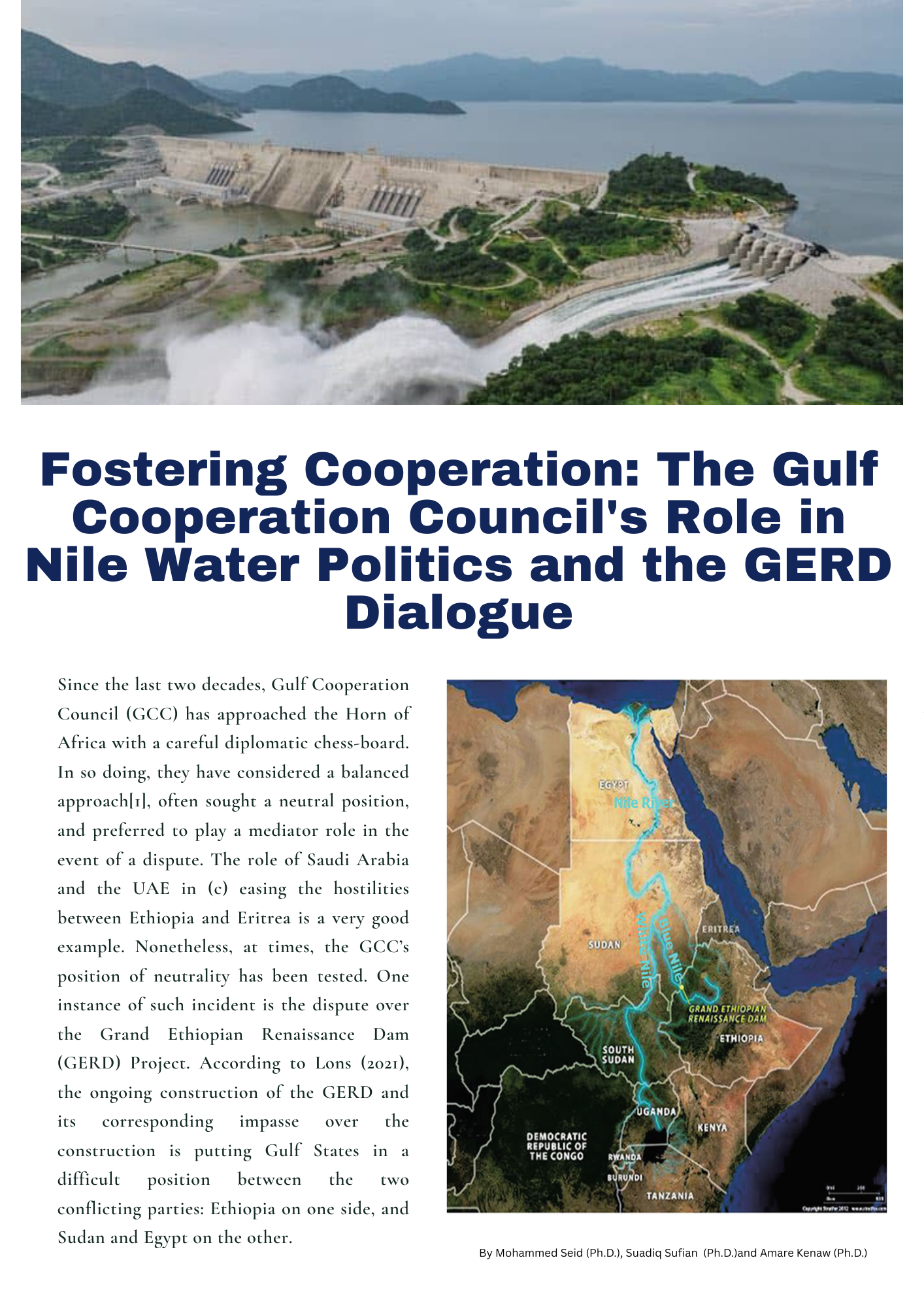
Since the last two decades, Gulf Cooperation Council (GCC) has approached the Horn of Africa with a careful diplomatic chess-board. In so doing, they have considered a balanced approach[1], often sought a neutral position, and preferred to play a mediator role in the event of a dispute. The role of Saudi Arabia and the UAE in (c) easing the hostilities between Ethiopia and Eritrea is a very good example. Nonetheless, at times, the GCC’s position of neutrality has been tested. One instance of such incident is the dispute over the Grand Ethiopian Renaissance Dam (GERD) Project. According to Lons (2021), the ongoing construction of the GERD and its corresponding impasse over the construction is putting Gulf States in a difficult position between the two conflicting parties: Ethiopia on one side, and Sudan and Egypt on the other.[2]
Gulf States have reacted to the dispute over the GERD differently. Some Gulf States preferred to play a mediation role. The effort of Saudi Arabia, Qatar and the UAE witnessed this fact. Yet, setting aside their neutral position, specific Gulf countries also sided with Egypt and Sudan against Ethiopia. For instance, Kuwait, Oman and Bahrain expressed their full support to downstream countries[3]. Meanwhile, the position of the UAE and especially Qatar remained unknown as they have not issued a statement supporting any specific country. Indeed, even the UAE whose position is confusing when it comes to GERD, joined the statement of the GCC and ‘echoed’ the water security of Egypt and Sudan like its Gulf neighbors. This entails there is an act of gulfanization of the Nile.
Gulfanization of the Nile is a new concept, coined by the authors of this policy brief. It is apparently parallel to the definition of Arabization. The latter refers to the process of Arab influence on the non-Arab peoples with cultural and political implications (EBSCO, 2025). These includes imposing Arab language and culture and political ideals of Arab nationalism at the expense of non-Arabs. Gulfanization is an equivalent or subset of Arabization. In this paper, it is understood as an act of the GCC in influencing non-Gulf States or issues for their geo-political interest in the region and beyond. Therefore, Gulfanization of the Nile is an attempt to own the issue of the Nile for the geopolitical interest of the Gulf States. At the backdrop of this, therefore, this policy brief assess the water stress of the Gulf region and the implication of the occasional reaction of the GCC to the GERD dispute in Africa.
Water Security in the GCC
Water security in the context of the GCC needs to be understood in terms of risk exploration and future threats, rather than the system’s ability to exploit resources and ensure a high level of supply coverage. The present and future implications for water consumption, therefore, form the central thesis of water security. In other words, to what extent areas are vulnerable to risks of present and future threats of water supply remains the crux of the concept. Of course, the risks and threats can only be measured with the parameters of quality and quantity of water supply (Al-Saidi and Saliba, 2019).
In this regard, the GCC region has the most depleted and insecure water resources in the world, characterized by a lack of reliable quantity and quality of water. The renewable water resources per capita of the GCC countries are far below the recognized poverty line of 1000 m³/y.ca (cubic meters per year per capita), while the worldwide threshold of water rests at 6000 m³/y.ca. This has reduced the GCC countries to having the lowest annual renewable water sources per capita in all the Arab countries and among the poorest in the whole world. Although water security meant harnessing the potential of water for every person in terms of quantity, at the worst an estimated 2.1 million people in the region have less than 29 m³/y.ca. The reason for this acute shortage of water in the region is, in one way or another, associated with the discovery of oil and natural gas and the subsequent rapid urbanization, fast population growth, and rising standard of living in the GCC region (Darwish, M. et al., 2014; Al-Reshid and Akber, 2015). A research projection on the future water stress of the GCC also unfolds that out of the total 33.8 billion (100%) cubic meters per year of water needed for consumption by the year 2050, countries will be able to provide only 7.8 billion cubic meters (23%) of the future total consumption. In other words, they will face a 26 billion (77%) cubic meter per year water shortage by 2050 (Droogers et al., 2012).
Countries of the GCC are largely dependent (50-90%) on the most expensive desalination of seawater for their freshwater consumption. The average annual cost of desalination of seawater in the GCC is estimated to be within the range of $1-14 billion between 2007 and 2016. Saudi Arabia, the UAE, and Kuwait are the leading users of desalination in the region and worldwide (see Fig. 1 below). As water security entails both quality and quantity of water, the GCC’s water security is constrained by pollution and inadequacy. Scrutinizing the financial, technical, and environmental costs of desalination, research reports from the GCC underscored the need to explore alternative avenues of freshwater supplies for the region (Ibid).
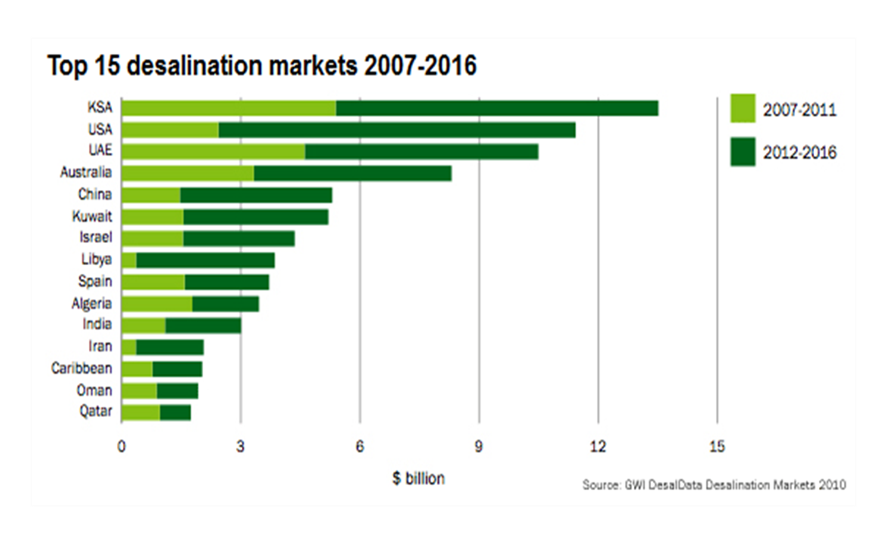
Fig. 1: World Desalination market share 2007 – 2016
Source: https://www.advisian.com/en/global-perspectives/the-cost-of-desalination
GCC’s Move in the Gulfanization of the GERD Agenda
At the backdrop of the water stress of the region, the GCC countries issued successive statements out of their domain on the GERD and Egypt’s water security on the Nile. Ethiopia embarked on the construction of one of the biggest Dam in Africa to meet its developmental aspiration through securing future energy needs. Ethiopia has made explicit that the dam will not affect the water security of Egypt and Sudan and invited them from the onset to participate in the future utilization of the Nile water on the principles of international laws of “equitable and reasonable use of water, not causing significant harm, consultation and negotiation and peaceful settlement of disputes”.[4] To this end, Ethiopia initiated successive tripartite water consultations and negotiations with downstream countries on the premise of settling the future use of water. Through time, however, Egypt and Sudan hold a contradictory position against Ethiopia. Egypt saw the project as a direct threat to its water security and status in the region, while Sudan is concerned for its investment along the Nile River.[5]
The conflicting position of the upper and the downstream countries over the GERD drew international and regional interventions. From time to time, especially, Ethiopia and Egypt have heated up the rhetoric and taken the dispute to the international diplomatic arena. Seemingly in response to Egypt’s call and partly for their own sake, the GCC and the Arab League have reaffirmed their support to Sudan and Egypt. Siding with the position of Egypt, the Arab League passed a resolution to inform the UN Security Council to take “necessary measures”. Ethiopia slammed the resolution, and instead, blaming the downstream countries for unreasonable politicization of the GERD’s negotiations. The Ministry of FDRE reiterated that “The GERD is an African issue. The disagreement between Ethiopia, Egypt, and Sudan can only be resolved through…the spirit of finding African solutions to African problems.” [6] Put in other words, Ethiopia refused to accept any attempt of ‘Arabization of its River’ under the pretext of supporting the water security of Egypt. Ethiopia added that “utilization of the Nile waters is also an existential matter for Ethiopia”.[7]
Similar to its superset, the GCC has issued successive statements on the GERD. Some of its statements equated Egypt’s water security to the water security of the GCC countries – Gulfinization of the Nile[8]. Two reasons might trigger countries of the GCC to undertake this action. Firstly, it might be an act of showing solidarity for their Arabization project. Secondly, pressing the agenda of Egypt might be out of the desperate need of water security that Nile would be a hope of the GCC region in the future. In strengthening the second reason, media outlets reported that giant developmental programs consists of agricultural and residential units have been launched by the Egyptian government in 2020 in the desert of Sanai Peninsula. For the effectiveness of the project, a huge water canal has reached from the Nile in the desert, right in the outdoor steps of the GCC (Al-Monitor, 2019). No wonder to wish the Nile for the dire water scarcity of the GCC region when compared to Saudi Arabia’s over ambitious and unsuccessful project in 1976. The project involved financing a French research firm to study the feasibility of towing hundred millions ton iceberg from Antarctica to the Red Sea where it was hoped to change into fresh water for the desperate need of the kingdom (Jones, 2010). It is, therefore, unwise for analysts not to be able to speculate the second destiny of the Nile water to be either to the GCC or Israel. Although the GCC cannot Gulfanize the Nile water for a moment, it has already Gulfanized the agenda some years before. However, the apparent bewildering position on backing the water security of Egypt seems an act of the GCC towards the full Gulfanization of the Nile water.
Conclusion
Water scarcity, geopolitical aspirations, and regional security dynamics come together in the Gulfanization of the Nile, which shows how the Gulf States are attempting to influence trans-boundary water politics outside of their boundaries. Under the guise of solidarity with Egypt and Sudan, their involvement in the GERD dispute belies a deeper strategic calculation motivated by an existential water crisis that is expected to worsen by 2050, leaving the region severely deficient. The Nile’s transformation from an African resource to a global strategic asset is highlighted by this engagement, but it also runs the risk of internationalizing what belongs to Africa, undermining the African Union’s tenet of “African solutions to African problems” and escalating mistrust among riparian states. If such trends continue unchecked, the politicization of water could exacerbate regional instability and complicate cooperative solutions. Therefore, policy responses must prioritize inclusive frameworks that safeguard the sovereignty and development aspirations of Nile Basin countries while addressing the legitimate water security concerns of external actors. This requires Ethiopia, Sudan, and Egypt to strengthen AU-led negotiations grounded in equitable and reasonable utilization, while Gulf States should shift from zero-sum alignments toward exploring alternative freshwater sources beyond desalinization, including options from Ethiopia.
References
Al-Reshid and Akber (2015) “Water security in the Gulf Cooperation Council (THE GCC) countries: Challenges and opportunities” in Hydrological Sciences and Water Security: Past, Present and Future, Proceedings of the 11th Kovacs Colloquium, Paris, France.
Darwish, M. et al (2014), “Qatar and THE GCC water security” a paper presented at the Conference on Desalination for the Environment: Clean Water and Energy, Limassol, Cyprus.
Droogers et al. (2012) “Water resources trends in Middle East and North Africa towards 2050”, in Hydrology and Earth System Science, 16, 3101–3114
EBSCO(2025) ‘Arabization’ Available at: https://www.ebsco.com/research-starters/language-and-linguistics/arabization?utm_source=chatgpt.com
Galal, Rami (2019) “Egypt launches development projects in north, south Sinai” Al-Monitor, Available at <https://www.al-monitor.com/originals/2019/11/sinai-egypt-development-agricultural-project-nile-water.html >
Jones, T (2010) Desert kingdom: how oil and water forged modern Saudi Arabia, Cambridge: Harvard University Press.
Kechichan, J (2007) “The gulf cooperation council: Search for security” in Third World
Quarterly, vol. 7(4), 853-881, DOI: 10.1080/01436598508419872.
Pasha. A.K.(2012) “The Gulf Cooperation Council: a regional approach to peace, security and development” in Journal of the Indian Ocean Region, 8:1, 90-98, DOI:
10.1080/19480881.2012.683630
Priess, David (2007) “Balance-of-threat theory and the genesis of the gulf cooperation council: an interpretative case study” in Security Studies, 5:4,143-171, DOI: 10.1080/09636419608429291
The GCC Charter (1981) available at https://www.the GCC-sg.org/en-us/Pages/default.aspx
Verhoeven, Harry (2018) “The Gulf and the Horn: Changing Geographies of Security Interdependence and Competing Visions of Regional Order” in Journal of Civil Wars, 20:3, 333-357, DOI: 10.1080/13698249.2018.1483125.
Vojin, D. (1973). The Concept of Security in International Relations, Beograd: Savremena Administracija.
[1] Lons, Camile. 2021. IISS. Gulf countries reconsider their involvement in the Horn of Africa. Available at https://www.iiss.org/blogs/analysis/2021/06/gulf–horn-of-africa
[2] Lons, Camile. 2021. IISS. Gulf countries reconsider their involvement in the Horn of Africa. Available at https://www.iiss.org/blogs/analysis/2021/06/gulf–horn-of-africa
[3] Al-Monitor. (2021). Available at https://www.al-monitor.com/originals/2021/12/gulf-states-back-egypt-nile-river-dam-dispute-ethiopia
[4] A presentation by one of the chief Ethiopian negotiators from Ethiopian Ministry of Foreign Affairs at Sheraton Addis, 2022.
[5] Embassy of FDRE, London, Uk. (2021). Statement on the Resolution of the League of Arab States on the GERD.
[6] Aljezeera. (2021). Ethiopia rejects Arab League resolution on Renaissance Dam https://www.aljazeera.com/news/2021/6/16/ethiopia-rejects-arab-league-resolution-on-renaissance-dam
[7] FDRE Embassy, London, UK. (2021)Statement on the Resolution of the League of Arab States on the GERD
[8] https://www.al-monitor.com/originals/2021/12/gulf-states-back-egypt-nile-river-dam-dispute-ethiopia#ixzz7hCuXfOKC
About the authors
Mohammed Seid (Ph.D.) and Suadiq Sufian (Ph.D.) are senior researchers at the Middle East Affairs Department in the Institute of Foreign Affairs.
Amare Kenaw (Ph.D.), lead researcher and Middle East Research Affairs Director General, Institute of Foreign Affairs
Disclaimer:
The content disseminated by the Institute of Foreign Affairs (IFA) – including, but not limited to, publications, public statements, events, media appearances, and digital communications – reflects the views of individual contributors and does not necessarily represent the official positions or policies of the Institute, its partners, or any affiliated governmental or non-governmental entities.
While the IFA endeavors to ensure the accuracy, integrity, and timeliness of the information presented, it makes no representations or warranties, express or implied, regarding the completeness, reliability, or suitability of such content for any purpose. The Institute expressly disclaims any liability for errors or omissions, as well as for any actions taken or decisions made based on the information provided.
The inclusion of external links, references, or third-party resources does not constitute an endorsement by the Institute. Additionally, engagement on social media platforms – including, but not limited to, likes, shares, retweets (RTs), or reposts – shall not be interpreted as an endorsement or validation of the views expressed therein.
Readers and audiences are encouraged to exercise critical judgment and seek independent verification when interpreting or relying upon any information disseminated through publications and posts on the Institute’s platforms or representatives.
image https://www.researchgate.net/figure/Nile-basin-map-