

- Introduction
Ethiopia and Kenya share one of the most enduring and strategically significant partnerships in East Africa. Their relationship stretches back centuries, with both countries being part of the ancient trade routes that once connected the African continent[i]. Their bilateral relationship is shaped by geography, history, security and shared development plans. Their ties has stayed for centuries but the initiative to demarcate the 890 km long border in 1907 when Kenya was still under British East Africa protectorate, during the reign of Emperor Menelik II[ii],, laid the foundation for later strong bond between them. Since then, despite the two countries had different colonial backgrounds, ideological differences or changes in leaderships, the relationship between two countries is characterized by cooperation[iii] rather than conflict.
The long standing and deep rooted relationship between Ethiopia-Kenya has been reinforced by several factors. First, the two countries supported each other during the periods of European colonial domination. Historical accounts indicate that Emperor Haile Selassie provide support to Kenya’s Mau Mau liberation struggle against British colonial rule and back the Kenyatta family. Conversely Ethiopia, while resisting the Italian occupation forces, use Kenyan territory’s as operation base and secured medical support and military aid[iv].
The second key factor that has prevented conflicts and fosters a sisterly relationship between the Ethiopia-Kenya is clear demarcation of their border. Most African countries often face recurring border conflicts with their neighbors since many borders are demarcated arbitrarily by European powers without regard for ethnic, cultural or historical realities.However, the Ethio-Kenya border is one of the few in Africa that was formally settled. The border demarcation process has begun in 1907 for the first time between British East Africa protectorate and Emperor Menelik II and later further clarified in 1947. After several rounds of negotiations, the border was demarcated and officially recognized on June 9, 1970, when Emperor Haile Selassie and President Jomo Kenyatta signed the agreement[v].
Furthermore, the defense pact signed between Ethiopia and Kenya has strengthened trust between the two nations. The Ethio-Kenya Defense Pact was concluded in 1964, shortly after Kenya’s independence to ensure mutual security[vi]. Many observers predicted that partnership would weaken after Ethiopia’s ideological shift to Marxism-Leninism following the fall of Imperial regime in 1974. However, despite their ideological differences, the Ethiopia and Kenya security partnership has continued[vii] and still sustained. Taken together, all these foundations contributed to a strong and stable bilateral relationship and helping the two countries avoid protracted conflicts that have troubled much of the Horn of Africa.
- Ethio-Kenya Economic Relationship
The relationship between Ethiopia and Kenya extends beyond diplomatic and security areas into economic spheres where their ties have steadily deepened over the years. Bilateral Trade between the two countries has grown consistently, with both nations benefiting from the exchange of goods and services[viii]. The Moyale Corridor in particular holds significant potential as a gateway for cross border commerce. Recent infrastructure investment, including the highway linking Isiolo to the Moyale border and construction of a one stop border post (OSBP) facility at Moyale is directly contributing trade flows and strengthening economic integration between them[ix].
In addition new infrastructure projects such as Lamu Port-South Sudan-Ethiopia Transport Corridor (LAPSSET), within which the Moyale Corridor falls, have strengthened economic ties between the two countries. The LAPSSET initiative is particularly significant as it provides Ethiopia with alternative sea access through the port of Lamu. Complementary developments including one stop border post and improved links could facilitate cross border trade, logistics and mobility. Ethiopia and Kenya are advancing efforts to enhance economic and digital integration across the Horn of Africa through Horn of Africa Gateway Development Project (HoAGDP) which prioritizes cross-border infrastructure, trade facilitation, and digital connectivity[x].
Ethiopia, the region’s largest economy, received Kenyan exports, particularly manufactured goods. Meanwhile, Kenya, East Africa’s second-largest economy, imports agricultural products such as wheat, pulses, and spices from Ethiopia, alongside smaller quantities of leather goods and electricity. In 2024, trade between the two countries totaled USD 200 million, with Kenya enjoying a USD 12 million surplus. Kenya exports medicines, pesticides, cleaning products, and fertilizers to Ethiopia, while Ethiopia exports electricity, dried legumes, vehicles, and machinery to Kenya. Ethiopia accounts for only 1.3% of Kenya’s exports, and Kenya for just 2.9% of Ethiopia’s exports[xi]. Despite the long standing bilateral relationship, the overall volume of trade between two countries remains relatively small and there is still enormous untapped potential. However there is significant improvement of trade exchanges overtime and Ethiopia’s ongoing macro-economic reforms and liberalization of telecom, banking and foreign trade sector, creates new opportunities for even further integration and growth.
- Hydropower strategic cooperation
A major milestone in Ethiopia and Kenya relationships was reached with the signing of a Power Purchase Agreement (PPA) establishing 500-kilo volts transmission line between the two countries. The 1,045-kilometre High Voltage Direct Current (HVDC) interconnector linking Wolayta Sodo in Ethiopia to Suswa in Kenya enables cross border electricity trade. Under the agreement, the Ethiopian Electric Power and Kenya Power & Lighting Company Plc. committed to an initial supply of 200 MW of electricity in the first phase of the power export and the amount of power supplied is expected to gradually increase to 400 MW. The twenty five year agreement was signed in 2022 by the CEOs of the utilities, in the presence of President Uhuru Kenyatta and Ethiopia’s Finance State Minister, Eyob Tekalign[xii].
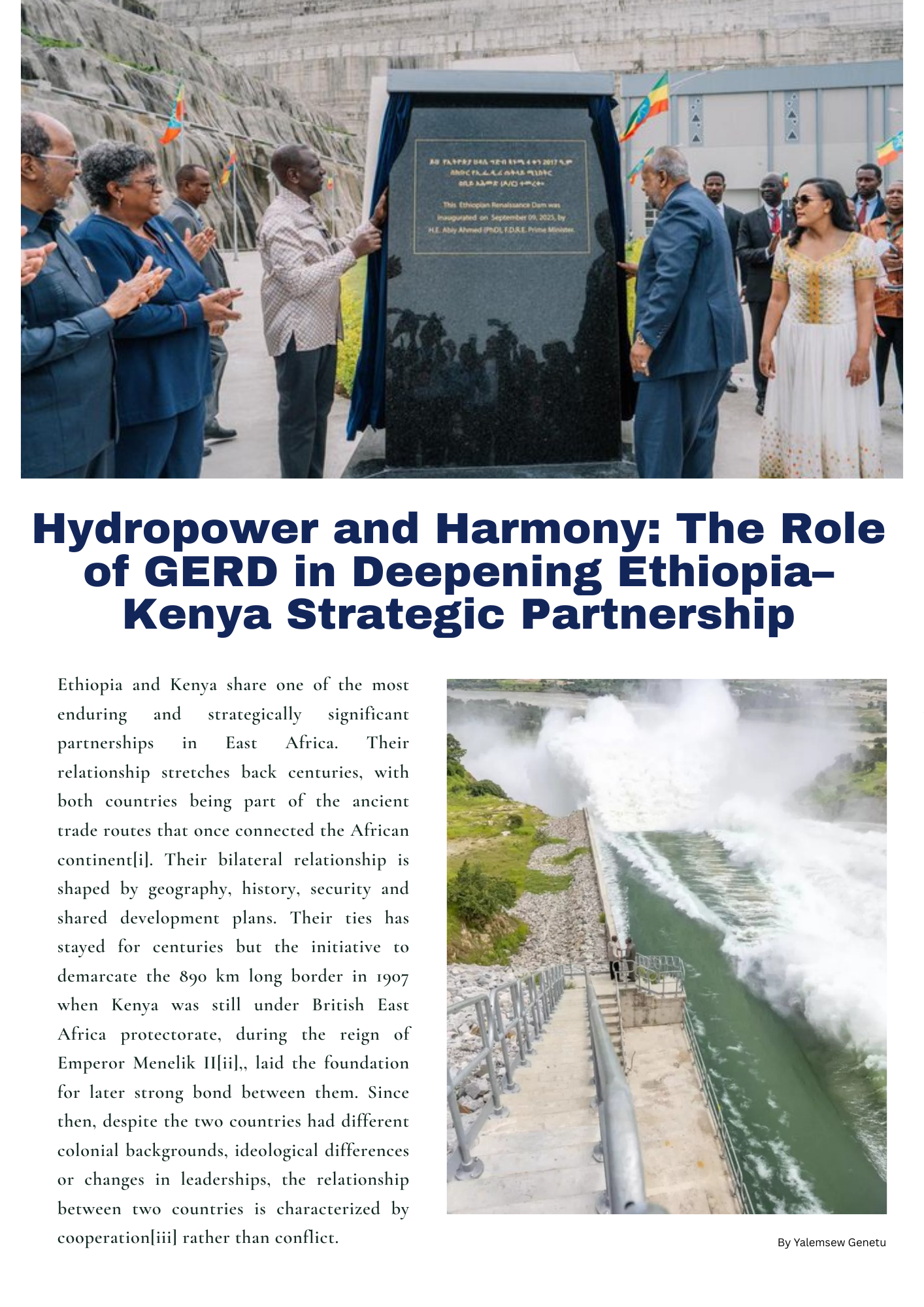
To meet Kenya’s demand and reduce the risk of power rationing[xiii], discussions are underway to further expand electricity imports from Ethiopia. The completion of Grand Ethiopian Renaissance Dam (GERD), Africa’s largest hydropower dam generating over 5,000 MW, is central to this ambition. By boosting Ethiopia’s power export competitiveness and fulfill the share of Kenya’s domestics and industrial demands, GERD is positioned to play a central role for both sides. President William Ruto, who attended and being one of the main guests during GERD inauguration ceremony in September 9, 2025, described the mega project as, a model for Africa’s energy future and confirmed that talks are underway with Addis Ababa to increase power imports.
“I have had a conversation with the Prime Minister, and we will have an extended conversation on whatever reserve power is available from this dam. We are ready to sign a power purchase agreement so we can take some of the power from this dam,” Ruto said.
GERD is set to play a central role in deepening Ethiopia and Kenya relationship. For Kenya, it ensures access to reliable and clean source of electricity, reducing energy costs and dependence on fossil fuels. For Ethiopia, electricity exports, a key element of its trade with Kenya, will expand strengthening one of its most strategic export markets. Beyond trade, the availability of affordable power supports industrial growth, stimulates regional value chains and creates jobs and especially it will anchor Ethiopia to position itself as a regional power hub. GERD not only consolidates bilateral ties but also transform regional economic integration and shared goals between them. By reinforcing the 500KV Ethiopia- Kenya interconnector, GERD is poised to become a cornerstone of the East African Power Pool (EAPP), linking Ethiopia’s vast hydropower capacity with Kenya’s growing electricity demand, contributing broader vision of an integrated East Africa electricity market.
- Conclusion
The bilateral relationship between Ethiopia and Kenya is evident across multiple areas and offers an example for other neighboring African countries. The two countries have sustained peaceful relationships while improving economic ties, complemented by public relations, historical linkage, diplomatic trust and security cooperation. The construction of long term development projects and energy integration between the two states will not only transform their historical ties but also redefine their economic relationship, creating a more interdependent and sustainable partnership. In this regard, GERD can provide a mutual benefit for both countries and deepens their economic and energy integration. To fully utilize these opportunities, both countries should strengthen institutional coordination, harmonize policies for energy integration and jointly establish a framework that enhances economic integration for the benefit of all countries in the East Africa.
v. References
[i] https://newbusinessethiopia.com/trade/ethiopia-kenya-political-and-economic-relations/
[ii] Aklilu, K.(2022). Ethiopias foreign relation from ancient to present. Jajaw publishing developers plc
[iii] Onyango, L. C.(1995) Kenya – Ethiopia relations: a study of the significance of economic and political factors contributing to co-operation, 1963 – 1991
[iv] Kabukuru, A. (2015). The Kenya-Ethiopia Defence Pact: Has Somalia become a pawn? NewAfrican Magazine.
[v] Belete, B. (2021) Ethiopia’s border: Unfinished Homework. Ethiopian Academic press
[vi] Kabukuru, A. (2015). The Kenya-Ethiopia Defence Pact: Has Somalia become a pawn? NewAfrican Magazine.
[vii] Nigusu, A. & Ketebo, A. (2022) Ethiopia and Kenya: a far-fetched cold war security pair (1974-1991). DOI: 10.18513/egetid.1226591.
[viii] Andualem, S.(2023).Ethiopia, Kenya political and economic relations. New Business Ethiopia. https://newbusinessethiopia.com/trade/ethiopia-kenya-political-and-economic-relations/
[ix] New Markets Lab & USAID (2018). Study of the Kenya – Ethiopia trade corridor a pathway to agricultural development, regional economic integration and food security. https://www.newmarketslab.org/assets/articles/29.pdf
[x] https://thereportermagazines.com/3995/
[xi] https://ethioembassy.ca/ethiopia-and-kenya-host-trade-and-investment-forum-in-nairobi-to-boost-bilateral-business-ties/
[xii] https://www.hoainitiative.org/news/kenya-and-ethiopia-signed-power-purchase-agreement-ppa
[xiii] https://www.thereporterethiopia.com/44913/
About the author
Yalemsew Genetu is a Researcher at the African Affairs Research Directorate, the Institute of Foreign Affairs, and a PhD candidate at Addis Ababa University..
Disclaimer:
The content disseminated by the Institute of Foreign Affairs (IFA) – including, but not limited to, publications, public statements, events, media appearances, and digital communications – reflects the views of individual contributors and does not necessarily represent the official positions or policies of the Institute, its partners, or any affiliated governmental or non-governmental entities.
While the IFA endeavors to ensure the accuracy, integrity, and timeliness of the information presented, it makes no representations or warranties, express or implied, regarding the completeness, reliability, or suitability of such content for any purpose. The Institute expressly disclaims any liability for errors or omissions, as well as for any actions taken or decisions made based on the information provided.
The inclusion of external links, references, or third-party resources does not constitute an endorsement by the Institute. Additionally, engagement on social media platforms – including, but not limited to, likes, shares, retweets (RTs), or reposts – shall not be interpreted as an endorsement or validation of the views expressed therein.
Readers and audiences are encouraged to exercise critical judgment and seek independent verification when interpreting or relying upon any information disseminated through publications and posts on the Institute’s platforms or representatives.