

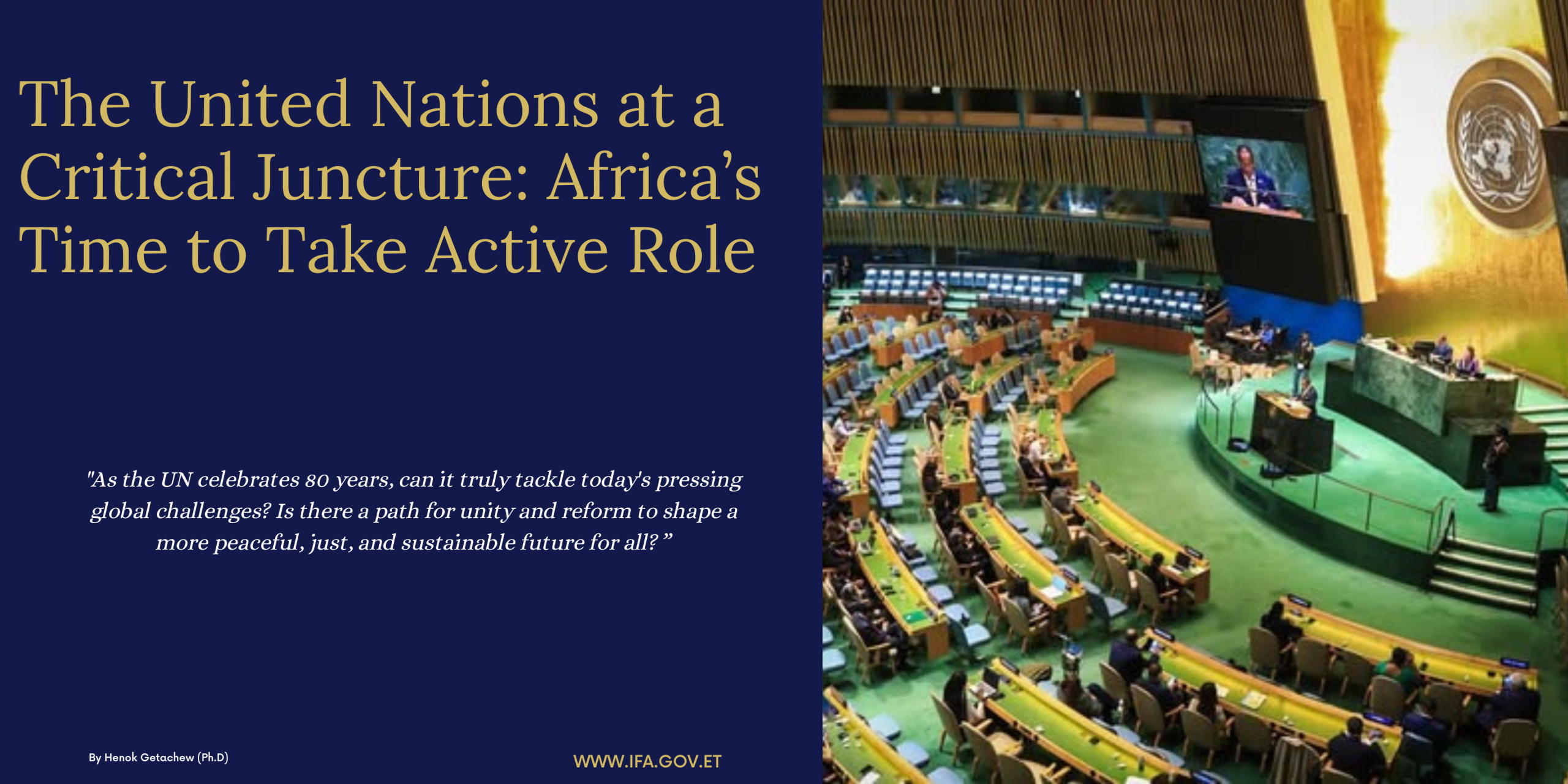
It was eighty years ago that the United Nations (UN) was established by the founding member states in 1945 to maintain international peace and security, foster friendly relations among the community of nations, and to attain international cooperation. It was the manifestation of determination to “save the succeeding generations from the scourge of war, which twice in our lifetime has brought untold sorrow to humankind.”[1] The establishment of the UN was raising hopes for peace and tranquility after five years of devastation that claimed millions of lives. Since then, the UN has gone through ups and downs to meet the spirit of the founding document, the Charter that serves as the bedrock of a “more peaceful, prosperous, and just world.” Different challenges that have emerged from the institutional setup, the paucity of transparency and accountability, the lack of commitment of the member states to reform the organization, geopolitical tensions, and major power competitions have caused the UN system to become “bureaucratic, costly, cumbersome, lacking in oversight, and often incapable of fulfilling the responsibilities placed upon it.”[2]
In response to persistent challenges confronting the organization, various reform initiatives have been proposed. Among these were An Agenda for Peace (1992) [3] and An Agenda for Development (1994)[4], the UN Millennium Declarations, High-Level Panels, and the 2005 UN Summit Outcome Document.[5] The foregoing and subsequent reforms aim to capacitate the organization to deal with the present economic and political realities.
At the time of commemorating its eightieth anniversary, the United Nations has faced formidable challenges that could compromise its responsibilities. Cognizant of the multifaceted crisis the UN is currently facing, the current Secretary General of the organization, Antonio Guterres, remarked that “we cannot solve 21st century problems with 20th century tools. We need a UN 2.0”[6] at the opening of the UN 2.0 in April 2024. Again, on 22 September 2024 at the Summit of the Future, global leaders adopted the Pact for the Future and its annexes, including the Global Digital Compact and the Declaration on Future Generations.[7] The agreement is the testimony of a commitment demonstrated by the member states to address the global challenges humanity is facing and prepare the generation for future challenges. The Pact for the Future addresses the lingering global issues as to peace and security (the Security Council reform, nuclear disarmament, space governance, and regulating emerging technologies); sustainable development and climate action (sustainable development goals, financial reform, climate finance, and rethinking progress); digital cooperation; youth and future generations; transforming global governance; and human rights and gender equality. [8] Banking on previous reforms, the UN80 initiative has been launched since March 2025 by Secretary-General Antonio Guterres to make the organization “more agile, integrated, and equipped to respond to today’s complex global challenges amid tightening resources.” [9]
Since 22 September 2025, leaders have attended the UN General Assembly. This meeting has been held amidst the rising of uncertainty, the erosion of multilateralism and the weakening of the collective security system, the rising of unilateralism, deteriorating relations between major powers, crises in the Middle East and in some parts of Africa, challenges accompanying the future of the peacekeeping operations in Africa, poverty, terrorism, pandemics, environmental challenges, migration and refugees, transnational crimes, human rights violations, and humanitarian crises. Furthermore, artificial intelligence and mounting biological risks are increasingly posing threats. [10] The multilateral response to the crises is severely affected by the lingering divisions among the members of the Security Council, “a divided international community and a divided membership.” [11]
In response to the multifaceted crisis the UN is facing, representing 54 states, the African Group (AG) needs to continue to demonstrate a common position and voice together with like-minded states and groups that could address the divisions and the paralysis afflicting the organization, particularly the Security Council during the 80th Session of the UN General Assembly that is held under the theme “Better together: 80 years and more for peace, development, and human rights” since 9 September 2025. [12] African states should further advance the historic agreement of the Pact for the Future and its annexes that call for enhanced international cooperation to address climate change, poverty, and health problems. [13] In line with the commitments, African states, including Ethiopia are also keeping on championing the reform of the UNSC by calling for the overturning of the historical underrepresentation of Africa , strengthening the Economic and Social Council, strengthening the United Nations System, more investment on regional security infrastructure, reforming the international financial architecture and sustainable financing, nuclear disarmament, preventing arms race in space, maritime security and safety and secure support for the realization of sustainable development goals. Indeed, the African Union, in this regard, can play a pivotal role by bringing the continent’s voices to the front stage as recently the chairperson of the AU Commission, Mahmoud Ali Youssouf, engaged in demonstrating a commitment to “join Africa’s heads of states and government to highlight Africa’s leadership and agency in addressing peace and security challenges”[14] and reach out to global partners to “promote investment and trade opportunities that can accelerate Africa’s development and advance the AU’s Agenda 2063.” [15] Thus, African states will continue to demonstrate their commitment to the UN’s multilateral framework as “the most viable path to achieving global peace and sustainable development.”[16] This will in turn help the goals of the present initiative to have a global institution that is efficient, effective, people-centered, accountable, and proactive in addressing global challenges amidst the shifting international order.
[1] United Nations.(1945). Charter of the United Nations and Statute of the International Court of Justice. San Francisco.Retrieved from https://www.ilsa.org/Jessup/Jessup15/UNCharterICJStatute.pdf
[2] Faridi, M.H.(2011).United Nations Reforms in International Perspectives. The Indian Journal of Political Science, 72(2):597-606. Pp.597.
[3] Boutros-Ghali, B.(1992). An agenda for peace : preventive diplomacy, peacemaking and peace-keeping : report of the Secretary-General pursuant to the statement adopted by the Summit Meeting of the Security Council on 31 January 1992. United Nations. Retrieved from https://digitallibrary.un.org/record/145749?v=pdf
[4] United Nations. (1994). An Agenda for Development: Report of the Secretary-General. Retrieved from https://digitallibrary.un.org/record/188719?v=pdf#files
[5]United Nations General Assembly.(2005). World Summit Outcome: resolution / adopted by the General Assembly during the 60th session. Retrieved from
https://digitallibrary.un.org/record/556636/usage?v=pdf&ln=ru
[6] https://news.un.org/en/story/2024/04/1148806
[7] United Nations.(2024). Summit of the Future: Our Common Agenda. Retrieved from https://www.un.org/en/summit-of-the-future/pact-for-the-future
[8] United Nations.(2024). Summit of the Future: Our Common Agenda. Retrieved from https://www.un.org/en/summit-of-the-future/pact-for-the-future
[9] https://www.un.org/un80-initiative/en/news/what-un80-initiative
[10] United Nations Office to the African Union.(2023). Launching New Agenda for Peace Policy Brief, Secretary-General Urges States to “Preserve Our Universal Institution” amid Highest Level of Geopolitical Tension in Decades. Retrieved from https://unoau.unmissions.org/policy-brief-new-agenda-peace-july-20-2023
[11] https://unlops.unmissions.org/peacekeeping-current-challenges-explained-jean-pierre-lacroix
[12] United Nations.(2025). General Assembly High-level Week. Retrieved from https://www.un.org/en/high-level-week-2025
[13] Bhattacharia, S. and Roy, A.(2025). UNGA 80: Africa’s Priorities on the Global Stage. Observer Research Foundation (ORF). Retrieved from https://www.orfonline.org/expert-speak/unga-80-africa-s-priorities-on-the-global-stage
[14] African Union.(2025). Chairperson of the African Union Commission Attends UNGA 80 in New York. Retrieved from https://au.int/en/pressreleases/20250919/chairperson-african-union-commission-attends-unga-80-new-york
[15] African Union.(2025). Chairperson of the African Union Commission Attends UNGA 80 in New York. Retrieved from https://au.int/en/pressreleases/20250919/chairperson-african-union-commission-attends-unga-80-new-york
[16] Bhattacharia, S. and Roy, A.(2025). UNGA 80: Africa’s Priorities on the Global Stage. Observer Research Foundation (ORF). Retrieved from https://www.orfonline.org/expert-speak/unga-80-africa-s-priorities-on-the-global-stage
About the author
Henok Getachew (Ph.D.) is a Senior Researcher at the African Affairs Research Directorate General, the Institute of Foreign Affairs.
Disclaimer:
The content disseminated by the Institute of Foreign Affairs (IFA) – including, but not limited to, publications, public statements, events, media appearances, and digital communications – reflects the views of individual contributors and does not necessarily represent the official positions or policies of the Institute, its partners, or any affiliated governmental or non-governmental entities.
While the IFA endeavors to ensure the accuracy, integrity, and timeliness of the information presented, it makes no representations or warranties, express or implied, regarding the completeness, reliability, or suitability of such content for any purpose. The Institute expressly disclaims any liability for errors or omissions, as well as for any actions taken or decisions made based on the information provided.
The inclusion of external links, references, or third-party resources does not constitute an endorsement by the Institute. Additionally, engagement on social media platforms – including, but not limited to, likes, shares, retweets (RTs), or reposts – shall not be interpreted as an endorsement or validation of the views expressed therein.
Readers and audiences are encouraged to exercise critical judgment and seek independent verification when interpreting or relying upon any information disseminated through publications and posts on the Institute’s platforms or representatives.