

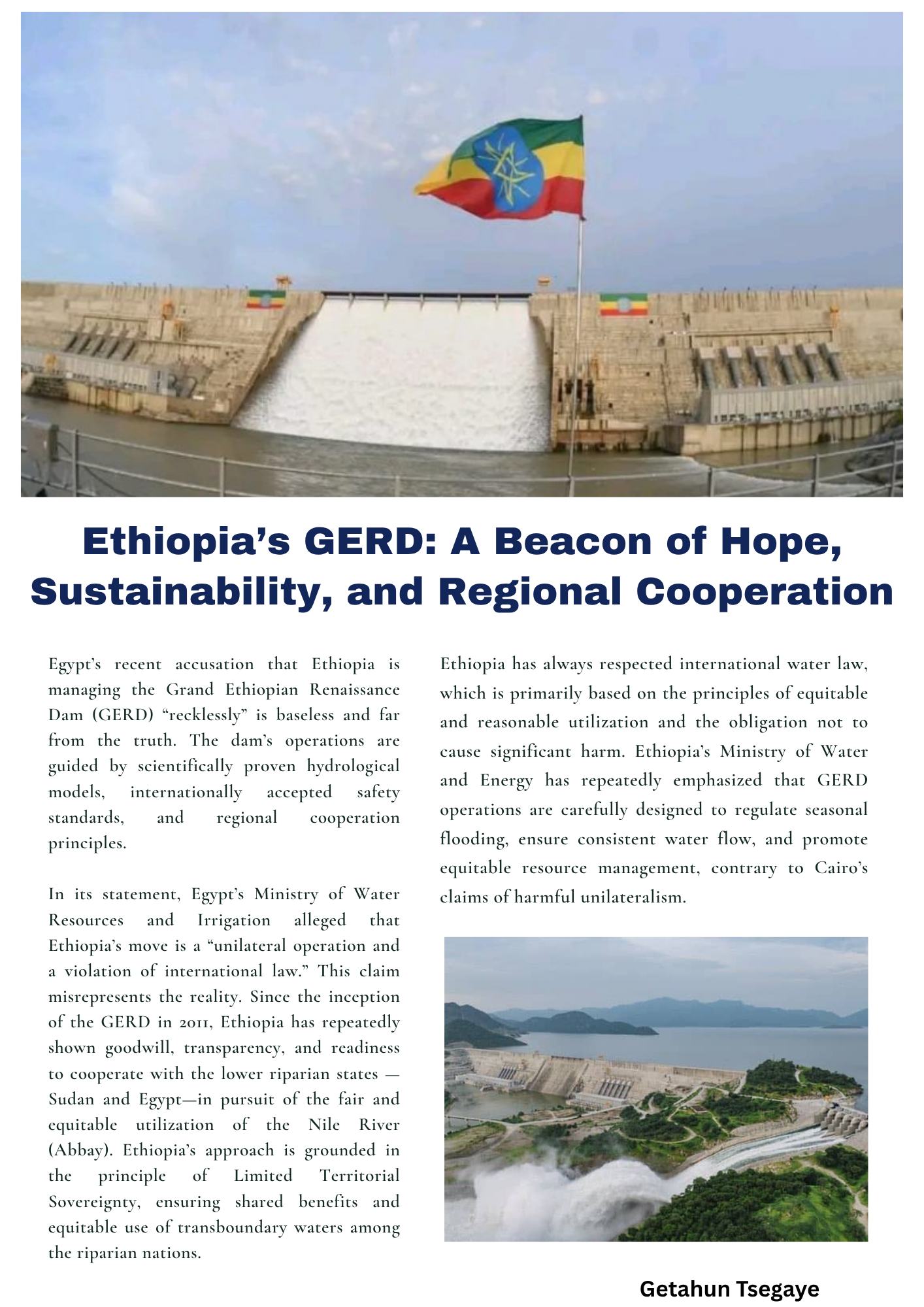
Egypt’s recent accusation that Ethiopia is managing the Grand Ethiopian Renaissance Dam (GERD) “recklessly” is baseless and far from the truth. The dam’s operations are guided by scientifically proven hydrological models, internationally accepted safety standards, and regional cooperation principles.
In its statement, Egypt’s Ministry of Water Resources and Irrigation alleged that Ethiopia’s move is a “unilateral operation and a violation of international law.” This claim misrepresents the reality. Since the inception of the GERD in 2011, Ethiopia has repeatedly shown goodwill, transparency, and readiness to cooperate with the lower riparian states — Sudan and Egypt — in pursuit of the fair and equitable utilization of the Nile River (Abbay). Ethiopia’s approach is grounded in the principle of Limited Territorial Sovereignty, ensuring shared benefits and equitable use of transboundary waters among the riparian nations.
Ethiopia has always respected international water law, which is primarily based on the principles of equitable and reasonable utilization and the obligation not to cause significant harm. Ethiopia’s Ministry of Water and Energy has repeatedly emphasized that GERD operations are carefully designed to regulate seasonal flooding, ensure consistent water flow, and promote equitable resource management, contrary to Cairo’s claims of harmful unilateralism.
Numerous hydrological studies have shown that the GERD actually benefits both Egypt and Sudan by reducing sedimentation and silt accumulation in their dams, mitigating devastating floods, and ensuring a more stable flow of water throughout the year. The dam also reduces evaporation losses due to its location in the Ethiopian highlands — a scientific advantage that improves overall Nile water efficiency for all.
Furthermore, research indicates that the GERD will play a significant role in reducing the effects of droughts in the Horn of Africa, including in Egypt and Sudan, by stabilizing water availability. This aligns perfectly with Ethiopia’s Green Legacy Initiative, which aims to combat climate change, expand renewable energy, and promote regional environmental sustainability.
Beyond regional benefits, the GERD stands as a symbol of hope for over half of Ethiopia’s population — millions who still live in darkness without access to electricity. The dam, entirely financed by Ethiopian citizens through bonds and public contributions, reflects a national spirit of self-reliance and unity. It embodies the Ethiopian people’s aspiration for sustainable development, industrial growth, and poverty reduction.
Cairo’s claim that the GERD poses a “direct threat to the lives and security of downstream states” is therefore misleading and provocative. Ethiopia has never sought to harm its neighbors; instead, it remains deeply committed to mutual benefit and regional prosperity. Prime Minister Abiy Ahmed (PhD) has repeatedly reaffirmed that Ethiopia seeks cooperation, not confrontation—emphasizing that the dam will ensure a steady and regulated flow of water throughout the year, thereby preventing floods and ensuring water security for all.
In fact, the Grand Ethiopian Renaissance Dam (GERD) stands as a beacon of regional integration and shared prosperity, reflecting Ethiopia’s unwavering commitment to mutual benefit among its neighbors. The inauguration ceremony was attended by several regional leaders, including President Hassan Sheikh Mohamud of Somalia, President William Ruto of Kenya, and President Ismaïl Omar Guelleh of Djibouti — a strong symbol of unity and collective progress in the Horn of Africa. The GERD has already begun exporting electricity to Kenya, Sudan, and Djibouti, with Tanzania next in line, underscoring Ethiopia’s role in advancing regional connectivity and sustainable development.
Ethiopia continues to uphold the principle of “African Solutions to African Problems,” supporting African Union (AU)-led dialogue as the appropriate platform for negotiation. Despite Egypt’s repeated attempts to internationalize the issue by bringing it to the United Nations Security Council more than a dozen times, Ethiopia has consistently maintained a peaceful, dialogue-based, and scientific approach.
Above all, Ethiopia believes that Ethiopia, Sudan, and Egypt share a common destiny—historically, culturally, and geographically—bound for centuries and for generations to come by the Nile River. The GERD should therefore be viewed not as a source of division, but as a catalyst for regional integration, energy cooperation, and shared prosperity.
Ethiopia remains open and ready to work with its brothers and sisters in Sudan and Egypt to realize the full potential of the Nile—a river meant to unite, not divide.
By Getahun Tsegaye, IFA staff
Disclaimer:
The content disseminated by the Institute of Foreign Affairs (IFA)—including, but not limited to, publications, public statements, events, media appearances, and digital communications—reflects the views of individual contributors and does not necessarily represent the official positions or policies of the Institute, its partners, or any affiliated governmental or non-governmental entities.
While the IFA endeavors to ensure the accuracy, integrity, and timeliness of the information presented, it makes no representations or warranties, express or implied, regarding the completeness, reliability, or suitability of such content for any purpose. The Institute expressly disclaims any liability for errors or omissions, as well as for any actions taken or decisions made based on the information provided.
The inclusion of external links, references, or third-party resources does not constitute an endorsement by the Institute. Additionally, engagement on social media platforms – including, but not limited to, likes, shares, retweets (RTs), or reposts – shall not be interpreted as an endorsement or validation of the views expressed therein.
Readers and audiences are encouraged to exercise critical judgment and seek independent verification when interpreting or relying upon any information disseminated through publications and posts on the Institute’s platforms or representatives.