

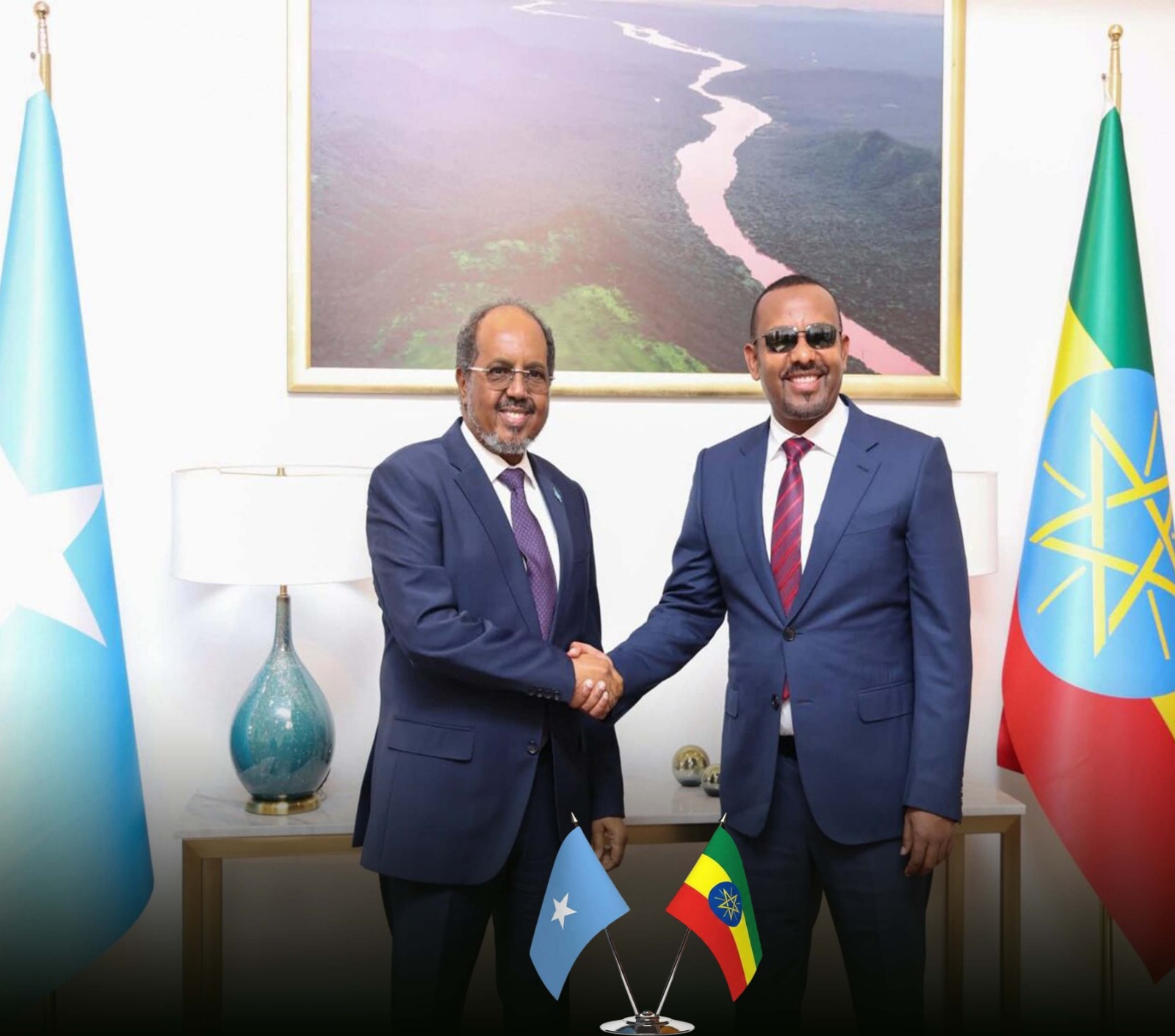
President Hassan Sheikh Mohamud’s arrival in Addis Ababa on Friday, December 19, 2025—his fourth official visit to Ethiopia this year—signals a deliberate recalibration of Somalia’s regional strategy and Ethiopia’s effort to consolidate influence within a rapidly shifting Horn of Africa order. Beyond ceremonial diplomacy, the visit reflects a pragmatic convergence shaped by security coordination, economic interdependence, and mutual risk management amid growing regional uncertainty.
Prime Minister Abiy Ahmed’s reception of the Somali President for a one-day working visit underscores Ethiopia’s intent to institutionalize bilateral dialogue as a tool of regional influence management, particularly in the context of fluid alliances, contested maritime access, and intensifying external competition. For Somalia, the frequency and symbolism of these high-level engagements point to a strategic choice: anchoring its fragile state-building project within Ethiopia’s political, security, and economic orbit as a means of securing regime stability, counterterrorism capacity, and international legitimacy.
The timing of the visit further amplifies its strategic significance. The Horn of Africa is undergoing a period of structural transition, marked by the drawdown and restructuring of international security missions in Somalia, recalibrated regional mediation roles, and increasing involvement by Gulf states, Turkey, and global powers. Against this backdrop, sustained Ethiopia–Somalia coordination reflects a shared assessment that unilateral approaches to security and development are no longer viable and that regional actors must assume greater ownership of stability management.
Yet beneath the language of partnership lies a pronounced power asymmetry. Ethiopia engages from a position of relative military, demographic, economic, and diplomatic advantage, seeking to preserve Somalia as both a strategic buffer against transnational threats and a source of leverage within broader Horn and Red Sea geopolitics. Somalia, by contrast, engages from a position of strategic necessity, prioritizing immediate security imperatives and external political backing over long-term autonomy. This asymmetry does not negate cooperation but rather structures it, raising persistent questions about influence, dependency, and the limits of sovereign decision-making.
The emphasis on continuity—through repeated leader-level contact, symbolic protocol gestures, and Somalia’s participation in major Ethiopian-hosted events such as the African Union Summit and the inauguration of the Grand Ethiopian Renaissance Dam (GERD)—signals a departure from episodic, crisis-driven diplomacy toward a more routinized bilateral relationship. However, continuity alone does not guarantee strategic convergence. Unresolved issues, including border security management, the future architecture of joint peace operations, maritime access sensitivities, and Somalia’s relations with Ethiopia’s regional rivals, remain latent friction points with the potential to destabilize cooperation if not carefully managed.
Importantly, this engagement cannot be understood in isolation from recent diplomatic repair efforts. Following tensions triggered by disputes over maritime access, Ethiopia and Somalia moved in January 2025 to restore full diplomatic representation and recommit to structured bilateral and regional cooperation. This step marked not only the normalization of relations but also a recognition by both governments of the costs associated with prolonged diplomatic rupture in an already volatile regional environment.
Subsequent high-level exchanges have reinforced this trajectory. In February 2025, Prime Minister Abiy Ahmed and President Hassan Sheikh Mohamud issued a joint Somalia’s Strategic Engagement with Ethiopia: Pragmatism, Power, and Regional Calculus
President Hassan Sheikh Mohamud’s arrival in Addis Ababa on Friday, December 19, 2025—his fourth official visit to Ethiopia this year—signals a deliberate recalibration of Somalia’s regional strategy and Ethiopia’s effort to consolidate influence within a rapidly shifting Horn of Africa order. Beyond ceremonial diplomacy, the visit reflects a pragmatic convergence shaped by security coordination, economic interdependence, and mutual risk management amid growing regional uncertainty.
Prime Minister Abiy Ahmed’s reception of the Somali President for a one-day working visit underscores Ethiopia’s intent to institutionalize bilateral dialogue as a tool of regional influence management, particularly in the context of fluid alliances, contested maritime access, and intensifying external competition. For Somalia, the frequency and symbolism of these high-level engagements point to a strategic choice: anchoring its fragile state-building project within Ethiopia’s political, security, and economic orbit as a means of securing regime stability, counterterrorism capacity, and international legitimacy.
The timing of the visit further amplifies its strategic significance. The Horn of Africa is undergoing a period of structural transition, marked by the drawdown and restructuring of international security missions in Somalia, recalibrated regional mediation roles, and increasing involvement by Gulf states, Turkey, and global powers. Against this backdrop, sustained Ethiopia–Somalia coordination reflects a shared assessment that unilateral approaches to security and development are no longer viable and that regional actors must assume greater ownership of stability management.
Yet beneath the language of partnership lies a pronounced power asymmetry. Ethiopia engages from a position of relative military, demographic, economic, and diplomatic advantage, seeking to preserve Somalia as both a strategic buffer against transnational threats and a source of leverage within broader Horn and Red Sea geopolitics. Somalia, by contrast, engages from a position of strategic necessity, prioritizing immediate security imperatives and external political backing over long-term autonomy. This asymmetry does not negate cooperation but rather structures it, raising persistent questions about influence, dependency, and the limits of sovereign decision-making.
The emphasis on continuity—through repeated leader-level contact, symbolic protocol gestures, and Somalia’s participation in major Ethiopian-hosted events such as the African Union Summit and the inauguration of the Grand Ethiopian Renaissance Dam (GERD)—signals a departure from episodic, crisis-driven diplomacy toward a more routinized bilateral relationship. However, continuity alone does not guarantee strategic convergence. Unresolved issues, including border security management, the future architecture of joint peace operations, maritime access sensitivities, and Somalia’s relations with Ethiopia’s regional rivals, remain latent friction points with the potential to destabilize cooperation if not carefully managed.
Importantly, this engagement cannot be understood in isolation from recent diplomatic repair efforts. Following tensions triggered by disputes over maritime access, Ethiopia and Somalia moved in January 2025 to restore full diplomatic representation and recommit to structured bilateral and regional cooperation. This step marked not only the normalization of relations but also a recognition by both governments of the costs associated with prolonged diplomatic rupture in an already volatile regional environment.
Subsequent high-level exchanges have reinforced this trajectory. In February 2025, Prime Minister Abiy Ahmed and President Hassan Sheikh Mohamud issued a joint statement in Mogadishu emphasizing trust-building and expanded cooperation across diplomatic, economic, and social domains. Parallel agreements between security institutions on status-of-forces arrangements and coordination mechanisms further indicate a shift toward operationalized cooperation in counterterrorism and peacekeeping frameworks.
Taken together, these developments suggest that Ethiopia’s engagement with Somalia is not merely reactive but strategically calibrated—aimed at cultivating a dependable partner that contributes to Ethiopia’s security depth while reinforcing its role as a central regional actor. For Somalia, alignment with Ethiopia offers short- to medium-term stability dividends but also necessitates careful navigation to prevent over-reliance from constraining future strategic flexibility.
President Hassan Sheikh Mohamud’s December visit, therefore, represents calculated pragmatism rather than a seamless partnership. Whether this momentum evolves into a durable stabilizing anchor for the Horn of Africa will depend on both states’ ability to manage power asymmetries, address unresolved structural risks, and align bilateral cooperation with an increasingly complex regional order. Domestic political shifts, external actor competition, and unresolved territorial and maritime questions will all test the resilience of this engagement.
In this sense, Ethiopia–Somalia relations are not simply improving; they are being strategically renegotiated. The implications extend beyond Addis Ababa and Mogadishu, offering a rare example of Horn of Africa states attempting to manage shared security and development challenges through sustained dialogue and coordinated action rather than default reliance on external guarantors. Whether this emerging model proves durable—or merely transitional—will shape regional stability in the years ahead.
in Mogadishu emphasizing trust-building and expanded cooperation across diplomatic, economic, and social domains. Parallel agreements between security institutions on status-of-forces arrangements and coordination mechanisms further indicate a shift toward operationalized cooperation in counterterrorism and peacekeeping frameworks.
Taken together, these developments suggest that Ethiopia’s engagement with Somalia is not merely reactive but strategically calibrated—aimed at cultivating a dependable partner that contributes to Ethiopia’s security depth while reinforcing its role as a central regional actor. For Somalia, alignment with Ethiopia offers short- to medium-term stability dividends but also necessitates careful navigation to prevent over-reliance from constraining future strategic flexibility.
President Hassan Sheikh Mohamud’s December visit, therefore, represents calculated pragmatism rather than a seamless partnership. Whether this momentum evolves into a durable stabilizing anchor for the Horn of Africa will depend on both states’ ability to manage power asymmetries, address unresolved structural risks, and align bilateral cooperation with an increasingly complex regional order. Domestic political shifts, external actor competition, and unresolved territorial and maritime questions will all test the resilience of this engagement.
In this sense, Ethiopia–Somalia relations are not simply improving; they are being strategically renegotiated. The implications extend beyond Addis Ababa and Mogadishu, offering a rare example of Horn of Africa states attempting to manage shared security and development challenges through sustained dialogue and coordinated action rather than default reliance on external guarantors. Whether this emerging model proves durable—or merely transitional—will shape regional stability in the years ahead.
𝐁𝐞𝐦𝐧𝐞𝐭 𝐀𝐥𝐞𝐦𝐚𝐲𝐞𝐡𝐮 @IFA
Disclaimer:
The content disseminated by the Institute of Foreign Affairs (IFA) – including, but not limited to, publications, public statements, events, media appearances, and digital communications – reflects the views of individual contributors and does not necessarily represent the official positions or policies of the Institute, its partners, or any affiliated governmental or non-governmental entities.
While the IFA endeavors to ensure the accuracy, integrity, and timeliness of the information presented, it makes no representations or warranties, express or implied, regarding the completeness, reliability, or suitability of such content for any purpose. The Institute expressly disclaims any liability for errors or omissions, as well as for any actions taken or decisions made based on the information provided.
The inclusion of external links, references, or third-party resources does not constitute an endorsement by the Institute. Additionally, engagement on social media platforms – including, but not limited to, likes, shares, retweets (RTs), or reposts – shall not be interpreted as an endorsement or validation of the views expressed therein.Readers and audiences are encouraged to exercise critical judgment and seek independent verification when interpreting or relying upon any information disseminated through publications and posts on the Institute’s platforms or representatives.