

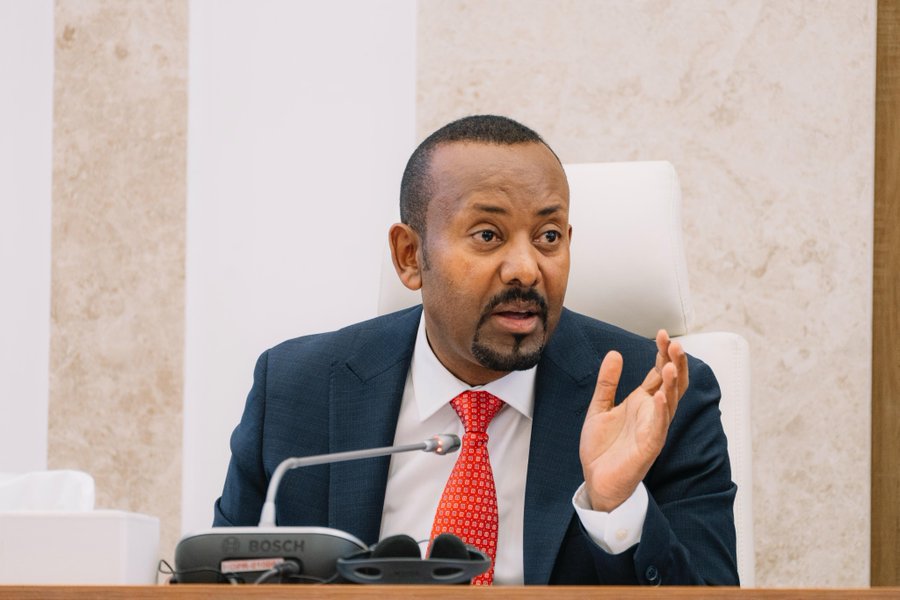
H.E. Prime Minister Abiy Ahmed (PhD) has reiterated Ethiopia’s legitimate right to address its long-standing landlocked status, framing the Red Sea issue as a “legal, historical, and existential question” that demands peaceful and principled dialogue with neighboring states.
Speaking to members of the House of People’s Representatives (HoPR) during the second regular session of the sixth parliamentary term on 28 October 2025, the Prime Minister underscored that there exists “no official record or institutional decision” documenting how Ethiopia lost its access to the Red Sea. “Ethiopia’s loss of sea access was not decided by the cabinet, parliament, or the public through any legal or consultative process,” the Premier said, calling attention to what he described as a “gap in the historical and legal record” surrounding the country’s maritime sovereignty.
PM Abiy stressed that Ethiopia’s quest for sea access is rooted not in expansionism but in a legitimate national interest tied to its economic survival, trade security, and regional stability. He reminded lawmakers that the country’s loss of Red Sea access was “gradual and drawn-out” over more than 30 years of conflict, culminating in Eritrea’s independence in 1993. “Ethiopia’s loss of access to the Red Sea came after a struggle that lasted more than 30 years — as you all know,” he said. “However, I do not believe that it would take another 30 years to restore what was lost.”
The Prime Minister also addressed the current diplomatic tensions with Eritrea, noting that the rift deepened in the aftermath of the Pretoria Agreement, which ended the two-year war in northern Ethiopia. “We thought that after Pretoria, things would change,” PM Abiy remarked. “But the Eritreans took a position that as long as the TPLF and Tigray were not fully destroyed, lasting peace could not be achieved.” He clarified Ethiopia’s refusal to accept this notion, affirming that “these are, after all, our own people. We refused to accept the idea of destroying them; we stood firm.”
Ethiopia’s renewed diplomatic focus on the Red Sea aligns with international legal principles governing access to the sea for landlocked states, as enshrined in the United Nations Convention on the Law of the Sea (UNCLOS) and the Almaty Programme of Action. Ethiopia, the second-most populous country in Africa and a major contributor to regional peacekeeping, argues that secure and equitable sea access is essential for its economic transformation and regional integration goals under the African Continental Free Trade Area (AfCFTA).
In reaffirming his government’s commitment to dialogue and cooperation, H.E. Abiy stressed that Ethiopia seeks a “mutually beneficial and peaceful solution” that respects the sovereignty of all neighboring states while ensuring the nation’s fundamental right to maritime access. The Prime Minister’s remarks underscore a broader national consensus that Ethiopia’s pursuit of Red Sea access is not only a question of geography but also of justice, development, and historical rectification.