

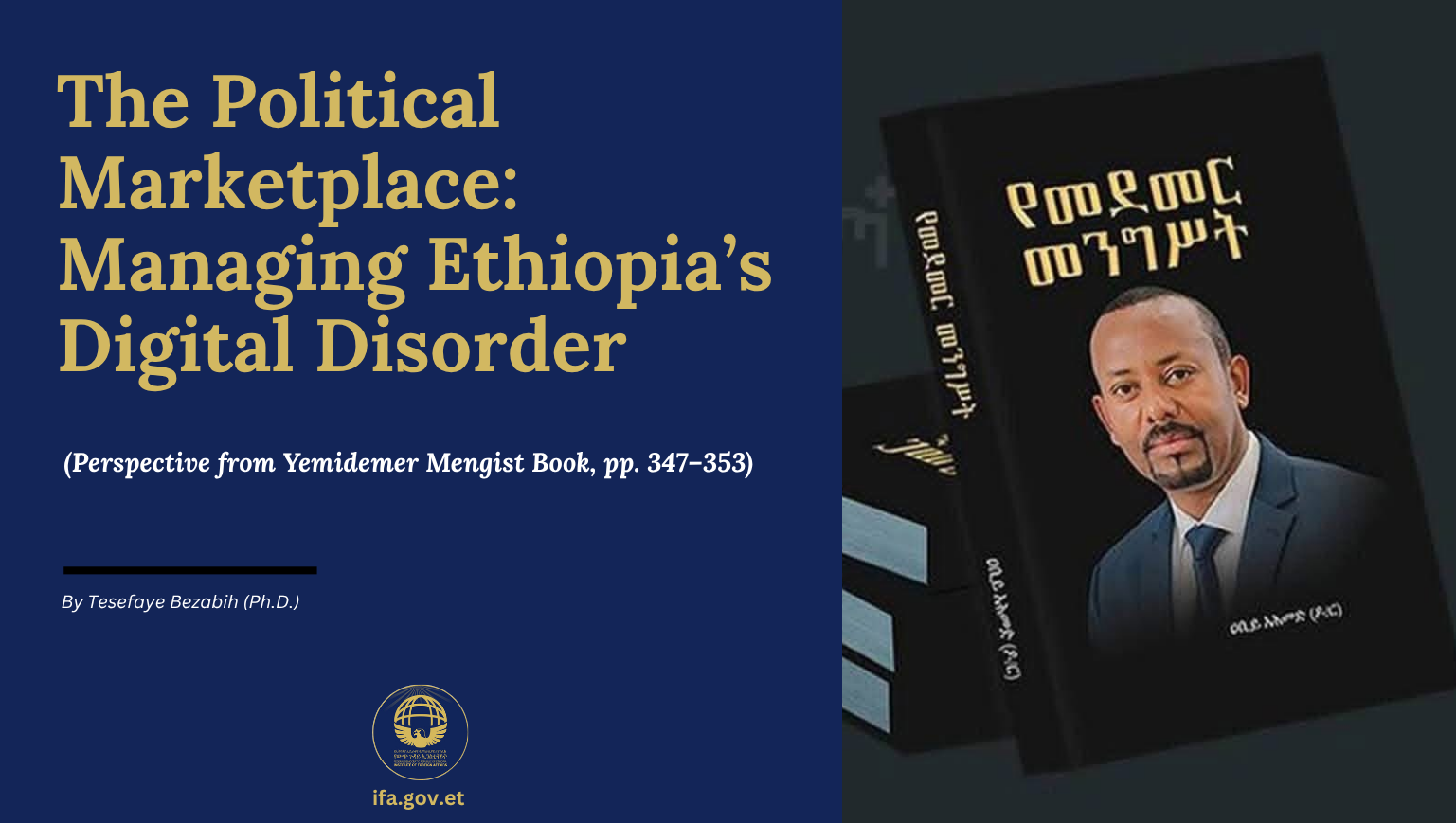
(Perspective from Yemidemer Mengist Book, pp. 347–353)
Executive Summary
The shift of Ethiopia to a digitally connected public space through the replacement of a state-controlled and centralized information environment has radically changed processes of governance, public discourse and power relations. Drawing insights from Prime Minister Abiy Ahmed’s recently launched book Yemidemer Mengist, this brief examines how the rise of a “political marketplace” intersects with Ethiopia’s digital transformation. In this volatile world, actors in the political arena are getting to capitalize on the disjointed digital communication to gain personal or sectarian benefit. Although digital tools have made information more democratic and included more people, they have also disaggregated narratives, polarized and undermined institutional authority. Unless it is properly addressed and rightly guided, digital transformation in the media sector in Ethiopia may escalate society can easily be misinformed and disinformed .Besides, such unavailing political market place may obviously promote political opportunism, and undermine the effectiveness of governance.
Background
Looking at the media history of Ethiopia media channels like newspapers, radio and television were under state control and also mediated the public sphere. This was so common and apparently showed the centralized form of media which allowed the state to control narratives, cohesion and influence the discourse of the people. Such a kind of media ownership system has however been shaken by the emergence of the rapid adoption of mobile internet and social media platforms and this has made citizens both consumers and producers of information. The outcome is the high number of competing stories that undermine the role of mainstream media and government agencies.
The political marketplace framework, as developed by Alex de Waal (2013), describes governance systems driven by transactional bargaining among elites for political and material gain. Power becomes fluid and loyalty is bought rather than institutionalized. When this logic extends into digital spaces, it produces digital disorder—environment where political actors manipulate online platforms to secure influence, consolidate power, or destabilize opponents (Gagliardone & Brhane, 2021). In this context, disinformation, troll farms, fake accounts, and viral propaganda become new currencies for “buying” public attention and legitimacy.
Since the 1990s, Ethiopia has exmplified the complex interplay between political repression and liberalization, where moments of openness have often been followed by renewed control, reflecting the state’s struggle to balance authority with democratic reform. Following the many years of strict state restrictions on media freedom, the coming of Prime Minister Abiy Ahmed in 2018 in the country signified the movement toward openness where arrested journalists were freed, more than 260 websites was unblocked, and press freedom ratings increased (Reporters Without Borders, 2018). Yet, such liberalization can be also viewed through the prism of the logic of political marketplace: as a strategic action aimed at gaining legitimacy, controlling the elite competition, and gaining outside allies. Therefore, this indicates that, media freedom was not only a democratic achievement but also a deal of political tactics.
Critical Analysis
The digital transformation in Ethiopia has transformed the interaction between people, state, and information systems in the country. The decentralized and many-t—many digital sphere networks have substituted the traditional one-to-many communication model, in which the government played the gatekeeper role. Such a democratization model in the information society ear has enabled citizens and disintegrated the authority of the masses as well as generated opposing narratives. What has emerged is an information environment of asymmetry, volatility, and mistrust – situations that make it harder and harder to achieve a national consensus on policy and priorities. There is a high level of political market place. Emotional appeals, appeals based on identity, and viral campaigns by digital actors, such as politicians, influencers, or organized interest groups, are employed to mobilize their supporters and attack opponents. Civic complaints are turned into a commodity, and social media interaction is a political capital. Such an act of transactional behavior resembles the process of elite bargaining within the offline political marketplace, only much faster, with a larger reach and more opaque. It implies that political rhetoric places value on spectacle and contests rather than substance and cooperation that undermines democratic deliberation and institutional legitimacy.
Key Implications
The emergence of the digital political market place in Ethiopia has far-reaching consequences in the areas of governance, stability and social cohesion. First, institutional power is undermined because the partial information streams circumvent the previous verification and accountability procedures. Likewise, divergent stories and falsehoods make people lose confidence in the government institutions, media and even the democratic process. Second, it leads to polarization of the public discourse, when the actors of the political life use the emotional and identity-based differences to strengthen their parties. This also further splits the nation in terms of social and prevents national dialogue and reconciliation. Third, the problem of policy coherence and governance efficiency is that the decision-making process is determined by reactive digital trends instead of an evidence-based evaluation. The exaggeration of the grievances via the social media platforms tends to alter the priorities of the population, diverting the focus of the developmental agenda to dealing with the crisis. Lastly, the image of legitimacy of the politics of Ethiopia on the international arena, where unregulated digital chaos can erode diplomatic integrity and investor trust, and give strength to the discourse of instability. Without intentional interventions and sustained investment in media literacy, Ethiopia’s digital transformation could evolve from an engine of progress into a driver of long-term institutional and governance weakness.
Policy Recommendations
1. Build a Complete National Digital Governance Framework: Ethiopia should have a well-spelled out digital governance policy that balances openness and accountability. This framework must find a way of providing legal and institutional means of controlling digital content, data security and defining the standards of transparency online. The Ethiopian Communications Authority (ECA) ought to be given the power to jointly work with civil societies and digital platforms to track the trends of disinformation and encourage responsible online behavior and set content ethics. The system needs to be based on such a framework also incorporating the mechanisms of periodic review so that it can be flexible to new technologies and global digital standards.
2. Invest in Nationwide Digital Literacy and Civic Education Programs: Informed citizens constitute the start point in the sustainable management of digital disorder. National curriculum on media literacy, digital ethics and critical thinking should be developed by the Ministry of Education and Ministry of Innovation and Technology. These programs should be school-, university-, and community-driven, and aimed at the methods of verifying the pieces of the information on the internet, noticing the manipulative information, and reporting the cyber misconduct. Partnerships with the media, NGOs, and international donors could raise the coverage; therefore, digital literacy is one of the pillars of civic engagement and resilience.
3. Increase Media Professionalism and Institutional Resilience: Recovery of ethical and professional journalism is important to overcome misinformation. This needs to be fulfilled by capacity-building journalists, incentives to conduct investigations, and the fact-checking institutions. Introduction of a National Media Standards Council would assist in enforcing accountability and bringing together the public, private and community media. Inclusion, ethnic bias in the media in reporting as well as tend to bridge the information divide between urban and rural will also be encouraged by supporting regional and community media outlets.
4. Improve Control of Digital Performance of Political Actors: The cyberspace cannot be a political free market. Digital campaigning and political advertising should be controlled by the National Electoral Board of Ethiopia (NEBE) and the ECA. Every political organization will be required to disclose online sources of funds, paid content, and the connection with online influencers or troll networks. The mechanisms should have sanctions on the hate speech, coordinated disinformation, and online bullying. These actions would minimize the instrumentalization of social media engagement to perpetrate politics by creating transparency and accountability.
5. Use Digital Resources to bring participatory and transparent governance: Organizations should utilize the digital platforms to interact with citizens in a constructive approach and not as a response. Policy participation by the people can be enhanced by developing open-data portals, e-governance mechanisms and online consultation forums. The citizen feedback systems can be used to reinforce the monitoring of service delivery and reporting of corruption, especially those that are mobile-based. Such efforts would not only improve the responsiveness of the governments but the reestablishment of trust between the citizens and the state would turn the online world into an avenue of cooperation and not confrontation.
6. Improve Multi-Stakeholder Digitial Resilience: In order to address the digital dilemmas in Ethiopia, there exists the necessity to unite the stakeholders, and such stakeholders are the government, academic institutions, media, civil society, and technological businesses. The creation of a National Digital Resilience Taskforce would assist in coordinating the strategies across the sectors, monitoring new risks, and assisting to respond collectively in the face of the disinformation crisis on the internet. Technical and policy assistance can be offered to Ethiopia through international collaboration with other organizations like UNESCO and UNDP, so that the approach developed by Ethiopia is similar to international standards on digital governance and human rights.
Conclusion
The changing digital landscape in Ethiopia represents the potential and outcome of democratized communication. The idea of Yemidemer Mengist presented by Prime Minister Abiy Ahmed helps to emphasize the necessity of synergy and joint rule, but the nature of the political market indicates the fact that transactionalism and manipulation in the online space remain prevalent. The problem is to turn the scattered information order in Ethiopia to an integrated, responsible and participatory one. Well-designed policy interventions (that are founded on literacy, ethics, regulation, and collaboration) can help Ethiopia to change digital disruption into democracy renewal and sustainable governance.
References
- Abiy Ahmed (2020). Yemidemer Mengist, Chapters 12.4–12.5.
- Alex de Waal (2013). The Political Marketplace: Analyzing Political Entrepreneurs and Political Bargaining in Africa.
- Gagliardone, I. & Brhane, A. (2021). Disinformation and Digital Disorder in Africa: The Ethiopian Case.
- Habermas, J. (1962). The Structural Transformation of the Public Sphere.
- Ethiopian Communications Authority (2023). Digital Penetration Statistics Report.
- UNDP (2022). Civic Engagement and Governance in Digital Societies.
- Reporters Without Borders (RSF) (2018). World Press Freedom Index.
About the author
Dr Tesfaye Bezabih is a lead researcher at the Institute of Foreign Affairs. He got his Ph.D. in Journalism and Mass Communication from Assam University through the Indian Cultural Council Relations African Scheme scholarship program. Formerly, he was an Assistant Professor of Journalism and Communication at Wollo University. He has also been serving as an External examiner and Guest Lecturer at AAU. He has published several empirical and policy research papers in the areas of media and communication, Foreign policy, climate diplomacy, public diplomacy, and much more. His Ph.D. dissertation has also won the 2017 Open Society Research Grant. He currently works as a Foreign Policy Researcher at the Europe and America Research Directorate at the Institute of Foreign Affairs (IFA) and Director General of Knowledge Management at the Training unit at IFA. Professionally, he has been participating in several government and Non-government duties and accomplished fundamental achievements.
Disclaimer:
The content disseminated by the Institute of Foreign Affairs (IFA) – including, but not limited to, publications, public statements, events, media appearances, and digital communications – reflects the views of individual contributors and does not necessarily represent the official positions or policies of the Institute, its partners, or any affiliated governmental or non-governmental entities.
While the IFA endeavors to ensure the accuracy, integrity, and timeliness of the information presented, it makes no representations or warranties, express or implied, regarding the completeness, reliability, or suitability of such content for any purpose. The Institute expressly disclaims any liability for errors or omissions, as well as for any actions taken or decisions made based on the information provided.
The inclusion of external links, references, or third-party resources does not constitute an endorsement by the Institute. Additionally, engagement on social media platforms – including, but not limited to, likes, shares, retweets (RTs), or reposts – shall not be interpreted as an endorsement or validation of the views expressed therein.
Readers and audiences are encouraged to exercise critical judgment and seek independent verification when interpreting or relying upon any information disseminated through publications and posts on the Institute’s platforms or representatives.