

Ethiopia’s Legitimate Maritime Aspiration and Rightful Role in Red Sea Governance
Egypt’s recent remarks asserting that “Ethiopia has no right to participate in Red Sea governance mechanisms as it is a landlocked nation” are inconsistent with historical and legal realities, and are both exclusionary and ahistorical.
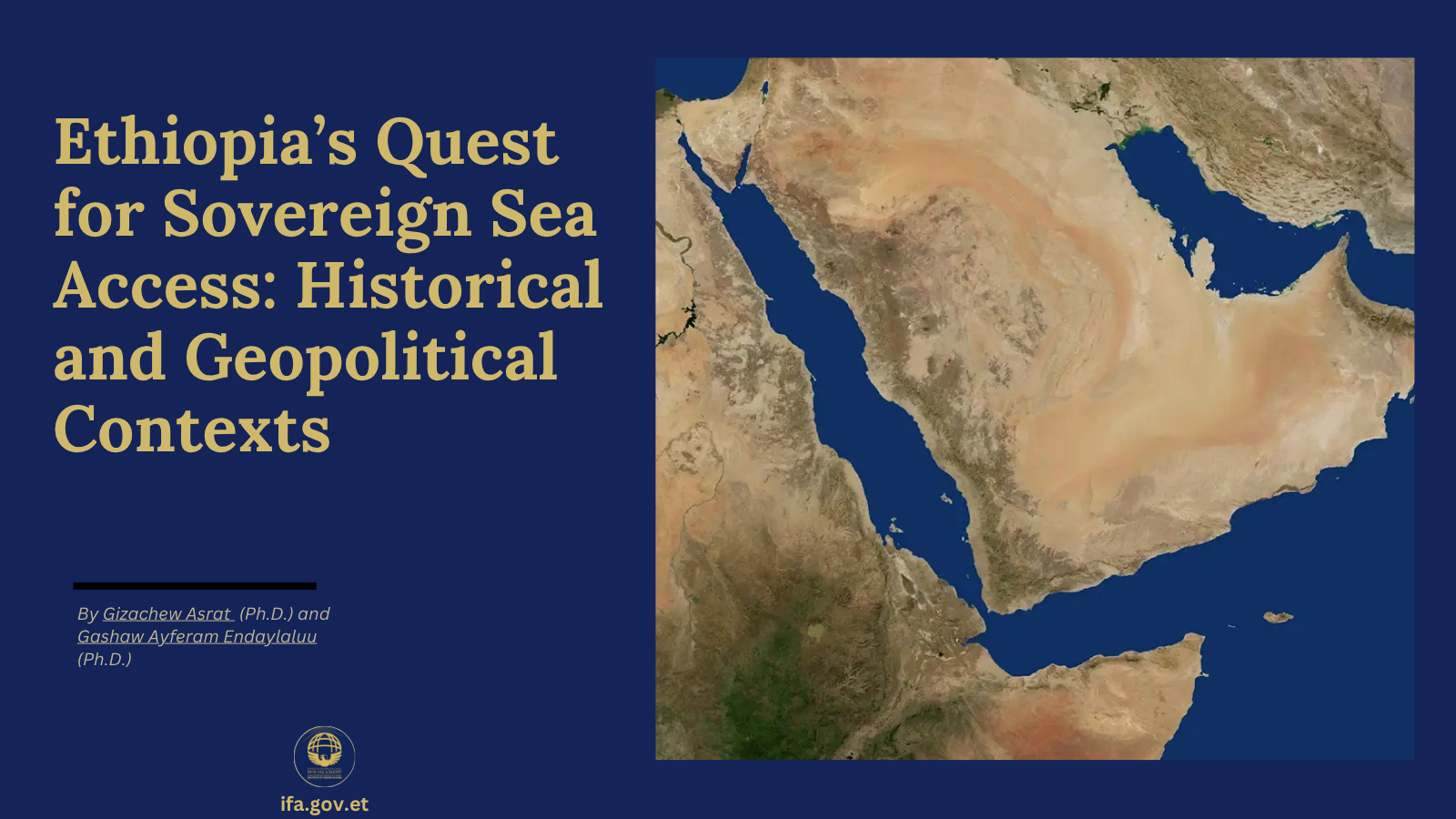
As Gizachew Asrat (PhD) and Gashaw Ayferam (PhD) argue in their study Ethiopia’s Quest for Sovereign Sea Access: Historical and Geopolitical Contexts, “Ethiopia’s quest for sovereign sea access stems from its historical, legal, psychological, and geographical connections to the Red Sea and the Gulf of Aden.” They note that Ethiopia’s maritime history—from Aksumite trade with the Greco-Roman world to the Solomonic and Muslim Sultanates’ control of coastal ports—demonstrates that sea access has always been central to its statecraft and survival. To portray Ethiopia as an “outsider” to the Red Sea order, therefore, is to ignore centuries of maritime engagement through ports such as Adulis, Zeila, Massawa, and Assab. The Red Sea has historically been, as the authors observe, “an outlet and bridge that connects Ethiopia with the external world—its main gateway for trade, cultural interaction, and civilizational exchange.”
Ethiopia’s maritime aspiration is thus not an act of interference or expansionism, but a legitimate and peaceful pursuit of equitable participation, mutual development, and regional stability. It rests on firm international legal foundations. The United Nations Convention on the Law of the Sea (UNCLOS), particularly Articles 125–127, guarantees landlocked states “the right of access to and from the sea” and “freedom of transit through the territory of transit states by all means of transport.” Likewise, the Vienna Programme of Action for Landlocked Developing Countries (2014–2024) underscores that access to the sea and regional connectivity are essential for sustainable development and equitable participation in global trade.
Furthermore, UN General Assembly Resolution 390(V)A (1950)—which established the federation between Eritrea and Ethiopia—recognized “Ethiopia’s legitimate need for adequate access to the sea,” setting a lasting legal and moral precedent that remains relevant to this day.
As Gizachew and Gashaw further observe, Ethiopia’s maritime policy has undergone a significant transformation since 2018—moving “from the EPRDF’s commoditized and transactional view of port access to a securitized and existential framing of sea access.” They contend that “maritime access is now central to hybrid sovereignty defined by the integration of land, sea, air, space, and cyber capabilities.” Ethiopia no longer views sea access as a mere logistical or commercial issue, but as a strategic necessity intertwined with its sovereignty, security, and long-term survival.
Given its position as the world’s largest landlocked country by population—surrounded by fragile states and serving as the Horn of Africa’s economic anchor—Ethiopia cannot remain excluded from the regional maritime governance framework. Its engagement seeks to restore its rightful functional role in the Red Sea–Gulf of Aden strategic order—anchored in partnership, shared prosperity, and regional stability.
The claim that Ethiopia has “no right” to participate in Red Sea governance is rooted in an outdated and exclusivist notion of sovereignty. In today’s interdependent world—where maritime trade, security, data transmission, and environmental protection transcend borders—it is untenable to confine decision-making to littoral states alone. Ethiopia’s demographic, economic, and security stakes in the region make its inclusion both legitimate and indispensable.
As Gizachew and Gashaw note, “Ethiopia’s absence from this multi-domain strategic architecture limits its ability to project power, safeguard interests, and participate fully in regional and global governance.” Excluding Ethiopia not only undermines equitable regional cooperation but also violates the spirit of African solidarity and integration embodied in the African Union’s Agenda 2063, which envisions “integrated, peaceful, and prosperous maritime spaces.”
Ethiopia’s engagement has been consistently defined by peaceful diplomacy and respect for the sovereignty of all nations. As Prime Minister Abiy Ahmed (PhD) has repeatedly underscored, “We seek access to the Red Sea in a peaceful manner, as is fitting for a nation of our size and growing economy.” In June 2025, he reaffirmed that access to the sea is “a matter of national survival … we are working legally and peacefully to secure access to the seas.” These statements reflect a consistent policy of dialogue, negotiation, and regional partnership—not coercion.
Ethiopia’s participation in Red Sea governance mechanisms is thus a question of legitimacy, necessity, and justice—not geography alone. Its historical legacy, international legal rights, and developmental imperatives collectively affirm its rightful role in shaping the maritime future of the Horn of Africa.
It is advisable for all states bordering the Red Sea and the Gulf of Aden to adopt inclusive and cooperative governance mechanisms that recognize the legitimate interests of both littoral and landlocked states. Only through such an inclusive approach can the region ensure sustainable security, connectivity, and prosperity for all.
Ethiopia’s maritime aspiration—grounded in peace, legality, and partnership—represents not a challenge to sovereignty, but an opportunity for collective advancement and a more balanced regional order.
Find Gizachew and Gashaw’s article here: https://doi.org/10.47932/ortetut.1783598
About the author
Getahun Tsegaye is a dedicated and versatile professional with extensive experience in education, healthcare, journalism, and non-profit leadership. He possesses a strong skill set in teaching, curriculum development, medical assistance, patient care, and freelance writing. As the founder and executive committee member of a youth-focused NGO, Getahun actively promotes peace, security, and regional cooperation.
He holds advanced degrees in Global Studies and International Relations, as well as a Master’s in Peace and Security.
Getahun is committed to fostering collaboration and understanding within the Horn of Africa, striving to enhance regional stability and development through his work and advocacy.
You can reach him at getishgift@gmail.com.
Disclaimer:
The content disseminated by the Institute of Foreign Affairs (IFA) – including, but not limited to, publications, public statements, events, media appearances, and digital communications – reflects the views of individual contributors and does not necessarily represent the official positions or policies of the Institute, its partners, or any affiliated governmental or non-governmental entities.
While the IFA endeavors to ensure the accuracy, integrity, and timeliness of the information presented, it makes no representations or warranties, express or implied, regarding the completeness, reliability, or suitability of such content for any purpose. The Institute expressly disclaims any liability for errors or omissions, as well as for any actions taken or decisions made based on the information provided.
The inclusion of external links, references, or third-party resources does not constitute an endorsement by the Institute. Additionally, engagement on social media platforms – including, but not limited to, likes, shares, retweets (RTs), or reposts – shall not be interpreted as an endorsement or validation of the views expressed therein.
Readers and audiences are encouraged to exercise critical judgment and seek independent verification when interpreting or relying upon any information disseminated through publications and posts on the Institute’s platforms or representatives.