

Introduction
Water scarcity is an escalating global problem, projected to intensify in the coming decades as the number of countries facing absolute scarcity has been witnessing a significant surge. The level of scarcity is also rising at an alarming rate owing to multiple factors across different geographical regions. The Arab region, in particular, faces the most acute water insecurity, with average per capita renewable water availability of 1,000 cubic meters annually. This is well below the internationally recognized minimum amount required per annum. In various Arab countries, this figure drops below 100 cubic meters per capita, placing the Arab region among the top water-stressed part of the planet. What makes the situation of this region more concerning is that water consumption continues alarmingly from time to time due to rapid economic growth, demographic expansion and accelerated urbanization.
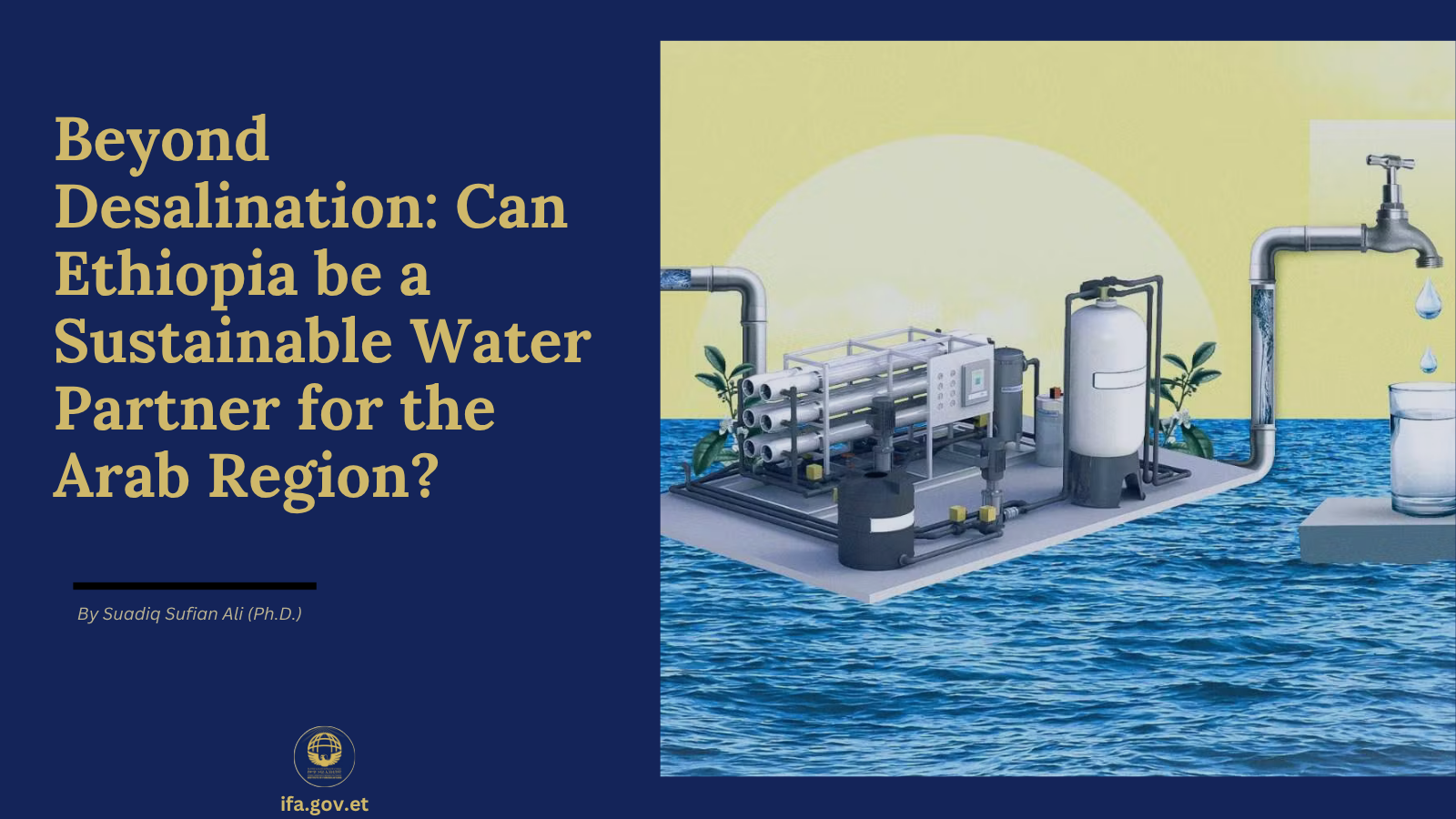
Triggered by the aforementioned complexities, the Arab countries have taken different measures to ensure their water security. A case in point, in this regard, is the proliferation of desalination projects in the region since the 1970s. Recently, Qatar built the world’s largest desalination plant, delivering an extraordinary 600 million liters of drinking water per day. In one of the driest parts on earth – the Arab region, the project is more than infrastructure – it is a lifeline. However, the desalination industry by itself is problematic and may not solve the issue of water scarcity in a sustainable manner, demanding a long-term solution. Notably, desalination by-products can further exacerbate the already high salinity levels of water in the region – Gulf and Red Sea. This alarms the need for establishing a cooperation framework between the Arab World and the nearby neighboring countries – such as Ethiopia.
Ethiopia’s Pathways to Foster Cooperation with Arab Countries
The idea of strengthening bond between countries is neither new nor uncommon to maintain water security. Ethiopia is an exemplary country, as the Ethio-Djibouti potable water project echoed this reality, albeit from a distance. It is hoped that Ethiopia can play similar roles with neighboring Arab countries, especially whose water insecurity forced them to import water from other countries. For instance, Ethiopia and Saudi Arabia can work together on water (in) security as the later extremely rely on imported water. Evidently, Saudi Arabia imports water from Switzerland ($12,967.37K), Austria ($5,043.61K), United Arab Emirates ($3,829.40K) and other countries. Except Egypt, the reality of most countries in the Arab region is not fundamentally different from Saudi Arabia – dependent on imported water. In this connection, despite I have no current updates, Addis fortune news reported that efforts of exporting water to Saudi Arabia underwent five years ago. According to the report one of the newest water bottler, Abebe Dinku Water & Non-Alcoholic Beverages, closed a 20-year deal with a Saudi Arabian company to export water.
Obviously, Ethiopia possesses abundant freshwater resources, especially from the Blue Nile Basin, Lake Tana, and highland rainfall. Being known as the ‘Water Tower of Africa’, it can be a potential candidate to contribute to the Arab world, leveraging its geographical proximity. The idea of supplying water to Arab countries via transnational pipelines has been under consideration for several decades. For instance, despite it was not realized, a similar project was drafted between Israel and Turkiye in 1998 to launch an undersea fresh-water pipeline from Turkey via northern Cyprus to Israel. Should Arab states fulfill their freshwater needs through Ethiopia, it would substantially elevate Ethiopia’s regional influence in the Horn of Africa, thereby strengthening its capacity to assert strategic autonomy.
Potential Challenges Facing Ethiopia
Despite Ethiopia is committed to work together with the Arab world in the area of water resources, challenges may arise from some of the Arab countries. Particularly, Egypt may try every avenue to create hassle as usual, very well demonstrated, during the construction of the GERD Project. Egyptians authorities often echo outdated colonial era agreements to silence Ethiopia’s just call for equitable utilization of trans-boundary water resources. Thus, Ethiopia and the Arab countries should jointly champion regional water-sharing mechanisms that meet the genuine interest of upstream and downstream countries. Above all, some esteemed readers may question the feasibility of the project – supplying water to Arab countries – citing Ethiopia’s landlocked status. Indeed, landlocked status cannot prevent the realization of such scheme. Several landlocked countries export water directly or indirectly to other countries. For instance, despite being a landlocked country, Switzerland exported $1.75 Million dollars of water, making it the 65th largest exporter of water across the world.
Conclusion and Policy Recommendations
Ethiopia possesses abundant freshwater resources, while the Arab world has faced chronic water scarcity and relied heavily on desalination, making external freshwater sources an attractive long-term option. Consequently, Ethiopia can be a sustainable water partner for the Arab Worldthrough various mechanisms. Among others, these include increasing bottled water export, building joint trans-national pipeline project and enhancing virtual water trade. Ethiopia starts to export bottled-water to some Arab countries in small commercial volumes. The country needs to increase its export level and destinations in order to reach more countries. Supplying fresh water through pipelines is another alternative for Ethiopia, as its experience with Djibouti permits to do so. Expanding those lessons obtained from the ambitious trans-national water project, spanning 258 kilometers from underground wells in Ethiopia’s Somali region to Djibouti city is vitally important. Last but not least, Ethiopia has the potential to expand its virtual water trade with Arab countries. By increasing the export of water-intensive goods, such as fruits, vegetables, and livestock, Ethiopia can indirectly supply freshwater to Arab countries. The realization of these strategies hinges on fostering a constructive spirit. This sprit should encounter divisive narratives including the partisan notion that erroneously asserts the water security of the Republic of Sudan and Egypt is an integral part of Arab national security.
About the author
Suadiq Sufian (PhD), Senior Researcher at the Institute of Foreign Affairs He can be reached at Sufiansuadiq8@gmail.com
Disclaimer:
The content disseminated by the Institute of Foreign Affairs (IFA) – including, but not limited to, publications, public statements, events, media appearances, and digital communications – reflects the views of individual contributors and does not necessarily represent the official positions or policies of the Institute, its partners, or any affiliated governmental or non-governmental entities.
While the IFA endeavors to ensure the accuracy, integrity, and timeliness of the information presented, it makes no representations or warranties, express or implied, regarding the completeness, reliability, or suitability of such content for any purpose. The Institute expressly disclaims any liability for errors or omissions, as well as for any actions taken or decisions made based on the information provided.
The inclusion of external links, references, or third-party resources does not constitute an endorsement by the Institute. Additionally, engagement on social media platforms – including, but not limited to, likes, shares, retweets (RTs), or reposts – shall not be interpreted as an endorsement or validation of the views expressed therein.
Readers and audiences are encouraged to exercise critical judgment and seek independent verification when interpreting or relying upon any information disseminated through publications and posts on the Institute’s platforms or representatives.