

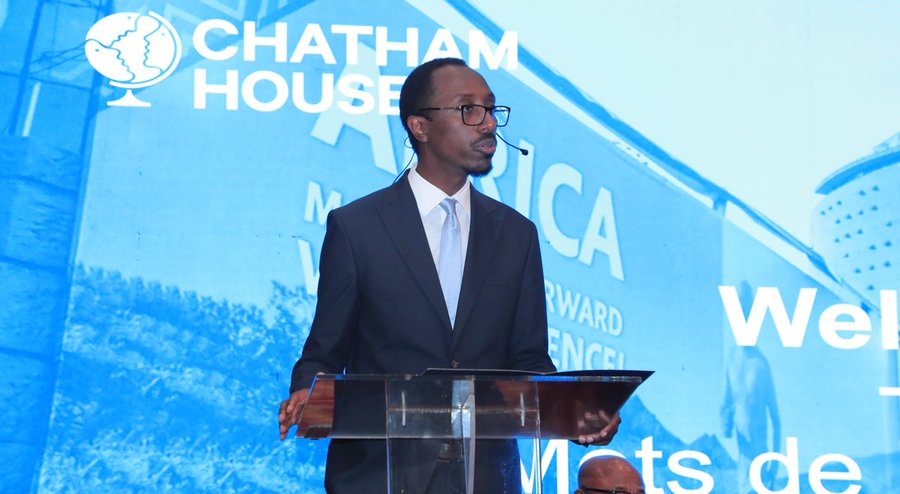
Ethiopia’s Foreign Minister, H.E. Gedion Timothewos (PhD), delivered a powerful keynote address at the Chatham House Conference on “Africa’s Rising Influence” on November 5, 2025, urging the continent to shift its role from being merely an arena of global competition to becoming a “co-author of the new multipolar world order.” He positioned Ethiopia as a crucial “continental connector,” actively unifying trade, infrastructure, and diplomacy to drive regional transformation in an ever-changing global political dynamics.
Opening his remarks, H.E. Gedion described Addis Ababa as “the diplomatic capital of Africa and home of our continental union.” This framing underscored his central argument: Africa must not be a bystander in global affairs but a shaper of outcomes.
He spotlighted a milestone that embodied this vision: the call for Africa to shape global affairs, particularly through regional integration. Ethiopia’s first exports under the African Continental Free Trade Area (AfCFTA) corroborate this argument. On 9 October 2025, convoys and cargo planes left Addis Ababa for Kenya, Somalia, and South Africa carrying coffee, fruits, meat, and processed foods. “Those trucks and planes carried more than merchandise,” he said. “They carried the promise of a continent trading with itself.”
For AfCFTA to happen, Ethiopia began implementing customs duty reductions on over 90% of eligible goods under Council of Ministers Regulation No. 574/2025, marking its formal entry into AfCFTA trade. The move opens Ethiopia to a continental market of 1.4 billion people with a combined GDP of over US$3.4 trillion.
For Ethiopia, it signifies export diversification and a strengthened role as a logistics hub leveraging its airline, trade corridors, and infrastructure. For Africa, it marks a decisive shift from slow intra-African trade to tangible action — proving that AfCFTA can be operational, not aspirational.
FM Gedion emphasized that frameworks such as the AU, IGAD, ECOWAS, and SADC must become “operational engines of continental integration.” Ethiopia’s Horn of Africa initiatives — including power, transport, and trade corridors supported by the Grand Ethiopian Renaissance Dam (GERD) — illustrate this principle, with electricity already flowing to Kenya, Sudan, and Djibouti, and plans underway for Tanzania and South Sudan.
He summarized Ethiopia’s AfCFTA entry as embodying three strengths:
- It positions Ethiopia as a connector in continental trade;
- It aligns trade, infrastructure, and institutions under one vision;
- It situates Ethiopia’s foreign policy within a multipolar framework.
While recognizing opportunities in market diversification and regional value chains, he cautioned that “progress is not linear,” warning that logistics bottlenecks, customs inefficiencies, and weak institutional coordination could undercut momentum.
Dr. Gedion contextualized his argument in global power dynamics. The unipolar moment of U.S. dominance and the earlier bipolar Cold War order, he observed, have given way to a multipolar era characterized by complex competition among major and middle powers.
“Africa must not be a prize in someone else’s contest for influence,” he said. “The question is how the continent should approach this reality — what opportunities and risks multipolarity presents, and how we can act collectively rather than be acted upon.”
Africa’s growing presence, exemplified by the African Union’s accession to the G20, must translate into genuine influence. “Participation alone is not enough,” he stressed. “Our task is to turn presence into influence, and influence into tangible outcomes for our people.”
A key part of Africa’s agency, Dr. Gedion argued, lies in reforming global governance institutions. The United Nations Security Council (UNSC), created eight decades ago, must include permanent African representation—not as a privilege, but as a matter of fairness.
His Excellency’s call heavily aligns with Africa’s long-aspired goal of real representation at the UNSC. The African Union (AU) has collectively and consistently demanded a permanent seat at the UN Security Council (UNSC). Africa argues that the current UNSC structure is an anachronistic historical injustice, as the continent was largely colonized when the UN was founded in 1945, and it remains the only continent without a permanent seat. Furthermore, African issues often dominate the Security Council’s agenda, with over half of its work and resolutions frequently concerning the continent, making a permanent voice essential for legitimacy and effective decision-making.
Likewise, the global financial system must reflect Africa’s economic realities. Ethiopia supports the creation of a regional credit rating agency that captures the continent’s true dynamism and advocates for reforms to expand access to development finance, climate adaptation resources, and debt restructuring mechanisms.
On peace and security, he stressed that Africa’s stability cannot be outsourced:
“Our continent’s security challenges must be met through African-led solutions that prioritize prevention, dialogue, and solidarity.” This African Solutions to African Problems (AfSoL) approach has been implemented by Ethiopia in resolving the dispute with Egypt over the Grand Ethiopian Renaissance Dam (GERD). In this context, Ethiopia has opted to resolve the dispute within the AU framework, while Egypt has consistently tried to internationalize the issue by bringing it to the UNSC, including on multiple occasions in a single year.
Ethiopia, he said, continues to support the African Peace and Security Architecture and efforts to secure predictable financing for peace operations.
H.E. Dr. Gedion noted that Africa’s influence will also be defined by its soft power — culture, innovation, and youth. “From music to technology, our youth are reshaping global perceptions,” he said. “It is through telling our own stories, in our own voices, that we will secure our rightful place in global discourse.”
“The world is watching Africa with renewed attention. The question is no longer whether Africa matters — but how Africa will choose to lead.”
He cautioned, however, that Africa’s rise must not be a “transient illusion built on fashionable platitudes.” Genuine progress, he said, demands strategic foresight and generational commitment.
“If demographic trends are any indication, the 22nd century could be the African century. For that to happen, the choices we make today — how we manage our resources and empower our youth — will make all the difference.”
H.E. FM Gedion’s speech signals Ethiopia’s foreign policy vision: helping Africa move from the margins of global decision-making to the center of a multipolar world. The AfCFTA export launch, in this context, is more than a trade event — it is a symbol of direction and intent.
As Dr. Gedion concluded:
“The question is no longer whether Africa matters — but how Africa will choose to lead.”