

Background
Somalia’s diplomatic stand has been shaped by its internal dynamics of political development and pressure from external forces [1]. Its foreign policy has also been influenced by the irredentist claims of the Barre regime, which sought to reclaim territory from its neighboring countries, such as Ethiopia and Kenya. For years, this has influenced the diplomatic relations of Somalia with its neighboring countries. Accordingly, for over three decades since 1991, the diplomatic relations between Addis Ababa and Mogadishu have been strained and often contentious. Over the past seven years, however, a political landscape with a reformist leadership in Ethiopia has seen a policy orientation shift towards the region and Ethiopia’s role in Somalia. Yet the actualization of this policy has rendered limited results, partly due to the spillover effect of the past diplomatic wound and the reasons embedded in the complex political and security landscape of the region, like the role of spoilers and weak institutions, the impacts of geopolitics and hydro politics of the Nile on internal dynamics of these states [1]. As a result, the diplomatic relations of Ethiopia and Somalia continued amid challenges and efforts to withstand them.
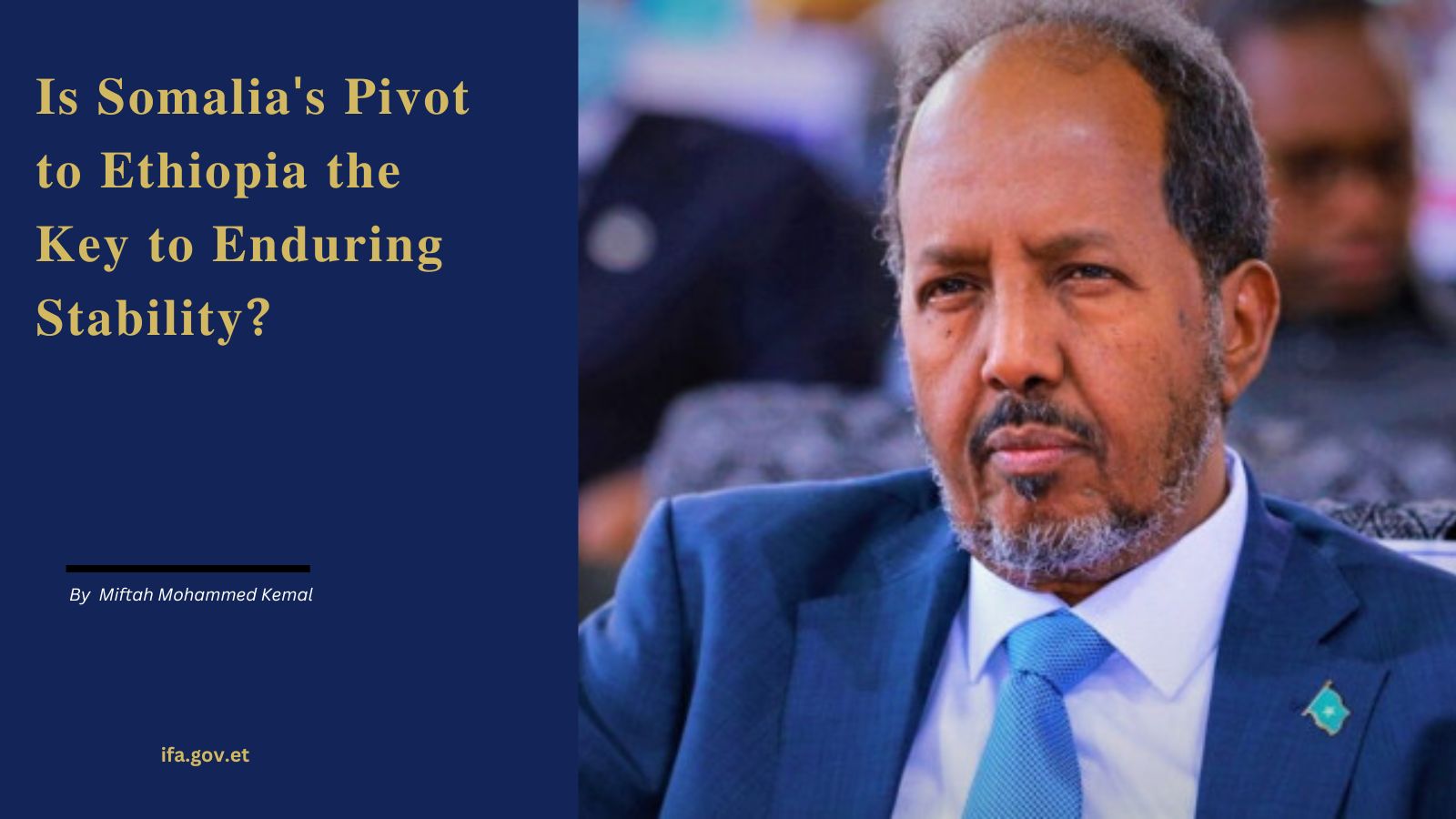
The completion of the GERD project and the subsequent participation of the Somalian president in the official inauguration ceremony, however, marked a big departure regarding Somalia’s views and position on core national security issues of Ethiopia. Similarly, Somalia’s president’s forward-looking policy came into light last October, illustrated by President Hassan Sheik’s positive words used in a recent interview with the Al-Arabia channel. Asserting Somalia’s position about the Great Ethiopian Renaissance Dam (GERD) as a developmental model for regional economic cooperation and shared prosperity in the Horn of Africa. By the same token, the president also commented on Ethiopia’s quest for Red Sea access affirmatively by endorsing it as a legitimate cause that needs to be addressed. Viewed against the backdrop of the often oscillating between cooperation and conflict character of the relation between these states, such statements amount to a diplomatic pivot from Somalia. This policy pivot hints at several aspects of the Somali president’s move. It highlights that the incremental normalization of diplomatic relations between Addis Ababa and Mogadishu has jumped to its next level.
Red Sea Dynamics and Somalia’s Strategic Imperative
The Geopolitical imperative of states emanates from their location relative to strategic points. Somalia is one of the Horn of Africa countries blessed with an extensive coastline along the Red Sea and the Indian Ocean. Its location between the Suez Canal, the Bab-El-Mandab, and the Indian Ocean places it in an important artery connecting international commerce, energy flows, and military projections [2]. Somalia, with its extensive coastline, is blessed. However, this strategic location, while a blessing, also presents significant vulnerabilities and challenges for Somalia [3].
For a long time, since the downfall of the Barre regime, the governments of Ethiopia have always had their eyes on Somalia’s security situation. The three-decade-long relationship between the two states has been characterized by both tension and relaxation. This diplomatic posture entered a new chapter after 2018. The government in Ethiopia came up with a policy of regional integration and neighborhood first. This brought the Ethio-Somalian relations to a period of renewed engagement and high-level cooperation between 2018 and 2022. Following regime change in Somalia in general and the signing of a memorandum of understanding between Ethiopia and Somaliland, at Addis Ababa on the first of January 2024 in particular, the relationship became troubled. The subsequent tension triggered the Ankara declaration of December 12th, 2024 [4]. This enabled a progressive normalization and diplomatic ties between Ethiopia and Somalia
Ethiopia’s Two Waters[i] Arguments and Somalia’s Current Diplomatic Support
Ethiopia, a historically Red Sea actor that had lost its maritime power since 1991, found itself entangled in the insecurity complex of the region. At the time, the new and reformist leadership in Ethiopia came into power in an external security context of the Horn region, exhibiting a heightened wave of geopolitical rivalry against which the background of which the government of Ethiopia devised the two waters strategy [5]. Ethiopia, as the source of the Nile waters and the GERD project, suffers from the geopolitical impact of hydro politics. Likewise, Ethiopia’s current landlocked status in the context of mounting tension around the Red Sea region placed it a risk zone. The current two waters arguments of the government of Ethiopia are therefore founded on these realities and contexts and unfolding regional developments. This strategy dictates the Ethiopian government’s foreign policy.
Besides some ups and downs over the past seven years, the governments of the two states were able to keep the momentum of diplomatic relations. The progress is proven by the official participation of the Somalian President in the inaugural ceremony of the GERD project held in September 2025. This was also complemented by the president’s positive statements made afterwards. The positive comments the president made during the interview with Al-Arabia Television in October 2025 regarding the GERD and Ethiopia’s red sea concerns signaled the beginning of a new chapter of diplomatic relations between Addis Ababa and Mogadishu. His commending the GERD as a regional hub for power connectivity attests a significant foreign policy change at Villa Somalia.
Similarly, the president’s comment about the regional imperative of addressing Ethiopia’s quest for access to the sea marks a very significant diplomatic change for several reasons. Firstly, Somalia is a country through which belligerent countries of Ethiopia put pressure; hence, the normalization neutralizes the potential pressure. Secondly, Somalia as a member of the Red Sea forum and the Arab League, could play a connecting role [6]. Somalia’s vast coastline could be used to satisfy Ethiopia’s quest for access to the sea. Somalia’s support, recognition, and promotion of Ethiopia’s two vital foreign policy concerns unlock the biggest door for resolving the intricate challenges of the region through dialogue. Somalia aligning with Ethiopia on the two water systems is therefore an important diplomatic result with several implications for Ethiopia, Somalia, and the wider Horn of Africa region.
Implications for Ethiopia and Somalia
Somalia’s diplomatic pivot will have various implications for both states. For instance, by subscribing to GERD’s energy project, Somalia could benefit from the regional cooperation. This can bring new markets, investment, and infrastructure creation opportunities that are crucial for both countries’ economic development and Stability [7]. Secondly, a constructive and balanced approach to controversies on GERD can enhance Somalia’s diplomatic credibility so that it can become a bridge-builder and an honest partner for negotiation. It may help both Ethiopia and Somalia to attract foreign direct investment (FDI) and bilateral and multilateral developmental finance, especially in strategic sectors such as energy and infrastructure [8]. However, reaping benefits from these potential positive implications demands from both parties a determination to go the extra mile forward.
Conclusion
The Somali president’s recent official participation in the inaugural ceremony of the GERD project in Ethiopia has marked a departure. His subsequent public speeches made in televised and international programs like Al-Arabia about the GERD project and Ethiopia’s legitimate question to access the Red Sea attest to a remarkable policy shift of Mogadishu towards Ethiopia and what it stands for. This also marks a departure from the traditional lack of trust between Addis Ababa and Mogadishu to a new approach of mutual trust and cooperation founded on a new, balanced diplomatic approach. Through a demonstrative effect, this change has put the regional spoilers into deep water. It has sent a clear message to spoilers in the region that the way to solve the contested problems affecting the region must be through negotiation. Successful implementation of these diplomatic gains will be crucial to ensuring both Ethiopia’s and Somalia’s future, regional stability, and economic growth. A new moment of diplomatic approach centered on trust and partnership for peace and development in the region and beyond has emerged. These countries need to keep the momentum.
Notes
- Aleksi Ylönen, “A Critical Appraisal of Realist International Relations Concepts in the Horn of Africa Persian Gulf Relations: The state, power, and agency”, Cadernos de Estudos Africanos [Online], 43 | 2022,
- Ken Menkhaus, Somalia: A Country in Transition (London: Routledge, 2014).
- Ingiriis M. H From Al-Itihaad to Al-Shabab: how the Ethiopian intervention and the ‘War on Terror’ exacerbated the conflict in Somalia. Third World Quarterly. 39:11, 2033-2052, DOI: 10.1080/01436597.2018.1479186, 2018.
- https://www.mfa.gov.tr/etiyopya-federal-demokratik-cumhuriyeti-ve-somali-federal-cumhuriyeti-nin-ankara-bildirisi.en.mfa
- Abiy Ahmed, “Yemedemer Mengist’ Addis Ababa, Ethiopia, September 2025, Melba, PPP SC,
- Mohamed Toumi, “The Red Sea: Geopolitical Challenges and Opportunities,” African Security Review 22, no. 4 (2013): 102–115.
- UNCTAD, “Regional Integration in Africa: Challenges and Opportunities for Trade and Development,” Geneva: United Nations Conference on Trade and Development, 2021.
- International Monetary Fund (IMF), “Somalia: Staff Report for the 2023 Article IV Consultation,” (Washington, D.C.: International Monetary Fund, 2023).
[i] Ethiopia’s ‘two waters’ strategy refers to its dual national security concerns regarding equitable utilization of the Nile waters (represented by the GERD) and secure access to maritime routes (via the Red Sea)
About the Author
Miftah Mohammed Kemal, Researcher at the African Affairs Director General, The Institute of Foreign Affairs, PhD Candidate of International Politics at the University of South Africa
Disclaimer:
The content disseminated by the Institute of Foreign Affairs (IFA) – including, but not limited to, publications, public statements, events, media appearances, and digital communications – reflects the views of individual contributors and does not necessarily represent the official positions or policies of the Institute, its partners, or any affiliated governmental or non-governmental entities.
While the IFA endeavors to ensure the accuracy, integrity, and timeliness of the information presented, it makes no representations or warranties, express or implied, regarding the completeness, reliability, or suitability of such content for any purpose. The Institute expressly disclaims any liability for errors or omissions, as well as for any actions taken or decisions made based on the information provided.
The inclusion of external links, references, or third-party resources does not constitute an endorsement by the Institute. Additionally, engagement on social media platforms – including, but not limited to, likes, shares, retweets (RTs), or reposts – shall not be interpreted as an endorsement or validation of the views expressed therein.Readers and audiences are encouraged to exercise critical judgment and seek independent verification when interpreting or relying upon any information disseminated through publications and posts on the Institute’s platforms or representatives.