

Summary
The seventh summit between the two sides of the Mediterranean Sea will set priorities to strengthen future relations, learning from the past. The possibility of cooperation anchored in mutual benefits, common values, and shared interests could benefit the two continents as long as they move toward actionable solutions. Nevertheless, the drifting away from supporting the African Solutions to African Problems, domestic security uncertainties in the continent, some African states’ turned their back on their European counterparts in the aftermath of military coup, demonstrated piecemeal move to reform the existing international institutions, the war between Moscow and Kyiv, and the emerging alternative economic and security arrangement seem to cloud the coming summit and hence remain the significant sources of divergences between the African Union and the European Union in the future relationship.
The Previous Summits
Africa has built bilateral and trilateral partnerships with major global actors. As part of addressing both continental and global challenges, the African Union, representing its member states, has been forging ties with its counterpart, the European Union, for the last twenty-five years. Since 2000, the AU-EU summit has been held in the selected capital cities of member states of the African Union and the European Union. Since the start of the partnership, the areas of cooperation between the two sides have focused on peace and security, migration, democracy, good governance and human rights, trade, health, development, multilateralism, global and emerging issues. The first meeting between the two sides of the Mediterranean Sea took place in Cairo, Egypt, on 3 and 4 April 2000 under the theme of ‘A New Dimension to Our Global Partnership for the Twenty-First Century’.[1] After a seven-year interval, the second summit was held in Lisbon, Portugal, in 2007 that culminated in the adoption of the Africa-EU Joint Strategy and its Action Plan[2] and the establishment of an institutional setup and funding mechanisms to support AU’s activities.
The third and fourth summits were held in Tripoli on November 29 and 30, 2010, and Brussels, Belgium, on 2 and 3 April 2014, respectively. During the Tripoli Summit, the Tripoli Declaration and a Joint Declaration on Climate Change were adopted.[3] The roadmap for EU-Africa relations (2014-2017) was adopted during the Brussels Summit.[4] In Abidjan, Côte d’Ivoire, the fifth AU-EU Summit was held on 29-30 November 2017. The Abidjan summit gave due recognition to the UN’s 2030 Agenda on sustainable development, the Paris Agreement on climate change, and Africa’s Agenda 2063.[5] The sixth EU-AU Summit took place in Brussels on 17 and 18 February 2022. During this summit, the leaders of both institutions agreed on a joint vision for a renewed partnership.[6] The Joint AU-EU Vision for 2030, among others, aims to augment AU peace support operations, support for the UN assessed contributions, support for the implementation of the Women, Peace and Security (WPS), Youth, Peace and Security and deepen cooperation on security. Luanda’s summit, scheduled for 24 and 25 November 2025, will be more than a symbolic celebration of the 25th anniversary of their cooperation. It will set the priorities and demonstrate the divergent positions both sides have vis-à-vis regional and global issues.
The Seventh AU-EU Summit: Priorities and Dark Clouds
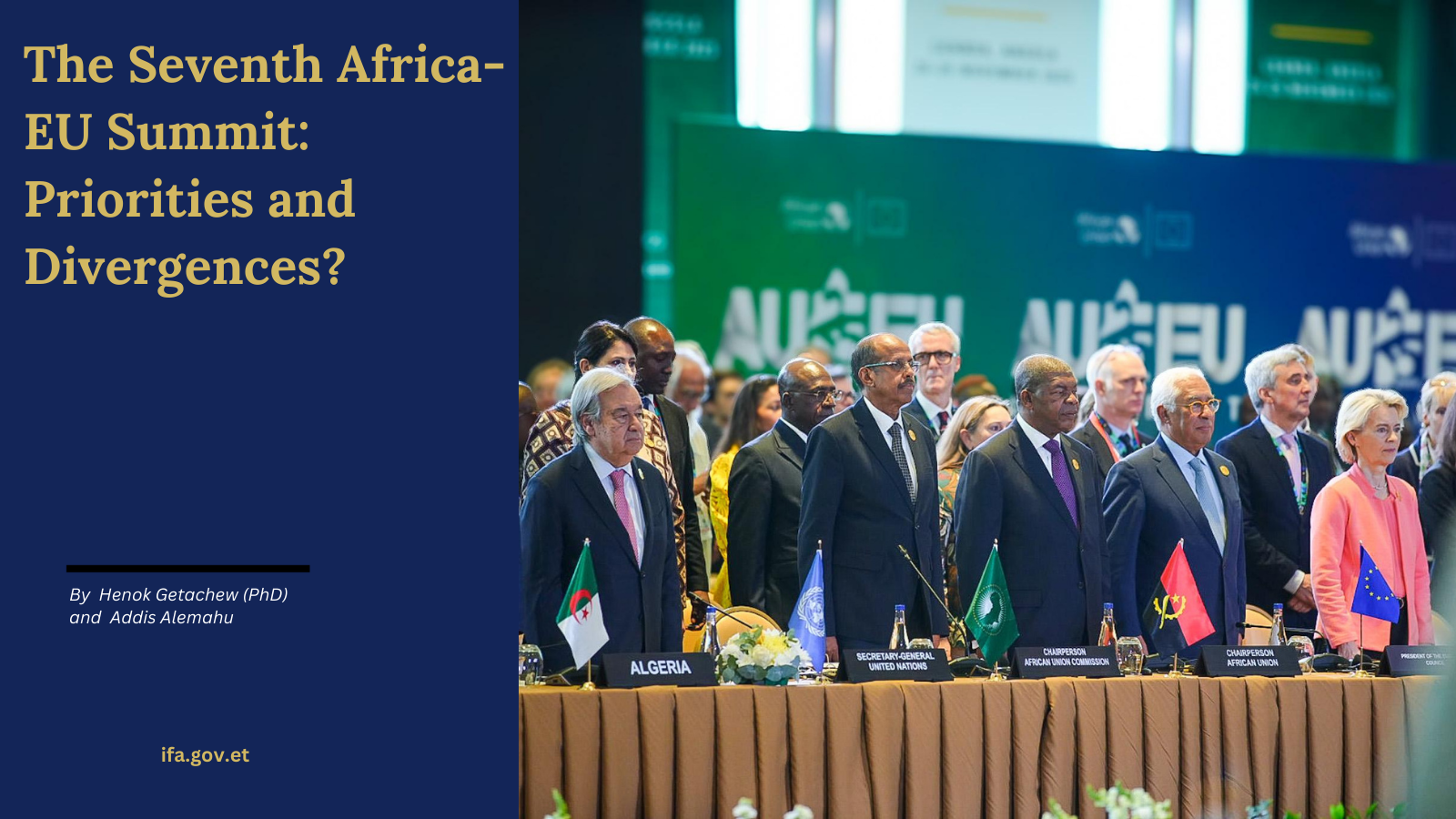
The seventh summit between the two sides marks a quarter-century partnership between the EU and the AU.[7] The coming summit will give due attention to regional economic integration, trade, peace and security, climate financing, AI, the erosion of multilateralism, the Global Gateway Initiative, and the unfolding conflict between Russia and Ukraine. On the side of Africa, Agenda 2063, the African Continental Free Trade Area (AfCFTA), Sustainable Global Development 2030, reforming the global financial and security architectures, particularly the International Monetary Fund, the World Bank and the United Nations Security Council, and financing the peacekeeping operations (UNSC 2719) will seize the center stage.
Both the AU and the EU share common priorities, albeit with concern about the prevailing misalignment evident in the two-decades-plus partnership. Indeed, both sides are also showing a commitment to shared values and to maintaining multilateral arrangements amid the unfolding challenges. Despite ties between the two sides, challenges remain in fostering deeper cooperation. This concern is indeed reflected during the third AU-EU ministerial meeting.[8] Among the challenges the upcoming summit is facing is whether the EU remains a major partner in financing African peace and security infrastructure, as it was witnessed in various peace operations on the continent. The EU’s decreasing interest in backing the continent’s peace and security efforts has been observed in its “shifting from supporting AfSol towards framing EU foreign and security policies with a direct link between African stability and European security (and economic) interests”[9]could be mentioned. Leaders in the EU and major member states are paying closer attention to Europe’s peace and security, especially after the 2022 war between Moscow and Kyiv. Furthermore, the emergence of right-wing groups in Europe has led to a decline in interest in African affairs. These instances are among the major factors that cast a shadow on the trajectory of the partnership between the two sides.
Another area of divergence between the two sides is military coups in the Sahel, which have caused diplomatic friction among regional states and with some European states. In an effort to fill the security vacuum left by European powers, extra-regional geopolitical actors and rivals are vying to forge new allies. Sahel states may not participate at a higher level at the upcoming summit due to increasingly precarious diplomatic relations with some European Union member states. Besides, the current geopolitical reality that shows alternative security and economic arrangement like that of BRICS Plus and its members inroads to Africa to build a closer ties with African states in tandem of the admission of Ethiopia and Egypt into the organization tend to compel the EU to refrain from “claiming Africa’s unique partner.”[10]Hence, there is a possibility of not giving weight to the coming summit as equal as its predecessors.
Currently, the global south is calling for reform of the international institutions established in the wake of the end of World War II. Even from the global north, particularly the EU, there is interest in backing the AU in its call for the democratization of international institutions to address the embedded unfairness and unrepresentativeness in the changing geopolitical and geo-economic order. Notwithstanding its commitments in joint declarations and summits, the EU is still criticized for failing to translate them into reality. Such a trajectory, according to a recent report by ECDPM, will incentivize “Africa and the wider Global South to continue to develop alternative institutions or gravitate towards non-Western power blocs such as the BRICS.”[11]
Another challenge that could affect the partnership between the AU and the EU is related to the model of the partnership between the two sides that has changed from what it was twenty-five years ago. Development aid, migration, and financing the peacekeeping operations were previously the major pillars of cooperation. Currently, however, investment, the fight against irregular migration, energy security, and access to strategic minerals has come to the forefront of the discussion table. It seems that a “transactional approach”[12] tends to highly affect the relationship between the two sides in the coming years or decades. As a result, the predominant mantra of “solidarity with the global south [Africa]” could be sidelined in future engagements. Rather, interests will dominate the discussion amid rising security uncertainties across different pockets of the continent. Furthermore, the third Russia-Africa summit that is scheduled to convene in one of the capitals of Africa by next year may cloud the condition of the coming summit and its subsequent effort to translate the declaration into reality.
Conclusions
In retrospect, the prior summits between the AU and the EU envisaged to build a deepening partnership anchored on “common values, equality, mutual respect, and cooperation.” Looking after twenty-five years of cooperation, there are still shortcomings in building political, economic and cultural ties that are reciprocated by mutual benefits while looking at the foregoing determinants stand between the two sides. Notwithstanding the challenges and uncertainties the international community has witnessed, the AU and the EU member states need to bolster their shared commitment to address global and continental challenges more than ever. Otherwise, foregoing trends will cast a shadow not just to the coming summit, but also the future partnership.
[1] European Union External Action.(2025). Looking back: key moments over 25 years of AU-EU Partnership. Retrieved from https://www.eeas.europa.eu/eeas/looking-back-key-moments-over-25-years-au-eu-partnership_en.
[2] Council of the European Union.(2007). The Africa-EU Strategic Partnership: A Joint Africa-EU Strategy. Lisbon.
[3] European Commission.(2010). 3rd Africa EU-Summit 29/30 November, Tripoli. Retrieved from https://ec.europa.eu/commission/presscorner/detail/en/memo_10_604
European Council.(2014). The Fourth EU-Africa Summit Declaration, 2-3 April 2014, Brussels.
[4] European Council.(2014). The Fourth EU-Africa Summit Declaration, 2-3 April 2014, Brussels.
[5] African Union.(2017). 5th African Union-European Union Summit. Retrieved from https://au.int/en/AUEUSummit2017
[6] African Union.(2022). 6th European Union – African Union Summit: A Joint Vision for 2030. Retrieved from https://au.int/en/pressreleases/20220218/6th-european-union-african-union-summit-joint-vision-2030
[7] European Council.(2025). EU-African Union to deepen cooperation at 24-25 November summit in Angola. Retrieved from https://www.consilium.europa.eu/en/press/press-releases/2025/07/08/eu-africa-union-to-deepen-cooperation-at-24-25-november-summit-in-angola/
[8] AU.(2025). Joint communiqué of the 3rd EU-AU Ministerial Meeting. Retrieved https://au.int/en/pressreleases/20250521/joint-communique-3rd-eu-au-ministerial-meeting
[9] Desmidst, et al.(2025). AU-EU summit: Does the EU still matter for Africa’s peace and security? Retrieved from https://ecdpm.org/work/au-eu-summit-does-eu-still-matter-africas-peace-and-security
[10] ECDPM. (2025).25 years of troubled EU-AU relations: Breaking the cycle of summit rituals. Retrieved from https://ecdpm.org/work/25-years-troubled-eu-au-relations-breaking-cycle-summit-rituals
[11] ECDPM. (2025).25 years of troubled EU-AU relations: Breaking the cycle of summit rituals. Retrieved from https://ecdpm.org/work/25-years-troubled-eu-au-relations-breaking-cycle-summit-rituals
[12] https://www.cgdev.org/blog/au-eu-summit-luanda-whats-table-and-what-should-change
About the Authors
Henok Getachew (PhD) is a Senior Researcher of African Affairs and an adjunct Professor at the School of International Relations and Diplomacy as well as the School of Law at the Ethiopian Civil Service University (ECSU) and the Ethiopian International Peacekeeping Taining Centre (EIPKTC). His research focus is African Union Peace and Security Architecture, political transition, security regionalism, global governance, and state fragility in sub-Saharan Africa. Henok works on Ethiopia’s role in the AUPSC and China’s increasing involvement in the Horn of Africa. His recent publications include The Post-African Union Transition Missionin Somalia and its Regional Security Implications, Ethiopia in an Era of Expanded BRICS: A Brief Look at Ethiopia’s Entry and Experience within the Organization, Lowering the Costs of the Red Sea Rivalry for the Horn of Africa, The Enigmatic Path of Political Transition in the Horn of Africa, Ethiopia’s Regional Position in the Horn of Africa: Constraints, Perspectives, and Scenarios and Taxed Foreign Policy of Ethiopia. He can be contacted via henokgetachew1983@gmail.com
| Addis Alemahu is a researcher in the Institution of Foreign Affairs, specializing in the Multilateral Governmental and Non-Governmental Affairs department. He holds an MA in Journalism and Communication. His work focuses on: Migration and Refugee Issues Peacekeeping and Military Issues Socioeconomic Issues He has authored numerous research articles, including: France’s Military Strategy Revision Plan in Africa and its Implications: Future Challenges & Opportunities for Africa Saudi Arabia’s Vision 2030 and Its Regional Implications Trajectories and Geopolitical Implications of the Gulf-Horn Interaction Militarization and Commercialization of Ports in the Horn of Africa For inquiries, you can contact him at addisalemahu@yahoo.com. |
Disclaimer:
The content disseminated by the Institute of Foreign Affairs (IFA) – including, but not limited to, publications, public statements, events, media appearances, and digital communications – reflects the views of individual contributors and does not necessarily represent the official positions or policies of the Institute, its partners, or any affiliated governmental or non-governmental entities.
While the IFA endeavors to ensure the accuracy, integrity, and timeliness of the information presented, it makes no representations or warranties, express or implied, regarding the completeness, reliability, or suitability of such content for any purpose. The Institute expressly disclaims any liability for errors or omissions, as well as for any actions taken or decisions made based on the information provided.
The inclusion of external links, references, or third-party resources does not constitute an endorsement by the Institute. Additionally, engagement on social media platforms – including, but not limited to, likes, shares, retweets (RTs), or reposts – shall not be interpreted as an endorsement or validation of the views expressed therein.Readers and audiences are encouraged to exercise critical judgment and seek independent verification when interpreting or relying upon any information disseminated through publications and posts on the Institute’s platforms or representatives.