

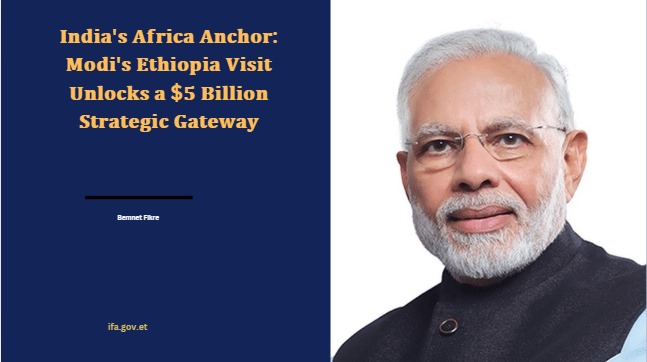
Prime Minister Narendra Modi’s upcoming visit to Ethiopia represents a significant moment in India’s Africa strategy, coming at a time when major global powers are actively expanding influence across the continent. Ethiopia’s role as host of the African Union Commission, its position as Sub-Saharan Africa’s third-largest economy, and its strategic location in the Horn of Africa make it a central partner for India’s long-term engagement.
The visit, the first by an Indian premier to Ethiopia in more than a decade, comes after Modi’s meeting with Prime Minister Abiy Ahmed on the sidelines of the BRICS Leaders’ Summit in Johannesburg last month. The two leaders are expected to discuss deepening bilateral cooperation across trade, investment, defence, ICT, agriculture, clean energy, railway modernization, youth skilling, and governance reforms. These discussions reflect a holistic approach, combining strategic investment with knowledge exchange and human-centered development.
Historically, India has played a critical role in Ethiopia’s development through financing infrastructure projects, supporting rural electrification, and providing technical and vocational training. Over 650 Indian companies operate in Ethiopia, covering manufacturing, textiles, pharmaceuticals, ICT, and agro-processing, with combined investments exceeding $5 billion. These enterprises are among Ethiopia’s largest private employers, demonstrating the tangible socio-economic impact of long-term engagement.
Defense cooperation is also a key pillar of the partnership. India and Ethiopia have established formal mechanisms for strategic dialogue, joint exercises, officer training, military medical collaboration, and partnerships with Indian defense manufacturers. Ethiopia’s participation in India-hosted UN Troop Contributing Countries Chiefs’ Conclave further reinforces the growing security ties.
The visit aligns with both countries’ expanded roles within BRICS and could pave the way for the long-delayed fourth India–Africa Forum Summit. Observers note that Ethiopia’s growing economic stability, industrial diversification, and strategic location provide a unique platform for India to consolidate its political and economic presence in Africa. High-level visits such as this are seen as key to translating long-standing historical and cultural linkages into concrete development outcomes.
In short, Modi’s trip signals India’s determination to strengthen a multi-dimensional partnership with Ethiopia, one that integrates development support, trade, governance, and security, while emphasizing inclusive growth and sustainable, people-centered benefits. At a time when Africa is increasingly a stage for global strategic engagement, Ethiopia emerges as a natural anchor for India’s long-term vision on the continent.
By Bemnet Fikre @IFA
Disclaimer:
The content disseminated by the Institute of Foreign Affairs (IFA) – including, but not limited to, publications, public statements, events, media appearances, and digital communications – reflects the views of individual contributors and does not necessarily represent the official positions or policies of the Institute, its partners, or any affiliated governmental or non-governmental entities.
While the IFA endeavors to ensure the accuracy, integrity, and timeliness of the information presented, it makes no representations or warranties, express or implied, regarding the completeness, reliability, or suitability of such content for any purpose. The Institute expressly disclaims any liability for errors or omissions, as well as for any actions taken or decisions made based on the information provided.
The inclusion of external links, references, or third-party resources does not constitute an endorsement by the Institute. Additionally, engagement on social media platforms – including, but not limited to, likes, shares, retweets (RTs), or reposts – shall not be interpreted as an endorsement or validation of the views expressed therein.Readers and audiences are encouraged to exercise critical judgment and seek independent verification when interpreting or relying upon any information disseminated through publications and posts on the Institute’s platforms or representatives.