

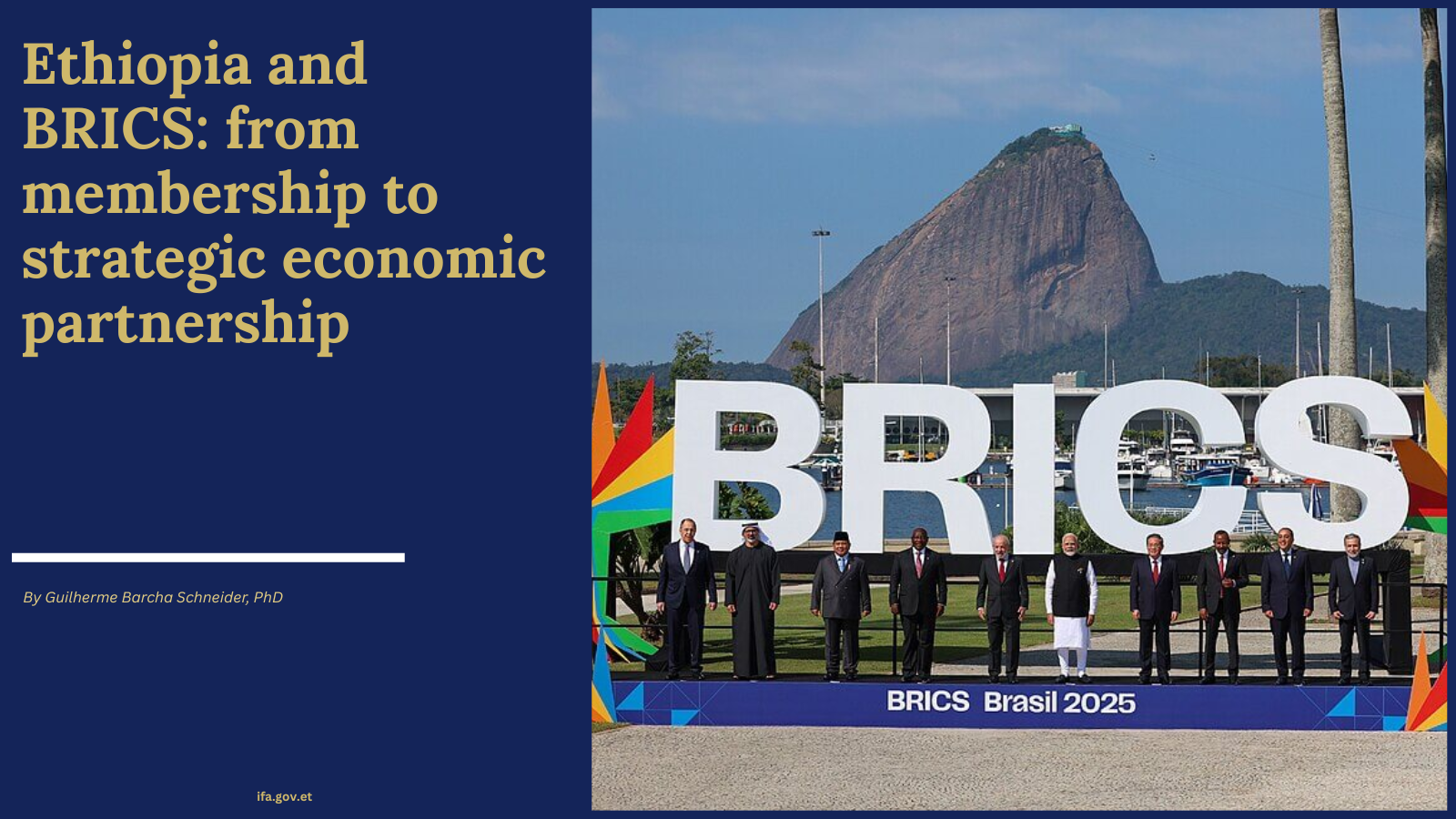
Leveraging BRICS Mechanisms for Development
EXECUTIVE SUMMARY
Ethiopia’s January 2024 accession to BRICS marks a transformative opportunity for development financing and macroeconomic diversification. This brief examines BRICS institutional architecture—particularly the New Development Bank (NDB) with $40 billion in approved financing across 122 projects (New Development Bank, 2025)—and distills lessons from South Africa’s 15-year membership, Brazil’s strategic positioning, and Egypt’s first-year experience (Stuenkel, 2015; Nogueira Batista, 2018).
Key Finding: Ethiopia’s BRICS membership can deliver measurable development outcomes through proactive engagement in NDB infrastructure financing, payment system integration, and technology partnerships, contingent upon strengthened institutional capacity and balanced multi-alignment with traditional Western partners (Gebregziabher & Geda, 2025).
Keywords: Ethiopia, BRICS, infrastructure financing, development finance, de-dollarization, technology transfer
1. CONTEXT: ETHIOPIA’S STRATEGIC RATIONALE
1.1 Global Economic Shifts and BRICS Innovation
The post-2008 financial crisis exposed structural deficiencies in Bretton Woods institutions where high-income nations dominate voting despite representing minority populations (Woods, 2014; Keohane & Nye, 2012). BRICS emerged as an institutional alternative, establishing the NDB in 2014 with equal founding member voting rights (Brazil, Russia, India, China, South Africa each hold 20%) and 45% governance space for emerging economies—fundamentally differentiating it from World Bank structures where voting correlates with financial contribution (New Development Bank, 2025).
1.2 Ethiopia’s Entry Context
Ethiopia’s February 2024 BRICS accession reflects acute macroeconomic pressures: external debt reached $28.9 billion, foreign exchange reserves collapsed to $1.4 billion (less than one month of imports), and inflation peaked at 33.89% (International Monetary Fund, 2024). The 2020-2022 Tigray conflict precipitated suspension of Western budget support and partial AGOA withdrawal (U.S. Department of State, 2022), creating rationale for financing diversification beyond traditional multilateral channels (Dos Santos, 2024).
BRICS membership offers four strategic benefits: (1) infrastructure financing without policy conditionalities, (2) local currency financing reducing dollar vulnerability, (3) South-South technology transfer partnerships, and (4) diplomatic leverage within emerging economy coalitions representing 40% of global GDP (BRICS, 2024).
2. BRICS INSTITUTIONAL MECHANISMS
2.1 New Development Bank: Governance and Performance
The NDB’s $40 billion portfolio across 122 projects (September 2025) demonstrates rapid institutional scaling (New Development Bank, 2025). Critically, it operates without policy conditionalities, preserves borrower autonomy, and increasingly provides local currency financing: 25-26% of lending denominated in RMB, reals, and rand (versus 15% historically), mitigating foreign exchange risk (Yao et al., 2024). Project processing averages 18-24 months versus World Bank’s 36-48 months, enhancing responsiveness (New Development Bank, 2025).
2.2 Contingent Reserve Arrangement and Payment Systems
The $100 billion CRA provides balance-of-payments support with reduced IMF conditionality, while BRICS payment systems facilitate de-dollarization—intra-BRICS local currency trade surged from 28% (2015) to 65% (2024), reducing transaction costs by 25-40% and insulating members from Western payment restrictions (Yao et al., 2024; BRICS Bridge, 2025).
2.3 Technology Transfer Frameworks
BRICS Science, Technology and Innovation programmes coordinate research in renewable energy, digital infrastructure, and manufacturing, while industrial park cooperation exemplifies technology transfer through Chinese and Indian foreign direct investment in Ethiopia (BRICS, 2024; Yao et al., 2024).
3. COMPARATIVE MEMBER OUTCOMES
3.1 South Africa: 15-Year Integration
South African BRICS trade expanded 70% over 2017-2022 to $50 billion (21% of total trade), yet remains commodity-concentrated (91-96% exports are coal, iron ore, manganese), indicating that market access alone insufficient for structural transformation (Republic of South Africa, 2023). The NDB approved 11 South African projects valued at $5.2 billion through 2023-2024 with generally successful outcomes, though implementation delays and currency effects constrained impact (New Development Bank, 2025).
3.2 Brazil and Egypt: Strategic Positioning
Brazil’s $7 billion NDB portfolio generated 7,500 renewable energy jobs, mobilized $845 million in co-financing, and exceeded emissions reduction targets, demonstrating catalytic potential when coupled with institutional partnership (New Development Bank, 2025). Egypt’s 19.5% trade growth with BRICS (2023-2024) and rapid market integration suggest immediate benefits for new members (CAPMAS, 2024).
4. RISKS AND ETHIOPIA’S STRATEGIC FRAMEWORK
4.1 Critical Challenges
Debt Sustainability: Ethiopia’s 35-40% bilateral debt to China risks entrenchment through NDB financing, requiring genuine creditor diversification (Gebregziabher & Geda, 2025).
IMF Compatibility:Concurrent IMF Extended Credit Facility conditionalities may conflict with BRICS development priorities, demanding sophisticated coordination.
Technology Dependency: Over-reliance on Chinese/Indian technology necessitates complementary non-BRICS partnerships (Yao et al., 2024).
4.2 Strategic Priorities (2025–2035)
Immediate (2025-2026): Prepare 3-5 bankable NDB projects targeting renewable energy ($500-750M), industrial parks ($300-400M), urban transport ($400-600M), water/irrigation ($200-350M), and digital infrastructure ($150-250M)—total potential: $1.55-2.35 billion generating 12,000-19,500 jobs (Appendix B).
Medium-term (2027-2029): Integrate BRICS payment systems, negotiate currency swaps, establish technology cooperation frameworks with China and India, and mobilize climate finance.
Long-term (2030-2035): Assume African BRICS leadership, position Ethiopia as regional hub for BRICS-Africa cooperation.
5. IMPLEMENTATION REQUIREMENTS
Domestically, Ethiopia requires: (1) Infrastructure Project Development Unit within Finance Ministry with international development finance expertise, (2) enhanced debt management frameworks integrating BRICS borrowing into debt sustainability analyses, (3) regulatory reforms for non-dollar currency settlements and BRICS payment system integration, (4) macroeconomic coordination between IMF and BRICS engagement, and (5) sectoral strategies incorporating technology partnerships into industrial policy (Gallagher, 2016).
6. CONCLUSION AND RECOMMENDATIONS
Ethiopia’s BRICS membership transcends symbolic significance only through deliberate institutional engagement and rigorous project preparation. Comparative analysis of South Africa, Brazil, and Egypt demonstrates that passive membership yields minimal benefits; strategic mobilization materially advances development objectives (Stuenkel, 2015; Gebregziabher & Geda, 2025).
Key Recommendations:
- Submit 3-5 bankable NDB infrastructure projects by end-2025
- Establish BRICS Affairs Office with technical capacity
- Integrate payment systems targeting 40-50% local currency trade by 2028
- Develop China-India technology cooperation frameworks
- Maintain balanced BRICS-Western engagement
- Strengthen IMF-BRICS macroeconomic coordination
- Position Ethiopia as African BRICS leader
With appropriate policy frameworks and implementation discipline, BRICS mechanisms can materially contribute to infrastructure financing, technology upgrading, and structural economic transformation complementing Ethiopia’s Homegrown Economic Reform Agenda (Yao et al., 2024). The window for strategic positioning remains open—Ethiopia should act decisively to convert potential into measurable development outcomes (Stuenkel, 2015).
REFERENCES
Acharya, A. (2017). Why govern? The demand for good governance. Journal of Democracy, 28(4), 156–170.
BRICS. (2024). BRICS expansion and institutional framework [Press Release]. Retrieved from https://brics.br
BRICS Bridge. (2025). Cross-border payment system infrastructure. Retrieved from https://bricsbridge.org
CAPMAS. (2024). Egypt-BRICS trade statistics 2024. Cairo: Central Authority for Public Mobilization and Statistics.
Dos Santos, A. L. (2024). BRICS development financing and global South cooperation. Emerging Markets Review, 52, 101–118.
Gallagher, K. P. (2016). The parable of the broken window: And other tales of economics and development finance. Washington, DC: Brookings Institution Press.
Gebregziabher, T., & Geda, A. (2025). Ethiopia’s development trajectory and BRICS strategic engagement. Ethiopian Journal of Economics, 34(2), 89–124.
International Monetary Fund. (2024). Ethiopia: 2024 Article IV consultation and third review under the extended credit facility. IMF Country Report No. 24/289.
Author: Guilherme Barcha Schneider, PhD
Affiliation: Instituto Latinoamericano de Estudios de Posgrado (ILEP), México
Date: December 2025
Disclaimer:
The content disseminated by the Institute of Foreign Affairs (IFA) – including, but not limited to, publications, public statements, events, media appearances, and digital communications – reflects the views of individual contributors and does not necessarily represent the official positions or policies of the Institute, its partners, or any affiliated governmental or non-governmental entities.
While the IFA endeavors to ensure the accuracy, integrity, and timeliness of the information presented, it makes no representations or warranties, express or implied, regarding the completeness, reliability, or suitability of such content for any purpose. The Institute expressly disclaims any liability for errors or omissions, as well as for any actions taken or decisions made based on the information provided.
The inclusion of external links, references, or third-party resources does not constitute an endorsement by the Institute. Additionally, engagement on social media platforms – including, but not limited to, likes, shares, retweets (RTs), or reposts – shall not be interpreted as an endorsement or validation of the views expressed therein.
Readers and audiences are encouraged to exercise critical judgment and seek independent verification when interpreting or relying upon any information disseminated through publications and posts on the Institute’s platforms or representatives.