

Introduction
The modern era of international peacekeeping began with the creation of the United Nations Truce Supervision Organization (UNTSO) in May 1948. This first mission, which oversaw the ceasefire between Israel and neighboring Arab states, set the stage for multinational efforts to manage conflicts. In the years that followed, the need for these operations grew significantly, with Africa becoming the main focus for United Nations peacekeeping activities. Currently, half of all global UN peacekeeping missions are deployed across the continent, showing its ongoing challenges with instability and a complicated history.
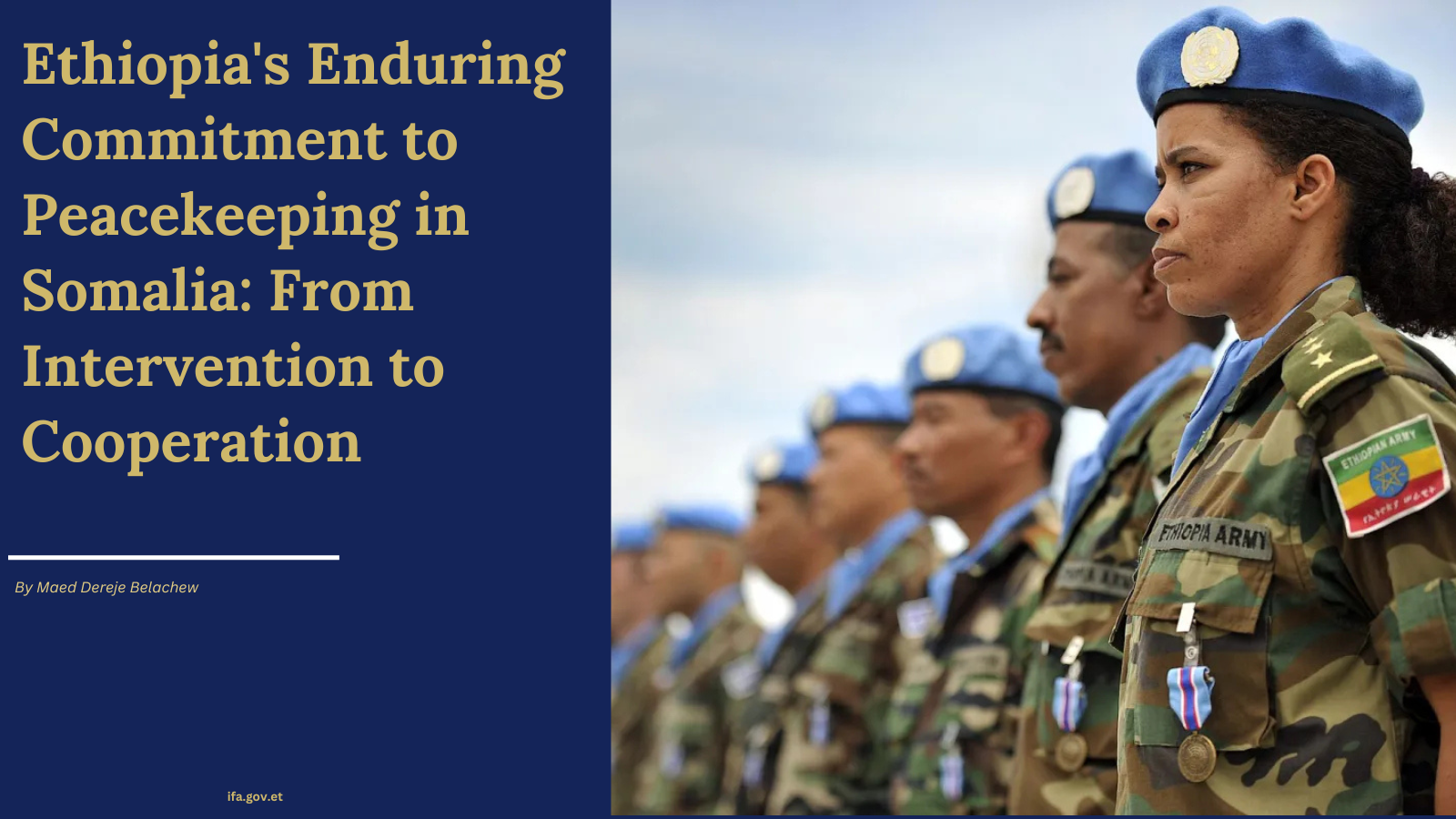
In this context, Ethiopia has become a key pillar of both international and African peacekeeping. It ranks among the largest contributors of personnel to both the UN and the African Union. Ethiopia routinely sends over 12,000 military and police peacekeepers to crisis zones around the world, with a history of service ranging from Korea to Sudan. However, it is in its immediate region, the Horn of Africa, that Ethiopia’s commitment has been most apparent and sustained. This is especially true in Somalia, a country marked by government failure and ongoing warfare.
This analysis looks at the varied and changing role Ethiopia has taken in peacekeeping operations in Somalia since 1991. It charts the development of this involvement from initial humanitarian actions to ongoing stabilization efforts under the African Union Mission in Somalia (AMISOM) and its successor, the African Union Transition Mission in Somalia (ATMIS) and now AUSSOM missions. Through this examination, the article shows how a regional player uses peacekeeping not just as a diplomatic tool but as an important strategy for enhancing collective security, protecting its own national interests, and fulfilling a sense of regional responsibility.
To understand Ethiopia’s role, we first need to look at the unstable environment that created it: the Horn of Africa. This region is strategically important but suffers from ongoing instability, facing security threats like terrorism and piracy due to competition for resources. At the heart of this crisis is Somalia, where the government collapsed in 1991, leading to a long civil war, clan conflicts, and lawlessness. This breakdown caused severe humanitarian suffering and allowed militant groups, particularly Al-Shabaab, to grow. The resulting chaos crossed borders, leading to refugee movements, illegal arms trafficking, and increased regional insecurity—threats felt acutely by neighboring Ethiopia. The international response initially focused on humanitarian aid during the 1992-1993 famine when militia blockades prompted the U.S.-led Operation Restore Hope. However, the mission’s failure after the deadly 1993 ambush in Mogadishu led Western powers to withdraw, creating a security void. This withdrawal discouraged further large-scale international military intervention, leaving regional actors, especially Ethiopia, to take on more responsibility for stabilizing Somalia.
Ethiopia’s military involvement in Somalia has evolved through three definitive stages, transitioning from unilateral interventionist actions to a cornerstone role in multilateral peacekeeping, and now into a phase of complex geopolitical realignment. Initially, from 1996-2006, Ethiopia acted independently to neutralize direct security threats, culminating in its 2006 campaign against the Islamic Courts Union (ICU). While militarily successful, this intervention fueled local backlash and inadvertently strengthened Al-Shabaab, prompting a strategic recalibration. This led to the second stage, where Ethiopia formally integrated into the African Union Mission in Somalia (AMISOM) in 2014, becoming its most pivotal troop contributor—bearing the primary combat burden, securing key sectors, and training Somali forces.
The current third stage, beginning in 2024, is defined by the post-ATMIS transition towards new frameworks like AUSSOM where Ethiopia’s primary role is as a major troop-contributing country involved in regional security and counter-insurgency efforts against the Al-Shabaab militant group, and helping strengthen Somalia’s governance and regional peace. The agreement for Ethiopia’s formal deployment within AUSSOM was a result of recent diplomatic efforts (specifically the Ankara Declaration and subsequent high-level talks in early 2025) which resolved previous political tensions and disagreements with the Federal Government of Somalia regarding Ethiopia’s involvement in the mission. Consequently, Ethiopia remains the indispensable security anchor against Al-Shabaab, a leading troop contributor within evolving AU missions, and the central geopolitical catalyst in a regional dispute navigating a fragile, externally-mediated resolution—all in service of its enduring objectives of border security, regional influence, economic access, and enhanced global partnerships.
Ethiopia’s critical role in Somali security is defined by a fundamental tension: it operates as the region’s most potent counterforce against Al-Shabaab, yet its effectiveness is hampered by a hybrid mandate that blurs peacekeeping with combat, eroding its perceived neutrality and escalating risks. This operational dilemma is compounded by Somalia’s internal divisions, which conscript Ethiopian forces into political mediation, and by the enduring legacy of the 2006 intervention, which militants weaponize to discredit the mission as an occupation. Underpinning these immediate obstacles are chronic systemic weaknesses—shortages in manpower and materiel, erratic financing, and the precariousness of short-term mandates—that stifle long-term strategy. To break this costly cycle and convert Somalia from a persistent security liability into a collaborative partner, Ethiopia must champion a comprehensive strategic pivot. This begins with diligently fulfilling the Ankara Agreement, leveraging port access as a mutual economic opportunity to restore diplomatic trust. Concurrently, Ethiopia should recalibrate its security approach by leading within the AUSSOM framework toward a mission focused on Somali capacity-building and precision strikes, while fortifying its own border as a defensive shield against spillover. Diplomatically, it must proactively shape consensus within the AU and IGAD and navigate relations with global powers without firm allegiance. Through this integrated strategy—balancing verified diplomacy, sustainable security, and inclusive economic statecraft—Ethiopia can evolve from a reluctant intervener into the principal architect of regional stability, thereby securing its own frontiers and unleashing its national economic potential.
Conclusion: From Cornerstone to Catalyst—A Role in Flux
Ethiopia’s role in peacekeeping in Somalia since 1991 is not a straightforward tale of humanitarian goodwill; it is a complex mix of national interests, regional duty, and adaptive strategies. From the unilateral actions of the 2000s to its central position within the AU’s mission, Ethiopia has been a crucial player in preventing Somalia’s total collapse and gradually reducing the threat of Al-Shabaab. Its contributions have come at a significant cost in lives and resources, reflecting a deep understanding that its own security is closely tied to Somalia’s stability. As AMISOM transitions to the African Union Transition Mission in Somalia (ATMIS) and later to AUSSOM, with a clearer focus on transferring security responsibilities to Somali forces, Ethiopia’s role has changed. It has shifted more towards training, mentoring, and providing strategic oversight while maintaining strong capabilities for counter-terrorism operations. The Somali case shows that in a region of ongoing conflict, lasting peace often relies not only on distant international organizations but also on committed regional stakeholders who have the most to lose from continued instability. Through its peacekeeping commitment, Ethiopia has positioned itself as such a stakeholder. The path to lasting peace in Somalia remains long and difficult, but it would be far more dangerous without its neighbor’s ongoing engagement. Understanding this role is crucial for analyzing not just Somalia’s future but also the changing nature of peacekeeping in an era where regional solutions are increasingly important.
Ethiopia, in collaboration with regional organizations such as IGAD and the AU, should strengthen capacity-building for Somali security forces, enhance regional diplomacy, and increase its focus on community-level stabilization by supporting local governance structures and reconciliation initiatives so that lasting stability can prevail.
References
- Abebaw, A. (2016). The role of Ethiopia in conflict resolution in the horn of Africa: the case of Somalia (since 1991-present). MA Thesis. Indira Gandhi National Open University Retrieved August 28, 2024 from http:// dx.doi.org/10.4314/jsdlp. /Pdf
- DW. (2024, December 11). Ethiopia, Somalia Reach Compromise to End Feud, Turkey Says. https://www.dw.com/en/ethiopia-somalia-reach-compromise-to-end-feud-turkey-says/a-69660000
- Mesfin. B. (2012). Ethiopia’s Role and Foreign Policy in the Horn of Africa; the International Journal of Ethiopian Studies. Tsehai Publishers
- The Ethiopian Herald. 2016. Ethiopia: Becoming a magnet of peace, economic integration.
- Hailemariam, Z. (2016). Africa: Ethiopia’s Contribution toward Peacekeeping Mission.RetrievedNovember23,2025fromhttp://Allafrica.Com/Stories/201601081.hml
- Henze, P. (1991), The Horn of Africa from War to Peace. The Macmillan Press, London. Retrieved November25, 2025 from doi: 10.1007/978-1-349-21456-3
- Hiiraan Online. (2024, December 6). Ethiopia, Somalia Resolve Year-Long Feud in Turkey-Brokered Agreement. https://hiiraan.com/news4/2024/Dec/199318/e
- Hopf, T. (1998), The Promise of Constructivism in International Relations Theory. International Security, 23:1, 171–200. Retrieved December 2, 2025 from doi:https://doi.org/10.1162/isec.23.1.171
- Jett, C. (1998). Why Peacekeeping Fails: A Comparative Assessment of Angola and Mozambique. London: Palgrave-Macmillan.
- Kaleab, T. (2021). Military Power As Foreign Policy Instrument: Post-1991 Ethiopian Peace Support Operations In The Horn Of Africa. National University Of Public Service, Budapest
- Mark, M. (1998): Peacekeeping In The New Millennium: Towards ‘Fourth Generation’ Peace Operations?, African Security Review, 7:3, 13-20
- Musoma, L. (2021). “Key Challenges Facing AMISOM in Military Diplomacy in the Horn of Africa.” African Journal of Empirical Research, 2 (1), 54-67 Retrieved November 15, 2025 from http:// dx.doi.org/10.4314/jsdlp. /Pdf
Tilahun,G. (2022).Ethiopia’s contribution to peace support operation in the horn of Africa and its implications on national interest. MA Thesis. Addis Ababa University. Retrieved November30, 2025 from http://www.researchgate.net/publication/363266743/Pdf
By Maed Dereje Belachew she can be reach at – maeddereje524@gmail.com
Disclaimer:
The content disseminated by the Institute of Foreign Affairs (IFA) – including, but not limited to, publications, public statements, events, media appearances, and digital communications – reflects the views of individual contributors and does not necessarily represent the official positions or policies of the Institute, its partners, or any affiliated governmental or non-governmental entities.
While the IFA endeavors to ensure the accuracy, integrity, and timeliness of the information presented, it makes no representations or warranties, express or implied, regarding the completeness, reliability, or suitability of such content for any purpose. The Institute expressly disclaims any liability for errors or omissions, as well as for any actions taken or decisions made based on the information provided.
The inclusion of external links, references, or third-party resources does not constitute an endorsement by the Institute. Additionally, engagement on social media platforms – including, but not limited to, likes, shares, retweets (RTs), or reposts – shall not be interpreted as an endorsement or validation of the views expressed therein.Readers and audiences are encouraged to exercise critical judgment and seek independent verification when interpreting or relying upon any information disseminated through publications and posts on the Institute’s platforms or representatives.