

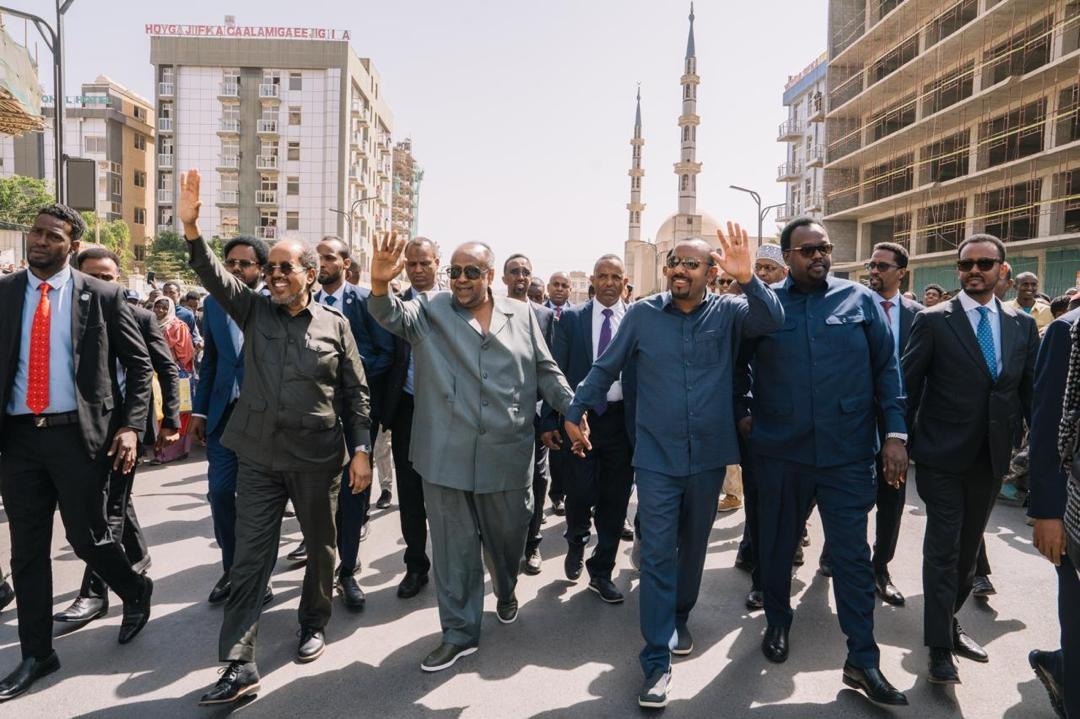
Ethiopia’s “Horn First” doctrine is often described in the language of corridors, cooperation, and shared prosperity. However, its clearest signals sometimes arrive wrapped in ceremony rather than communiqués. On January 31, 2026, Prime Minister Abiy Ahmed hosted President Hassan Sheikh Mohamud and President Ismaïl Omar Guelleh in Jigjiga for the inauguration of Shabeely Resort—a “development showcase” in Ethiopia’s Somali region signaling a thaw in regional relations after a season of regional tensions.1 The choreography mattered: three leaders standing together in a historically sensitive borderland, presenting investment and connectivity as a shared regional project, at a moment when the Horn’s crises overlap and external competition along the Red Sea is intensifying.
That scene captures the promise and the peril of “Horn First.” The doctrine, developed after 2018 and linked theoretically to Medemer (“synergy”), positions Ethiopia’s foreign policy around regional economic integration, cross-border infrastructure, and cooperative security, with the aim of reducing costly dependence on extra-regional patrons.15 The wager is straightforward: if the Horn’s states trade more, coordinate more, and share basic rules for movement and investment, they will have stronger incentives to manage disputes and fewer reasons to outsource security.
In early 2026, however, the wager is under severe pressure. The region’s conflicts are mutually reinforcing: Sudan’s fragmentation has unsettled borders and displaced millions; Somalia’s insecurity continues to spill across frontiers; and Ethiopia’s own internal violence has strained state capacity and complicated regional diplomacy.10,9 Meanwhile, the Red Sea and Gulf of Aden have become arenas where ports, bases, and commercial-security hybrids blur, ensuring that infrastructure decisions increasingly carry geopolitical weight.14,15
In that environment, “Horn First” cannot be treated as a development slogan. It is a bid to shape regional order—and it will be judged by whether Ethiopia can pursue integration without triggering fear. The doctrine remains plausible, even necessary. But it is also vulnerable to a basic dilemma: Ethiopia’s scale makes it indispensable to regional solutions, yet that same scale can produce suspicion—especially when institutions are weak and threat perceptions are high. “Horn First” will succeed only if Ethiopia professionalizes it: institutionalizes the doctrine at home, practices reassurance abroad, and treats domestic stabilization as a core foreign-policy asset rather than a separate file.
The Doctrine in Brief
“Horn First” can be understood as three interlocking priorities:13,11,8
- Connectivity and integration—trade corridors, power interconnection, investment facilitation, and logistics cooperation intended to lower transaction costs and create shared economic stakes.
- Cooperative security—border management, counterterrorism coordination, and crisis diplomacy designed to reduce transnational threats and prevent interstate escalation.
- Strategic self-reliance—not withdrawal from global partnerships, but a rebalancing toward regional problem-solving and a stronger capacity to bargain with external actors on better terms.
As a narrative, “Horn First” positions Ethiopia as a convener and market maker in the Horn, leveraging its demographic and economic weight and its status as host to the African Union to promote a regionally anchored agenda. High-visibility development diplomacy moments—such as the January 2026 Jigjiga inauguration—are intended to socialize this agenda as normal, cooperative, and regionally owned.2,1 As a policy, it is a claim about sequencing: regional order first, then external alignment—rather than the reverse.
Deep Roots, New Packaging
The label is new. The underlying imperatives are not. Ethiopian foreign policy has long been shaped by a handful of durable concerns: sovereignty protection, access to markets and trade routes, and the management of borderland insecurity. What has changed is the framing and the toolkit.
Imperial Ethiopia: Pan-African Prestige, External Reliance
Under Haile Selassie, Ethiopia paired sovereignty diplomacy with pan-African activism, culminating in Addis Ababa’s role as the diplomatic capital of the continent.2 But the imperial system relied heavily on extra-regional partners for security and modernization; “regional integration” was not a central organizing principle. Ethiopia’s engagement with its neighborhood was often filtered through frontier control and internal consolidation rather than institution-building across borders.3
The Derg: Regional Policy as Regime Survival
The Derg period converted regional policy into a militarized survival strategy. The Ogaden War and the Cold War alignments it activated demonstrated how quickly domestic security imperatives can dominate external orientation.4 This history offers an enduring lesson for “Horn First”: when internal conflict escalates, regional diplomacy tends to become reactive, and external leverage over domestic choices increases.
The EPRDF: Developmental Realism and Interventionism
After 1991, Ethiopia’s EPRDF government pursued what many analysts describe as “developmental state”: an emphasis on state-led development at home and a security-first posture in the region.7,8 Ethiopia helped animate regional processes but also used unilateral tools when it assessed threats as intolerable, as in Somalia in 2006.5 The Ethiopia–Eritrea war (1998–2000) further entrenched strategic mistrust between the two countries that lasted two decades.6 By the late 2000s, Ethiopia was already acting as a central regional player—but often through coercive security logic rather than integrationist statecraft.
The Post-2018 Turn: Medemer Meets Geo-economics
Since 2018, Ethiopia have tried to elevate integration and reconciliation as instruments of security and foreign policy. The shift is visible in diplomatic messaging that links peace with investment, connectivity, and macroeconomic reform.13 Yet the post-2020 cycle of internal conflict has simultaneously constrained credibility and diplomatic bandwidth, reinforcing a persistent tension in Ethiopia’s ‘Horn First’ Agenda: Ethiopia’s integration agenda requires predictability, but predictability is precisely what internal instability undermines.9
What “Horn First” Gets Right
Despite its strains, the doctrine contains a clear strategic insight: the Horn’s insecurity is reinforced by economic fragmentation and institutional weakness. A connectivity agenda, if pursued cooperatively, can reshape incentives in ways that traditional crisis diplomacy cannot.
Connectivity Can Create Shared Stakes
Cross-border roads, rail, and power links do not automatically produce peace. But they can create constituencies for stability—traders, logistics firms, border communities, and investors—whose livelihoods depend on stability. Ethiopia’s reform engagement with international partners has, at least in principle, created fiscal and policy space to pursue infrastructure-led growth and regional economic ties.13 When such projects are designed as shared gains rather than unilateral advantages, they can reduce the appeal of disruptive escalation.
Regional Bargaining Is a Rational Response to External Penetration
The Horn’s strategic geography attracts external actors seeking ports, basing arrangements, and influence along the Red Sea and Gulf of Aden.14 In a fragmented region, external engagement often proceeds through bilateral deals that deepen asymmetries and encourage balancing behavior. A credible institutional “Horn First” approach could strengthen regional bargaining by coordinating standards on transparency, debt sustainability, and security-sector external partnerships—without demanding that smaller states abandon their outside relationships.
Ethiopia Can Supply Regional Public Goods
If Ethiopia prioritizes institution building, it can underwrite “public goods” the region struggles to provide: mediation capacity, early warning, and the political convening power required for crisis management. IGAD and its early-warning mechanisms already provide a framework for shared situational awareness; what is often missing is sustained political commitment and resources.12,11 The intentions and methods of “Horn First” policy could be the political logic that mobilizes that commitment—if regional states foster mutual trust.
Conclusion
Ethiopia’s “Horn First” doctrine starts from a hard truth: the Horn’s fragmentation fuels its vulnerability—to internal conflict, to cross-border spillovers, and to external agendas. Connectivity and cooperative security are not naïve alternatives to geopolitics; they are tools for surviving it. But the doctrine’s success depends on the credibility of its methods. In the Horn, reassurance is not diplomatic ornamentation—it is the operating system. If Ethiopia institutionalizes “Horn First,” designs initiatives within regional institutional frameworks, and creates internal stability as strategic enabler, the doctrine can mature into a sustainable regional framework.
Sources:-
- “Horn of Africa leaders inaugurate Shabeely Resort in Ethiopia’s Somali Region,” Hiiraan Online, January 31, 2026. Also see: Ethiopian Broadcasting Corporation, “Ethiopia PM Abiy Ahmed hails Somali Region as new development destination,” January 31, 2026.
- African Union, OAU Summit Speeches (May 1963), AU archives.
- Addis Ababa University thesis archive materials on imperial Ethiopian diplomacy and sovereignty strategy (AAU thesis, 2002).
- David R. Jackson, “The Ogaden War and the Demise of Détente,” Journal of Cold War Studies (2010).
- N. A. Bamfo, “Ethiopia’s Invasion of Somalia in 2006,” African Journal of Political Science and International Relations 4, no. 2 (2010).
- Alexandra Magnólia Dias, “The Eritrea–Ethiopia Border War of 1998–2000 Revisited,” Cadernos de Estudos Africanos 22 (2011).
- South African Institute of International Affairs (SAIIA), “Ethiopia’s Foreign Policy One Year After Meles Zenawi,” 2013.
- Rift Valley Institute / Peace Research Facility (PRF), “Understanding Ethiopia’s Regional Security and Foreign Policy,” briefing paper, 2023.
- ACLED reporting and analysis on political violence trends in Ethiopia (2024).
- UNHCR, “Horn of Africa Situation: Displacement Overview,” 2025.
- IGAD/CEWARN & UN OSE-HoA, “Regional Conflict Profiling,” 2023.
- IGAD, “Communiqué of the 43rd Extraordinary Summit of IGAD Heads of State and Government on South Sudan,” March 12, 2025.
- International Monetary Fund, “Fourth Review under the Extended Credit Facility for Ethiopia,” January 2026.
- International Institute for Strategic Studies (IISS), strategic commentary on Red Sea/Gulf of Aden trends (ports, access, and regional security), 2024.
- Chatham House, analysis on Red Sea competition and escalation risks in the Horn, 2025.
By IFA Staff writer
Disclaimer:
The content disseminated by the Institute of Foreign Affairs (IFA) – including, but not limited to, publications, public statements, events, media appearances, and digital communications – reflects the views of individual contributors and does not necessarily represent the official positions or policies of the Institute, its partners, or any affiliated governmental or non-governmental entities.
While the IFA endeavors to ensure the accuracy, integrity, and timeliness of the information presented, it makes no representations or warranties, express or implied, regarding the completeness, reliability, or suitability of such content for any purpose. The Institute expressly disclaims any liability for errors or omissions, as well as for any actions taken or decisions made based on the information provided.
The inclusion of external links, references, or third-party resources does not constitute an endorsement by the Institute. Additionally, engagement on social media platforms – including, but not limited to, likes, shares, retweets (RTs), or reposts – shall not be interpreted as an endorsement or validation of the views expressed therein.Readers and audiences are encouraged to exercise critical judgment and seek independent verification when interpreting or relying upon any information disseminated through publications and posts on the Institute’s platforms or representatives.