

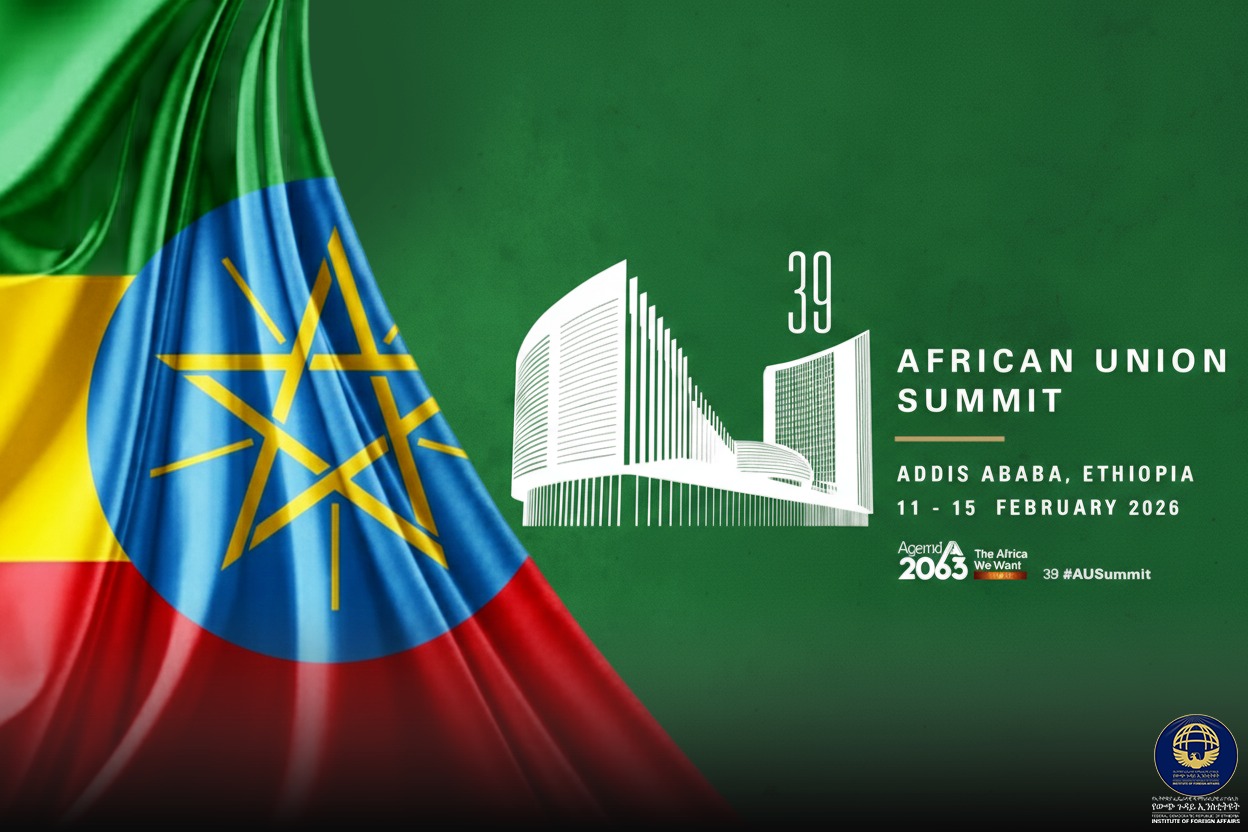
The 39th Ordinary Session of the African Union (AU) Assembly, convening in Addis Ababa in February 2026, meets at a threshold where the institution’s credibility is increasingly tied to delivery rather than declaration. This summit is defined by four strategic clusters: the 2026 focus on water and sanitation (WASH) as a human-security driver; a peace-and-security landscape testing the African Peace and Security Architecture (APSA); the transition of the AfCFTA from legal treaty to commercial reality; and the institutional challenge of financing the AU’s permanent G20 seat. This analysis looks at the ways for this AU summit to shift from agenda proliferation to a “results-based” framework. As the permanent host, Ethiopia occupies a unique position to broker consensus around financing compliance and the stabilization of regional tensions, ensuring that the 2026 theme becomes a functional success rather than a ceremonial milestone.
The 2026 Threshold: Structural Pressures on the Union
The 39th Ordinary Session (14–15 February 2026) arrives at a moment when the AU’s internal reform process must confront an increasingly complex global and regional matrix. The institution is currently navigating a “polycrisis” where active conflicts in Sudan, the eastern DRC, and the Sahel compete for a shrinking pool of political and financial capital. This environmental pressure is not merely a logistical challenge; it is a structural reality that threatens to drown sectoral agendas—such as the 2026 water theme—in a sea of crisis management.
The primary constraint remains the AU’s self-financing mechanism. While the 0.2% import levy adopted in Kigali was designed to ensure institutional autonomy, uneven implementation across member states continues to undermine multi-year planning. Furthermore, the coordination between the AU Commission and Regional Economic Communities (RECs) remains fragmented. Without a clear division of labor and enforced reporting discipline, the strategic decisions made in Addis Ababa often dissipate before they can influence domestic policy.
Peace and Security: Assessing the Viability of African Crisis Management
The credibility of the African Peace and Security Architecture (APSA) is currently facing its most rigorous test since its inception. The peace-and-security docket for the 39th Summit reveals that effectiveness now hinges on “mediation legitimacy” and institutional capability rather than the mere existence of architecture.
Sudan, DRC, and the Sahel
In Sudan, the conflict continues to drive regional polarization, and the AU’s role is increasingly scrutinized. The summit’s success here depends on reducing “forum-shopping”—where belligerents exploit overlapping mediation tracks—and consolidating a single, coherent political pathway. Similarly, in the eastern DRC, the presence of multiple regional interventions requires the AU to provide mandate clarity to avoid operational confusion. In the Sahel, the AU faces the recurring dilemma of balancing constitutional norms with the practical reality of transitional authorities. A transition to an “implementation-first” approach would see the Assembly define clear, minimum benchmarks for the return to constitutional order, backed by specific incentives rather than blanket sanctions.
Red Sea and Horn Dynamics
The militarization of the Red Sea and the escalating port-politics in the Horn have introduced external competition into the heart of the regional security matrix. This shift makes the AU’s conflict-prevention tools—such as the Continental Early Warning System (CEWS) and the Panel of the Wise—far more critical than its post-crisis response. The APSA only functions when its components are treated as standing capabilities. The Peace Fund, a vital pillar for these operations, requires consistent replenishment if the AU is to maintain its “G20-level” voice in global security debates.
The 2026 Theme: Translating the WASH Mandate into Service Delivery
The 2026 theme, focusing on sustainable water availability and sanitation, is framed as a fundamental substrate for Agenda 2063. However, translating this from a high-level concept note into a material reality requires addressing the vast infrastructure and governance gap revealed by JMP reporting and UNICEF data. Hundreds of millions of Africans still lack managed sanitation, a deficit that directly affects productivity and human capital.
Bridging the Infrastructure-Service Gap
A successful 2026 theme must move past infrastructure “grandeur” toward utility performance and maintenance. While large-scale hydropower projects like the Grand Ethiopian Renaissance Dam (GERD) demonstrate state capacity and support regional power trade, they do not automatically solve household-level WASH constraints. The summit’s value-add is to elevate water governance as a public-finance priority. This involves creating results-based financing windows for high-burden districts and ensuring that climate adaptation funds are directed toward protecting water sources in fragile settings.
Ethiopia’s Hydro-Political Leadership
Ethiopia’s strategic alignment with the 2026 theme is both an opportunity and a challenge. As a major hydropower exporter, Ethiopia is positioning itself as a regional integration hub. However, domestic data emphasizes that the “last-mile” delivery of water services remains a governance-intensive task. By modeling a domestic WASH governance package that emphasizes service sustainability over mere construction, Ethiopia can demonstrate that the 2026 theme begins with domestic policy discipline, providing a blueprint for the rest of the continent.
Economic Integration: Moving the AfCFTA “Plumbing”
The African Continental Free Trade Area (AfCFTA) is currently transitioning from a legal framework into a commercial reality, a shift that exposes the “plumbing gap” in continental trade. Implementation is no longer about signing treaties; it is about the digitization of customs, the harmonization of rules of origin, and the functionality of logistics corridors.
The Guided Trade Initiative has shown that while trade can move under AfCFTA rules, administrative capacity and infrastructure deficits remain persistent barriers. A delivery-oriented summit would focus on a narrow list of measurable targets: the full operationalization of the Pan-African Payments and Settlement System (PAPSS) to enable local-currency settlement, and the mutual recognition of standards in high-growth agricultural value chains. For Ethiopia, the potential synergies between its light manufacturing sector and regional power-trade corridors offer a clear path to reducing foreign exchange constraints, provided that transaction costs at the border are systematically lowered.
Institutional Reform and Global Representation
The AU’s permanent seat in the G20 provides a historic opportunity for the continent to influence the global financial architecture, particularly regarding debt reform and climate finance. However, this representation requires internal coordination. The AU system must be capable of speaking with a single voice, which in turn depends on the legitimacy of its own internal reforms.
Compliance with the Kigali financing decision is the litmus test for this legitimacy. The risk of “reform fatigue”—where decisions are adopted but not funded—remains high. A realistic outcome for the 39th Summit would be the publication of a financing compliance scorecard, linking leadership roles or hosting rights to a member state’s adherence to their payment obligations. Only a self-financed AU can bargain effectively within the G20 matrix.
Ethiopia’s Strategic Calculus: The Host as an Architect
As the host, Ethiopia’s diplomatic bandwidth is central to the summit’s success. Addis Ababa is not just a venue; it is a platform for Ethiopia to demonstrate its role as a regional anchor. Ethiopia’s calculus is increasingly shaped by its economic logic of connectivity—seeking cooperative, rules-based access to regional markets and maritime hubs.
By anchoring its regional priorities within AU frameworks like Agenda 2063, Ethiopia can mitigate regional anxieties and frame its connectivity ambitions as part of a collective continental gain. The synergy between IGAD and the AU is crucial here; Ethiopia can lead the effort to reduce fragmentation by encouraging joint planning for mediation and stabilization in the Horn.
By Beminet Alemayehu, Assistant Researcher
Disclaimer:
The content disseminated by the Institute of Foreign Affairs (IFA) – including, but not limited to, publications, public statements, events, media appearances, and digital communications – reflects the views of individual contributors and does not necessarily represent the official positions or policies of the Institute, its partners, or any affiliated governmental or non-governmental entities.
While the IFA endeavors to ensure the accuracy, integrity, and timeliness of the information presented, it makes no representations or warranties, express or implied, regarding the completeness, reliability, or suitability of such content for any purpose. The Institute expressly disclaims any liability for errors or omissions, as well as for any actions taken or decisions made based on the information provided.
The inclusion of external links, references, or third-party resources does not constitute an endorsement by the Institute. Additionally, engagement on social media platforms – including, but not limited to, likes, shares, retweets (RTs), or reposts – shall not be interpreted as an endorsement or validation of the views expressed therein.Readers and audiences are encouraged to exercise critical judgment and seek independent verification when interpreting or relying upon any information disseminated through publications and posts on the Institute’s platforms or representatives.