

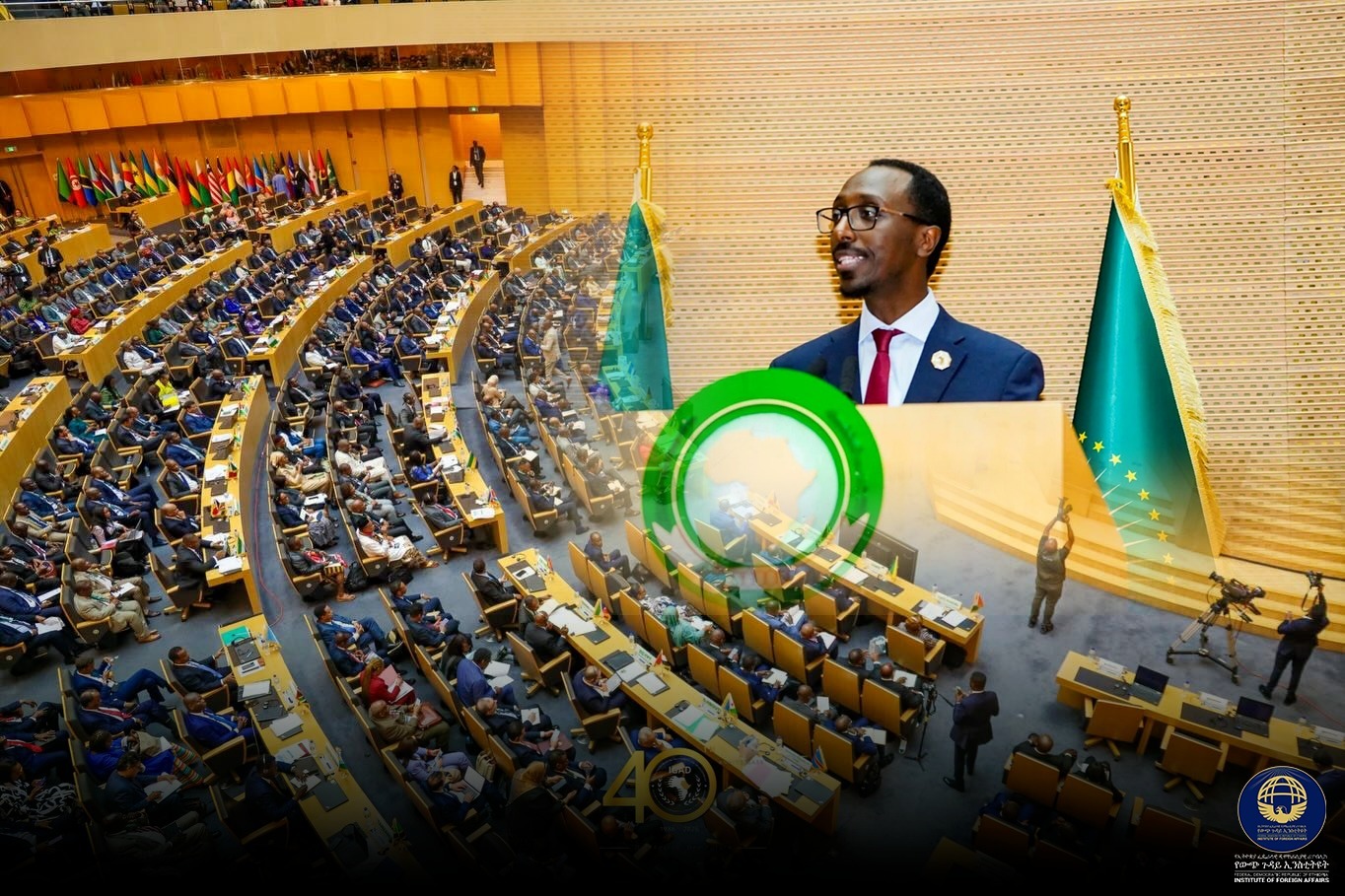
Speaking at the 48th Ordinary Session of the Executive Council of the African Union (AU) on 11 February 2026 at AU Headquarters in Addis Ababa, Minister of Foreign Affairs, H.E. Gedion Timothewos, delivered a pointed assessment of the evolving global order and its implications for Africa.
In his opening remarks, the Minister warned that the “evolving global geopolitical landscape is increasingly undermining multilateralism and international cooperation,” highlighting intensifying competition over technological supremacy, critical minerals, and strategic logistics corridors. His observation reflects a broader structural shift in international politics: the post–World War II liberal multilateral order—long anchored in institutional cooperation and neoliberal economic interdependence—is facing significant strain amid the resurgence of great power rivalry and the emergence of middle and regional powers.
Nowhere is this transformation more visible than in the Horn of Africa and the Red Sea corridor, regions that have become focal points of geopolitical contestation. Strategic maritime routes, critical mineral supply chains, and expanding military footprints have heightened the region’s volatility. Within this context, Ethiopia’s foreign policy doctrine of “Horn First” was implicitly underscored—prioritizing regional peace, economic integration, and cooperative security frameworks as stabilizing mechanisms in an increasingly competitive environment.
Minister Gedion’s emphasis on competition over critical minerals and logistics corridors also aligns with Africa’s growing strategic relevance in global supply chains. The challenge, as implied in his remarks, is not to resist engagement with external powers, but to negotiate from a position of unity and parity—ensuring that partnerships are based on equality, mutual benefit, and respect for African agency.
Against a backdrop of geopolitical fragmentation and unpredictability, the Minister asserted that “Africa must confront the multifaceted challenges it faces by strengthening unity among its peoples.”
This appeal echoes the vision of the founding leaders of the Organization of African Unity (OAU)—established in Addis Ababa in 1963—including Emperor Haile Selassie of Ethiopia, Kwame Nkrumah of Ghana, Julius Nyerere of Tanzania, Gamal Abdel Nasser of Egypt, Ahmed Sékou Touré of Guinea, and Jomo Kenyatta of Kenya, among others. Their foundational aspiration for continental solidarity later evolved into the African Union (AU).
Minister Gedion’s call is consistent with the AU’s regional integration agenda, particularly through Regional Economic Communities (RECs) such as ECOWAS, SADC, EAC, and IGAD. These blocs serve as pillars of economic integration, conflict resolution, and political coordination—mechanisms designed to translate Pan-African ideals into institutional practice.
He further expressed confidence that the Executive Council’s deliberations “would contribute to reinforcing collective solidarity and renewing commitment to shared objectives.” In doing so, Ethiopia reaffirmed its longstanding identity as both host and institutional anchor of the AU, situating itself within the historic continuum of Pan-African diplomacy.
A central pillar of the Minister’s address was the importance of strengthening African ownership in advancing “African solutions to African problems.” This principle has become foundational in AU mediation frameworks and conflict resolution efforts across the continent.
In referencing Africa’s abundant water resources and shared river systems, the Minister emphasized that transboundary resource governance must be guided by equitable and cooperative principles that consider “the interests, circumstances, and aspirations of all stakeholders.” This reflects the AU’s emphasis on dialogue-based dispute resolution and cooperative basin management—an approach particularly relevant in the Nile Basin and other shared waterways.
Minister Gedion also called for unified African positions on structural reform in global governance. He highlighted the need for:
- Fairness in the global financial system
- Equitable African representation in the United Nations Security Council (UNSC)
- Coordinated approaches to debt relief and climate finance
Africa, despite being the world’s second-largest continent and home to nearly 1.4 billion people, continues to lack permanent representation in the UNSC. The AU’s long-standing position, articulated in the Ezulwini Consensus (2005), calls for at least two permanent seats with veto power and five non-permanent seats for Africa. The Minister’s remarks reaffirmed this continental demand within the broader discourse of reforming global multilateral institutions.
Turning to climate diplomacy, the Minister expressed confidence that Africa can demonstrate global leadership in advancing climate solutions. He noted Ethiopia’s preparations to host COP32, aligned within the broader context of Ethiopia’s Green Legacy Initiative (GLI)—launched in 2019 to combat environmental degradation, expand forest cover, and promote climate resilience. The initiative has reportedly led to the planting of billions of seedlings nationwide, positioning Ethiopia as an active contributor to continental climate action narratives.
Climate diplomacy thus becomes not only an environmental imperative but also a strategic domain through which Africa can shape global agendas rather than merely respond to them.
In a world marked by declining multilateral cohesion and intensifying strategic competition, Ethiopia’s message was unequivocal: continental fragmentation weakens bargaining power, while unity enhances strategic autonomy.
As Nelson Mandela once stated, “I dream of the realization of the unity of Africa, whereby its leaders combine in their efforts to solve the problems of this continent.” Minister Gedion’s address resonates with this vision—suggesting that Africa’s ability to navigate great power competition, secure equitable partnerships, and stabilize volatile subregions like the Horn of Africa depends fundamentally on collective coherence.
The Red Sea corridor and the Horn’s geostrategic location ensure continued external attention. The decisive variable, however, is whether African states approach this reality individually or through coordinated continental frameworks.
The underlying thesis of the Minister’s address is therefore clear:
A divided Africa negotiates from vulnerability. A united Africa negotiates from strength.
Getahun Tsegaye, Associate Researcher @IFA
Disclaimer:
The content disseminated by the Institute of Foreign Affairs (IFA) – including, but not limited to, publications, public statements, events, media appearances, and digital communications – reflects the views of individual contributors and does not necessarily represent the official positions or policies of the Institute, its partners, or any affiliated governmental or non-governmental entities.
While the IFA endeavors to ensure the accuracy, integrity, and timeliness of the information presented, it makes no representations or warranties, express or implied, regarding the completeness, reliability, or suitability of such content for any purpose. The Institute expressly disclaims any liability for errors or omissions, as well as for any actions taken or decisions made based on the information provided.
The inclusion of external links, references, or third-party resources does not constitute an endorsement by the Institute. Additionally, engagement on social media platforms – including, but not limited to, likes, shares, retweets (RTs), or reposts – shall not be interpreted as an endorsement or validation of the views expressed therein.
Readers and audiences are encouraged to exercise critical judgment and seek independent verification when interpreting or relying upon any information disseminated through publications and posts on the Institute’s platforms or representatives.