

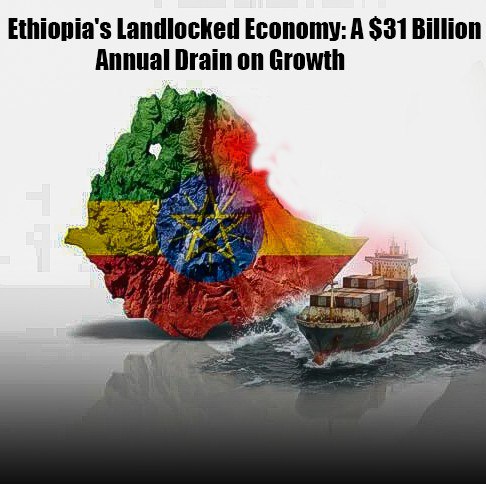
When Ethiopian economists at the Policy Studies Institute began tallying the costs of their country’s landlocked status, they expected significant numbers. What they found instead was a hemorrhage: between $19 billion and $31 billion bleeding from Ethiopia’s economy each year—losses now approaching nearly a quarter of the country’s entire gross domestic product.
Released this month following a validation workshop in Ethiopia, the study titled “Reclaiming Sovereignty at Sea” represents the most comprehensive attempt yet to measure what three decades without direct sea access has cost Africa’s second-most populous nation. The findings arrive at a important moment, as Ethiopia increasingly frames maritime access not as economic preference but existential necessity—a posture that has garnered popular support internally, yet unsettled neighbors.
The research punctures conventional assumptions about landlocked nations. Ethiopia isn’t simply paying premium shipping rates. According to the PSI model, the country faces what amounts to a permanent 15.2 percent tax on all international trade: 12.2 percent in direct port fees, plus an additional three percent lost to delays, damaged goods, and logistical inefficiencies. As Ethiopia’s economy has grown, so too has the absolute cost of this geographic constraint. In 2024 alone, these inefficiencies carved $16 billion from potential trade value—equivalent to 193 percent of the country’s external debt servicing that year.
The Eritrea Effect
Understanding Ethiopia’s current predicament requires revisiting 1993, when Eritrea’s independence transformed the regional map. For centuries, Ethiopian rulers from Axum to Haile Selassie maintained varying degrees of control over Red Sea coastal territories. The Treaty of Wuchale in 1889, Italy’s colonial annexation of Eritrea, and subsequent federal arrangements all reflected Ethiopia’s recognition that control of Massawa and Assab ports represented strategic imperatives, not mere commercial conveniences.
Eritrea’s secession, while resolving a brutal thirty-year conflict, left Ethiopia without sovereign access to any coastline—the world’s most populous landlocked country. Initial arrangements allowed Ethiopian access to Eritrean ports, but the 1998-2000 border war severed those ties. Since then, approximately 95 percent of Ethiopia’s $50 billion in annual trade flows through Djibouti’s overtaxed facilities at Doraleh.
This dependency creates what Jemal Mohammed, the PSI senior researcher who architected the economic model, describes as compounding vulnerabilities. “You’re not just paying for port services,” Jemal explained during the study’s validation workshop. “You’re paying rent to a neighbor who knows you have no alternatives.” The research documents waiting times reaching 30 months in extreme cases—delays that result in cancelled contracts, rotting agricultural exports, and penalties that can exceed $10,000 per shipment.
The Human Cost of Geographic Isolation
The macroeconomic figures mask grinding individual impacts. PSI researchers calculated that landlockedness costs each Ethiopian between $145 and $235 annually—up to 35,000 birr at current exchange rates. In a country where per capita GDP hovers around $1,000, this represents a substantial welfare drain, translating directly into foregone poverty reduction and constrained social mobility.
“We’re talking about the equivalent of several months’ income for rural households,” notes Megersa Sori, an Ethiopia University economist not involved in the study but familiar with its methodology. “These aren’t abstract losses. They show up as higher prices for imported medicines, smaller returns for coffee exporters, reduced competitiveness for nascent manufacturers.”
The cumulative twenty-year toll exceeds $38 billion in export losses alone—more than 270 percent of Ethiopia’s total debt repayments during the same period. This connection between port dependency and chronic foreign exchange shortages helps explain Ethiopia’s increasingly urgent call for maritime access.
The Red Sea’s Crowded Waters
Yet Ethiopia’s path back to the sea confronts a regional landscape transformed beyond recognition from the 1990s. The Red Sea littoral has become one of the world’s most militarized waterways, hosting facilities operated by the United States, France, China, Italy, Japan, Russia, Turkey, Saudi Arabia, and the United Arab Emirates. What was once primarily commercial infrastructure has evolved into a geopolitical chessboard where great powers project influence and Gulf states pursue strategic depth.
The PSI study identifies this militarization as both opportunity and constraint. Ethiopia contributes substantial water resources to the region through the Abbay (Blue Nile), Awash, and Wabi-Shebelle rivers, yet exercises no direct control over adjacent maritime spaces. This paradox—environmental contribution without strategic autonomy—increasingly grates on Ethiopian policymakers.
The Diplomacy of Dependency
Ethiopia’s diplomatic challenge lies in navigating what the PSI researchers call ‘asymmetric interdependence’. While Djibouti derives an estimated 60-70 percent of port revenues from Ethiopian trade, the relationship favors the smaller state because Ethiopia lacks alternatives. Djibouti can tolerate inefficiencies; Ethiopia cannot afford them.
The research identifies what it terms the “tunnel effect”—infrastructure investment becoming radially oriented toward Djibouti transit corridors rather than distributed development patterns. This concentrates economic activity in and around a single transit corridor while bypassing secondary cities, exacerbating regional inequalities within Ethiopia’s federal structure.
Legal Frameworks and Political Realities
International law provides cold comfort for landlocked states. The UN Convention on the Law of the Sea (UNCLOS) guarantees transit rights but not port access, and certainly not sovereignty over maritime territory. African Union declarations affirm colonial-era borders, effectively enshrining Ethiopia’s landlocked status. The AU’s Agenda 2063 contains aspirational language about economic integration but no enforcement mechanisms compelling coastal states to provide preferential access.
The PSI study proposes developing what researchers call a “Grand Narrative”—positioning Ethiopia’s maritime aspirations within historical claims to Red Sea access dating to the Axumite kingdom. This framing would make sovereign sea access a civilizational project comparable in national importance to the Grand Ethiopian Renaissance Dam.
Yet such historical arguments carry risks. Eritrea achieved independence through armed struggle and subsequent referendum, creating internationally recognized borders. Somalia’s territorial integrity, fragile as it is, enjoys broad diplomatic support. Claims rooted in pre-colonial history could easily be dismissed as irredentism, triggering the very regional isolation Ethiopia seeks to avoid.
Scenarios and Strategic Choices
Looking ahead, three broad trajectories appear plausible. The first involves doubling down on Djibouti while gradually building alternative capacity through Berbera and Lamu—essentially muddling through with incremental improvements. This path avoids regional tensions but locks in current inefficiencies for at least another decade.
A second scenario sees Ethiopia pursuing more aggressive negotiating postures, potentially including quid pro quo arrangements that leverage upstream water resources or economic access to Ethiopia’s 120 million consumers. This approach risks escalation with Egypt and might further alienate Eritrea and Somalia, but could shift regional power dynamics in Ethiopia’s favor.
The third, and wildest card, involves some form of territorial accommodation—whether through land swaps, long-term leases, or confederal arrangements with neighbors. Historical precedents exist: Eritrea’s 1952-1962 federal status, or Bangladesh’s 2015 border enclaves exchange with India. Yet given the Horn’s toxic politics and unresolved conflicts, such creative diplomacy appears remote.
An Intractable Dilemma?
The PSI study’s most sobering implication may be this: Ethiopia’s landlocked status constitutes a solvable problem in theory but an intractable one in practice. Economic logic overwhelmingly favors Ethiopian access to multiple ports under flexible arrangements. Regional security would benefit from reduced Ethiopian desperation and Djibouti’s monopoly rents. Continental integration rhetoric universally supports freer movement of goods and services.
Yet territorial disputes trump economic efficiency, historical grievances outweigh mutual gains, and zero-sum thinking prevails among leaders whose political survival depends on nationalist positioning. The $31 billion annual cost, as staggering as it is, has not yet exceeded the political price leaders perceive in the compromises required to address it.
As African Union leaders gather in Ethiopia, Ethiopia’s landlocked economy stands as an unacknowledged elephant in the Summit Hall—a constraint on continental ambitions that rhetoric alone cannot remedy. The question isn’t whether Ethiopia’s maritime isolation imposes unsustainable costs. The PSI study settles that debate. The question is whether regional politics can evolve quickly enough to address those costs before they catalyze the very instability all parties claim to want to avoid.
By Getahun Tsegaye assistant researcher at IFA
Disclaimer:
The content disseminated by the Institute of Foreign Affairs (IFA) – including, but not limited to, publications, public statements, events, media appearances, and digital communications – reflects the views of individual contributors and does not necessarily represent the official positions or policies of the Institute, its partners, or any affiliated governmental or non-governmental entities.
While the IFA endeavors to ensure the accuracy, integrity, and timeliness of the information presented, it makes no representations or warranties, express or implied, regarding the completeness, reliability, or suitability of such content for any purpose. The Institute expressly disclaims any liability for errors or omissions, as well as for any actions taken or decisions made based on the information provided.
The inclusion of external links, references, or third-party resources does not constitute an endorsement by the Institute. Additionally, engagement on social media platforms – including, but not limited to, likes, shares, retweets (RTs), or reposts – shall not be interpreted as an endorsement or validation of the views expressed therein.Readers and audiences are encouraged to exercise critical judgment and seek independent verification when interpreting or relying upon any information disseminated through publications and posts on the Institute’s platforms or representatives.