

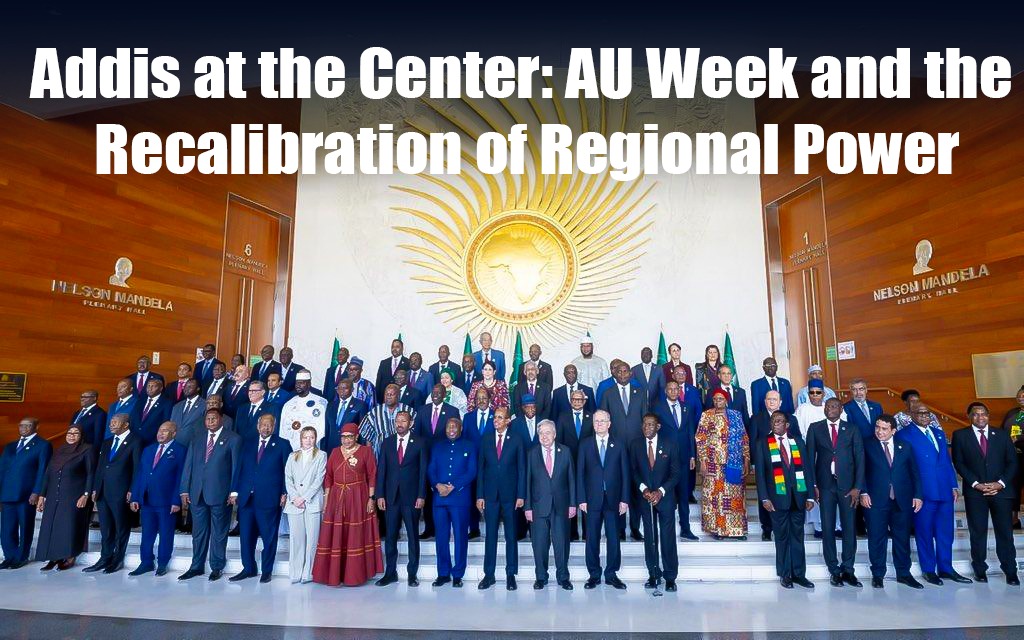
Addis Ababa is frequently described as Africa’s diplomatic capital. Yet the phrase often reduces a complex political reality to ceremonial imagery. The annual African Union (AU) Summit Week demonstrates that Addis is not simply a host city—it is a site where regional hierarchies are tested, recalibrated, and, at times, quietly reordered. In moments of geopolitical strain, convening power becomes strategic capital.
As Sudan’s war destabilizes the Nile Valley, Red Sea security acquires renewed urgency, Somalia recalibrates its security architecture, and transboundary water negotiations remain unresolved, the concentration of continental diplomacy in Addis produces more than symbolism. It shapes sequencing, frames narratives, and influences outcomes. The question is not whether AU Week matters, but how it subtly reshapes Ethiopia’s regional leverage within a competitive and fluid Horn of Africa.
Institutional Centrality and Historical Continuity
Addis Ababa’s diplomatic prominence is anchored in institutional history. The founding of the Organization of African Unity (OAU) in 1963—and its transformation into the African Union in 2002—embedded the city at the core of Africa’s multilateral architecture. Over six decades, a dense ecosystem of ambassadors, policy experts, mediators, and committees has taken root.
Historical institutionalism reminds us that foundational choices generate durable effects. By designating Addis as the permanent headquarters of the AU, African states created continuity in continental governance. Diplomatic networks accumulated, procedural norms crystallized, and bureaucratic expertise consolidated in one geographic location.
Equally consequential is the presence of the Intergovernmental Authority on Development (IGAD), whose mediation efforts in Sudan and Somalia remain central to regional stabilization. The proximity of continental and sub-regional institutions reinforces Addis as a focal point of diplomatic engagement. Yet centrality is not static. It must be sustained through effective facilitation, diplomatic discipline, and credible neutrality.
AU Week as Political Architecture
Summit Week compresses continental politics into a single arena. Heads of state convene in plenary sessions, but the deeper negotiations occur in ministerial meetings, drafting committees, and informal consultations. Language is scrutinized, positions refined, and coalitions assembled.
Perhaps most revealing is the importance of procedural sequencing. Which crises receive priority? How are agenda items structured? What phrasing enters the final communiqué? These seemingly technical decisions carry strategic consequences.
In international relations theory, power is often measured through military capability or economic scale. Yet institutional power operates differently. It is expressed through agenda-setting, norm construction, and procedural stewardship. Addis, as host of the AU, occupies a position of proximity to these mechanisms.
This role becomes especially significant in an era marked by fragmentation in global governance. As the United Nations Security Council faces polarization, regional institutions increasingly serve as first responders to crises. AU deliberations in Addis shape continental responses before they reach global forums.
Sudan and Somalia: Mediation in a Competitive Environment
Sudan’s war has transformed the political geography of the Nile Valley. Displacement, economic disruption, and armed fragmentation have generated cascading regional effects. Multiple mediation tracks—led by regional blocs, Gulf states, and international actors—operate simultaneously.
Within this complex field, AU and IGAD mechanisms headquartered in Addis provide a structured diplomatic platform. Their authority rests not on coercion but on continental mandate and legitimacy. Summit Week amplifies these mechanisms by enabling high-level consultations among affected states and external partners.
Similarly, Somalia’s evolving security transition remains deeply intertwined with AU frameworks. Decisions regarding stabilization missions, mandate renewals, and financing arrangements pass through Addis-based institutions. The city thus becomes a recurring site where regional security arrangements are negotiated and recalibrated.
Skeptics argue that material leverage ultimately determines outcomes. Gulf states and global powers, they note, wield financial and military instruments beyond the AU’s reach. This is true. Yet institutional legitimacy shapes the durability of agreements. Endorsement under AU auspices confers normative weight that alternative venues may lack.
The Nile Basin and the Politics of Venue
The Nile dispute remains one of the most consequential hydropolitical contests in Northeast Africa. Colonial-era arrangements—including the 1929 Anglo-Egyptian Treaty and the 1959 Nile Waters Agreement between Egypt and Sudan—entrenched downstream privilege while excluding upstream states. The construction of the Grand Ethiopian Renaissance Dam (GERD) since 2011 has unsettled that historical equilibrium.
The 2015 Declaration of Principles between Ethiopia, Egypt, and Sudan signaled an attempt at cooperative management, yet negotiations have oscillated between engagement and stalemate. Hydro-hegemony theory identifies material, bargaining, and ideational dimensions of power within river basins. Venue choice intersects with all three.
When Nile negotiations are conducted under AU auspices, the dispute is reframed within a continental normative framework emphasizing sovereign equality and cooperative utilization. Addis, as the AU’s seat, assumes procedural relevance without displacing the substantive interests of Egypt or Sudan.
Equally consequential is how Nile discussions intersect with broader continental debates on climate resilience and water governance. Summit deliberations situate hydropolitics within collective African priorities, reinforcing principles that extend beyond a single basin.
Red Sea Geopolitics and Regional Convergence
The Red Sea corridor has emerged as one of the most strategically contested maritime spaces in the world. External military presences, port investments, and security alliances intersect along its coastline. While coastal states anchor these dynamics, continental institutions headquartered in Addis increasingly serve as arenas for discussion and coordination.
Summit Week gathers representatives from Red Sea littoral states alongside Sahelian and Central African leaders. Maritime security, counterterrorism, and trade integration enter the same deliberative space. This convergence underscores Addis’ significance as a diplomatic crossroads.
Over all, the city’s leverage derives not from territorial reach but from institutional embeddedness. It provides continuity amid shifting alliances and external competition.
Great Power Competition and Continental Legitimacy
The Horn of Africa has become a focal point of great-power competition. The United States maintains security partnerships; China’s economic and military footprint has expanded; Gulf states engage through investment and mediation; Turkey has deepened its presence in Somalia.
Within this environment, continental legitimacy acquires heightened importance. External actors frequently seek engagement with the AU to anchor their initiatives in multilateral endorsement. Summit Week intensifies this dynamic, as delegations pursue consultations on the margins.
Addis thus occupies a strategic position in mediating between African priorities and external interests. The challenge lies in maintaining balanced engagement while preserving the perception of neutrality.
Centrality as Strategic Capital
AU Week demonstrates that diplomatic centrality is not ornamental—it is structural. Addis Ababa’s role as the seat of continental and regional institutions grants it sustained relevance in shaping narratives, sequencing negotiations, and framing crises.
This centrality does not eliminate regional competition, nor does it resolve entrenched disputes in Sudan or the Nile Basin. Yet it provides a consistent arena for engagement. In a Horn of Africa defined by overlapping crises and evolving alliances, such continuity is itself a form of influence.
Ultimately, Addis’ significance rests on its capacity to remain an inclusive forum where divergent interests converge. Its strength lies not in imposing outcomes but in sustaining deliberation. In a region marked by volatility, that function alone ensures that Addis remains at the center of African diplomacy.
By Beminet Alemayehu, Assistant researcher at IFA
Disclaimer:
The content disseminated by the Institute of Foreign Affairs (IFA) – including, but not limited to, publications, public statements, events, media appearances, and digital communications – reflects the views of individual contributors and does not necessarily represent the official positions or policies of the Institute, its partners, or any affiliated governmental or non-governmental entities.
While the IFA endeavors to ensure the accuracy, integrity, and timeliness of the information presented, it makes no representations or warranties, express or implied, regarding the completeness, reliability, or suitability of such content for any purpose. The Institute expressly disclaims any liability for errors or omissions, as well as for any actions taken or decisions made based on the information provided.
The inclusion of external links, references, or third-party resources does not constitute an endorsement by the Institute. Additionally, engagement on social media platforms – including, but not limited to, likes, shares, retweets (RTs), or reposts – shall not be interpreted as an endorsement or validation of the views expressed therein.Readers and audiences are encouraged to exercise critical judgment and seek independent verification when interpreting or relying upon any information disseminated through publications and posts on the Institute’s platforms or representatives.