

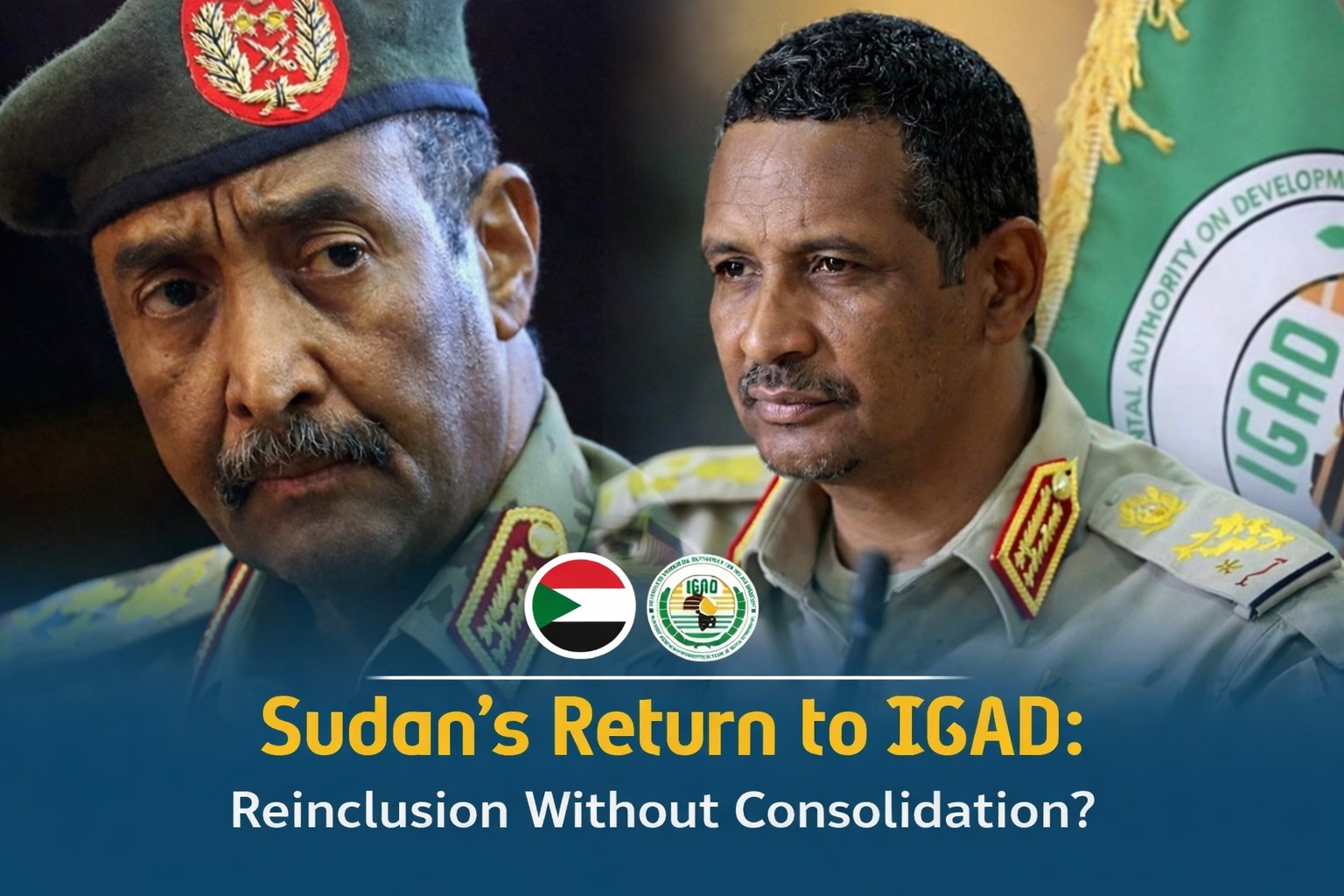
Sudan’s return to IGAD can be read, at first glance, as a diplomatic normalization story: a troubled member state re-engages a regional institution, a channel is restored, and the possibility of renewed mediation re-enters the conversation. In a region as conflict-exposed as the Horn of Africa, even procedural re-engagement can appear significant. But in the Horn’s political history, institutional reinclusion and political consolidation are rarely the same process.
That distinction matters. Sudan’s re-entry into IGAD may restore a measure of regional institutional legitimacy at a time when mediation fragmentation has weakened coherence across multiple diplomatic tracks. Yet reinclusion alone does not resolve the deeper constraints that have limited progress in Sudan: conflict-party fragmentation, member-state divergence, parallel mediation arenas, and the gap between declaratory diplomacy and enforceable mechanism. In other words, Sudan can return to the institution without the conflict moving any closer to resolution.
This is not an argument against reinclusion. On the contrary, reinclusion may be necessary. But analytical and policy discussions should resist treating it as inherently transformative. The more useful question is whether Sudan’s return can be converted into mediation leverage in a conflict environment shaped by competing incentives, overlapping forums, and uneven regional alignment.
For Horn of Africa diplomacy, that is the real test. The issue is not simply Sudan’s institutional status. It is whether regional institutions—especially those that carry political and normative legitimacy—can translate procedural access into strategic coherence.
Re-entry as Signal, Not Settlement
Sudan’s return to IGAD matters because it signals that regional institutional arenas remain politically relevant, even when they are contested. In a fragmented mediation environment, participation itself is not trivial. It affects who can convene, who can claim representational legitimacy, and which forums remain available for de-escalation, negotiation, and coordination. A state’s absence from a regional body narrows options. Its return, at minimum, reopens them.
But reopening options is not the same as generating outcomes. In the Horn, mediation processes often accumulate formal steps—meetings, declarations, re-engagements, procedural resets—without necessarily producing strategic convergence among the actors that matter most. Sudan’s return should therefore be read less as a settlement milestone and more as a diagnostic event: it reveals the continuing importance of regional institutions, while also exposing the limits of institutional participation in the absence of alignment.
That is precisely why this development deserves analytical attention beyond headline diplomacy. Sudan’s conflict is not contained within Sudan. Its consequences radiate outward through refugee flows, border insecurity, trade disruptions, humanitarian pressure, and diplomatic recalibration across the Horn and beyond. Any shift in the institutional architecture through which Sudan is discussed—especially within IGAD—has implications for regional order, not just for Sudan’s diplomatic standing.
The significance of re-entry, then, lies in the contradiction it carries. It can strengthen the legitimacy of a regional mediation arena while leaving the political and military foundations of the conflict largely unchanged. This is the central tension of Sudan’s return to IGAD: reinclusion may improve the procedural ecology of diplomacy without yet consolidating the substance of mediation.
Why Sudan’s Return to IGAD Matters for the Horn
Analytical reading of this moment begins with strategic significance, not symbolic visibility. Sudan’s return to IGAD matters because it affects at least three interlinked systems: the legitimacy of African-led mediation, the architecture of regional diplomatic coordination, and the wider stability of the Horn.
First, it is a test of African institutional legitimacy under conditions of war. IGAD, like the AU, operates in a space where symbolic authority and political necessity often coexist with operational constraints. Its value is not only in what it can enforce, but in whether it can serve as a legitimate regional arena through which conflict management is organized. Sudan’s participation matters in this context because it affects whether that arena remains viable or becomes increasingly bypassed by bilateral and external initiatives.
Second, Sudan’s return reopens the question of mediation architecture. The Sudan file has been marked by competing and overlapping tracks: subregional, continental, bilateral, and externally backed processes, each with different timelines, priorities, and leverage instruments. In such environments, the key problem is not the absence of diplomacy but the fragmentation of it. Re-entry into IGAD does not solve fragmentation automatically, but it can alter the balance among forums by restoring one regional channel’s claim to relevance.
Third, Sudan’s conflict has direct spillover implications for the Horn and neighboring systems. Refugee movements, border stress, illicit flows, and diplomatic alignments are all affected by the trajectory of the war and the credibility of mediation efforts. For regional actors, Sudan is not merely a neighboring crisis; it is a conflict whose unmanaged escalation can reshape security and governance pressures across multiple borders. From this perspective, institutional developments around Sudan are not procedural side notes. They are part of the region’s risk management architecture.
This is why Sudan’s return to IGAD should not be interpreted narrowly as an internal matter between a member state and a regional organization. It is a strategic event because it touches the Horn’s broader question: can African-led institutions retain political centrality in managing major conflicts when both internal fragmentation and external intervention pressures are intensifying?
Diplomatic Opening or Symbolic Reinclusion?
Two broad interpretations of Sudan’s return to IGAD now compete in regional policy discussions, and each captures part of the reality.
The first sees the move as a positive institutional opening. From this perspective, re-engagement restores a necessary diplomatic channel and reduces the costs of estrangement. Even if immediate breakthroughs remain unlikely, bringing Sudan back into IGAD improves the possibility of regional coordination and lowers the risk that mediation efforts become entirely dependent on external or ad hoc forums. In this reading, reinclusion is not a solution but a precondition: a state that is absent from a regional arena cannot be meaningfully shaped through it.
This interpretation has a strong basis. Regional institutions often matter most not when they impose outcomes, but when they preserve political space for negotiation, legitimacy, and sequencing. In prolonged conflicts, process continuity can itself be an asset. Re-entry can also function as a confidence-building signal, suggesting that parties still recognize the utility—or at least the inevitability—of regional engagement.
The second interpretation is more skeptical. It treats Sudan’s return as primarily symbolic: diplomatically useful, perhaps, but of limited immediate strategic effect. According to this view, the structural constraints that have reduced mediation effectiveness remain intact. IGAD still operates amid member-state divergence, limited coercive capacity, and overlapping diplomatic tracks. Sudan’s conflict remains fragmented, militarized, and politically unresolved. Under these conditions, re-entry may improve optics more than outcomes.
This interpretation is also credible. Horn of Africa diplomacy has repeatedly shown that institutional participation can coexist with deep conflict inertia. Attendance, communiqués, and procedural normalization do not necessarily alter battlefield incentives, political exclusion, or implementation deficits. If reinclusion is not followed by stronger sequencing and coordination, it risks becoming a form of institutional stabilization without conflict de-escalation.
A more accurate judgment lies between optimism and dismissal. Sudan’s return to IGAD is strategically meaningful precisely because legitimacy arenas matter in the Horn. But legitimacy is not the same as leverage. Reinclusion can restore access; it cannot, on its own, produce convergence. The analytical task is therefore to ask what conditions would allow this re-entry to become more than symbolic.
Reinclusion Without Consolidation
The core risk in the current moment is not reinclusion itself. It is the possibility of reinclusion without consolidation: a situation in which Sudan’s return restores procedural membership and diplomatic contact, while the wider mediation and conflict landscape remains too fragmented to translate that access into progress.
The first layer of this problem is conflict-party fragmentation. A state can re-enter a regional institution, but the conflict inside that state may still lack the conditions required for coherent negotiation. Command structures may be contested, military incentives may favor continued confrontation, and civilian political actors may remain marginalized from meaningful process design. In such circumstances, institutional reinclusion may improve the diplomatic environment while leaving the core problem—who can credibly negotiate, commit, and implement—unresolved.
The second layer is the gap between regional legitimacy and operational leverage. IGAD’s normative importance is difficult to dismiss. It is geographically proximate, politically embedded, and institutionally tied to the region’s security and governance concerns. But normative importance does not automatically produce mediation effectiveness. That depends on member-state alignment, mandate clarity, sustained diplomacy, and coordination with other institutions. When these conditions are weak, a regional body can retain symbolic centrality while struggling to shape outcomes.
The third layer is sequencing. Diplomatic re-entry often generates momentum narratives. Yet momentum in mediation is rarely self-sustaining. Without a credible sequence linking de-escalation, humanitarian access, political talks, and implementation mechanisms, re-engagement can become procedurally active but strategically thin. Meetings continue, statements accumulate, and institutional contact is preserved—but the process does not materially alter conflict trajectories.
This is where Sudan’s return should be evaluated most carefully. The question is not whether re-entry is positive in abstract terms. It is whether it is embedded in a sequencing logic that connects institutional access to conflict management. Reinclusion without sequencing can preserve diplomacy as form while leaving mediation weak as function.
The fourth layer concerns sovereignty and mediated transition. Regional institutions must navigate member-state sensitivities around sovereignty, legitimacy, and external influence. But effective mediation often requires some degree of pressure, oversight, or coordinated expectation-setting that can be politically uncomfortable. The balance is delicate. If sovereignty concerns completely narrow the scope of mediation, institutions become consultative arenas with limited effect. If mediation is perceived as externally driven or politically intrusive, state buy-in erodes. Sudan’s return to IGAD reactivates this tension rather than resolving it.
In this sense, “reinclusion without consolidation” is not simply a descriptive phrase; it is a structural diagnosis. It names the gap between restored institutional participation and the still-missing architecture required to produce strategic movement.
IGAD in a Fragmented Mediation Arena
One reason this gap persists is that IGAD should not be analyzed as an isolated actor. It is better understood as an institutional arena embedded in a wider mediation ecology. Its effectiveness depends not only on its formal mandate, but on how it interacts with member states, the AU, and external powers operating on the Sudan file.
IGAD’s role is shaped, first and foremost, by member-state politics. Like many subregional organizations, it does not operate as a unitary strategic actor in practice. Its coherence reflects the extent to which member states align on priorities, threat perceptions, diplomatic tactics, and acceptable outcomes. When neighboring states face different security exposures, domestic calculations, or alliance pressures, institutional positions can become harder to consolidate. Under such conditions, even a legitimate forum may struggle to generate a coherent mediation line.
This does not make IGAD irrelevant. It makes it political. Horn diplomacy often fails when institutions are judged against an unrealistic standard of technocratic neutrality. Regional organizations are arenas through which political differences are managed, not magically suspended. Sudan’s return therefore increases IGAD’s importance as a site of regional bargaining, even if it does not immediately increase its coercive leverage.
The relationship between IGAD and the AU is especially important in this context. In principle, the two can be mutually reinforcing: IGAD provides subregional proximity and political access, while the AU contributes continental legitimacy and broader diplomatic framing. In practice, the value of this relationship depends on sequencing and division of labor. When regional and continental processes are aligned, they can accumulate legitimacy and reduce confusion. When they operate in parallel without clear coordination, they risk signaling institutional competition to conflict parties and external actors alike.
Sudan’s return to IGAD should therefore be assessed partly through this AU–IGAD interface. If re-engagement strengthens coordination, it could improve the overall mediation architecture even without producing immediate breakthroughs. If it deepens procedural duplication, its strategic value will remain limited.
External actors further complicate this ecology. Their involvement is not inherently destabilizing; in many cases, they provide resources, diplomatic support, or pressure that regional institutions cannot mobilize alone. But external engagement can also fragment incentives, encourage forum shopping, and shift attention toward tracks that are more financially or politically resourced but less regionally grounded. The relevant question is not whether external actors are present, but whether their engagement reinforces African institutional coordination or displaces it.
Under these constraints, IGAD’s importance may lie less in direct enforcement than in legitimating and coordinating functions. It can preserve a regional channel, structure diplomatic expectations, and potentially serve as a platform through which future settlement efforts become more governable. That role should not be inflated into decisive leverage, but it should not be dismissed as merely ceremonial either.
The Regional Order Stakes
Sudan’s return to IGAD matters beyond Sudan because the Horn’s regional order increasingly depends on whether mediation arenas can function under conditions of fragmentation. The region’s crises are deeply interconnected, and their spillovers often move faster than institutions can adapt. In this context, institutional weakness is not just an administrative problem; it is a strategic variable.
If Sudan’s reinclusion remains largely symbolic, the costs will extend beyond one mediation track. It may reinforce a broader pattern in which regional institutions retain formal legitimacy but lose practical confidence, prompting more actors to bypass them in favor of bilateral or external arrangements. This, in turn, can deepen forum competition and reduce the possibility of coherent sequencing across crises. For a region already dealing with overlapping security transitions and diplomatic strain, that trajectory would increase fragmentation at precisely the wrong time.
By contrast, if reinclusion is converted into more effective coordination—especially between IGAD, the AU, and key partners—it could help re-anchor regional diplomacy. The strategic gain would not be institutional dominance or a sudden mediation breakthrough. It would be a more coherent architecture through which de-escalation, humanitarian access, and political dialogue can be linked, however incrementally. In the Horn, that kind of coherence is often more valuable than dramatic diplomatic announcements.
There is also a precedent dimension. How IGAD handles Sudan’s return may shape expectations for future cases involving suspension, estrangement, or contested re-engagement in the region. If reinclusion is treated as an endpoint, institutions risk normalizing symbolic resets without strategic follow-through. If it is treated as an opening that requires sequencing, alignment, and conditional process design, it can strengthen the credibility of regional forums as arenas of managed political return rather than mere diplomatic rehabilitation.
The Horn is not a passive theater of recurring crises; it is a strategic system undergoing contested reordering. In such a system, institutions matter even when weak, because they structure the terms on which sovereignty, legitimacy, and external influence are negotiated. Sudan’s return to IGAD should be read through that lens: not as a simple success or failure, but as a test of whether regional institutions can retain strategic relevance without overstating their immediate power.
Reinclusion as Opening, Not Outcome
It would be analytically premature to describe Sudan’s return to IGAD as a diplomatic breakthrough. It would be equally mistaken to dismiss it as meaningless symbolism. The move is better understood as a potentially important opening—one that restores institutional access and regional legitimacy while leaving unresolved the harder questions of mediation leverage, political sequencing, and conflict-party convergence.
The distinction between reinclusion and consolidation is therefore central. Reinclusion can restore process space. Consolidation requires more: coordination among institutions, alignment among member states, sequencing across military and political tracks, and a framework that treats procedural progress as a means rather than an end. Without these conditions, Sudan’s return may stabilize the optics of regional engagement while doing little to alter the strategic trajectory of the conflict.
Three tests will likely determine which path becomes more plausible.
The first is a coordination test: can IGAD, the AU, and other mediation actors reduce track fragmentation and establish a clearer division of labor that conflict parties and regional states recognize as credible? Without this, re-entry may add another channel without strengthening the architecture.
The second is a sequencing test: can Sudan’s re-engagement be linked to a realistic progression from de-escalation and humanitarian access toward political dialogue, rather than remaining within parallel declaratory processes? Without sequencing, reinclusion risks becoming institutional movement without conflict movement.
The third is an alignment test: can key member states and external partners converge sufficiently to reinforce African-led mediation channels instead of undercutting them through competing priorities and forums? Without alignment, legitimacy will continue to outpace leverage.
Sudan’s return to IGAD is, in this sense, a strategic signal rather than a settlement marker. It indicates that regional institutional arenas remain necessary. It does not yet demonstrate that they are consolidated. Whether this reinclusion becomes a foundation for more credible mediation—or another episode of procedural re-entry amid continuing fragmentation—will depend on whether the Horn’s institutions and states can convert restored access into strategic coherence.
By Adoniyas Eyob at IFA
Disclaimer:
The content disseminated by the Institute of Foreign Affairs (IFA) – including, but not limited to, publications, public statements, events, media appearances, and digital communications – reflects the views of individual contributors and does not necessarily represent the official positions or policies of the Institute, its partners, or any affiliated governmental or non-governmental entities.
While the IFA endeavors to ensure the accuracy, integrity, and timeliness of the information presented, it makes no representations or warranties, express or implied, regarding the completeness, reliability, or suitability of such content for any purpose. The Institute expressly disclaims any liability for errors or omissions, as well as for any actions taken or decisions made based on the information provided.
The inclusion of external links, references, or third-party resources does not constitute an endorsement by the Institute. Additionally, engagement on social media platforms – including, but not limited to, likes, shares, retweets (RTs), or reposts – shall not be interpreted as an endorsement or validation of the views expressed therein.
Readers and audiences are encouraged to exercise critical judgment and seek independent verification when interpreting or relying upon any information disseminated through publications and posts on the Institute’s platforms or representatives.