

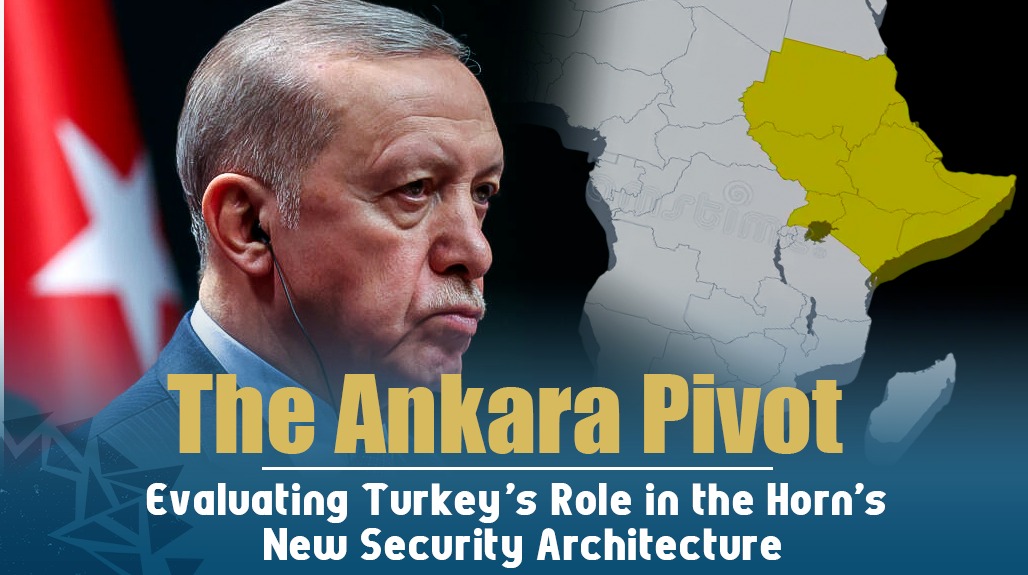
The post-Cold War era has witnessed a structural realignment in Turkey’s geopolitical gravity. Once defined primarily by its utility as the North Atlantic Treaty Organization’s (NATO) southeastern flank, Ankara has transitioned into an assertive middle power with independent strategic ambitions. Nowhere is this “Ankara Pivot” more visible than in the Horn of Africa. Since the Justice and Development Party (AK Party) assumed power in 2002, Turkey has moved from a peripheral observer to a structural component of the Horn’s security and economic architecture.
This evolution is not merely a matter of increased bilateral trade; it represents a fundamental shift in the regional order. By positioning itself along the Bab el-Mandeb strait—the maritime chokepoint mediating 10–20% of global trade—Turkey has embedded itself into a strategic corridor where the interests of the United States, China, the Gulf States, and regional states intersect. To understand this trajectory, one must examine the transition from “soft-power donor” to “kinetic security provider” and the unresolved tensions this role creates for the region’s sovereignty and institutional stability.
The Evolution of Engagement: From Humanitarianism to Strategic Footholds
Turkey’s entry into the Horn followed a deliberate, scaled ladder of engagement. The “Opening to Africa” policy in 2005 and Turkey’s subsequent status as an African Union (AU) strategic partner in 2008 provided the normative framework. However, the 2011 Somali famine served as the pivotal opening for Ankara’s interventionist phase.
The visit of then-Prime Minister Recep Tayyip Erdoğan to Mogadishu in 2011 was a watershed moment, signaling a departure from the “risk-averse” posture of traditional Western donors. Initially, the engagement was framed through the logic of humanitarian-developmentalism. Agencies like the Turkish Cooperation and Coordination Agency (TIKA) and the Turkish Red Crescent led the charge. Yet, this “soft power” was quickly institutionalized into “hard infrastructure.” By securing management rights for the Port of Mogadishu and Aden Adde International Airport, Turkish firms transformed humanitarian access into strategic leverage, linking Ankara’s foreign policy to the survival of the Somali state.
The Pivot: From ‘Soft Power’ to ‘Kinetic Security Provider’
The definitive shift in Turkey’s posture occurred around 2017, catalyzed by the Gulf Cooperation Council (GCC) crisis. The blockade of Qatar by a Saudi-led coalition forced Ankara to abandon its posture of “calculated neutrality” in the Red Sea. As the Horn became a secondary theater for the intra-GCC rivalry, Turkey moved to secure its investments through direct security projection.
The inauguration of the TURKSOM military facility in Mogadishu in 2017 marked Turkey’s transition into a “kinetic security provider.” This was no longer just aid; it was state-building through the security apparatus. By training nearly a third of the Somali National Army (SNA), including the elite Gorgor commandos, Turkey has become an indispensable guarantor of the federal government’s survival.
This security logic expanded regionally. The 2017 Suakin Island agreement with Sudan—though currently stalled by Sudan’s internal collapse—signaled an ambition to project naval power across the Red Sea corridor. Furthermore, the proliferation of Turkish Unmanned Aerial Vehicles (UAVs) in Ethiopia, Somalia, and Sudan has integrated Ankara into the region’s tactical conflict dynamics.
Contested Diagnosis: Stabilizer or Disruptor?
The “Ankara Pivot” introduces a central friction in the regional order: the tension between state-led stabilization and externalized security competition. Supporters argue that Turkey provides a unique “integrated model” of engagement. Unlike Western actors who often silo security from development, or Gulf actors who prioritize elite-level bargains, Turkey’s model combines military training, infrastructure management, and direct budgetary support. In Somalia, Turkish engagement is seen as a vital counterweight to Al-Shabaab, providing the professionalization necessary for the post-ATMIS (African Union Transition Mission in Somalia) transition. From this perspective, Turkey is a force for institutional resilience.
Conversely, Turkey’s presence is viewed with suspicion by regional rivals. For the UAE and Israel, Turkey remains a primary competitor for port dominance and ideological influence. The competition risks turning the Horn into a “rentier theater,” where local elites leverage external powers against one another, potentially fragmenting regional coordination and stability.
Strategic Implications : Sovereignty vs. Integration
The most consequential development in Ankara’s strategic shift is the 2024 Maritime Defense and Economic Cooperation Agreement (MDECA) between Turkey and Somalia. Under this ten-year pact, Turkey will provide maritime security for Somalia’s Exclusive Economic Zone (EEZ) in exchange for a share of the resources found therein.
This agreement highlighted a recurring tension in between regional agency and the capacity to achieve security in Horn. Somalia, facing territorial threats and a lack of naval capacity, has effectively outsourced its maritime sovereignty to Ankara to gain functional security. While this strengthens the federal government’s hand, it creates a precedent for “sovereignty-for-security” swaps that may complicate regional security and stability.
Moreover, while Ankara’s “critical realism” allows it to talk to all sides, its extensive engagement with Mogadishu may limit its role as a neutral arbiter.
Conclusion
Turkey’s transformation from a soft-power donor to a kinetic security provider signifies more than a successful power projection exercise in foreign policy—it represents a structural reordering of the Horn security architecture. Ankara is no longer a transient guest in the Horn; it has become a permanent, agency-bearing stakeholder in the region’s stability and its fractures. While the “Ankara Pivot” has provided enhanced military capability for Mogadishu, it has simultaneously introduced a regime of high-stakes dependencies that challenge the traditional boundaries of Somalia’s sovereignty.
For the Somalia and for the Horn in general, the key question remains whether this externalized agency will ultimately serve to consolidate state building through successful counter-terrorism operations or open an new regional contest for influence that continue further state fragmentation in the Horn.
By Robel Befikadu, Assistant researcher at IFA
Disclaimer:
The content disseminated by the Institute of Foreign Affairs (IFA) – including, but not limited to, publications, public statements, events, media appearances, and digital communications – reflects the views of individual contributors and does not necessarily represent the official positions or policies of the Institute, its partners, or any affiliated governmental or non-governmental entities.
While the IFA endeavors to ensure the accuracy, integrity, and timeliness of the information presented, it makes no representations or warranties, express or implied, regarding the completeness, reliability, or suitability of such content for any purpose. The Institute expressly disclaims any liability for errors or omissions, as well as for any actions taken or decisions made based on the information provided.
The inclusion of external links, references, or third-party resources does not constitute an endorsement by the Institute. Additionally, engagement on social media platforms – including, but not limited to, likes, shares, retweets (RTs), or reposts – shall not be interpreted as an endorsement or validation of the views expressed therein.Readers and audiences are encouraged to exercise critical judgment and seek independent verification when interpreting or relying upon any information disseminated through publications and posts on the Institute’s platforms or representatives.