

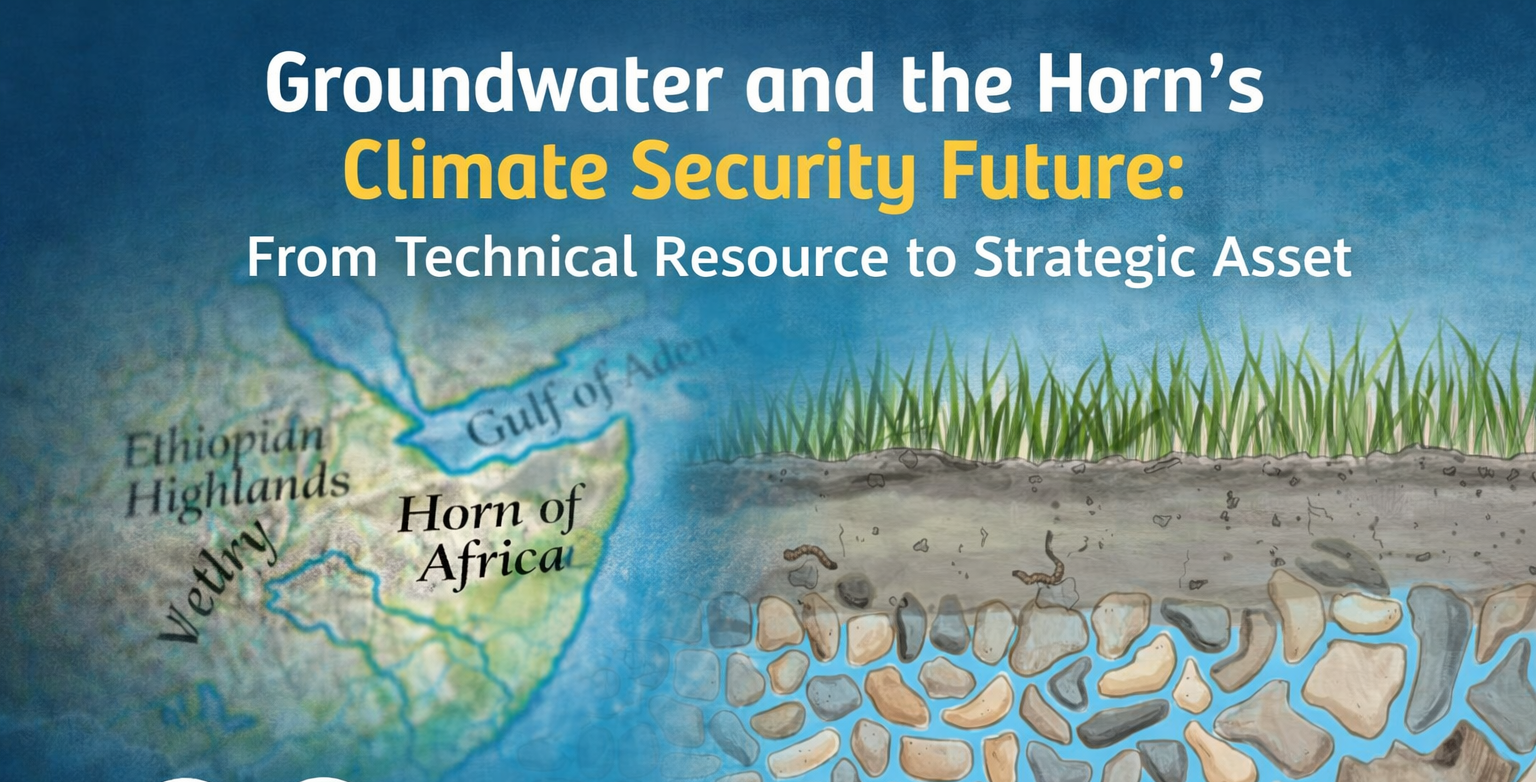
The Horn of Africa’s climate debate is often framed above ground: failed rains, drying rivers, shrinking pastures, emergency relief corridors, and displacement flows. But one of the region’s most consequential climate-security questions now lies below the surface. As rainfall becomes more erratic and surface water more volatile, groundwater is no longer merely a technical adaptation issue. It is increasingly becoming a strategic resource tied to pastoral stability, local legitimacy, and cross-border security.
This shift matters because the Horn’s most fragile geographies are not governed through formal sovereignty alone. They are governed through a combination of local bargains, resource access, mobility arrangements, and uneven state presence. In such contexts, a functioning borehole is not just infrastructure; it is often an instrument of social order. It can sustain livestock economies through drought, reduce pressure on contested grazing corridors, and strengthen the credibility of public authority. Its absence—or politicized control—can do the opposite.
Groundwater, then, should be treated less as a narrow water-sector concern and more as part of the Horn’s emerging climate-security architecture. The central question is not whether groundwater matters for adaptation. It is whether states and institutions in the region can govern it in ways that reduce fragility rather than deepen it.
From Climate Adaptation to Strategic Governance
For years, groundwater has typically appeared in policy discussions as a technical matter: hydrology, drilling, pumps, maintenance, and rural service delivery. That framing remains necessary, but it is no longer sufficient. In the Horn, climate pressure is changing the political consequences of groundwater governance.
As drought cycles intensify and rainfall patterns become less predictable, communities and local authorities increasingly depend on groundwater as a buffer against surface-water shocks. This increases the strategic value of wells and boreholes, especially in pastoral and agro-pastoral areas where water access shapes mobility, herd survival, and seasonal livelihood decisions. In these contexts, groundwater is not simply an environmental resource; it is a determinant of who can stay, who must move, and under what conditions coexistence remains possible.
This is why a purely technical reading of groundwater misses the larger regional story. The issue is no longer just extraction and access. It is allocation, authority, and legitimacy. Who decides where water infrastructure is built? Who maintains it? Who controls access in times of stress? Which communities are prioritized, and which are excluded? These are governance questions with security consequences.
Why Groundwater Is Becoming Strategic in the Horn
The strategic reclassification of groundwater is not driven by a single event. It is the product of overlapping structural shifts.
First, climate variability is increasing reliance on subsurface water. In many parts of the Horn, seasonal expectations that once structured livelihood decisions have become less reliable. Communities respond by turning to the water systems that are comparatively less visible but more durable in periods of surface scarcity. This does not make groundwater unlimited or politically neutral. It simply makes it more central to survival and, therefore, more politically consequential.
Second, pastoral systems depend on water access as much as they depend on territory. Regional policy debates often discuss pastoral conflict through the language of land, ethnicity, or armed competition. Those dimensions matter. But in practice, mobility routes, grazing use, livestock concentration, and local disputes are deeply shaped by the geography of water points. A borehole can stabilize a corridor by reducing stress and enabling negotiated access. It can also become a focal point of competition if access is captured, restricted, or perceived as unfair.
Third, groundwater infrastructure is one of the clearest ways the state is experienced in peripheral regions. In fragile borderlands and climate-stressed areas, public legitimacy is rarely built through abstract policy messaging. It is built through tangible performance: whether a water point functions, whether repairs are timely, whether access rules are enforced fairly, and whether basic security is present around critical resource sites. In this sense, groundwater governance is an expression of everyday sovereignty. It is where state authority is tested in practical terms.
Fourth, groundwater has cross-border effects even when legal and administrative systems remain nationally organized. Pastoral movement, livestock trade, and drought displacement do not follow official maps. Changes in water access in one zone can redirect movement into another, reshape local bargaining, and alter the burden on neighboring communities and administrations. What appears as a local water management failure can quickly become a frontier governance problem.
These shifts do not mean groundwater is replacing other strategic variables in the Horn such as ports, corridors, maritime access, or high-level diplomacy. They do mean that climate-security analysis in the region can no longer treat groundwater as a secondary technical issue. It is becoming part of the infrastructure of stability in precisely those areas where fragility is most politically costly.
Beyond the Technical Frame
There are at least two competing ways to understand groundwater in the Horn, and both capture part of the truth.
The first frame treats groundwater primarily as a technical adaptation and public goods issue. From this perspective, the problem is underinvestment, weak hydrogeological data, poor drilling standards, inadequate maintenance systems, and limited administrative capacity. The logical response is to improve mapping, strengthen local water governance, build resilient infrastructure, and finance maintenance rather than only new construction. This view is important because it keeps attention on institutional capacity and service delivery, and it resists turning every environmental challenge into a security problem.
The second frame treats groundwater as a climate-security variable. This perspective emphasizes that in fragile and conflict-affected areas, water points shape power relations and can become strategic assets in local competition. Access may be mediated by armed actors, local elites, or informal authorities. Infrastructure can become a tool of patronage, exclusion, or coercion. From this angle, groundwater governance cannot be separated from legitimacy, security provision, and conflict prevention.
Both frames are useful, but each becomes misleading when applied in isolation. A purely technical approach underestimates the political realities that determine who actually benefits from water infrastructure. A purely security approach risks militarizing resource governance and displacing local institutions with coercive responses that may worsen long-term trust.
A more accurate framing for the Horn is strategic governance. Groundwater is a technical resource whose management has become politically and strategically significant. The task is not to securitize water as such, but to recognize that water governance failures can undermine stabilization and that effective groundwater management can strengthen resilience, legitimacy, and local order.
This distinction matters. It avoids the false choice between development and security. In many parts of the Horn, groundwater governance is one of the places where development capacity and security outcomes are already fused.
Groundwater, Pastoral Stability, and the Infrastructure of Coexistence
Pastoral systems in the Horn are often described through the language of vulnerability. That is only part of the picture. They are also systems of adaptation, negotiation, and mobility that have historically managed climatic variability through social institutions and movement. The current challenge is that climate pressure, demographic change, conflict, and administrative boundaries are increasing the difficulty of that adaptation.
In this context, groundwater points are becoming part of the infrastructure of coexistence. They structure when and where herds move, how long they remain in a given zone, and how much pressure falls on surrounding grazing areas. Where access is predictable and governed through accepted arrangements, groundwater can reduce friction. It can create space for negotiated mobility and lower the likelihood that scarcity becomes immediate confrontation.
But where infrastructure is absent, unreliable, or captured, the opposite dynamic can emerge. Communities may concentrate around fewer functioning points, increasing pressure on both water and pasture. Seasonal movement can become more abrupt and less coordinated. Existing tensions over grazing access, local authority, or historical grievance can harden under ecological stress. Here, groundwater does not “cause” conflict in a deterministic sense. Rather, it shapes the operating conditions in which conflict becomes more or less likely.
This is an important analytical distinction. The Horn does not require simplistic “water wars” narratives to demonstrate the strategic relevance of groundwater. The more serious argument is that water access influences the viability of social bargains in climate-stressed environments. Groundwater governance is therefore not peripheral to pastoral stability; it is increasingly one of its core variables.
The policy implication is not that every water intervention should be treated as a peacebuilding program. It is that groundwater systems in fragile pastoral areas should be designed and managed with an explicit awareness of how they interact with mobility, local dispute mechanisms, and access norms. Without that integration, technically successful projects may still produce politically destabilizing outcomes.
Local Legitimacy and the Politics of Access
If pastoral stability is one strategic arena of groundwater governance, local legitimacy is another. This is especially visible in peripheral and frontier areas where state presence is intermittent, contested, or unevenly institutionalized.
In such environments, legitimacy is often built less through constitutional abstraction and more through visible performance. Communities evaluate public authority through what it can provide, coordinate, and protect. Water infrastructure becomes a central site of that evaluation because it is both essential and recurring. A functioning borehole is not a one-time political promise; it requires maintenance, oversight, and fair access over time. Its reliability can signal competence. Its breakdown can signal neglect.
This dynamic gives groundwater governance a political weight that standard sectoral planning sometimes overlooks. Decisions about where to drill, how to allocate budgets, which sites to rehabilitate, and who participates in local management committees are not merely technical choices. They shape perceptions of fairness, inclusion, and state intent. In settings already marked by mistrust, selective allocation or uneven maintenance can quickly be read as exclusionary governance rather than administrative constraint.
At the same time, groundwater infrastructure can be used as a tool of political incorporation. When managed transparently and linked to local institutions, it can strengthen relationships between communities and public authorities. It can make the state more legible in areas where coercive presence alone does not generate durable legitimacy. In this sense, groundwater is not just a welfare concern; it is part of the institutional architecture through which authority is negotiated.
This is one reason to give emphasis on state agency and state capacity is especially relevant. The strategic value of groundwater depends not only on the existence of the resource, but on the administrative and political capacity to govern access credibly. States may recognize climate risk and prioritize water rhetorically, yet still fail to build the maintenance systems, data infrastructure, and local governance arrangements needed to convert groundwater into a stabilizing asset.
The result is a recurring regional tension: the political significance of groundwater is rising faster than the institutional systems required to manage it.
Frontier Governance and Cross-Border Security
The Horn’s borderlands are not empty margins of national politics. They are zones where sovereignty, mobility, trade, and security are continuously negotiated. They are also areas where climate stress can produce cross-border effects faster than formal diplomacy can respond.
Groundwater is increasingly central to this frontier reality. Water access influences the routes people and livestock take, the duration of seasonal stays, and the intensity of competition in shared ecological systems. When key water points fail or become inaccessible, movement patterns may shift across administrative and national boundaries, placing pressure on neighboring local authorities and communities. What begins as infrastructure failure can become a border governance issue.
This matters because state responses are often shaped by security logics that focus on movement control rather than resource drivers. Under conditions of stress, authorities may tighten border enforcement, increase local militarization, or frame mobility primarily as a security threat. Such measures may address immediate symptoms but do little to resolve the water-access conditions that produced the pressure. In some cases, they can intensify local grievances and reduce the space for negotiated access arrangements that historically helped manage variability.
The strategic significance of groundwater in frontier zones lies precisely in this gap. It links local resource governance to broader questions of border stability, cross-border trade continuity, and conflict prevention. A region that debates security mainly through armed actors and diplomatic alignments risks underestimating the role of resource infrastructure in shaping the terrain on which those security dynamics unfold.
This does not mean every groundwater challenge should be elevated to inter-state diplomacy. It does mean that cross-border climate security in the Horn requires more than military posture or high-level political dialogue. It requires resource-governance coordination in the ecological systems where fragility is reproduced.
The Governance Gap Beneath the Surface
If groundwater is becoming a strategic asset, why has that recognition not produced strategic management? The answer lies less in scarcity alone than in institutional fragmentation.
The first problem is uneven implementation capacity. Many states in the Horn recognize climate and water stress as major risks. Yet groundwater governance is often divided across multiple agencies and levels of administration with unclear coordination. Strategic recognition at the national level does not automatically translate into durable local systems for monitoring, maintenance, access regulation, and dispute management. The result is a familiar regional pattern: high political awareness, uneven administrative execution.
The second problem is data and planning deficits. Groundwater governance requires more than emergency drilling. It depends on hydrogeological mapping, monitoring, and realistic planning for sustainable access. Where data systems are weak, interventions become reactive and crisis-driven. Decisions may be shaped by immediate pressure, donor timelines, or political visibility rather than long-term resource management. This weakens resilience and reduces the capacity to anticipate conflict risks associated with changing access patterns.
The third problem is an infrastructure bias. Building new boreholes is visible. It produces immediate political and humanitarian value and is easier to finance than maintenance systems or governance institutions. But groundwater’s strategic role depends less on initial construction than on reliability over time. An expanding inventory of water points without robust maintenance, transparent allocation, and local management can create the appearance of progress while leaving fragility unresolved.
The fourth problem is fragmentation between humanitarian, development, and security approaches. Humanitarian actors often address water as emergency relief. Development institutions treat it as service delivery. Security institutions encounter it as a conflict variable. Each approach is rational within its own mandate. Yet in fragile regions, these dimensions are already interconnected. Without coordination, responses remain parallel, and the strategic value of groundwater governance remains unrealized.
The key contradiction is therefore not simply that the Horn faces water stress. It is that groundwater’s political importance has expanded beyond the management frameworks still governing it.
What This Means for Regional Order
The Horn’s geopolitical debates often focus on visible strategic assets: ports, maritime access, corridors, military partnerships, and regional diplomacy. These are indispensable topics. But inland stability in pastoral and frontier zones is not peripheral to them. It is one of the conditions that determine whether larger integration and state-building projects are sustainable. Climate stress that undermines local legitimacy and borderland order can quietly erode the foundations of regional stability even when high-level diplomacy appears active.
Groundwater should therefore be understood as part of the region’s strategic infrastructure—not in the same sense as a port or an energy corridor, but as a distributed subsurface system that underpins resilience in fragile geographies. If managed well, it can reduce the frequency with which climate shocks translate into displacement, local violence, and coercive security responses. If managed poorly, it can intensify pressure on already fragile institutions and widen the gap between state authority and local trust.
This also has implications for African institutions and regional platforms. Organizations such as the AU and IGAD retain normative and political importance in climate-security discussions, but their effectiveness will depend on whether they can support member states in linking adaptation, conflict prevention, and frontier governance rather than treating them as separate tracks. As in other Horn crises, legitimacy and operational capacity are distinct. Institutional declarations matter. But outcomes will depend on implementation design, state buy-in, and coordination with local governance systems.
External partners remain relevant as well, especially in financing, technical support, and emergency response. Yet the Horn’s experience with externally supported interventions suggests a familiar caution. Support can be necessary and productive, but project-based approaches that bypass local governance realities can reproduce dependency and fragmentation. The question is not whether external involvement should exist, but whether it strengthens durable institutions or substitutes for them.
A Strategic Resource, Not a Deterministic Explanation
It is important to avoid overclaiming. Groundwater is not the single driver of instability in the Horn, and resource analysis should not displace political analysis. Conflict, legitimacy crises, and regional tensions are shaped by governance failures, armed competition, exclusionary politics, economic shocks, and historical grievances. Groundwater does not replace these factors.
What it does is increasingly shape the conditions under which they are managed. It affects whether pastoral adaptation remains viable, whether local authorities can mediate stress credibly, and whether states can project legitimacy in climate-vulnerable regions through service delivery rather than coercion alone. In this sense, groundwater is not a deterministic cause of security outcomes. It is a strategic variable within them.
That distinction is central to the analysis because it preserves complexity. It resists both technocratic reductionism and securitized overreach. Groundwater matters not because every drought becomes conflict, but because the governance of water access influences whether fragile systems absorb shock or fracture under it.
The Strategic Test Ahead
The Horn’s groundwater question is not simply whether more wells will be drilled. The deeper issue is whether states and regional institutions can build governance systems capable of treating groundwater as a resilience asset, a legitimacy instrument, and a conflict-prevention infrastructure.
Three tests will likely determine which trajectory becomes more plausible.
The first is a governance test: can states move from project-based expansion toward durable systems of maintenance, monitoring, and access regulation? Without that transition, groundwater infrastructure may expand while reliability and trust remain fragile.
The second is a legitimacy test: can water provision be governed in ways that communities perceive as fair, especially in politically sensitive and climate-stressed regions? Without credible access arrangements, infrastructure can become another site of grievance.
The third is a coordination test: can adaptation planning, local resource governance, and security analysis be linked before crises trigger reactive and militarized responses? Without that integration, the Horn risks continuing to treat climate shocks as episodic emergencies rather than structural governance challenges.
Groundwater will not resolve the Horn’s wider political dilemmas. But it is becoming one of the region’s most underappreciated strategic assets. If governed effectively, it can reinforce the social and institutional foundations of stability in fragile geographies. If neglected or politicized, it may deepen precisely the climate-security pressures the region can least afford.
By Kidus Tesfaye at IFA
Disclaimer:
The content disseminated by the Institute of Foreign Affairs (IFA) – including, but not limited to, publications, public statements, events, media appearances, and digital communications – reflects the views of individual contributors and does not necessarily represent the official positions or policies of the Institute, its partners, or any affiliated governmental or non-governmental entities.
While the IFA endeavors to ensure the accuracy, integrity, and timeliness of the information presented, it makes no representations or warranties, express or implied, regarding the completeness, reliability, or suitability of such content for any purpose. The Institute expressly disclaims any liability for errors or omissions, as well as for any actions taken or decisions made based on the information provided.
The inclusion of external links, references, or third-party resources does not constitute an endorsement by the Institute. Additionally, engagement on social media platforms – including, but not limited to, likes, shares, retweets (RTs), or reposts – shall not be interpreted as an endorsement or validation of the views expressed therein.
Readers and audiences are encouraged to exercise critical judgment and seek independent verification when interpreting or relying upon any information disseminated through publications and posts on the Institute’s platforms or representatives.