

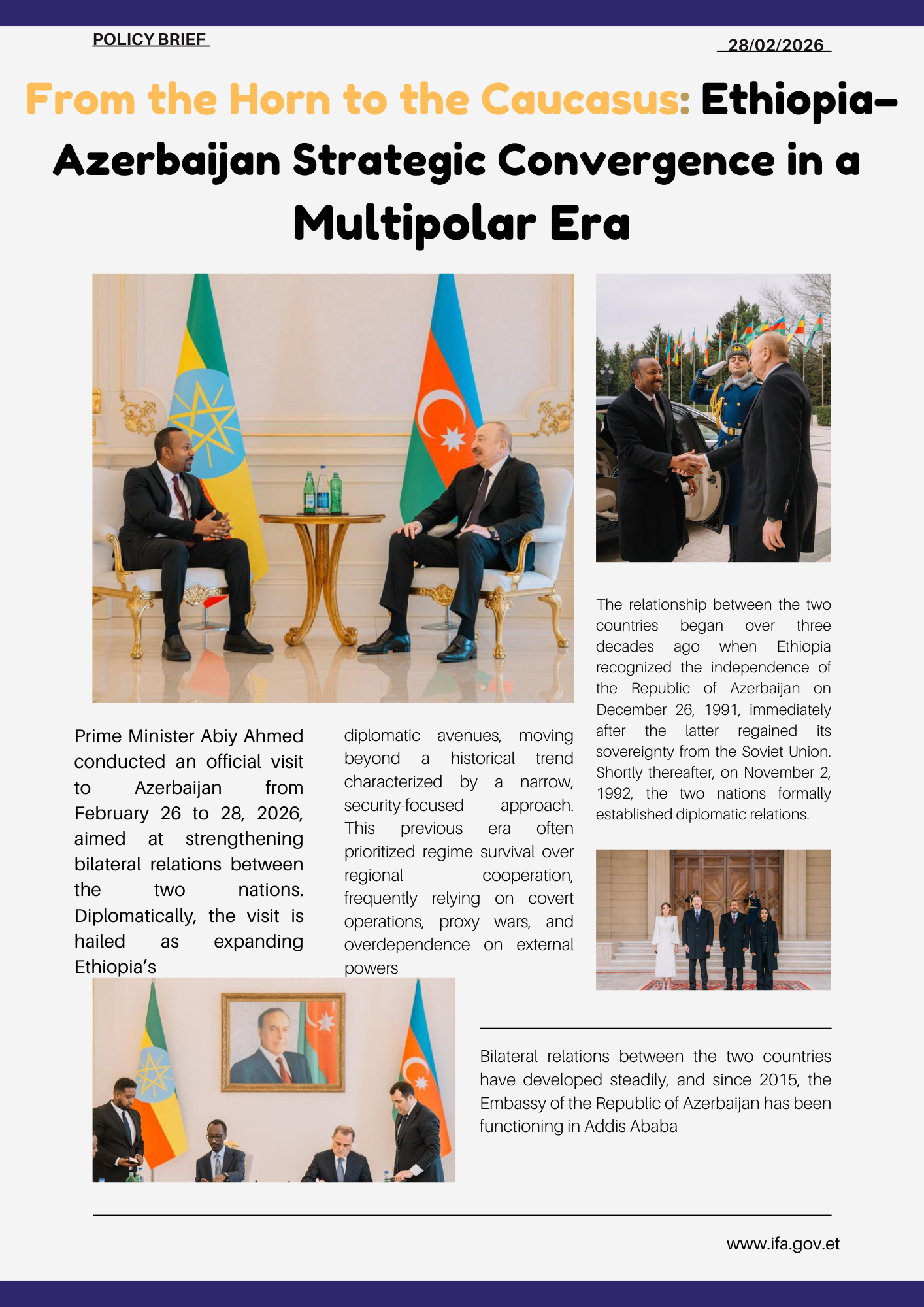
Prime Minister Abiy Ahmed conducted an official visit to Azerbaijan from February 26 to 28, 2026, aimed at strengthening bilateral relations between the two nations. Diplomatically, the visit is hailed as expanding Ethiopia’s diplomatic avenues, moving beyond a historical trend characterized by a narrow, security-focused approach. This previous era often prioritized regime survival over regional cooperation, frequently relying on covert operations, proxy wars, and overdependence on external powers.[1]
The relationship between the two countries began over three decades ago when Ethiopia recognized the independence of the Republic of Azerbaijan on December 26, 1991, immediately after the latter regained its sovereignty from the Soviet Union. Shortly thereafter, on November 2, 1992, the two nations formally established diplomatic relations. [2]
Bilateral relations between the two countries have developed steadily, and since 2015, the Embassy of the Republic of Azerbaijan has been functioning in Addis Ababa.[3]
The recent official visit by Prime Minister Abiy Ahmed, following an invitation from President Ilham Aliyev of Azerbaijan, represents a significant extension of the decades-long diplomatic relationship between the two nations. The visit is widely seen as having consolidated high-level political trust, institutionalized defense and economic cooperation frameworks, strengthened climate diplomacy coordination, and opened new avenues for digital governance collaboration.
The diplomatic protocol observed during Prime Minister Abiy Ahmed’s arrival in Baku spoke volumes. An official welcome ceremony was held, featuring a guard of honor alongside the national flags and anthems of both countries. This ceremonial display underscores the significant political weight both nations accord to their decades-old bilateral relations.[4]
On February 27, President Ilham Aliyev held an expanded meeting with Prime Minister Abiy Ahmed. Following the meeting, in the presence of the two leaders, Azerbaijani Minister of Foreign Affairs Jeyhun Bayramov and Ethiopian Minister of Foreign Affairs Gedion Timothewos signed the ‘Agreement on Cooperation between Ethiopia and Azerbaijan in the Field of Defense’ and the ‘Memorandum of Understanding on Cooperation in the Organization of the Thirty-Second Session of the Conference of the Parties (COP32) to the United Nations Framework Convention on Climate Change.’[5]
Additionally, the parties agreed to extend cooperation in agriculture, media development, investment promotion, and anti-corruption initiatives. This includes experience sharing with the Ethiopian Broadcasting Corporation and a cooperation program between Azerbaijan’s ASAN Service and Ethiopia’s MESOB services.[6]
These high-level discussions between Prime Minister Abiy and President Ilham Aliyev are an affirmation of their commitment to broaden cooperation across governmental sectors. For Ethiopia, this visit has multiple meanings; it signals a pragmatic diplomatic recalibration toward engagement with emerging yet influential middle powers, moving beyond its ‘Neighbor First’ foreign policy. Azerbaijan’s geostrategic location at the intersection of Europe and Asia enhances its relevance as a partner in Ethiopia’s broader foreign policy diversification strategy.
The visit, moreover, strengthens Ethiopia’s diplomatic profile in the Eurasian political arena. This aligns with Ethiopia’s diversification of its foreign policy strategy since 2018, which harnesses partnerships with multiple states to advance institutional reform and strategic autonomy. This adaptive approach reflects a pragmatic, multilayered engagement model suited to a competitive multipolar landscape.[7]
While details are limited, the signing of a defense cooperation agreement between the two nations includes the establishment of a framework for technical exchange and institutional collaboration, formalizing channels for structured security dialogue and capacity-building initiatives. For Ethiopia, which continues to navigate complex security dynamics in the Horn of Africa, diversified defense cooperation contributes to strategic flexibility and institutional modernization without overdependence on a single external actor.
Simultaneously, this strengthens its status as an anchor state in the region, solidifying its role as a guarantor of regional stability and protection in the ongoing fight against terrorism and Al-Shabaab. Equally important, enhancing defense cooperation will support Ethiopia’s pursuit of strategic autonomy and institutional capacity strengthening within a balanced foreign policy framework.
The visit, as previously mentioned, resulted in multiple agreements covering agriculture, investment promotion, and institutional cooperation—including collaboration in industrial parks, aviation, and free economic zones.[8]
The Prime Minister’s visit to technological sites—including Azerbaijan’s Innovation Center of the State Agency for Public Service and Social Innovations (ASAN), the AI Academy, and the Alat Free Economic Zone—signals an interest in replicable development models that could inform Ethiopia’s industrialization and logistics strategies. [9] The engagement, furthermore, could potentially facilitate foreign direct investment (FDI), technology transfer, and market diversification. This would strengthen Ethiopia’s export-led economic growth strategy and its position as a gateway to African markets, while bolstering its role in advancing the African Continental Free Trade Area (AfCFTA) initiatives.
The Prime Minister’s visit to Azerbaijan’s ASAN public service centers and digital governance institutions reflects Ethiopia’s interest in continuing its initiatives of modernizing public service delivery systems. Exposure to Azerbaijan’s AI Academy and digital innovation infrastructure further underscores opportunities for cooperation in emerging technologies. This aligns squarely with Ethiopia’s ongoing public sector reform agenda, including the MESOB initiative (Modern Ethiopian Services for Organized Benefit). This flagship national program is designed to unify and digitalize government services through physical hubs where citizens can access dozens of services from different federal agencies in a single location, eliminating the need to travel between multiple offices. [10]
The two countries’ institutional collaboration in digital governance will accelerate Ethiopia’s modernization agenda and enhance public service effectiveness. This aligns with the government’s commitment to digital transformation, as seen in the official launch of Digital Ethiopia 2030—a comprehensive national blueprint aimed at harnessing the power of technology for inclusive development. In December 2025, Prime Minister Abiy announced that Ethiopia had successfully transitioned from its previous roadmap, stating, “Digital Ethiopia 2025 has been completed after achieving its intended goals to an almost full extent.” [11]
A memorandum of understanding related to cooperation on COP32—scheduled to be hosted by Ethiopia in 2027—was signed during the visit. Azerbaijan’s prior experience hosting COP29 offers practical diplomatic and organizational insights. This collaboration positions Ethiopia to strengthen its leadership profile in global climate governance while building cross-regional alliances around development-centered climate finance and adaptation priorities.
Enhanced climate diplomacy coordination supports Ethiopia’s aspiration to play a more central role in multilateral environmental governance. This aligns squarely with the Green Legacy Initiative (GLI), which has enabled the country to plant billions of seedlings since its launch in 2019.[12] Such efforts signal Ethiopia’s commitment to combating global warming and reducing desertification in the Sub-Saharan region.
Geostrategically, the visit is part of a broader expansion of Ethiopia’s global diplomatic outreach. This engagement demonstrates Ethiopia’s effort to diversify strategic partnerships beyond traditional alignments, engage pragmatically with emerging middle powers, and strengthen leverage across the economic, security, and climate diplomacy domains. In a multipolar international order, such calibrated engagement enhances Ethiopia’s negotiating flexibility and diplomatic resilience.
“Over the past few years, our partnership has steadily expanded, underpinned by recent economic cooperation in the aviation sector, collaboration in industrial parks and free trade zones, and joint engagements between Ethiopian Investment Holdings and its Azerbaijani counterpart,” PM Abiy stated, hailing the initiatives as establishing a strong foundation for further strengthening bilateral ties.[13]
Conclusion
The Prime Minister and his high-level delegation’s visit to Baku constitutes a meaningful diplomatic milestone. This engagement aligns with Ethiopia’s foreign policy of diversifying strategic partnerships and advancing its modernization and Digital Ethiopia 2030 initiatives. Furthermore, it reinforces Ethiopia’s position as an anchor state in the Horn of Africa and an emerging global hub. While the frameworks established during the visit provide the institutional foundation for deeper cooperation in defense, economic development, and climate diplomacy, effective implementation remains decisive. To this end, sustained inter-ministerial coordination and pragmatic follow-through mechanisms are essential to translate this diplomatic momentum into tangible national gains.
References
- Abdi Zenebe, “Understanding Ethiopian Foreign Policy in the Post-2018 Era: The Medemer Perspective,” Institute of Foreign Affairs (IFA), March 4, 2025, https://newsite.ifa.gov.et//2025/03/04/understanding-ethiopian-foreign-policy-in-the-post-2018-era-the-medemer-perspective/.
- “Ethiopia and Azerbaijan: Strengthening Ties for Mutual Prosperity,” The Reporter Ethiopia, November 19, 2022, https://www.thereporterethiopia.com/27571/#:~:text=Ethiopia%20and%20Azerbaijan%20have%20had%20diplomatic%20relations,integrity%20*%20Non%2Dinterference%20in%20internal%20domestic%20affairs
- “Ethiopia,” Republic of Azerbaijan Ministry of Foreign Affairs, accessed February 28, 2026, .
https://www.mfa.gov.az/index.php/en/category/africa/ethiopia
- APA News Agency, “Official Welcome Ceremony Was Held for Prime Minister of Ethiopia,” February 2026, https://en.apa.az/official-news/official-welcome-ceremony-was-held-for-prime-minister-of-ethiopia-493407.
- Samira Abdullayeva, “President Ilham Aliyev Holds Expanded Meeting with Ethiopian Prime Minister and Several Documents Were Signed Between the Two Countries,” Report News Agency, November 13, 2024, . https://report.az/en/foreign-politics/president-ilham-aliyev-holds-expanded-meeting-with-ethiopian-prime-minister-and-several-documents-were-signed-between-the-two-countries
- “MoUs in Defense, COP29, Agriculture, Media, Investment and Anti-Corruption Advance Cooperation Between Ethiopia and Azerbaijan,” Fana Broadcasting Corporate, November 13, 2024, . https://www.fanamc.com/english/mous-in-defense-cop32-agriculture-media-investment-and-anti-corruption-advance-cooperation-between-ethiopia-and-azerbaijan/
- Shimellis Hailu Dessie, “Expanding Diplomatic Horizons,” Institute of Foreign Affairs (IFA), February 21, 2026, . https://newsite.ifa.gov.et//2026/02/21/expanding-diplomatic-horizons/?fbclid=IwY2xjawQPsGlleHRuA2FlbQIxMABicmlkETFXemVKcmNjcjcxeUxRYk5Hc3J0YwZhcHBfaWQQMjIyMDM5MTc4ODIwMDg5MgABHu_pms3j9sPwzmcPgOOaWzTdWCdXvRIAivqVAFax_aBeYlmr5a24YpO7YabG_aem_K6Wjr-qFtmJ_Pz1oPKjWKw
- Caliber.az, “PM: Ethiopia and Azerbaijan Pledged to Strengthen Bilateral Ties,” February 2026, https://caliber.az/en/post/pm-ethiopia-and-azerbaijan-pledged-to-strengthen-bilateral-ties.
- Ethiopian News Agency (ENA), “PM Abiy Visits Innovation and Economic Sites in Azerbaijan,” February 2026, https://www.ena.et/web/eng/w/eng_8396678.
- “About Us,” MESOB (Modern Ethiopian Services for Organized Benefit), accessed February 28, 2026, . https://mesobcenter.et/
- “Digital Ethiopia 2025 Success Marks Major Milestone in National Digital Transformation,” Ethiopian News Agency (ENA), December 24, 2025, . https://www.ena.et/web/eng/w/eng_7990351
- Hailu Terefe, Bogale Nigir Hailemariam, and Dejene K. Mengistu, “Ethiopia’s Green Legacy Initiative Embarks on Exemplary Landscape Restorations,” Alliance of Bioversity International and CIAT, July 16, 2025, .
- “PM Abiy Hails Expanding Ethiopia–Azerbaijan Partnership Driven by Economic Cooperation,” Ethiopian News Agency (ENA), February 27, 2026, . https://www.ena.et/web/eng/w/eng_8392657
[1] Abdi Zenebe, “Understanding Ethiopian Foreign Policy in the Post-2018 Era: The Medemer Perspective,” Institute of Foreign Affairs (IFA), March 4, 2025, https://newsite.ifa.gov.et//2025/03/04/understanding-ethiopian-foreign-policy-in-the-post-2018-era-the-medemer-perspective/.
[2] “Ethiopia and Azerbaijan: Strengthening Ties for Mutual Prosperity,” The Reporter Ethiopia, November 19, 2022, .
[3] “Ethiopia,” Republic of Azerbaijan Ministry of Foreign Affairs, accessed February 28, 2026, .
https://www.mfa.gov.az/index.php/en/category/africa/ethiopia
[4] APA News Agency, “Official Welcome Ceremony Was Held for Prime Minister of Ethiopia,” February 2026, https://en.apa.az/official-news/official-welcome-ceremony-was-held-for-prime-minister-of-ethiopia-493407.
[5] Samira Abdullayeva, “President Ilham Aliyev Holds Expanded Meeting with Ethiopian Prime Minister and Several Documents Were Signed Between the Two Countries,” Report News Agency, November 13, 2024, . https://report.az/en/foreign-politics/president-ilham-aliyev-holds-expanded-meeting-with-ethiopian-prime-minister-and-several-documents-were-signed-between-the-two-countries
[6] “MoUs in Defense, COP29, Agriculture, Media, Investment and Anti-Corruption Advance Cooperation Between Ethiopia and Azerbaijan,” Fana Broadcasting Corporate, November 13, 2024, . https://www.fanamc.com/english/mous-in-defense-cop32-agriculture-media-investment-and-anti-corruption-advance-cooperation-between-ethiopia-and-azerbaijan/
[7] Shimellis Hailu Dessie, “Expanding Diplomatic Horizons,” Institute of Foreign Affairs (IFA), February 21, 2026, . https://newsite.ifa.gov.et//2026/02/21/expanding-diplomatic-horizons/?fbclid=IwY2xjawQPsGlleHRuA2FlbQIxMABicmlkETFXemVKcmNjcjcxeUxRYk5Hc3J0YwZhcHBfaWQQMjIyMDM5MTc4ODIwMDg5MgABHu_pms3j9sPwzmcPgOOaWzTdWCdXvRIAivqVAFax_aBeYlmr5a24YpO7YabG_aem_K6Wjr-qFtmJ_Pz1oPKjWKw
[8] Caliber.az, “PM: Ethiopia and Azerbaijan Pledged to Strengthen Bilateral Ties,” February 2026, https://caliber.az/en/post/pm-ethiopia-and-azerbaijan-pledged-to-strengthen-bilateral-ties.
[9] Ethiopian News Agency (ENA), “PM Abiy Visits Innovation and Economic Sites in Azerbaijan,” February 2026, https://www.ena.et/web/eng/w/eng_8396678.
[10] “About Us,” MESOB (Modern Ethiopian Services for Organized Benefit), accessed February 28, 2026, . https://mesobcenter.et/
[11] “Digital Ethiopia 2025 Success Marks Major Milestone in National Digital Transformation,” Ethiopian News Agency (ENA), December 24, 2025, . https://www.ena.et/web/eng/w/eng_7990351
[12] Hailu Terefe, Bogale Nigir Hailemariam, and Dejene K. Mengistu, “Ethiopia’s Green Legacy Initiative Embarks on Exemplary Landscape Restorations,” Alliance of Bioversity International and CIAT, July 16, 2025, .
[13] “PM Abiy Hails Expanding Ethiopia–Azerbaijan Partnership Driven by Economic Cooperation,” Ethiopian News Agency (ENA), February 27, 2026, . https://www.ena.et/web/eng/w/eng_8392657
By Getahun Tsegaye at IFA
Disclaimer:
The content disseminated by the Institute of Foreign Affairs (IFA) – including, but not limited to, publications, public statements, events, media appearances, and digital communications – reflects the views of individual contributors and does not necessarily represent the official positions or policies of the Institute, its partners, or any affiliated governmental or non-governmental entities.
While the IFA endeavors to ensure the accuracy, integrity, and timeliness of the information presented, it makes no representations or warranties, express or implied, regarding the completeness, reliability, or suitability of such content for any purpose. The Institute expressly disclaims any liability for errors or omissions, as well as for any actions taken or decisions made based on the information provided.
The inclusion of external links, references, or third-party resources does not constitute an endorsement by the Institute. Additionally, engagement on social media platforms – including, but not limited to, likes, shares, retweets (RTs), or reposts – shall not be interpreted as an endorsement or validation of the views expressed therein.Readers and audiences are encouraged to exercise critical judgment and seek independent verification when interpreting or relying upon any information disseminated through publications and posts on the Institute’s platforms or representatives.