

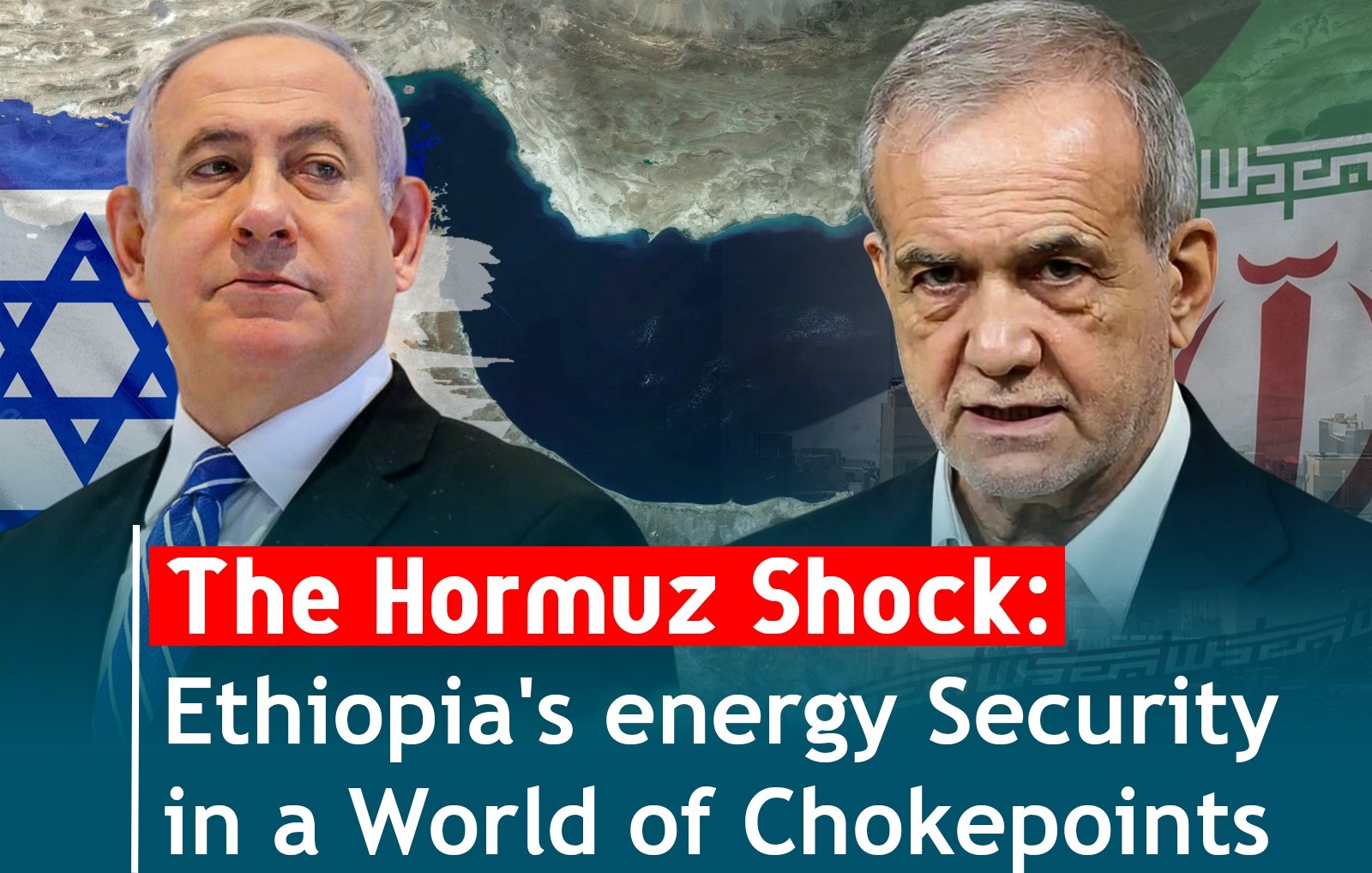
Initially, the potential closure of the Strait of Hormuz appears to be a crisis geographically confined to the Persian Gulf. The narrow maritime corridor between Iran and Oman—through which roughly one-fifth of global oil trade transits—has long served as a barometer of Middle Eastern geopolitical tensions. Yet for a landlocked state such as Ethiopia, the closure of Hormuz would not merely represent a distant geopolitical confrontation; it would constitute a profound economic and strategic shock.
This paradox lies at the heart of Ethiopia’s contemporary vulnerability. Although geographically removed from the Gulf, its economic lifelines remain tightly intertwined with global maritime energy routes. A disruption of traffic through the Strait of Hormuz amid escalating confrontation between Iran, the United States, and Israel would reverberate far beyond the Gulf. Through cascading price shocks, supply disruptions, and logistical bottlenecks, Ethiopia’s energy security architecture—already precariously balanced—would face severe stress.
Perhaps most revealing is the structural contradiction exposed by such a crisis: Ethiopia’s ambitious developmental trajectory, anchored in industrialization and infrastructure expansion, remains heavily dependent on imported fossil fuels transported through maritime chokepoints over which the country exercises no strategic control.
The Strait of Hormuz: Global Chokepoint, Systemic Risk
The Strait of Hormuz is among the most strategically significant maritime corridors in the global economy. At its narrowest point, the strait is roughly 33 kilometers wide, yet it carries approximately 20 percent of global petroleum liquids consumption and nearly one-third of the world’s seaborne oil trade (U.S. Energy Information Administration [EIA], 2023). Major exporters—including Saudi Arabia, Iraq, Kuwait, Qatar, and the United Arab Emirates—ship their hydrocarbons through this corridor.
For decades, Iranian leaders have periodically threatened to close the strait in response to sanctions or military pressure. Analysts have long described such a move as a geopolitical “nuclear option,” capable of triggering immediate spikes in global energy prices and destabilizing international energy markets (Cordesman, 2018).
Yet the implications extend far beyond oil markets. Because the global economy is deeply integrated through maritime logistics networks, disruptions in the Gulf cascade across supply chains affecting fertilizers, food commodities, industrial inputs, and maritime insurance costs (World Bank, 2024).
For import-dependent economies such as Ethiopia, these disruptions quickly translate into macroeconomic stress.
Ethiopia’s Energy Dependence and Structural Exposure
Despite impressive advances in renewable electricity generation, Ethiopia remains heavily dependent on imported petroleum products. Diesel, gasoline, aviation fuel, and liquefied petroleum gas continue to underpin transportation networks, agricultural mechanization, and industrial production.
According to the International Energy Agency, Ethiopia imports nearly all of its refined petroleum products, with a substantial share sourced from Gulf suppliers (IEA, 2023). These shipments typically travel via maritime routes connecting Gulf export terminals to the Port of Djibouti—Ethiopia’s principal maritime gateway.
This logistical dependency reveals a deeper strategic paradox. Ethiopia has invested heavily in renewable power infrastructure, most notably through the Grand Ethiopian Renaissance Dam. Yet while electricity production is expanding rapidly, the country’s transportation and logistics sectors remain overwhelmingly fossil-fuel dependent.
Consequently, any disruption to global oil flows triggered by a closure of Hormuz would translate into immediate economic pressures.
Price Shocks and Inflationary Pressures
Perhaps the most immediate impact of a Hormuz disruption would be global oil price volatility. Historically, even the perception of instability in the Strait of Hormuz has triggered significant market reactions. During crises such as the Tanker War of the 1980s and the 2019 Gulf tanker attacks, oil prices surged amid fears of supply disruptions (BBC News, 2019).
Economic modelling suggests that a full closure of the strait could temporarily remove up to 17 million barrels per day from global supply (EIA, 2023). Even partial disruptions would likely trigger sharp price spikes.
For Ethiopia, the consequences would be immediate. Fuel imports already account for a substantial share of the country’s foreign exchange expenditures. Rising oil prices would therefore widen the trade deficit while intensifying pressure on Ethiopia’s limited hard-currency reserves.
The escalation of global oil prices would also drive up domestic transportation costs. As logistics expenses rise, these costs cascade across the broader economy—raising food prices and amplifying inflationary pressures. In a country where inflation has remained persistently elevated, such price shocks could further strain household purchasing power.
As Ayele (2026) notes, global oil price volatility poses a significant risk to Ethiopia’s macroeconomic stability by increasing import costs and widening the trade deficit.
Equally consequential are the implications for food security. Ethiopia relies heavily on imported wheat, cooking oil, and fertilizer. Rising fuel costs increase the price of transporting these commodities across domestic markets, ultimately pushing up the cost of basic nutrition—an outcome that disproportionately affects lower-income households.
Supply Chain Vulnerability and Maritime Logistics
Beyond price shocks, a closure of the Strait of Hormuz would disrupt global shipping routes. Tankers transporting crude oil and refined products from Gulf exporters would be unable to transit the strait, forcing rerouting or reducing supply.
Recent market volatility illustrates the scale of potential disruption. Crude oil prices have surged above $110 per barrel, the highest level since the 2022 Ukraine war energy shock, amid fears of prolonged disruptions to Gulf exports (Conley, 2026).
For Ethiopia, such disruptions would directly affect deliveries through the Port of Djibouti, which handles more than 90 percent of Ethiopian trade (UNCTAD, 2022). Because Djibouti’s fuel terminals are tightly integrated into Gulf supply chains, disruptions upstream would translate into downstream shortages.
Shipping insurance costs would also rise dramatically. During past crises in the Gulf, war-risk premiums for oil tankers increased several fold, raising transportation costs across global energy markets (Stopford, 2019).
Even if shipments continued through alternative routes, higher insurance and freight costs would ultimately be passed on to energy-importing economies such as Ethiopia.
Red Sea Geopolitics and Strategic Spillovers
Equally consequential are the geopolitical spillovers into the Red Sea and the Bab el-Mandeb Strait—another critical maritime chokepoint linking the Red Sea with the Gulf of Aden.
Perhaps most revealing is the transformation of the Red Sea from a secondary theater of geopolitical competition into a primary arena of asymmetric maritime warfare. Non-state actors such as the Houthi movement have demonstrated an ability to disrupt global shipping through missile attacks, drones, and naval mines.
The Yemeni conflict has therefore created what might be described as a form of “locational power”—the ability of actors controlling strategic geography to exert disproportionate influence over global trade.
Should hostilities escalate and the Houthis align more closely with Iranian strategic objectives, the Bab el-Mandeb could become a second disrupted chokepoint. For Ethiopia—whose maritime trade is overwhelmingly routed through the Djibouti-Addis corridor—this would represent a severe strategic vulnerability.
The Horn of Africa has already become a focal point of geopolitical competition involving China, the United States, and several Gulf powers (Melvin, 2019). In such an environment, disruptions in one maritime chokepoint can quickly cascade into others.
Domestic Economic Implications
The domestic consequences for Ethiopia would be multifaceted. Fuel shortages could disrupt agricultural production, particularly mechanized farming and fertilizer transportation. Manufacturing industries—especially those operating in Ethiopia’s industrial parks—would face rising operational costs.
The aviation sector would also feel significant pressure. Ethiopian Airlines, Africa’s largest airline group, relies heavily on imported aviation fuel sourced through global energy markets.
Together, these pressures could slow economic growth and undermine Ethiopia’s broader development strategy.
Yet it is important to note that a complete and sustained closure of the Strait of Hormuz remains a relatively low-probability scenario. The strategic costs of such an action—including global economic retaliation and the disruption of revenue streams for Gulf exporters—act as powerful deterrents.
While the risks are real, the catastrophic scenarios often projected remain worst-case possibilities rather than imminent realities.
Strategic Adaptation and Energy Diversification
Crises, however, often reveal opportunities for strategic recalibration.
Ethiopia’s long-term energy strategy has increasingly emphasized renewable electricity generation. Projects such as the Grand Ethiopian Renaissance Dam will significantly expand power production.
Yet electricity alone cannot substitute for petroleum in transportation, aviation, and logistics sectors.
A more comprehensive energy security strategy may therefore require:
- Accelerating electric mobility initiatives, particularly urban transport electrification.
- Expanding national fuel storage capacity to buffer supply disruptions.
- Diversifying fuel import sources beyond the Gulf.
- Strengthening regional logistics corridors linking Ethiopia to multiple ports.
- Developing regional energy integration frameworks through institutions such as Intergovernmental Authority on Development.
Conclusion: From Vulnerability to Strategic Resilience
The potential closure of the Strait of Hormuz illustrates a broader truth about contemporary geopolitics: in an interconnected global economy, distant conflicts can rapidly evolve into domestic crises.
For Ethiopia, the implications extend beyond temporary fuel shortages. They expose the structural vulnerability of landlocked economies dependent on external maritime corridors and imported energy.
Over the long term, Ethiopia’s resilience will depend not only on hydropower expansion but also on diversification—of energy sources, logistics corridors, and economic partnerships.
The strategic challenge is therefore not simply to withstand the next geopolitical shock, but to transform Ethiopia’s energy architecture so that future disruptions—whether in the Gulf or elsewhere—do not derail the country’s developmental trajectory.
References
- Ayele, T. T. (2026, March 7). The economic impact of global oil prices on Ethiopia. The Reporter Ethiopia. https://www.thereporterethiopia.com/49568/
- BBC News. (2019, June 17). Gulf of Oman tanker attacks: What we know. https://www.bbc.com/news/world-middle-east-48627014
- Conley, J. (2026, March 9). Oil crosses $110 for the first time since 2022 as Iran war keeps Strait of Hormuz closed, forces shut-ins. Yahoo Finance. https://finance.yahoo.com/news/oil-crosses-110-for-the-first-time-since-2022-as-iran-war-keeps-strait-of-hormuz-closed-forces-shut-ins-224917473.html
- Cordesman, A. H. (2018). Iran and the Gulf military balance. Center for Strategic and International Studies.
- International Energy Agency. (2023). Africa energy outlook 2023. https://www.iea.org/reports/africa-energy-outlook-2023
- Melvin, N. (2019). The foreign military presence in the Horn of Africa region. Stockholm International Peace Research Institute.
- Stopford, M. (2019). Maritime economics (4th ed.). Routledge.
- U.S. Energy Information Administration. (2023, November 13). The Strait of Hormuz is the world’s most important oil transit chokepoint. https://www.eia.gov/todayinenergy/detail.php?id=61002
- UNCTAD. (2022). Review of maritime transport 2022. United Nations Conference on Trade and Development. https://unctad.org/publication/review-maritime-transport-2022
- World Bank. (2023, April). Macro poverty outlook for Ethiopia: April 2023. World Bank Group. https://documents.worldbank.org/en/publication/documents-reports/documentdetail/099655304122342440
- World Bank. (2024). Global economic prospects, January 2024. World Bank Group.
By Hanan Hassen at IFA
Disclaimer:
The content disseminated by the Institute of Foreign Affairs (IFA) – including, but not limited to, publications, public statements, events, media appearances, and digital communications – reflects the views of individual contributors and does not necessarily represent the official positions or policies of the Institute, its partners, or any affiliated governmental or non-governmental entities.
While the IFA endeavors to ensure the accuracy, integrity, and timeliness of the information presented, it makes no representations or warranties, express or implied, regarding the completeness, reliability, or suitability of such content for any purpose. The Institute expressly disclaims any liability for errors or omissions, as well as for any actions taken or decisions made based on the information provided.
The inclusion of external links, references, or third-party resources does not constitute an endorsement by the Institute. Additionally, engagement on social media platforms – including, but not limited to, likes, shares, retweets (RTs), or reposts – shall not be interpreted as an endorsement or validation of the views expressed therein.Readers and audiences are encouraged to exercise critical judgment and seek independent verification when interpreting or relying upon any information disseminated through publications and posts on the Institute’s platforms or representatives.