

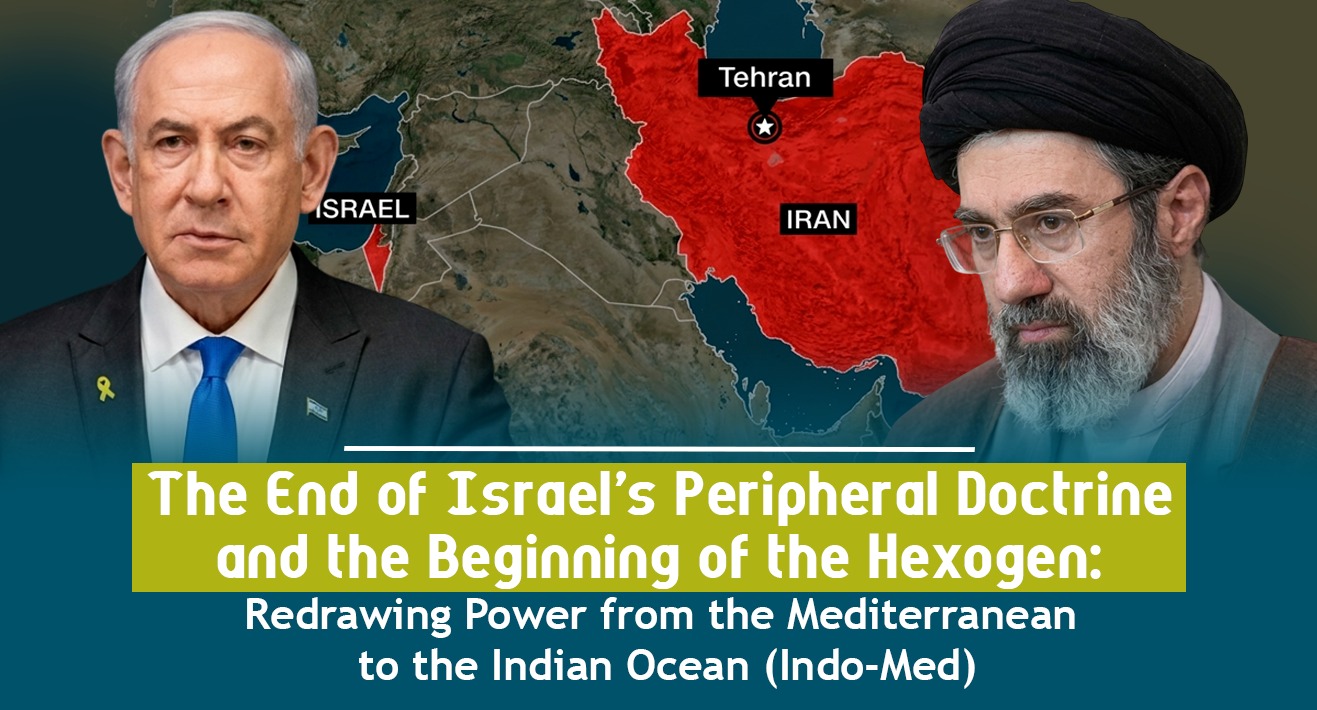
What began as U.S.–Israel joint strikes on Iran on 28 February 2026 has expanded into an extra-regional confrontation stretching from the Mediterranean Sea to the Indian Ocean—hereafter referred to as the Indo-Mediterranean (Indo-Med) space. It also spans from the Caspian Sea to the Arabian Sea.Beyond its immediate military dimension, the conflict is shaping the evolution of Israel’s geopolitical strategy, with far-reaching implications for the Indo-Med regional order. At the same time, the war unfolds within a broader geopolitical reordering, marked by shifts in the balance of power, evolving threat perceptions, and the reconfiguration of regional alignments.
Wars rarely eliminate threats outright; more often, they reshape the geopolitical landscape by altering the balance of power, weakening one force and creating space for another to rise, while simultaneously reordering alliances and giving rise to new security challenges. On 27 February 2026, just hours before Israel’s ‘so‑called pre‑emptive strike’[1] former Israeli Defense Minister Yoav Gallant warned of wider geopolitical consequences of the imminent operation: “Wars do not merely eliminate threats. They rearrange the balance of power. When one force weakens, another moves to fill the space.” [2]
The central question now is how the war in Iran will reshape the regional balance of power—from the Strait of Hormuz to Bab el-Mandeb, and from the Eastern Mediterranean to the Indian Ocean. Equally important is who will emerge as Israel’s primary regional rival if Iran is weakened. According to former Israeli officials, including Gallant[3] and Bennett,[4] Turkey is increasingly viewed as Israel’s main rival, with Egypt as secondary. Israel’s peripheral doctrine[5]—once reliant on alliances with non-Arab states such as Iran (until 1979) and Ethiopia (until 1974)—is reaching its final stage, with Turkey “no longer a partner on the periphery.”[6] Meanwhile, Israel’s reverse peripheral doctrine—alliances with immediate Arab neighbors—also shows signs of partial failure.
In response to these shifts, Israel seeks to establish a ‘Hexogen of alliances’ [7]in the Indo-Med region to counter what it identifies as ‘the radical axes’. The intention according to Netanyahu is “to create an axis of nations that see eye-to-eye on the reality, challenges, and goals against the radical axes, both the radical Shia axis…and the emerging radical Sunni axis.”[8] These refer respectively to Iran and its allied resistance network, and to Turkey and Qatar, which have historically supported movements linked to the Muslim Brotherhood.
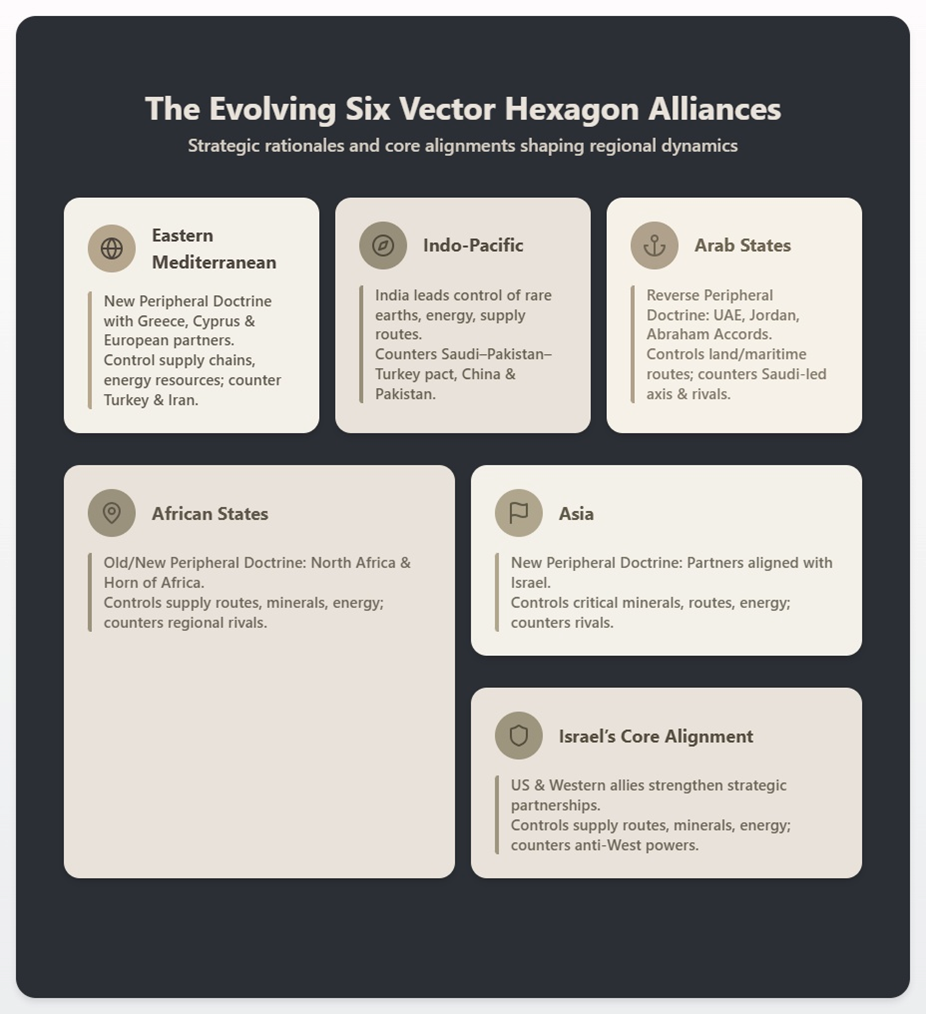
This marks a doctrinal evolution: from the old peripheral doctrine (alliances with non-Arab states such as Iran, Ethiopia, and Turkey to counter Pan-Arabism), to the reverse peripheral doctrine (alliances with Arab neighbors via the Abraham Accords to counter Iran and Turkey), and now toward a possible Hexogen bloc. The envisioned alignment spans six geographic and power vectors: “We will create an entire system, essentially a hexagon of alliances around or within the Middle East. This includes India, Arab nations, African nations, Mediterranean nations (Greece and Cyprus), and nations in Asia that I won’t detail at the moment.”[9] Hence, the six-vector power alignment may be understood as the key sub-geopolitical regions in the Indo-Med space.
The Evolving Six vector Hexagon Alliances
- Eastern Mediterranean (inner core) – The Hellenic states (Greece and Cyprus), together with other European partners. Strategic rationale: control of supply chain routes, energy resources (e.g., hydrocarbons), critical infrastructure; countering Turkey and Iran.
- Indo-Pacific (New Peripheral Doctrine) – India. Strategic rationale: control of supply chain routes, critical rare earth minerals, energy resources, infrastructure; countering the evolving Saudi–Pakistan–Turkey defense pact (“Islamic NATO”), China, Pakistan, and other rival powers.
- Arab states (Reverse Peripheral Doctrine) – UAE, Jordan, and other Abraham Accords signatories. Strategic rationale: control of land and maritime supply routes, energy resources, and infrastructure; countering the Saudi-led anti-UAE axis, Turkey, Arab nationalism, Muslim Brotherhood, and other rival powers.
- African states (Old/New Peripheral Doctrine) – North African Mediterranean states (e.g., Morocco) and Horn of Africa–Red Sea–Gulf of Aden states (e.g., Ethiopia (part of old peripheral doctrine), and South Sudan, Somaliland (new). Strategic rationale: control of land and maritime supply routes, critical minerals, energy, infrastructure; countering the Saudi-led anti-UAE axis, Egypt–Eritrea–Somalia–Turkey axis, Muslim Brotherhood, and other rival powers.
- Asia (New Peripheral Doctrine) – Broader partners aligned with Israel’s peripheral doctrine. Strategic rationale: control of land and maritime supply routes, critical rare earth minerals, energy resources, infrastructure; countering rival powers.
- Israel’s core alignment – United States and Western allies, building on the foundations of the peripheral doctrine. Strategic rationale: strengthen strategic partnerships around common threats, restore trans-Atlantic alliance in the Indo-Med region, control land and maritime supply routes, critical minerals, energy, and infrastructure; countering anti-West powers.
The Hexogen bloc thus represents a synthesis of Israel’s (old) new peripheral doctrine and its reverse peripheral doctrine. By combining alliances with non-Arab states and Arab neighbors, Israel seeks to counter both the “radical Shia axis” led by Iran and the “emerging radical Sunni axis” associated with Turkey and Qatar. This configuration provides Israel with strategic depth across the Eastern Mediterranean, Red Sea, Gulf of Aden, and Indian Ocean, embeds it within Indo-Pacific security frameworks, and diversifies its partnerships to avoid reliance on a single doctrine or region. In essence, Netanyahu’s “hexagon” is not merely rhetorical; it is a blueprint for a layered alliance system aimed at redrawing the Indo-Mediterranean balance of power in the aftermath of the Iran war.
Among the states considered in Israel’s “old periphery doctrine,” Ethiopia may still occupy a significant place in Israel’s strategic consideration. Ethiopia’s two-water doctrine[10]—treating the Nile River and the Red Sea as existential necessity—positions it as a potential partner at the southern tip of the Red Sea and the Gulf of Aden. Historically, Ethiopia and Israel shared strategic interests in Red Sea governance/security, particularly in countering Egypt’s initiative to establish a Red Sea Council restricted to littoral Arab states. Egypt’s aim was to transform the Red Sea into an “Arab lake,” excluding non-Arab littorals such as Ethiopia and Israel. Egypt also played a primary role in making Ethiopia landlocked by supporting secessionist movements, including Shabia and Woyane-the TPLF. Even after Ethiopia’s post-2018 policy to reclaim sovereign access to the sea, Egypt remains the principal actor obstructing Ethiopia’s historical and legal claim to Red Sea littoral status—more so than Ethiopia’s immediate coastal neighbors.
However, history teaches a simple lesson: Ethiopia–Israel relations have long been marked by both ‘alliance and alienation.’[11] This pattern reflects Ethiopia’s unique geopolitical and geocultural setting, its legacy of supporting subaltern struggles, and proximity and historical ties to Arab and Gulf states; and more importantly the identity layers. As Haggai Erlich observes in Alliance and Alienation: Ethiopia and Israel in the Days of Haile Selassie, the Ethiopian attitude toward Israel “was much more complex and fraught with contradictory statements of intimacy and rejection”.[12] This historical ambivalence underscores both the depth of Ethiopia–Israel ties and the challenges of translating them into a stable strategic partnership within the contemporary Indo-Med order.
From the Middle East, the United Arab Emirates and Jordan remain central to Israel’s reverse peripheral doctrine. The UAE’s military bases along the southern Red Sea—a corridor of strategic vulnerability for Israel due to Houthi attacks and Turkey’s growing presence in Somalia’s maritime domain—may also serve Israeli interests. Although Israel has long sought a physical presence in the southern Red Sea, this objective remains elusive given the absence of pro-Israel littoral states along the Red Sea and Gulf of Aden. This explains the paradox: the UAE’s assertive military build-up in the region, despite not being a major naval power, reflects broader regional alignments rather than purely Emirati defense needs. Somaliland, strategically located at the Gulf of Aden which link the Indian Ocean with the Red Sea via Bab el-Mandeb, could also serve as Israel’s southern front, particularly against potential Houthi threats.
The Hellenic states, Greece and Cyprus, are key actors in the Eastern Mediterranean. The region has increasingly become a geopolitical chessboard shaped by a web of actors, including Turkey, Israel, Egypt, Libya, Greece, Cyprus, Lebanon, Syria, Italy, France, the UAE, Saudi Arabia, and the EU. [13] Alongside this complexity, new forms of minilateralism are emerging, such as Israel–Greece–Cyprus, Egypt–Greece–Cyprus, and Israel–Egypt–Greece–Cyprus alignments, largely aimed at counterbalancing Turkey.[14] At the same time, divisions persist over conflicts in Libya and Syria.
Disputes over maritime boundaries, exclusive economic zones, natural gas, supply routes, and the Libyan conflict are the main sources of the regional tensions, particularly between Turkey and Greece, Turkey and Egypt, Turkey and Cyprus, and Turkey and Israel. Greece, Cyprus, Israel, and Egypt collectively counter Turkey’s “Blue Homeland” doctrine, which seeks to expand Turkish maritime boundaries across the Eastern Mediterranean, Aegean Sea, and Black Sea, thereby asserting Turkey as a maritime power controlling energy resources and vital routes.[15]
In the Indo-Pacific, India plays a central role, viewing the Indian Ocean region as part of its extended neighborhood.[16] Maritime route is the main factor due to the India–Middle East–Europe Economic Corridor (IMEC), which counters China’s BRI, multi-modal cross-continental transit route connecting India to Europe via the UAE, Saudi Arabia, Jordan, Israel, and Greece. Within this broader geopolitical context, the Hexogen bloc could reorder regional alignments and reshape the Indo-Med balance of power in the aftermath of the Iran war.
Implications for the Southern Red Sea and the Horn of Africa
Southern Red Sea: the Southern Red Sea, bordered by Sudan, Eritrea, Djibouti, Yemen, and Somaliland, is geo‑strategically important due to the Bab el‑Mandeb Strait, the Gulf of Aden, and the Socotra Islands. The Iran war will further increase the strategic importance of the Southern Red Sea and is likely to reorder the balance of power across both land and maritime domains. It will become a contested arena among a web of actors: Ethiopia, Eritrea, Djibouti, Somaliland, Somalia, Saudi Arabia, the UAE, Egypt, Israel, and Turkey. For Ethiopia, the Southern Red Sea is its natural geopolitical breathing space and strategic depth, which it should navigate assertively.
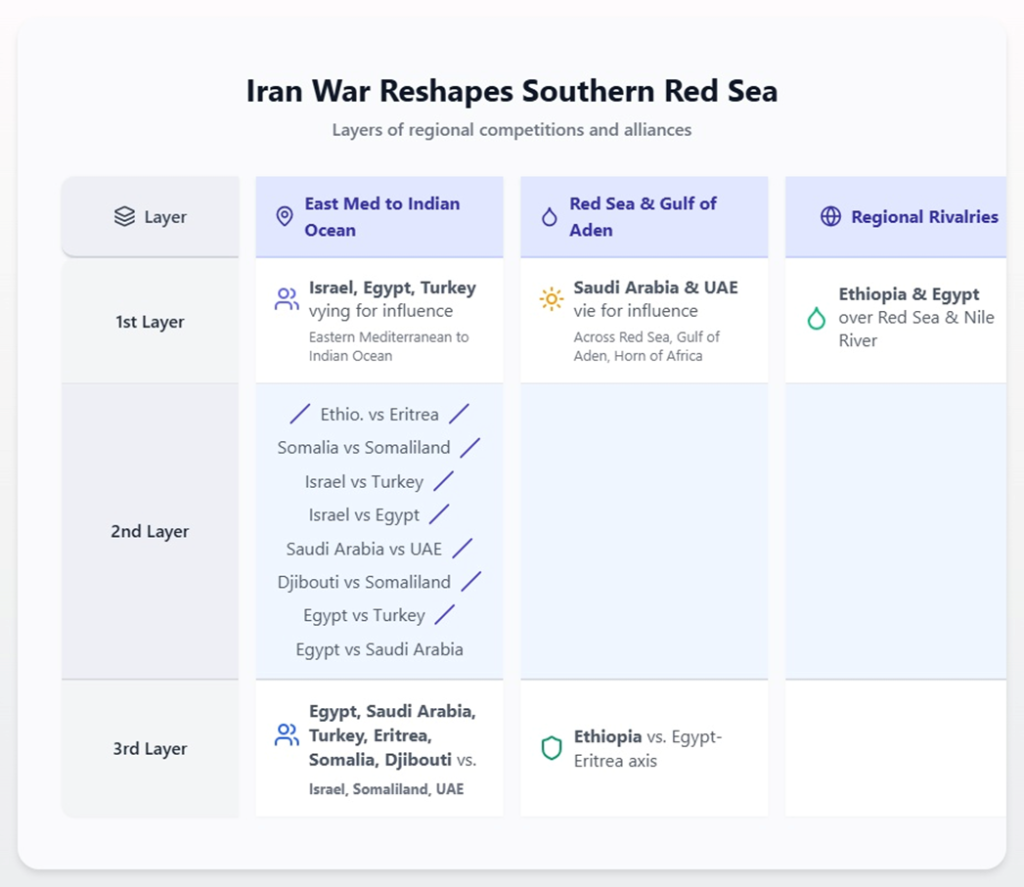
In this emerging order, Israel, Egypt, and Turkey will be the primary rival powers competing from the Eastern Mediterranean to the Indian Ocean, while Saudi Arabia and the UAE will vie for influence across the Red Sea, Gulf of Aden, and the Horn of Africa. At the other layer level, competition will manifest in rivalries such as Ethiopia versus Egypt, Ethiopia versus Eritrea, Somalia versus Somaliland, Israel versus Turkey, Israel versus Egypt, Saudi Arabia versus the UAE, Egypt versus Turkey, Egypt versus Saudi Arabia, and Djibouti versus Somaliland. At the trilateral level, more complex alignments will emerge, including Egypt, Saudi Arabia, Turkey, Eritrea, Somalia, and Djibouti against Israel, Somaliland, and the UAE, as well as Ethiopia confronting the combined axis of Egypt and Eritrea. However, these alignments are ad hoc and issue-based rather than formal alliances, reflecting the fluid and transactional nature of regional politics. These overlapping rivalries illustrate the layered nature of competition in the Indo-Mediterranean, where bilateral disputes feed into broader coalitions and counter-coalitions, reshaping the regional balance of power.
Yemen: a weakening of Iran or regime change as a result of the current war could reduce the operational capacity of the Iran‑backed Houthis, thereby favoring the UAE‑backed Southern Transitional Council; the Saudi‑backed internationally recognized government of Yemen, and other minor actors. Such a shift would also affect the Houthi–al‑Shabab tactical alliance, as the Houthis have provided training and logistical support to al‑Shabab. Yet, Houthi retaliation against U.S.–Israel strikes could target Israel directly, as well as U.S. bases in Djibouti and UAE bases in Somaliland, Puntland, and Yemen—disrupting maritime security across the Red Sea and Gulf of Aden. This scenario may push the U.S. and Israel to consolidate their presence in the southern Red Sea.
However, the Southern Red Sea littorals remains fragmented: Sudan and Yemen are mired in conflict, Eritrea remains a rogue state, and Djibouti is critical of UAE–Israel regional roles. Against this backdrop, Somaliland may emerge as potential partner of the U.S. and Israel. Ethiopia may also emerge as a relatively reliable actor. Its geographic position at the Horn of Africa, combined with its two‑water doctrine (Nile and Red Sea), and its historical role in regional security, could make Ethiopia a stabilizing partner in an otherwise volatile environment.
Sudan: The Iran war could reshape Sudan’s internal conflict. It has the potential to disrupt the logistical supply lines on which the Sudanese Armed Forces (SAF) have depended, particularly those linked to Iran and Saudi‑Pakistan channels. Iran has been one of the actors supplying drones and other military equipment to SAF via Eritrea’s port of Massawa. However, the most potent threat to SAF is not supply chain disruption but the growing influence of radical Islamists, the Muslim Brotherhood, and ISIS within SAF itself. Although this danger was long recognized, it became explicit after the Iran war exposed the Sudanese Muslim Brotherhood’s ties to Iran’s IRGC. On 16 March 2026, the U.S. designated the Sudanese Muslim Brotherhood a Foreign Terrorist Organization.[17] This designation may undermine SAF’s diplomatic outreach and strengthen the image of RSF backer UAE, which promotes itself as a Western ally advocating “moderate Islam” in contrast to Turkey and Qatar’s support for the Brotherhood. These dynamics may also cause internal divisions within SAF, between hardliners and soft‑liners. The splitters may further increase divisions among the external backers of SAF, including Turkey, Egypt, Eritrea, Iran, Saudi Arabia, and Pakistan. Muslim Brotherhood actors are likely to turn toward Qatar and Turkey, while non–Muslim Brotherhood factions may continue to their ties with Egypt, Eritrea, and Saudi Arabia. Regionally, East African states view SAF’s Islamist inclinations as a threat to regional stability.
Eritrea: Eritrea’s Red Sea coastline, proximity to Bab el-Mandeb, and islands give it strategic importance. Yet, its regime’s anti-Western stance, destabilizing behavior, and ties with Iran complicate its potential as a U.S. or Israeli ally. While Eritrea seeks to leverage its geostrategic importance to normalize relations with Washington, the Iran war places the regime in a difficult position.
Djibouti: Djibouti hosts multiple foreign military bases, making it both strategically valuable and vulnerable. The Iran war highlights the risks of hosting foreign military bases, which could become targets for Iranian or Houthi retaliation. Although Djibouti has not yet been attacked, its vulnerability is evident. This may push Djibouti and the wider region to reconsider the proliferation of military bases and ports, and to reclaim agency through regional integration and strategic autonomy.
Ethiopia: the Iran war exposes Ethiopia’s vulnerabilities but also presents opportunities. Aviation, energy, agriculture (exports to Gulf states), and imports are at risk from escalation. Yet, the conflict indicates Ethiopia’s existential need for sovereign sea access to the Red Sea and Gulf of Aden, as well as the need for self-sufficiency in food, pharmaceuticals, energy, and fertilizer. It also provides Ethiopia with leverage to persuade neighbors of the necessity of regional strategic autonomy, reclaim regional agency, and regional integration, positioning sea access as a collective existential issue rather than a unilateral demand.
Conclusion
The war in Iran is not merely a military confrontation; it is a catalyst for a broader geopolitical transformation stretching from the Eastern Mediterranean to the Indian Ocean (Indo-Med). As the balance of power shifts across this vast strategic corridor, Israel’s long-standing peripheral doctrine appears to be entering its final phase. The traditional model—built on alliances with non-Arab states such as Iran, Turkey, and Ethiopia—has gradually eroded as regional dynamics, ideological alignments, and geopolitical rivalries evolved.
In its place, a more complex and layered alliance structure is emerging. Israel’s envisioned “Hexogen” system of alliances represents an attempt to integrate multiple strategic theaters—including the Eastern Mediterranean, the Red Sea, the Gulf of Aden, the Indo-Pacific, and parts of Africa—into a single geopolitical framework. By combining elements of the old peripheral doctrine with the reverse peripheral doctrine created through the Abraham Accords, this evolving network aims to provide Israel with strategic depth while counterbalancing rival power centers, particularly Iran and an increasingly assertive Turkey and Egypt.
Within this emerging Indo-Mediterranean order, control of maritime corridors and geopolitical chokepoints will become increasingly decisive. Strategic passages such as the Bab el-Mandeb and the Suez Canal connect the Mediterranean basin to the Indian Ocean and serve as arteries of global trade and energy flows. As competition over these routes intensifies, regional powers—including Israel, Turkey, Egypt, Saudi Arabia, and the United Arab Emirates—are likely to expand their strategic presence along both the northern and southern Red Sea corridors.
For the Horn of Africa, these developments have far reaching implications. The region is increasingly embedded within wider geopolitical rivalries linking the Middle East, Africa, and the Indo-Pacific. For Ethiopia in particular, the changing regional order underscores the strategic significance of its “two-water doctrine,” which links the Nile Basin and the Red Sea to the country’s long-term security and economic interests. As geopolitical competition intensifies around maritime access, logistics corridors, and regional infrastructure, Ethiopia’s ability to navigate these rivalries while pursuing sovereign sea access and regional integration will become increasingly central to its national strategy.
Ultimately, the emerging Indo-Mediterranean geopolitical space will likely remain fluid and contested rather than defined by rigid alliance blocs. The Hexogen outlined in this analysis should therefore be understood not as a formal alliance system but as an evolving network of strategic alignments shaped by shifting threat perceptions, economic corridors, and maritime security concerns. As the aftermath of the Iran war unfolds, the interplay between these overlapping alliances and rivalries will play a decisive role in determining the future balance of power from the Mediterranean to the Indian Ocean.
[1] Fabian, E. (2026, February 28). Israel has launched a preemptive attack on Iran, defense minister Katz says; sirens sound across Israel. The Times of Israel. https://www.timesofisrael.com/liveblog_entry/israel-has-launched-a-preemptive-attack-on-iran-defense-minister-katz-says-sirens-sound-across-israel/
[2] Gallant, Y.. (2026, February 27). The next strategic shift in the Middle East: How Iran’s weakness is creating Turkey’s opportunity. The Defense Memo (Substack). https://generalyoavgallant.substack.com/p/the-next-strategic-shift-in-the-middle
[3] Gallant, Y. (2026, February 27). The next strategic shift in the Middle East: How Iran’s weakness is creating Turkey’s opportunity. The Defense Memo (Substack). https://generalyoavgallant.substack.com/p/the-next-strategic-shift-in-the-middle
[4] Oruç, H. (2026, March 3). Hexagon bloc: Israel’s new anti-Türkiye alliance formula. Daily Sabah. https://www.dailysabah.com/opinion/op-ed/hexagon-bloc-israels-new-anti-turkiye-alliance-formula
[5] Guzansky, Y. (2021). Israel’s periphery doctrines: Then and now. Middle East Policy, 28(4), 88–100. https://doi.org/10.1111/mepo.12579
[6] Gallant, Y. (2026, February 27). The next strategic shift in the Middle East: How Iran’s weakness is creating Turkey’s opportunity. The Defense Memo (Substack). https://generalyoavgallant.substack.com/p/the-next-strategic-shift-in-the-middle
[7] Prime Minister’s Office. (2026, February 22). PM Netanyahu’s remarks at the start of today’s government meeting [Media statement]. https://www.gov.il/en/pages/spoke-start220226
[8] Prime Minister’s Office. (2026, February 22). PM Netanyahu’s remarks at the start of today’s government meeting [Media statement]. https://www.gov.il/en/pages/spoke-start220226
[9] Prime Minister’s Office. (2026, February 22). PM Netanyahu’s remarks at the start of today’s government meeting [Media statement]. https://www.gov.il/en/pages/spoke-start220226
[10] Office of the Prime Minister. (2023, October 27). From a drop of water to sea [Video]. YouTube. https://www.youtube.com/watch?v=MPOdp4s4XXE
[11] Erlich, H. (2014). Alliance and alienation: Ethiopia and Israel in the days of Haile Selassie. Red Sea Press.
[12] Erlich, H. (2014). Alliance and alienation: Ethiopia and Israel in the days of Haile Selassie. Red Sea Press.
[13] Dalay, G. (2021, January 28). Turkey, Europe, and the Eastern Mediterranean: Charting a way out of the current deadlock. Brookings Institution. https://www.brookings.edu/articles/turkey-europe-and-the-eastern-mediterranean-charting-a-way-out-of-the-current-deadlock
[14] Hasan, M., Moitree, S., Wahi, C. A. M., Talukder, M. A. M. H., & Islam, M. S. (2025). Eastern Mediterranean Sea dispute: Exploring sustainable resolutions. Open Journal of Marine Science, 15(2), 74–99. https://doi.org/10.4236/ojms.2025.152005
[15] Denizeau, A. (2021). Mavi Vatan, the “Blue Homeland”: The origins, influences and limits of an ambitious doctrine for Turkey. French Institute of International Relations.
[16] Khaund, A. (2025, February 11). India’s turn toward its extended neighborhood. The Diplomat. https://thediplomat.com/2025/02/indias-turn-toward-its-extended-neighborhood/
[17] U.S. Department of State. (2026, March). Terrorist designation of the Sudanese Muslim Brotherhood. https://www.state.gov/releases/office-of-the-spokesperson/2026/03/terrorist-designation-of-the-sudanese-muslim-brotherhood
About the author
Gashaw Ayferam (Ph.D.), Senior African Affairs Researcher at the Institute of Foreign Affairs
Disclaimer:
The content disseminated by the Institute of Foreign Affairs (IFA) – including, but not limited to, publications, public statements, events, media appearances, and digital communications – reflects the views of individual contributors and does not necessarily represent the official positions or policies of the Institute, its partners, or any affiliated governmental or non-governmental entities.
While the IFA endeavors to ensure the accuracy, integrity, and timeliness of the information presented, it makes no representations or warranties, express or implied, regarding the completeness, reliability, or suitability of such content for any purpose. The Institute expressly disclaims any liability for errors or omissions, as well as for any actions taken or decisions made based on the information provided.
The inclusion of external links, references, or third-party resources does not constitute an endorsement by the Institute. Additionally, engagement on social media platforms – including, but not limited to, likes, shares, retweets (RTs), or reposts – shall not be interpreted as an endorsement or validation of the views expressed therein.
Readers and audiences are encouraged to exercise critical judgment and seek independent verification when interpreting or relying upon any information disseminated through publications and posts on the Institute’s platforms or representatives.