

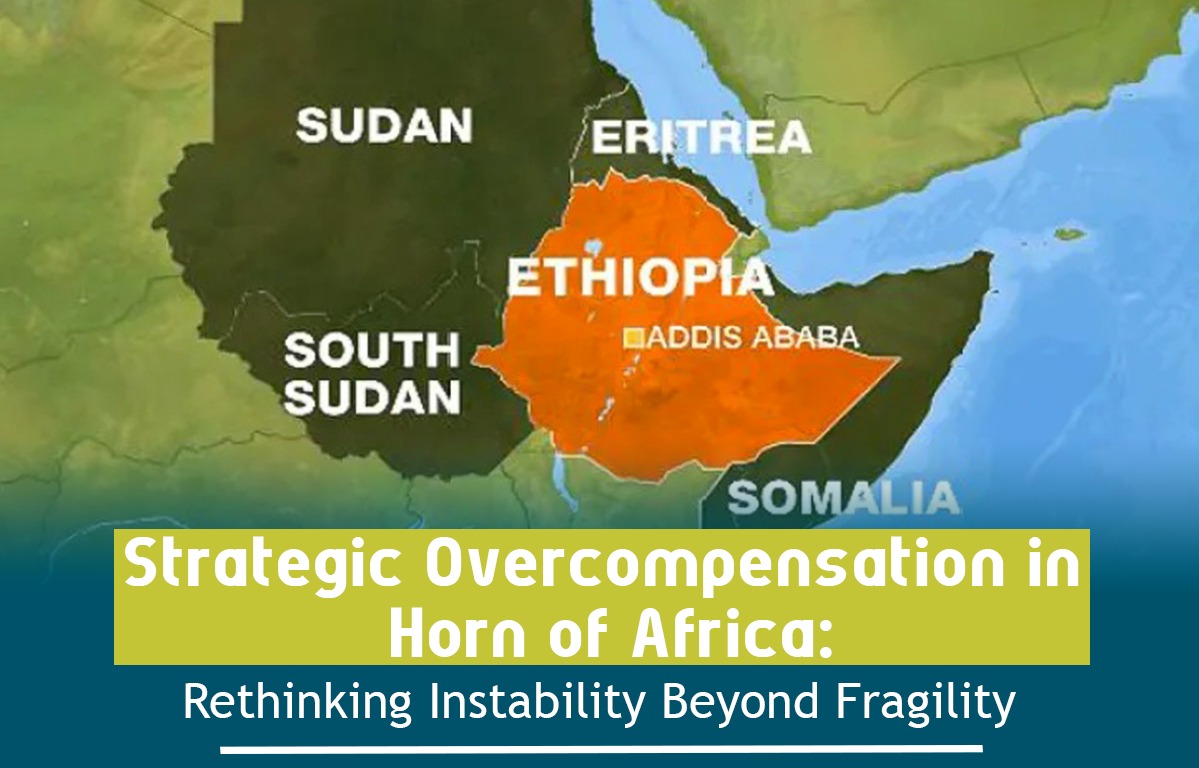
For decades, the Horn of Africa has been defined through the language of fragility. It has routinely been described as a cluster of weak states struggling with institutional deficits, humanitarian emergencies, and cyclical conflict (Clapham 2017; World Bank 2020). This instability has often been attributed primarily to institutional incapacity: fragile governments unable to control territory, deliver services, or manage political competition.
Yet recent developments across the region suggest a more complex reality. Governments in the Horn are not merely struggling to govern; they are acting—often assertively—to correct what they perceive as structural disadvantages embedded in geography, historical treaties, and regional power balances. Ethiopia has intensified its campaign for diversified maritime access. Somalia is attempting to consolidate federal authority amid a precarious security transition. Eritrea continues to entrench a deterrence-based posture along the Red Sea corridor. Meanwhile, Sudan’s civil war has spilled across borders through proxy networks and the increasing use of drone warfare (International Crisis Group 2024). External actors—from Egypt to Gulf states and Türkiye—are simultaneously deepening their involvement across the Red Sea strategic system.
Taken together, these developments suggest that the Horn is no longer best understood solely as a region of fragility. Rather, it is increasingly becoming a market for what may be termed strategic overcompensation, where states respond to insecurity by adopting assertive geopolitical strategies designed to correct long-standing vulnerabilities. Fragility remains real, but it no longer fully explains the tempo of escalation or the behavior of state actors.
Understanding this shift requires moving beyond humanitarian narratives toward a framework grounded in realist international relations theory and securitization dynamics, where states—weak or strong—seek to mitigate perceived threats to survival and autonomy.
From Fragmented Crises to an Integrated Strategic System
The Horn’s political landscape is undergoing a subtle yet consequential transformation: crises that once appeared geographically isolated are converging into an interconnected strategic system.
Historically, tensions unfolded along distinct axes—Ethiopia–Eritrea border disputes following the Algiers Agreement, Sudan’s internal crises after the 2005 Comprehensive Peace Agreement (CPA), Somalia’s collapse following the fall of Siad Barre in 1991, and Nile Basin disputes shaped by colonial-era agreements such as the 1929 and 1959 Nile Waters Agreements.
Today, however, these once separate dynamics increasingly intersect. Ethiopia’s maritime ambitions interact with Eritrea’s Red Sea security calculus. Sudan’s civil war influences alignments across Ethiopia’s western frontier and Egypt’s regional balancing strategy. Somalia’s constitutional tensions unfold within a competitive environment shaped by Gulf investment in ports and logistics infrastructure.
Consequently, almost every major political decision—whether constitutional reform, security deployment, or infrastructure agreement—now carries regional geopolitical implications. The Horn is shifting from a patchwork of fragile states into a regional security complex, where the actions of one state directly reshape the strategic calculations of others.
Ethiopia’s Maritime Doctrine and the Logic of Structural Vulnerability
Ethiopia provides perhaps the clearest illustration of this shift from fragility to strategic correction.
Since Eritrea’s independence in 1993, Ethiopia has been the world’s most populous landlocked state, with over 120 million people. For decades, it has relied on Djibouti for more than 90 percent of its external trade (AfDB 2019).
Once framed as a mere economic inconvenience, the lack of maritime access is now increasingly viewed within Ethiopian strategic discourse as a structural vulnerability. Prime Minister Abiy Ahmed and other senior officials have repeatedly asserted that sea access is not simply a commercial necessity, but a fundamental requirement for long-term sovereignty and existential resilience. Ethiopia’s evolving maritime diplomacy—including port negotiations and regional infrastructure initiatives—can thus be interpreted less as expansionism than as a long-term effort to diversify strategic options.
Nevertheless, such policies inevitably stoke anxiety among neighboring states, especially those whose strategic leverage is tied to Red Sea access. Ethiopia’s push for maritime access has been subject to various interpretations by its neighbors; in the Horn, sea access is not merely an economic concern but a deeply political one, central to sovereignty and the regional balance of power.
Eritrea’s Deterrence Strategy and the Politics of Strategic Entrenchment
If Ethiopia represents structural correction, Eritrea represents strategic deterrence. Since independence, Eritrea has pursued a security doctrine shaped by distrust of external interference and an overriding emphasis on regime survival (Plaut 2016). The 1998–2000 war with Ethiopia entrenched a defensive strategic culture that persists today.
Even after the 2018 rapprochement, Eritrea’s posture has remained rooted in deterrence rather than integration. Asmara continues to prioritize strategic autonomy and leverage, particularly along the Red Sea corridor.
While Ethiopia’s constructive regional leadership and pursuit of integrated growth reflect a forward-looking vision for the Horn, these initiatives are occasionally met with apprehension by its neighbors. From the perspective of Asmara, Ethiopia’s dynamic expansion is often viewed through a narrow lens of power asymmetry. Consequently, rather than embracing the mutual benefits of regional integration, the response has remained one of reflexive entrenchment—an approach that prioritizes static isolation over the transformative potential of modern cooperation.
In this context, Eritrea’s ability to influence or complicate regional political settlements becomes a form of geopolitical power—what analysts describe as “spoiler capacity” in fragile regional systems.
Somalia’s Constitutional Centralization and State Survival
Somalia offers another illustration of how governments respond to structural vulnerability.
Following state collapse in 1991, Somalia gradually reconstituted a federal system under the 2012 Provisional Constitution. However, recent constitutional reforms have reignited debates over centralization versus federalism (Barre, 2024).
Supporters argue that stronger central authority is necessary to confront al-Shabaab and manage the transition from African Union peacekeeping forces. Critics warn that excessive centralization risks undermining fragile political agreements.
Somali leaders are framing governance challenges as existential threats requiring extraordinary measures. This framing legitimizes constitutional restructuring as a tool of state survival.
In a move that has both electrified and polarized the Somali political landscape, President Hassan Sheikh Mohamud recently declared a “historic day” following the parliamentary approval of landmark constitutional amendments. This legislative shift—which the President framed as a “promise made and kept”—officially terminates the country’s decades-long reliance on a provisional charter, signaling a bold transition toward a more permanent governance structure. However, the celebration is not universal; the move has encountered a wall of resistance from opposition figures and regional administrations. These critics warn that such fundamental changes, if executed without broad-based consensus, risk fracturing the nation’s fragile federal arrangement and undermining the very national unity the new constitution seeks to solidify (Yeni Şafak, 2026).
Thus, Somalia’s internal political debates are not merely domestic—they reflect broader regional pressures and strategic positioning in an increasingly competitive environment.
Sudan’s War and the Transformation of Regional Conflict
Sudan’s ongoing civil war has further transformed the Horn’s strategic landscape by turning borders into operational corridors.
The conflict between the Sudanese Armed Forces (SAF), commanded by Al-Burhan, and the Rapid Support Forces (RSF), led by Mohamed Hamdan Dagalo, has evolved into a regionalized war involving complex cross-border networks, proxy actors, and advanced military technologies
Sudan’s internal conflict has evolved into a regionalized security threat, driven by massive population displacement and the involvement of external powers jockeying for influence over Red Sea resources. The proliferation of arms via these foreign alliances has intensified the violence and created a deadlock in global diplomatic channels, particularly within the UN Security Council. Despite a proliferation of competing mediation frameworks, the lack of a synchronized international approach has stalled progress toward a credible ceasefire or a long-term political settlement (European Parliament, 2025).
Two developments are particularly significant. First, the growing use of drones enables combatants to project force beyond traditional front lines. Second, informal logistics networks allow the movement of weapons and fighters across borders (UN Panel of Experts 2024).
As a result, Sudan’s conflict now intersects with Ethiopia’s frontier dynamics, Egypt’s Nile Basin strategy, and Gulf competition along the Red Sea. In practical terms, it is no longer a national conflict but part of a broader regional security ecosystem.
The Red Sea: A Corridor of Strategic Multiplicity
It would be no exaggeration to say that nowhere is strategic overcompensation more visible than along the Red Sea corridor. This maritime route—linking the Bab el-Mandeb Strait to the Suez Canal—handles roughly 12 percent of global trade (UNCTAD 2022). Its importance has attracted intense geopolitical competition.
While the UAE has focused on port infrastructure along the Horn of Africa’s littoral, Saudi Arabia has prioritized the promotion of regional security frameworks. In parallel, Türkiye has significantly expanded its footprint in Somalia, and Egypt remains focused on Nile hydropolitics and the ongoing GERD dispute.
These engagements do not form fixed alliances but rather overlapping networks of cooperation. This creates what can be described as strategic multiplicity, where states maintain multiple partnerships to maximize flexibility. While this expands strategic options, it also intensifies competition and incentivizes ambitious policies aimed at securing long-term advantage.
Fragility and Strategic Overcompensation
Critics may argue that this framework overestimates state capacity. Indeed, many governments in the Horn continue to face fiscal constraints and internal fragmentation.
However, fragility and strategic behavior are not mutually exclusive. Realist theory suggests that even weak states pursue strategies to maximize security under uncertainty. In fact, vulnerability often drives more assertive behavior.
The Horn therefore presents a paradox: fragile states behaving strategically within an increasingly competitive system.
Implications for the Region
Recognizing this shift carries important implications.
First, regional diplomacy should address structural grievances—not just immediate crises. Second, institutions such as IGAD and the African Union could strengthen mechanisms to reduce misperception and escalation risks. Third, external actors should calibrate their engagement to avoid reinforcing competitive dynamics.
Finally, regional states may benefit from balancing strategic correction with cooperative frameworks, particularly in areas such as trade corridors and maritime access.
Conclusion
The Horn of Africa is not simply collapsing into disorder, nor is it stabilizing through cooperation. Instead, it is entering a phase in which governments actively seek to correct structural vulnerabilities through increasingly assertive policies.
These strategies interact, producing a system where insecurity fuels assertiveness—and assertiveness generates further insecurity. This dynamic helps explain why the region appears more volatile today. States are no longer merely reacting to crises; they are attempting to reshape the strategic map.
Whether this leads to equilibrium or escalation will depend on how effectively regional actors reconcile national ambitions with collective stability. For now, one conclusion is clear: instability in the Horn is no longer driven only by fragility, but by states acting strategically to overcome it.
References
- African Development Bank (AfDB). 2019. Djibouti Port and Ethiopia Trade Dependency Report. https://www.afdb.org
- Barre, G. S. (2024). Weaknesses of federalism in Somalia and required reforms. East African Journal of Arts and Social Sciences, 7(2), 1–10. https://doi.org/10.37284/eajass.7.2.2152
- Clapham, Christopher. 2017. The Horn of Africa: State Formation and Decay. Oxford University Press. https://global.oup.com
- European Parliament. (2025, November 4). Understanding the war in Sudan: The human cost of geopolitics (Briefing No. PE 779.180). European Parliamentary Research Service. https://www.europarl.europa.eu/thinktank/en/document/EPRS_BRI(2025)779180
- International Crisis Group, Intra-Gulf Competition in Africa’s Horn: Lessening the Impact, Middle East & North Africa Report No. 206 (Brussels: International Crisis Group, 2019), 14, https://www.crisisgroup.org/rpt/middle-east-north-africa/gulf-and-arabian-peninsula/206-intra-gulf-competition-africas-horn-lessening-impact.
- International Crisis Group. 2020. Eritrea: The Prison State. https://www.crisisgroup.org
- International Crisis Group. 2024. Sudan’s Expanding War and Regional Spillovers. https://www.crisisgroup.org
- Plaut, Martin. 2016. Understanding Eritrea: Inside Africa’s Most Repressive State. Oxford University Press.
- UN Panel of Experts on Sudan. 2024. Final Report on Sudan Conflict Dynamics. https://www.un.org
- World Bank. 2020. Fragility, Conflict and Violence Overview. https://www.worldbank.org
- Yeni Şafak. (2026, March 22). Saudi Arabia orders five Iranian diplomats to leave within 24 hours. https://en.yenisafak.com/world/saudi-arabia-orders-five-iranian-diplomats-to-leave-within-24-hours-3716114
By Yodit Bulcha, IFA
Disclaimer:
The content disseminated by the Institute of Foreign Affairs (IFA) – including, but not limited to, publications, public statements, events, media appearances, and digital communications – reflects the views of individual contributors and does not necessarily represent the official positions or policies of the Institute, its partners, or any affiliated governmental or non-governmental entities.
While the IFA endeavors to ensure the accuracy, integrity, and timeliness of the information presented, it makes no representations or warranties, express or implied, regarding the completeness, reliability, or suitability of such content for any purpose. The Institute expressly disclaims any liability for errors or omissions, as well as for any actions taken or decisions made based on the information provided.
The inclusion of external links, references, or third-party resources does not constitute an endorsement by the Institute. Additionally, engagement on social media platforms – including, but not limited to, likes, shares, retweets (RTs), or reposts – shall not be interpreted as an endorsement or validation of the views expressed therein.
Readers and audiences are encouraged to exercise critical judgment and seek independent verification when interpreting or relying upon any information disseminated through publications and posts on the Institute’s platforms or representatives.