

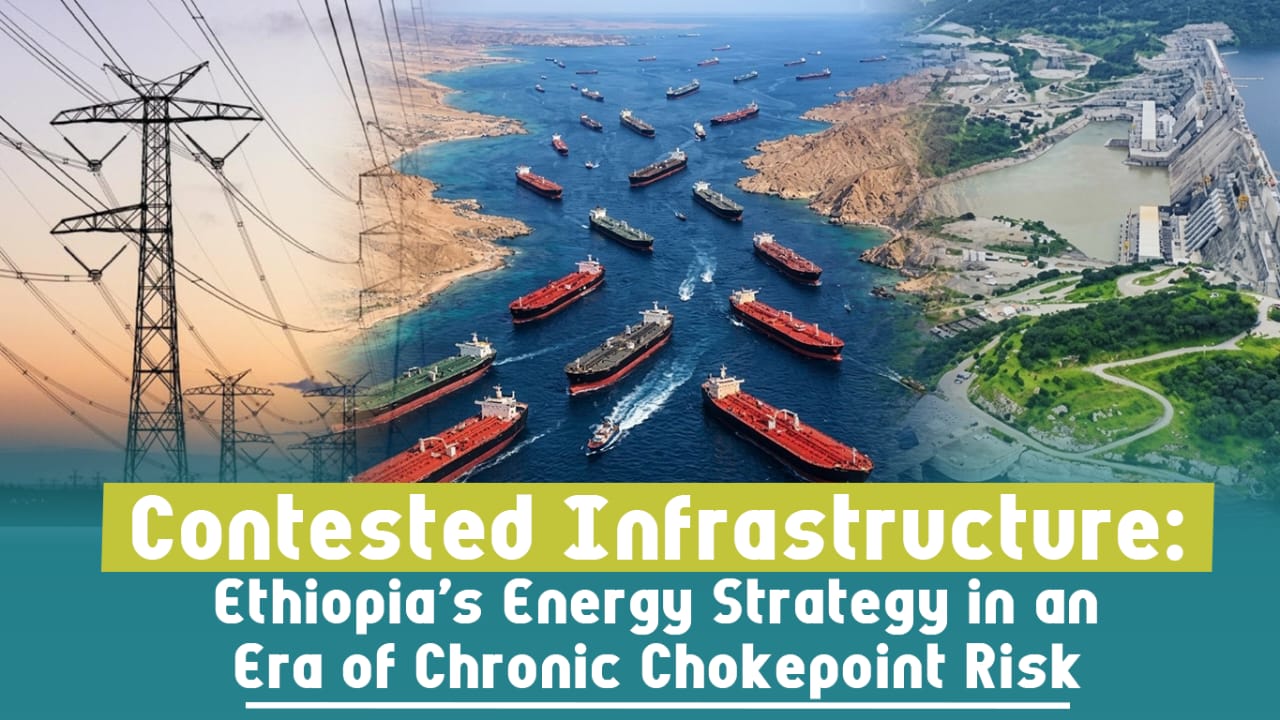
The war between the United States, Israel, and Iran is often discussed as if its significance lies mainly in oil prices. That framing is too narrow. The more important development is that the conflict has begun to reclassify the Gulf in the eyes of markets: not simply as a low-cost export basin, but as contested infrastructure.[1] Once that shift occurs, the consequences extend far beyond a temporary spike in Brent crude. The issue becomes whether pipelines, LNG trains, export terminals, tankers, and maritime corridors can still be treated as continuously operable systems under conditions of recurring strategic stress. That is a structural question, not a cyclical one.[1]
This matters because the Gulf remains central to the global energy order. Oil flows through the Strait of Hormuz averaged about 20 million barrels per day in 2024, accounting for more than one-quarter of global seaborne oil trade and about one-fifth of global oil and petroleum product consumption. Around one-fifth of global LNG trade also passed through Hormuz, primarily from Qatar.[2][3] This is not peripheral geography. It is one of the system’s core valves.
For Ethiopia, the stakes are significant even without direct military involvement or import volumes comparable to Asia’s largest consumers. Ethiopia’s exposure runs through petroleum imports, shipping and insurance costs, fertilizer availability, inflation transmission, and foreign-exchange pressure.[4][5] The strategic question is therefore not whether Ethiopia can influence events in the Gulf. It cannot. The relevant question is whether Ethiopia can reduce the share of its economic life that depends on Gulf energy infrastructure functioning normally.
The Strategic Reclassification of the Gulf
The standard energy-market interpretation of war in the Gulf is familiar: hostilities interrupt flows, prices jump, emergency reserves are released, diplomatic pressure mounts, and markets eventually stabilize. That sequence still matters. But it misses the larger transformation now underway. The real change is that risk is moving from transit alone to infrastructure itself.[1]
The current war has damaged major oil and gas assets across the Middle East, including facilities in Iran, Qatar, Bahrain, and the UAE. One of the most consequential cases involves Qatar’s LNG sector, where damage has reportedly removed around one-sixth of export capacity and could take years to restore fully.[1][6] Whether every estimate is revised later is less important than the threshold already crossed: the market is now pricing the possibility that fixed energy assets in the Gulf can be degraded on a multi-year basis, not merely interrupted for days.
That alters the logic of the system. Shipping delays can be absorbed. Price spikes can be hedged. Emergency stocks can buy time. But when importers, insurers, and investors begin to assume that infrastructure itself may be recurrently vulnerable, the governing assumptions of energy security change. Reliability becomes conditional. Insurance becomes political. Freight becomes a strategic variable. Long-term contracts become not just questions of price but of confidence in asset survivability.[1]
In that sense, the most enduring legacy of the war may be institutional before it is volumetric. Even if physical flows recover, the market will remember that some of the world’s most important energy assets have become targetable under live conflict conditions. Once that memory enters risk models, it tends to persist longer than the immediate battlefield phase.[1]
Why Gas May Matter More Than Oil
The war’s most durable effects may emerge through gas markets even more than through crude oil. The International Energy Agency notes that the United States and Qatar together account for 70% of the roughly 300 bcm per year of new LNG liquefaction capacity expected to come online globally by 2030.[7] In other words, the future balancing of global gas markets was already expected to depend heavily on a narrow supplier set. That concentration looked manageable when Qatar was treated as a highly reliable cornerstone producer. It looks different when major Gulf gas assets have just demonstrated their vulnerability.
This is where the long-term market story becomes more serious than a commodity-price story. If one of the core pillars of future LNG growth now carries a higher security premium, the consequences spread outward quickly. Importers seek more redundancy. Governments carry more storage. Buyers value destination flexibility more heavily. States that can afford it diversify supply contracts. States that cannot afford it absorb higher import costs and greater volatility.[7] The result is not necessarily a permanent shortage, but a more expensive and more politically contingent gas system.
That matters for Ethiopia even though it is not a major LNG importer. Gas shapes fertilizer production, industrial costs, and the broader inflation environment. It also matters because gas-market instability spills into electricity markets elsewhere, which then feeds into shipping, manufacturing, and food costs globally.[5][8] In an interconnected energy economy, Ethiopia can be exposed to LNG disruption without importing LNG directly.
The Emergence of a Permanent Security Premium
The most likely long-run consequence of the war is not simply a sequence of price spikes, but the emergence of a more durable security premium on Gulf-origin energy. The barrel or cargo may still move, but it now moves through thicker layers of risk pricing: war-risk insurance, higher freight rates, storage costs, hedging costs, and wider precautionary behavior by buyers and governments.[1][9]
The current disruption has been described as one of the most severe global energy shocks in recent history, with oil prices surging sharply and emergency stockpile releases proving insufficient to offset all of the lost or endangered supply. The IEA has already moved to release hundreds of millions of barrels from emergency reserves. Consumer-side demand restraint has also entered the discussion, including lower speed limits, reduced travel, and more work from home to cut oil demand.[1][10][11] These are not the responses of institutions treating the problem as a routine bout of volatility. They suggest that the shock is being processed as systemic.
Macroeconomic institutions are reacting accordingly. The IMF warned on March 19 that a prolonged increase in energy prices from the conflict could raise inflation and lower global growth. European authorities have also considered easing gas-storage targets in response to price surges tied to damage to Gulf gas infrastructure.[12][13] These moves indicate that the market is no longer dealing only with the question of whether energy is available today. It is now dealing with how to govern prolonged insecurity in one of the most concentrated energy corridors on earth.
This is the core analytical shift Ethiopia should internalize. The Gulf is unlikely to lose its centrality. Its volumes remain too large and its assets too important. But centrality is not the same thing as dependability. A basin can remain indispensable while becoming more expensive, more vulnerable, and more politically conditional.[2][3]
The Secondary Transmission: Fertilizer, Food, and Balance-of-Payments Stress
The long-term danger to countries such as Ethiopia does not stop at fuel imports. It travels through second-order channels that are often more destabilizing than the initial oil shock. Fertilizer is the clearest example.
The war is disrupting fertilizer shipments through Hormuz, with roughly 30% of global fertilizer trade normally moving through the strait. Urea prices have already surged sharply, and analysts warn that continued disruption could reduce crop yields and intensify food insecurity across developing countries.[5][8] Unlike crude oil, fertilizer does not benefit from comparable strategic stockpiles. When it becomes scarce or delayed, agricultural systems feel the effect quickly.
That turns a Gulf energy crisis into a broader development problem. Fuel becomes more expensive. Shipping becomes costlier. Fertilizer becomes harder to source. Food production costs rise. Urban transport costs increase. Inflation spreads across household budgets. Governments face greater subsidy pressure just as foreign exchange becomes tighter.[5][8] This is what chronic chokepoint risk really means: not one isolated shock, but cascading pressures across multiple sectors that all depend on the same corridor and the same pricing environment.
For Ethiopia, that is especially important because the country remains vulnerable to imported-input inflation even when its domestic electricity base is comparatively strong. The energy issue is therefore not confined to petroleum. It is about how petroleum disruption amplifies fertilizer risk, food risk, and macroeconomic stress simultaneously.[4][5]
Ethiopia’s Structural Exposure
Ethiopia enters this period with a mixed profile. On one side, it possesses a major strategic advantage: a largely domestic and renewable electricity base. The National Bank of Ethiopia’s 2023/24 annual report shows that Ethiopia’s power generation remains overwhelmingly renewable and dominated by hydropower.[4] That gives the country a stronger foundation for long-term energy autonomy than many African peers that rely more heavily on imported fossil fuels for power generation.
On the other side, Ethiopia still carries a large petroleum burden. In 2023/24, the Ethiopian Petroleum Enterprise imported about 3.8 million metric tons of petroleum products worth Birr 197.5 billion. Gas oil alone accounted for 60.7% of total petroleum import volume. Quarterly data for 2024/25 also indicate that petroleum import dependence remains substantial.[4][14] This is the country’s core strategic asymmetry: sovereign electricity on one side, imported mobility and petroleum-linked logistics on the other.
That asymmetry matters because energy sovereignty cannot be measured by generation capacity alone. A country may produce most of its electricity domestically and still remain highly exposed if transport, irrigation, backup generation, freight, and urban services rely on imported oil. Ethiopia’s vulnerability now lies less in the grid than in the wider oil dependence embedded in everyday economic circulation.[4] Chronic chokepoint risk in the Gulf therefore interacts directly with Ethiopia’s domestic development model.
What Ethiopia Should Do
The first task is to build a more credible petroleum buffer. Ethiopia does not have the balance sheet to maintain massive reserves on the scale of industrial powers, but it does need a more deliberate emergency stock strategy than ordinary commercial inventories provide.[2] In an era of chronic chokepoint risk, reserves are not merely anti-price tools. They are continuity instruments that buy time when procurement cycles lengthen, shipping is disrupted, or freight markets seize.
The second task is to accelerate transport electrification as a macroeconomic security strategy. Ethiopia’s renewable electricity profile gives it an uncommon advantage: it can substitute domestically generated power for imported oil in selected sectors over time.[4] Urban buses, municipal fleets, light logistics, two- and three-wheel transport, and segments of freight support services are all areas where electrification can reduce fuel-import dependence. The strategic case for electrification is no longer only environmental. It is about reducing exposure to Gulf instability.
The third task is to treat clean cooking, distributed renewable energy, and solar irrigation as resilience policies rather than merely development policies. Ethiopia’s National Energy Compact targets 75% electricity access by 2030, 57.74% clean-cooking access, and a higher share of non-hydro renewables. The document also emphasizes productive uses such as solar irrigation.[15] In the present context, these targets should be read through a harder lens. Electric cooking lowers dependence on imported fuels and biomass stress. Solar irrigation reduces diesel dependence in agriculture. Distributed renewables widen resilience during external supply shocks.
The fourth task is institutional. Ethiopia needs a more integrated energy-risk coordination mechanism that links fuel procurement, freight and insurance monitoring, fertilizer-market surveillance, and foreign-exchange contingency planning.[5][8] A chokepoint crisis is not just an oil-market event. It is a compound systems shock. Monitoring pump prices alone is inadequate when the true stress moves across maritime risk, fertilizer access, agricultural planning, and external financing needs at the same time.
Preparing for a More Expensive Geography
The strategic lesson of the US-Israel-Iran war is not simply that energy can become expensive very quickly. It is that geography is being repriced. The Gulf will remain central to the global energy system, but the assumptions attached to that centrality are changing. The market is beginning to treat the region less as a routine export platform and more as contested infrastructure operating under chronic chokepoint risk.[1][2]
For Ethiopia, the response cannot be rhetorical. It must be practical. The country cannot reopen Hormuz, harden Gulf LNG terminals, or stabilize international insurance markets. But it can reduce the share of its economy that depends on those systems working without interruption. That means modest but real fuel buffering, faster oil-substituting electrification, more serious attention to clean cooking and solar irrigation, and stronger coordination across procurement, agriculture, and macroeconomic management.[4][15]
The prudent conclusion is clear. Ethiopia should not prepare merely for another round of high prices. It should prepare for an era in which one of the world’s essential energy corridors remains indispensable yet repeatedly unstable. In that environment, the most effective energy strategy is not to guess when the next Gulf shock will come. It is to build an economy that is less damaged when it does.
References
[1] Reuters, “Iran war’s energy impact forces world to pay up, cut consumption,” March 21, 2026.
[2] U.S. Energy Information Administration, “Amid regional conflict, the Strait of Hormuz remains critical …,” June 16, 2025.
[3] U.S. Energy Information Administration, “About one-fifth of global liquefied natural gas trade flows through the Strait of Hormuz,” June 24, 2025.
[4] National Bank of Ethiopia, Annual Report 2023/24.
[5] Reuters, “War in Iran threatens fresh food-price shock across developing world,” March 20, 2026.
[6] Reuters, “Iran attack damage wipes out 17% of Qatar’s LNG capacity for three to five years, QatarEnergy says,” March 19, 2026.
[7] International Energy Agency, Gas 2025 executive summary.
[8] Reuters, “How does the Iran war affect fertiliser supplies, prices and food security?” March 17, 2026.
[9] UNCTAD, Review of Maritime Transport 2024.
[10] Reuters, “Emergency stockpile oil coming soon to Iran-wracked markets, IEA says,” March 15, 2026.
[11] Reuters, “Work from home, avoid air travel to deal with higher energy prices, IEA says,” March 20, 2026.
[12] Reuters, “IMF says prolonged increase in energy prices could boost inflation, lower growth,” March 19, 2026.
[13] Reuters, “EU urges members to cut gas-storage targets due to Iran war,” March 21, 2026.
[14] National Bank of Ethiopia, Quarterly Bulletin: First Quarter 2024/25.
[15] Ethiopia National Energy Compact, Mission 300 framework.
By Dinaol Ibraahim, IFA
Disclaimer:
The content disseminated by the Institute of Foreign Affairs (IFA) – including, but not limited to, publications, public statements, events, media appearances, and digital communications – reflects the views of individual contributors and does not necessarily represent the official positions or policies of the Institute, its partners, or any affiliated governmental or non-governmental entities.
While the IFA endeavors to ensure the accuracy, integrity, and timeliness of the information presented, it makes no representations or warranties, express or implied, regarding the completeness, reliability, or suitability of such content for any purpose. The Institute expressly disclaims any liability for errors or omissions, as well as for any actions taken or decisions made based on the information provided.
The inclusion of external links, references, or third-party resources does not constitute an endorsement by the Institute. Additionally, engagement on social media platforms – including, but not limited to, likes, shares, retweets (RTs), or reposts – shall not be interpreted as an endorsement or validation of the views expressed therein.
Readers and audiences are encouraged to exercise critical judgment and seek independent verification when interpreting or relying upon any information disseminated through publications and posts on the Institute’s platforms or representatives.