

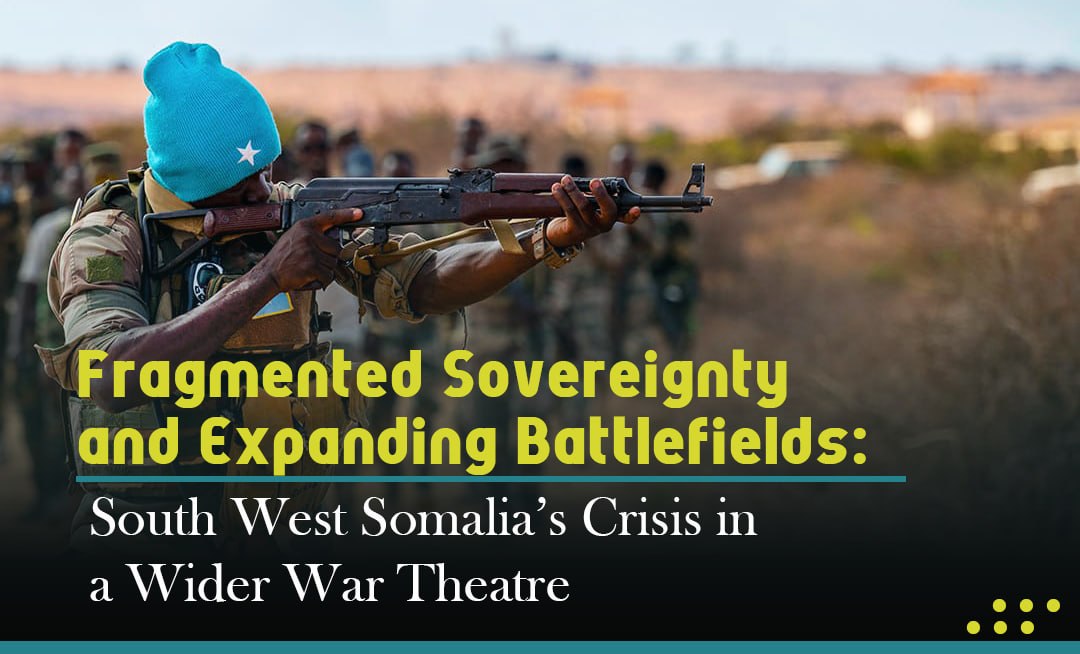
Initially, the reported advance of federal troops toward Baidoa appears as yet another episode in Somalia’s long struggle to consolidate central authority over its federal member states. Yet, this reading—while not incorrect—is profoundly incomplete. What is unfolding in South West State is less a localized political dispute and more a convergence point of layered conflicts: federal–regional tensions, insurgent opportunism, and an increasingly interconnected Red Sea security complex (Garowe Online, 2026). The paradox is stark: as the federal government seeks to assert sovereignty, the fragmentation it produces may inadvertently widen the operational space for insurgent actors such as Al-Shabaab. In this sense, Baidoa is not merely a domestic political theatre—it is an emerging node in a broader regional security architecture defined by overlapping crises and shifting power dynamics.
Somalia’s federal project, institutionalized in the provisional constitution of 2012, was conceived as a pragmatic response to decades of state collapse and civil war. By devolving authority to regional states, federalism aimed to accommodate clan diversity and mitigate zero-sum struggles over centralized power (Wahiu, W., & Abebe, A. K. 2025). Yet, more than a decade later, the system remains deeply contested, both in its design and implementation. South West State—whose political center lies in Baidoa—has historically been one of the most politically volatile federal entities, shaped by complex clan configurations, contested leadership transitions, and significant external involvement. Leadership disputes, externally influenced electoral processes, and the uneven distribution of security authority have rendered it particularly susceptible to recurring crises (Rift Valley Institute, 2023).
The current political impasse—stemming from contested electoral transitions and federal involvement—mirrors previous historical cycles, particularly the 2018 Baidoa crisis. During that period, the involvement of federal-aligned security forces was instrumental in determining regional leadership. These precedents have fostered a view among regional stakeholders that the federal center may operate as an active political participant rather than a neutral mediator.
This tension reflects a significant structural challenge within Somalia’s federalization process. While the central government aims to consolidate authority, it faces limitations in institutional legitimacy and administrative reach when applying that authority across diverse regions (Wahiu & Abebe, 2025). Consequently, a fragile equilibrium often emerges where centralized pressure serves as a temporary substitute for political consensus, potentially securing immediate cooperation while complicating long-term stability and state-building objectives.
In this fragmented landscape, Al-Shabaab has demonstrated remarkable strategic patience and adaptability. Unlike conventional insurgencies that rely on rapid territorial conquest, the group has cultivated a model of embedded resilience—exploiting governance vacuums, clan divisions, and political crises to entrench itself within local communities (Hansen, 2022; United Nations Security Council [UNSC], 2024). Its operational logic is not predicated solely on battlefield victories but on the gradual erosion of state legitimacy and the expansion of parallel governance structures. Taxation systems, shadow courts, and coercive enforcement mechanisms enable the group to maintain influence even in areas nominally controlled by government forces.
Historically, moments of intra-state conflict in Somalia have provided Al-Shabaab with critical opportunities for expansion. When federal and regional forces are preoccupied with each other, counterinsurgency pressure diminishes, intelligence-sharing breaks down, and operational coordination falters (Williams, 2020). Local communities, caught between competing authorities, often adopt pragmatic survival strategies that can include tacit accommodation with insurgent actors. The Baidoa crisis risks reproducing precisely these conditions. Reports of troop mobilization toward the city suggest an imminent confrontation that could divert significant federal resources away from ongoing offensives in central and southern Somalia (Garowe Online, 2026). Even if the federal government secures a tactical victory, the strategic cost may be a weakened counterinsurgency posture and a reconstitution of insurgent networks in previously contested areas.
Equally consequential is the psychological dimension of the conflict. Al-Shabaab has long framed the federal government as externally manipulated and internally illegitimate, portraying itself as a more authentic and consistent authority. A forceful intervention in South West State—particularly if it disrupts local political processes—could reinforce this narrative, enhancing the group’s recruitment appeal. In insurgency dynamics, perception often matters as much as capability. Legitimacy deficits, once entrenched, can prove far more difficult to reverse than territorial losses.
Yet, the Baidoa crisis cannot be understood in isolation from the broader geopolitical transformations unfolding along the Red Sea corridor. The growing assertiveness of Houthi forces in targeting maritime traffic has effectively transformed the Red Sea into a contested strategic theatre. Attacks on commercial shipping and the resulting disruptions at chokepoints such as the Bab el-Mandeb have begun to reverberate across global supply chains, increasing transport costs and altering trade routes (World Bank, 2024). What was once a relatively stable maritime artery is now an arena of geopolitical contestation with direct implications for the Horn of Africa.
This evolving context introduces a new layer of complexity for Somalia. Although geographically removed from the immediate theatre of Houthi operations, Somalia’s extensive coastline and limited maritime governance capacity render it vulnerable to spillover effects. The convergence of maritime insecurity and terrestrial insurgency could create hybrid threat environments in which actors like Al-Shabaab expand their operational repertoire. There is historical precedent for such convergence. During the height of Somali piracy in the late 2000s, militant groups demonstrated an ability to adapt to shifting security dynamics and exploit emerging opportunities . While Al-Shabaab has not traditionally prioritized maritime operations, the evolving Red Sea context may incentivize strategic recalibration—particularly if maritime insecurity creates new economic and logistical niches.
Overlaying these regional dynamics is the intensifying confrontation between the United States and Iran. Although the prospect of a full-scale ground war remains uncertain, even limited escalation carries significant implications for the Horn of Africa. First, increased U.S. military engagement in the Middle East could lead to a reallocation of strategic attention and resources away from East Africa. This would weaken international support for Somalia’s counterinsurgency efforts, placing greater strain on already overstretched federal forces. Somalia’s security architecture remains heavily dependent on external assistance, both in terms of funding and operational support. Any reduction in this support would have immediate and tangible consequences.
Second, Iran’s networked approach to regional influence—often mediated through non-state actors—raises the possibility of indirect engagement in the Horn of Africa. While there is no definitive evidence of Iranian support to Somali insurgents, the broader pattern of proxy dynamics suggests that prolonged confrontation with the United States could incentivize the expansion of influence into new theatres. The Horn, with its strategic location and fragile governance structures, presents a potentially attractive arena for such engagement.
Third, the securitization of maritime routes—particularly in response to Houthi activities—could militarize the Red Sea in ways that disrupt regional trade and exacerbate economic vulnerabilities. For Somalia, this could translate into reduced port revenues, increased import costs, and heightened socio-economic pressures. Such conditions are often fertile ground for insurgent recruitment, as economic hardship intersects with political marginalization.
For Ethiopia, the implications of these intersecting crises are both immediate and structural. Ethiopia’s security and economic interests are deeply intertwined with developments in Somalia and the Red Sea corridor. Instability in South West State—particularly if it enables an Al-Shabaab resurgence—poses a direct threat to Ethiopian border regions. The group has previously demonstrated the capacity to conduct cross-border incursions, targeting both military and civilian infrastructure (UNSC, 2024). A fragmented Somali security landscape would complicate Ethiopia’s counterinsurgency coordination, increasing the risk of unilateral actions that could further strain bilateral relations.
Equally consequential is Ethiopia’s economic exposure. As a landlocked state, Ethiopia’s economic lifelines are heavily dependent on Red Sea maritime routes, particularly through Djibouti. Disruptions caused by Houthi activities—or broader militarization linked to U.S.–Iran tensions—could significantly increase transport costs and delay critical imports, including fuel. This is not merely an economic concern but a strategic vulnerability. Rising costs and supply disruptions could exacerbate domestic inflationary pressures, with potential socio-political repercussions.
Diplomatically, the expanding conflict arc—from Somalia to the Red Sea to the Persian Gulf—places Ethiopia in an increasingly complex position. Maintaining balanced relations with competing external actors while safeguarding national interests will require nuanced engagement and strategic foresight. Ethiopia’s recent efforts to diversify port access and strengthen regional partnerships provide some insulation, but the scale and interconnectedness of emerging challenges demand a more comprehensive approach.
The Baidoa crisis should be understood not as an isolated event but as a node within a wider network of instability. Addressing its implications requires a shift from reactive crisis management to proactive strategic planning. For Somalia, this means recalibrating federal–regional relations by prioritizing political dialogue and establishing mechanisms for electoral dispute resolution. It also requires maintaining a consistent focus on counterinsurgency operations and investing in maritime governance to mitigate potential spillover from Red Sea instability.
For Ethiopia, the priorities are equally clear: strengthening border security and intelligence capabilities, diversifying trade and energy routes, and engaging in preventive diplomacy to support political stabilization in Somalia. At the same time, Ethiopia should pursue a strategy of diplomatic hedging, maintaining balanced relations amid intensifying global rivalries.
For regional and international actors, the imperative is to sustain support for Somalia’s stabilization while pursuing diplomatic solutions to Red Sea security challenges. Premature disengagement or unilateral militarization risks exacerbating an already volatile situation.
The unfolding events in Baidoa underscore a fundamental lesson: in fragile state contexts, internal fragmentation rarely remains contained. It creates openings—first for insurgents, then for external actors, and ultimately for systemic instability. Somalia stands at a critical juncture. The choices made in addressing the South West crisis will reverberate far beyond its borders, shaping the trajectory of security in the Horn of Africa and the Red Sea region.
References
Garowe Online. (2026). Somalia: Federal troops advance toward Baidoa as Southwest state heads to election. https://www.garoweonline.com/en/news/somalia/somalia-federal-troops-advance-toward-baidoa-as-southwest-state-heads-to-election
Hansen, S. J. (2013/2016). Al-Shabaab in Somalia: The History and Ideology of a Militant Islamist Group. Oxford University Press / Hurst.
Rift Valley Institute. (2023, August 15). Establishing an inclusive and sustainable political settlement in South West State: Opportunities for re-establishing dialogue. ReliefWeb. https://reliefweb.int/report/somalia/establishing-inclusive-and-sustainable-political-settlement-south-west-state-opportunities-re-establishing-dialogue
United Nations Security Council. Report of the Secretary-General on the Situation in Somalia. S/2024/129.
Wahiu, W., & Abebe, A. K. (2025). From substate governance to constitution-building at the centre: A view from Somalia. International IDEA. https://www.idea.int/sites/default/files/2025-04/from-substate-governance-to-constitution-building-somalia.pdf
Williams, P. D. (2018). Fighting for Peace in Somalia: A History and Analysis of the African Union Mission (AMISOM), 2007-2017. Oxford University Press.
World Bank. (2024). Global economic impacts of Red Sea shipping disruptions. https://www.worldbank.org
By Hanan Hassen, IFA
Disclaimer:
The content disseminated by the Institute of Foreign Affairs (IFA) – including, but not limited to, publications, public statements, events, media appearances, and digital communications – reflects the views of individual contributors and does not necessarily represent the official positions or policies of the Institute, its partners, or any affiliated governmental or non-governmental entities.
While the IFA endeavors to ensure the accuracy, integrity, and timeliness of the information presented, it makes no representations or warranties, express or implied, regarding the completeness, reliability, or suitability of such content for any purpose. The Institute expressly disclaims any liability for errors or omissions, as well as for any actions taken or decisions made based on the information provided.
The inclusion of external links, references, or third-party resources does not constitute an endorsement by the Institute. Additionally, engagement on social media platforms – including, but not limited to, likes, shares, retweets (RTs), or reposts – shall not be interpreted as an endorsement or validation of the views expressed therein.
Readers and audiences are encouraged to exercise critical judgment and seek independent verification when interpreting or relying upon any information disseminated through publications and posts on the Institute’s platforms or representatives.