

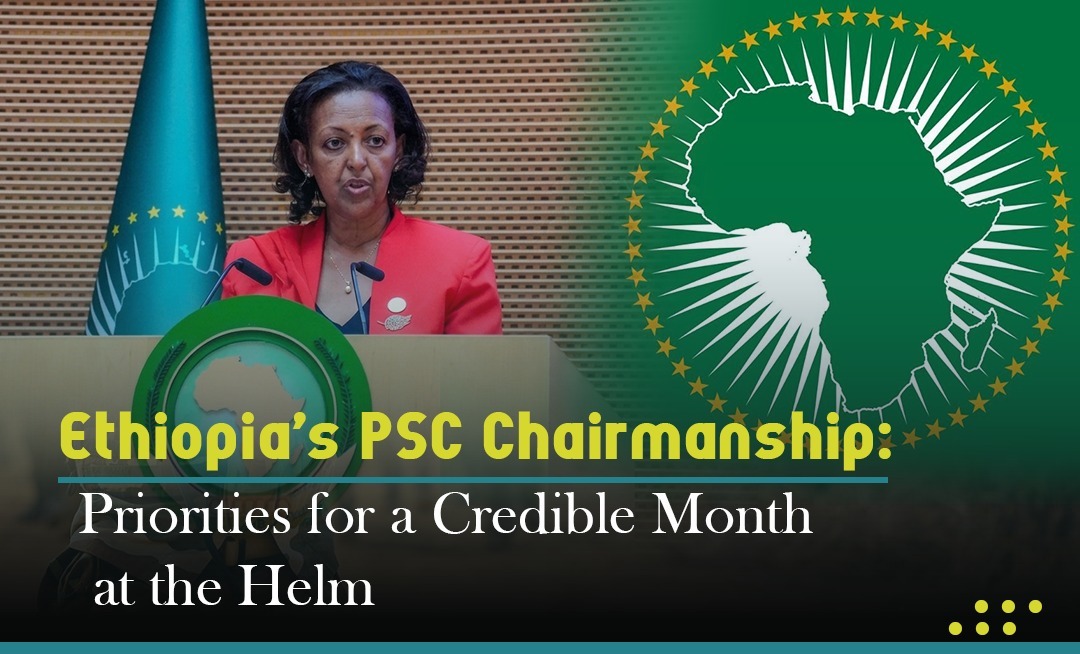
Ethiopia’s assumption of the chairmanship of the African Union Peace and Security Council (PSC) in April 2026 should be read less as a ceremonial rotation than as an opportunity to reinforce the Council’s institutional value at a demanding moment in African peace and security diplomacy.[1] The month’s programme is both dense and politically relevant. It spans thematic deliberation on hate crimes and genocidal ideology, a post-election assessment of the Central African Republic (CAR), a ministerial discussion on artificial intelligence and peace and security, an A3 briefing on African coordination in the UN Security Council, a field mission to South Sudan, an open session on peace support operations, and the fifth annual PSC-APRM retreat.[2] In that sense, Ethiopia’s chairmanship is not simply about occupying the seat at the head of the table. It is about shaping whether the Council appears coherent, purposeful, and strategically useful across a varied set of files.
This is where Ethiopia enters with distinct advantages. As host of the African Union and one of the continent’s most experienced diplomatic hubs, Addis Ababa occupies a singular place in African multilateral practice. That role gives Ethiopia a familiarity with institutional tempo, political signalling, and intergovernmental process that can help turn a rotating chairmanship into an exercise in continuity rather than disruption.[3] More broadly, Ethiopia’s place in African diplomacy gives it an interest in ensuring that the PSC is seen not as a reactive forum, but as a functioning continental mechanism able to link prevention, political engagement, and follow-up. A constructive Ethiopian chairmanship would therefore serve two purposes at once: it would project national diplomatic competence while also helping to consolidate the authority of the PSC as a central pillar of African security governance.
African multilateral institutions are neither symbolic ornaments nor all-powerful instruments. They need to be indispensable arenas of legitimacy whose performance depends on collaboration, coordination, and state buy-in.[4] The PSC’s value lies precisely in its ability to convene African states around shared frameworks for conflict prevention, crisis management, and policy coordination, even when outcomes remain constrained by political realities. Ethiopia’s task, then, is to give the Council a month that feels disciplined, connected, and cumulative.
A first priority lies in protecting the chairmanship from politicization. Because Ethiopia is a consequential regional actor, its management of Council proceedings may attract efforts by adversarial states or competing actors to recast ordinary procedural decisions as evidence of hidden political intent. The best answer is not defensiveness. It is procedural steadiness. Transparent scheduling, inclusive consultations, careful handling of sensitive agenda items. Ethiopia’s effort to preserve the institutional integrity of the chairmanship is part of effective statecraft within a contested diplomatic environment.
The second priority is to ensure that the month’s diverse agenda produces strategic coherence. The April programme already contains the elements of a strong chairmanship. What matters is whether they are treated as disconnected events or woven into a recognizable line of institutional effort. One useful organizing frame would be to link the month around three related themes: prevention, operational relevance, and implementation. The open session on hate crimes and genocidal ideology fits naturally into a prevention agenda. The AI ministerial can be situated within the future of governance tools and security oversight. The South Sudan field mission and the peace support operations session can anchor the month’s operational dimension. The A3 briefing and PSC-APRM retreat can then serve as vehicles for alignment and implementation follow-up.[6] Such an approach would give April a strategic rhythm rather than a crowded but fragmented calendar.
The early open session on hate crimes and genocidal ideology offers Ethiopia an opportunity to foreground the preventive side of the PSC’s mandate. The official programme notes that the session builds on the Council’s April 2025 conclusions, which emphasized accountability, anti-impunity measures, stronger national legal and institutional frameworks, improved early warning, and closer cooperation with digital platforms, media, and civil society.[7] This is an important agenda for the PSC because it links normative commitment to policy capacity. Ethiopia’s constructive role here would be to keep the discussion anchored in operational prevention: how legal and institutional tools can be strengthened, how digital incitement can be monitored without rhetorical excess, and how the Council can support practical continental frameworks rather than issue broad declarations detached from implementation.
The CAR session requires a similarly calibrated approach. The programme indicates that the PSC will shift from its earlier pre-election focus to a post-election assessment following President Faustin-Archange Touadéra’s January 2026 victory, while also taking into account the fragility of recent political gains and the persistence of humanitarian and security pressures.[8] Ethiopia can add value by ensuring that the discussion remains balanced and constructive. The issue is not whether the Council should choose between endorsement and alarm. It is whether the PSC can support a pathway that protects political dialogue, encourages confidence-building, and sustains attention to fragile stabilization gains. In this respect, a well-managed session would reflect one of the PSC’s more useful functions: giving African states a forum for sober post-election assessment without surrendering the discussion either to complacency or to diplomatic theatrics.
The ministerial session on artificial intelligence may become the most visible item of the month, but its significance lies in whether it produces policy direction rather than symbolism. The programme notes that earlier PSC sessions in 2024 and 2025 already advanced discussion on the risks and opportunities of AI, including its application to peace support operations, early warning systems, and preventive diplomacy, while also calling for an African Common Position and an African Charter on AI.[9] It also records subsequent institutional movement, including the establishment of the AU AI Advisory Group on Governance, Peace and Security and the adoption of a joint AU–RECs/RMs roadmap to integrate AI into early warning processes.[10] Ethiopia is well placed to make this session constructive by keeping it focused on governance consequences: how AI can strengthen anticipatory capacity, how disinformation and surveillance risks can be mitigated, and how African institutions can shape standards rather than merely absorb external technological agendas. That would allow the PSC to show that strategic modernization and institutional responsibility can advance together.
The strongest practical test of the chairmanship will likely come with the South Sudan field mission and the Council’s subsequent consideration of its report. The programme makes clear that the visit comes at a critical juncture, amid continued delays in implementing key provisions of the peace agreement and rising concern around the transition toward elections planned for December 2026.[11] Field missions matter because they place the Council in direct engagement with realities on the ground; they are one of the PSC’s clearest tools for connecting diplomacy with oversight. Ethiopia’s opportunity here is to ensure that the mission is translated into focused findings, politically useful recommendations, and follow-up that keeps the Council engaged beyond the visit itself. If that happens, the mission will stand as evidence that the PSC remains capable of combining presence with purpose.
The same logic applies to the open session on peace support operations. The official programme anticipates discussion of the future, effectiveness, financing, and legitimacy of AU-led and AU-mandated operations, including lessons from wider debates on peacekeeping and the need to reposition operations in more complex security environments.[12] This is an area where Ethiopia can help move the conversation toward practical strategic questions: mandate design, adaptability, partnerships, protection of civilians, and sustainable financing. A constructive chairmanship would not try to solve these longstanding debates in one sitting. But it can ensure that the discussion produces usable direction and reinforces the PSC’s role as a forum where African states think seriously about the future of continental security mechanisms.
The A3 briefing and the PSC-APRM retreat complete the month by addressing a quieter but essential issue: institutional alignment. The programme notes that the A3 session will review how African members of the UN Security Council have coordinated positions on major African files, while the APRM retreat will examine implementation of past conclusions and advance discussion on early warning and conflict prevention.[13] These are not secondary events. They are points where continental diplomacy, governance analysis, and security policy can be brought into closer conversation. Ethiopia’s added value as chair would be to use these moments to strengthen coherence between Addis Ababa and New York, and between diagnosis and follow-through inside the AU system itself.
In the end, the success of Ethiopia’s April chairmanship will not depend on whether it dominates the Council, but on whether it helps the Council perform at a high institutional standard across a demanding agenda. The more durable contribution would be to show that the PSC can still function as a credible mechanism of African coordination when guided by procedural confidence, strategic coherence, and practical follow-up. For Ethiopia, that would reinforce its standing not only as the host of the AU, but as a state capable of converting diplomatic centrality into constructive multilateral leadership. For the PSC, it would offer something equally important: a month in which the institution appears not overstretched, but governed.
References
References
[1] Provisional Programme of Work of the Peace and Security Council for April 2026.
[2] Provisional Programme of Work of the Peace and Security Council for April 2026;;.
[3] Horn Review Editorial Intelligence Brief.
[4] Horn Review Editorial Intelligence Brief.
[5] Provisional Programme of Work of the Peace and Security Council for April 2026.
[6] Provisional Programme of Work of the Peace and Security Council for April 2026;.
[7] Provisional Programme of Work of the Peace and Security Council for April 2026.
[8] Provisional Programme of Work of the Peace and Security Council for April 2026.
[9] Provisional Programme of Work of the Peace and Security Council for April 2026.
[10] Provisional Programme of Work of the Peace and Security Council for April 2026.
[11] Provisional Programme of Work of the Peace and Security Council for April 2026;.
[12] Provisional Programme of Work of the Peace and Security Council for April 2026.
[13] Provisional Programme of Work of the Peace and Security Council for April 2026;.
By Dinaol Ibraahim, IFA
Disclaimer:
The content disseminated by the Institute of Foreign Affairs (IFA) – including, but not limited to, publications, public statements, events, media appearances, and digital communications – reflects the views of individual contributors and does not necessarily represent the official positions or policies of the Institute, its partners, or any affiliated governmental or non-governmental entities.
While the IFA endeavors to ensure the accuracy, integrity, and timeliness of the information presented, it makes no representations or warranties, express or implied, regarding the completeness, reliability, or suitability of such content for any purpose. The Institute expressly disclaims any liability for errors or omissions, as well as for any actions taken or decisions made based on the information provided.
The inclusion of external links, references, or third-party resources does not constitute an endorsement by the Institute. Additionally, engagement on social media platforms – including, but not limited to, likes, shares, retweets (RTs), or reposts – shall not be interpreted as an endorsement or validation of the views expressed therein.
Readers and audiences are encouraged to exercise critical judgment and seek independent verification when interpreting or relying upon any information disseminated through publications and posts on the Institute’s platforms or representatives.