

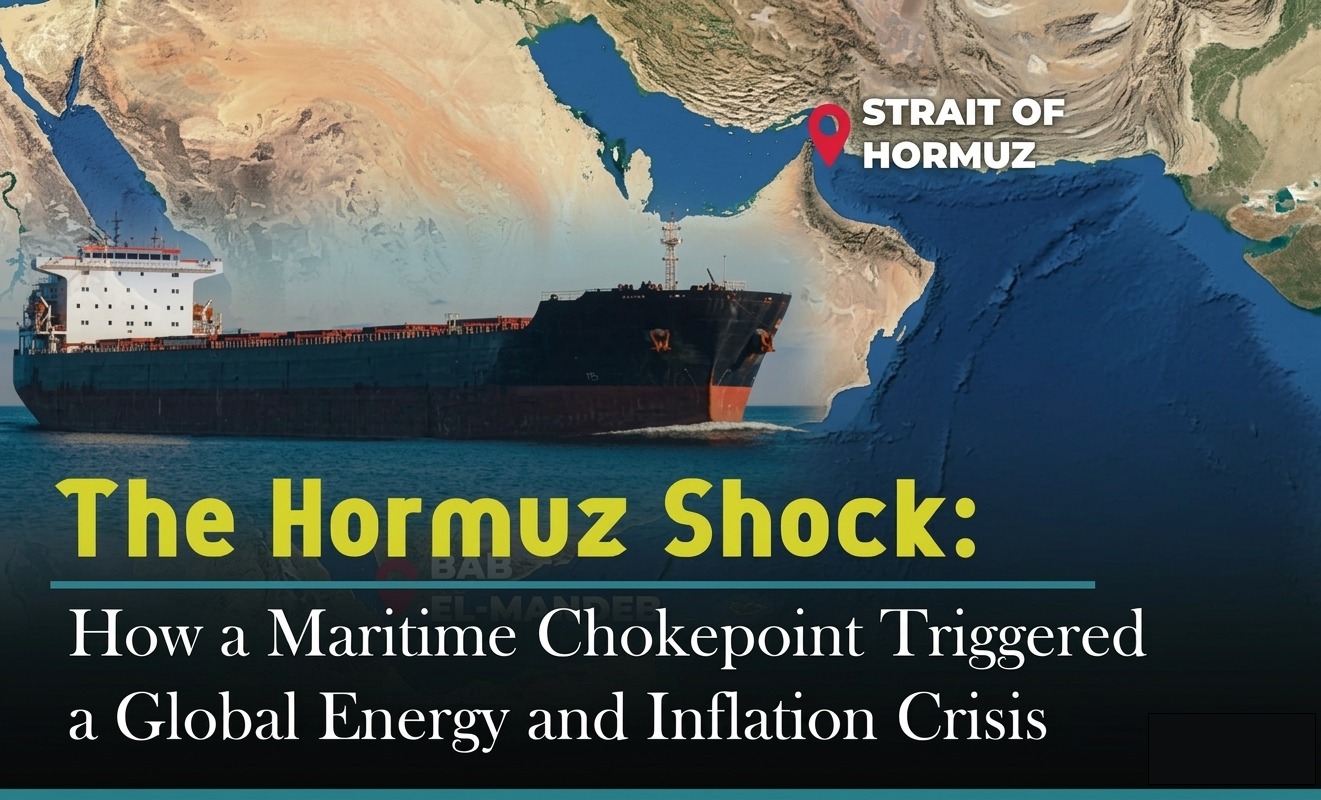
Executive Summary
The Strait of Hormuz is a critical chokepoint in the global energy landscape, facilitating the transit of oil and gas via Very Large Crude Carriers (VLCCs). Its unique hydrographic characteristics make it essential for global energy supplies, and any disruption can significantly constrain transport capacity, leading to increased costs and reduced supply. While alternative routes like Saudi Arabia’s Petroline and the UAE’s Habshan–Fujairah pipeline exist, they can only accommodate a small fraction of the volume that typically transits through the Strait. This vulnerability was starkly illustrated during the 2026 escalation, where a “Denial of Access” strategy halted commercial traffic. The immediate aftermath saw insurance exclusions drive up war-risk premiums and freight costs triple, resulting in Brent crude prices exceeding $100 per barrel and highlighting market volatility.
The repercussions of this crisis extended beyond oil markets, triggering inflation as rising energy prices increased transportation and agricultural costs, contributing to a widespread cost-of-living crisis. Oil-importing nations faced fiscal pressures as they managed subsidy costs while addressing social unrest. The Strait exemplifies a “single point of failure” in the global energy system, with nearly a third of seaborne oil and a fifth of global LNG passing through it. The 2026 crisis demonstrated how quickly disruptions can lead to broader economic consequences, cutting off global spare capacity and undermining market stabilization. Thus, the Strait of Hormuz is not just a transit route; it is a pivotal element that shapes global energy markets and economic stability. Its inherent vulnerabilities necessitate strategic considerations for energy security and underscore the potential for cascading effects on the global economy in case of disruptions.
1. Background and Context: The Hormuz Bottleneck and the 2026 Crisis
The Strait of Hormuz constitutes a non-negotiable transit corridor for approximately 21 million barrels of oil per day and nearly one-fifth of global liquefied natural gas (LNG) consumption.¹ ⁴ Accounting for close to 25% of all seaborne oil trade, it operates with minimal alternative routes, creating a structurally fragile system in which even limited disruptions generate immediate market volatility.² This vulnerability reached a critical tipping point in early 2026. Following high-intensity kinetic strikes on strategic assets, a “Denial of Access” doctrine was swiftly operationalized, effectively halting commercial maritime traffic through the Strait. Within 72 hours, the crisis escalated beyond the Persian Gulf, extending to the Bab el-Mandeb Strait and merging two of the world’s most critical chokepoints into a single, high-risk conflict zone.³
The disruption was further intensified by a simultaneous collapse in the global marine insurance market. War-risk premiums surged by approximately 1,000%, raising insurance costs for Very Large Crude Carriers (VLCCs) from around $750,000 to nearly $9 million per voyage, while tanker freight rates tripled amid heightened risk and rerouting requirements.⁵ ⁶ With global spare production capacity largely concentrated within—and effectively trapped behind—the Hormuz bottleneck, the market lost its primary supply buffer. Consequently, Brent crude prices surged above $100 per barrel, marking a 50% increase within two weeks, while futures markets began pricing in scenarios approaching $150 per barrel.⁷
2. The Global Significance of the Hormuz Chokepoint
The Strait of Hormuz constitute approximately 20–30% of global seaborne petroleum trade and roughly one-fifth of liquefied natural gas (LNG) flows, a volume that underscores its absolute centrality to the global energy system.¹ ⁴ Its geographic position makes it an indispensable gateway for Gulf exporters, linking regional supply to international markets with few viable large-scale alternatives.
The depth of this dependency was starkly illustrated during the 2026 crisis, when the immobilization of more than 150 tankers revealed that disruption occurs not only through physical interdiction but also through financial paralysis—specifically the collapse of maritime insurance coverage.³ This dual vulnerability, both physical and financial, transformed a localized security incident into a systemic global shock.
The Strait’s strategic weight is further reinforced by its hydrographic characteristics, which allow it to accommodate Very Large Crude Carriers (VLCCs), the backbone of global energy transport. Because international energy infrastructure is calibrated to these specific vessels, any disruption imposes disproportionate constraints on transport capacity, sharply increasing costs while simultaneously reducing effective supply.² Although bypass infrastructure exists—such as Saudi Arabia’s Petroline and the UAE’s Habshan–Fujairah pipeline—these alternatives can offset only a small fraction of the Strait’s total transit volumes.¹
The 2026 escalation demonstrated how rapidly these structural constraints translate into market chaos. Following the operationalization of a “Denial of Access” doctrine, commercial traffic through the Strait was effectively halted. Simultaneously, the imposition of blanket insurance exclusions caused war-risk premiums to surge and freight costs to triple.³ ⁵ ⁶ With the world’s spare production capacity largely concentrated within—and effectively trapped behind—the Gulf, the global market lost its primary stabilizing mechanism.⁴ Consequently, Brent crude prices exceeded $100 per barrel, with expectations of further volatility.⁷
Beyond energy markets, the shock transmitted rapidly into the broader global economy. Rising energy prices acted as a catalyst for inflation; a sustained 10% increase in energy costs typically adds approximately 0.4 percentage points to global inflation.⁸ For oil-importing economies, this created acute fiscal pressures as governments struggled to balance rising subsidy burdens against the threat of social unrest. Higher energy costs also inflated transportation and agricultural input prices, driving up the cost of food and fertilizer and contributing to a pervasive cost-of-living crisis.⁸
The Strait of Hormuz constitutes a classic “single point of failure” within the global energy system. The concentration of critical flows through this narrow, non-substitutable corridor creates a state of permanent systemic vulnerability. Carrying nearly a third of seaborne oil and a fifth of global LNG, the Strait lacks the redundant routes necessary to absorb a disruption.¹ ⁴ ² The 2026 crisis proved how rapidly this fragility can cascade: the closure of the Strait not only halted physical transit but also rendered global spare capacity inaccessible, stripping the market of its ability to self-stabilize.³ ⁴ As logistics collapsed, the shock reverberated through the global economy in the form of inflation, fiscal strain, and supply chain breakdown.⁷ ⁸ Ultimately, Hormuz does more than influence global markets—it structurally determines them, acting as a chokepoint whose failure can override market mechanisms and dictate the trajectory of global economic stability.
3. Managing the Hormuz Shock
- Immediate to short-term actions (0–12 months): Implement emergency responses such as releasing national oil reserves, enforcing fuel rationing with priority given to essential services and logistics, and expanding financial assistance to those economically disadvantaged by the crisis.⁸
- Mid-term strategies (1–5 years): Transition away from oil reliance: Focus on policies that support the rapid electrification of transport and industrial sectors, while significantly increasing the capacity of renewable energy generation to diminish reliance on foreign oil supplies.⁵
- Long-term plans (5+ years): Economic Diversification: Efforts should be made to fundamentally restructure economies to lessen their oil dependency through diversification into sectors with higher productivity, investing in workforce development, and enhancing governance to foster secure investments.⁹
4. Takeaways
The crisis of 2026 has elevated the Strait of Hormuz to not just a global flashpoint, but a systemically vulnerable chokepoint and single point of failure in the world energy market. Limited re-route alternatives and effective buffering capacity mean that future disruptions to the flow of oil through the Strait threaten significant macroeconomic and geopolitical consequences far beyond oil price spikes.
References
- U.S. Energy Information Administration (EIA), 2023. World Oil Transit Chokepoints: The Middle East. Washington, D.C.: U.S. Department of Energy.
- Yergin, D., 2020. The New Map: Energy, Climate, and the Clash of Nations. New York: Penguin Books.
- Reuters, 2026c. Shipping Paralyzed: 150 Tankers Stranded as Iran Issues Transit Warnings. 14 March.
- International Energy Agency (IEA), 2023. Oil Market Report 2023. Paris: IEA/OECD.
- Lloyd’s List, 2026a. Insurance and Freight: The New Reality of Gulf Transit. March.
- International Monetary Fund (IMF), 2026a. PortWatch: Real-Time Monitoring of the Strait of Hormuz Disruptions. Washington, D.C.: IMF.
- Reuters, 2026a. Brent hits record highs as Hormuz traffic remains paralyzed. 28 March; EIA, 2026c. Impact of Persian Gulf Interdiction on Brent Benchmarks.
- International Monetary Fund (IMF), 2026b. World Economic Outlook: Managing the 2026 Energy Shock. Washington, D.C.: IMF.
- International Monetary Fund (IMF), 2023. Economic Diversification in Oil-Dependent Economies. Washington, D.C.: IMF.
About the author
Yitina Gebre (Ph.D.), Senior Researcher at the Multilateral Affairs Department, Institute of Foreign Affairs
Disclaimer:
The content disseminated by the Institute of Foreign Affairs (IFA) – including, but not limited to, publications, public statements, events, media appearances, and digital communications – reflects the views of individual contributors and does not necessarily represent the official positions or policies of the Institute, its partners, or any affiliated governmental or non-governmental entities.
While the IFA endeavors to ensure the accuracy, integrity, and timeliness of the information presented, it makes no representations or warranties, express or implied, regarding the completeness, reliability, or suitability of such content for any purpose. The Institute expressly disclaims any liability for errors or omissions, as well as for any actions taken or decisions made based on the information provided.
The inclusion of external links, references, or third-party resources does not constitute an endorsement by the Institute. Additionally, engagement on social media platforms – including, but not limited to, likes, shares, retweets (RTs), or reposts – shall not be interpreted as an endorsement or validation of the views expressed therein.
Readers and audiences are encouraged to exercise critical judgment and seek independent verification when interpreting or relying upon any information disseminated through publications and posts on the Institute’s platforms or representatives.