

Executive Summary
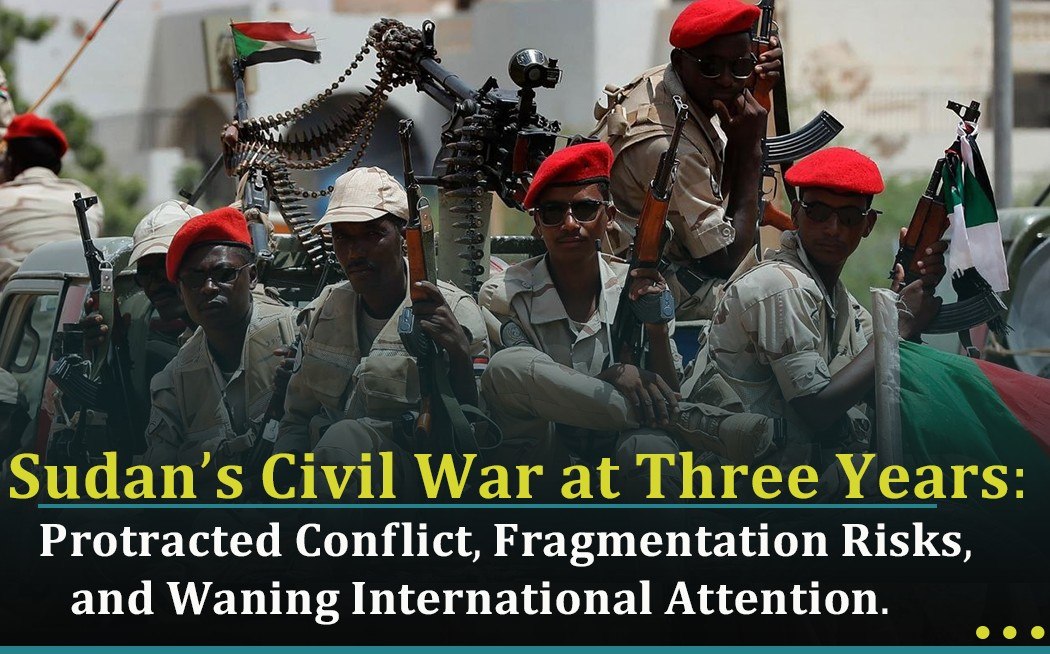
April 15 marks the third year of the outbreak of civil war in the Sudan. The conflict erupted on 15 April 2023 when rival powers, the Sudan Armed Forces (SAF) and the paramilitary Rapid Support Forces (RSF), were trying to outmaneuver each other. Since then, the conflict has brought havoc to the country that has far reaching consequences. Despite regional and international efforts to resolve the crisis and put the country back on the right track, the conflict seems unlikely to end in the near future. The outbreak of the war between Israel, the United States, and Iran has further overshadowed the unfolding crisis in the country. The current crisis raises a question of what will come next amid the declining attention from the international community. Cognizant of the current internal and external settings, the conflict in Sudan will remain protracted and continue to accentuate the fragility of the state that has a spillover effect on neighboring states.
Antecedents to the Current Crisis
Since its independence in 1956, Sudan has experienced different attempts at political openings. The attempt to open the political space where civilians controlled the state apparatus, however, often faced reversals in part due to “crisis in governance, political class’s incapacity to lead the country effectively and the failure to anchor political transition on historical settlement.”[1] The prevailing “political marketplace”[2], above all, according to close observers of Sudanese politics, helped the political system under Omar al-Bashir build loyalty among the political and military elites while maintaining divisions among the ruling elite. This state of affairs tended to narrow the prevalence of political space that could give an opportunity to make a successful political transition to democracy.
Al-Bashir, during its stay in power, entrenched the regime’s legitimacy through “the transactional nature of power and resource exchange”.[3] This modus operandi had dominated the country’s system of governance. Nevertheless, the dwindling of oil revenues that helped the regime buy allegiance compelled Khartoum to forge a closer tie with Abu Dhabi and Riyadh to overcome financial deficits by opening the country to Gulf investment and aligning its foreign policy in Yemen’s civil war during 2015 and 2016. During these times, Saudi Arabia and the United Arab Emirates financed SAF and the RSF to deploy their troops separately.[4] Furthermore, the separation of South Sudan in July 2011 compelled Omar al-Bashir’s regime to rely on major alternative source of revenue: gold. Generating alternative sources of revenue, however, failed to maintain the patronage system as it did in pre-2011 periods.[5]
After nearly three decades of rule under Omar al-Bashir, the wind of change swept the political landscape of Sudan in 2019, when protests erupted across the country calling for political reforms. The inability to maintain the patron-client system coupled with the difficulties of diluting the discontents harbored by different segments of society that paved the way for protest. The protesters’ demands were not limited to economic reforms and included calls for regime change, which ultimately led to the regime’s demise. Indeed, the cracks within the regime’s political and military elites were the primary reason for its toppling. The fall of Al-Bashir marked the inability of the regime to maintain the old rule of the game that deeply rooted in “the transactional nature of power and resource exchange”.[6]
The lack of unity among the civilian force and the military’s intransigence in serving its interests intact made the political transition to democracy fragile, however. The military’s resistance to civilian rule was evident when it violently crushed protests in Khartoum calling for civilian rule. The atrocities committed against the civilians drew criticism and condemnation from different international actors. The pressure forced the Transitional Military Council (TMC) to reach a negotiated agreement with the Forces of Freedom and Change (FFC) on April 17, 2019, that paved the way for the appointment of Abdalla Hamdock as prime minister on 21 August 2019. The civilian government, however, failed to materialize the demands and proposed priorities to reform the political space, amid a lack of or weakness in disincentives vis-à-vis the military’s vested interests in clinging to power. In October 2021, the TMC staged a coup against the civilian government. In response to the military crackdown on the civilians and the military coup in October 2021, the African Union Peace and Security Council, during its 1041st meeting, suspended Sudan from membership, particularly from “the participation of the Republic of Sudan in all AU activities until the effective restoration of the civilian-led Transitional Authority.”[7] Although Prime Minister Hamdock was reinstated with external pressure mounted on the coup makers, Hamdock resigned after a couple of months in January 2022. The circumstances provided an opportunity for a struggle between the SAF and RSF, which finally erupted on 15 April 2023 in Khartoum.
Three Years of Civil War and Regional Implications
The sidelining of the civilian group from charting the political path of the country could not assure the TMC to rule the state as a coherent unit. The components of the TMC, the SAF and the RSF, had demonstrated crack when both groups were trying to outmaneuver against one another. With little anticipation from the close observers of Sudan’s internal politics, violent conflict erupted between the two rival groups on 15 April 2023 around Khartoum. Since then, Sudan has gone through violent conflicts. Reports confirmed that the conflict has produced “the worst humanitarian and protection crisis for women and girls”[8], given the fact that sexual violence has been often used as a weapon of war. According to the United Nations report, the violent conflict has resulted in the internal displacement of 9 million people and 4.4 million Sudanese are forced to seek refugees in neighboring countries of Chad, South Sudan and Egypt.[9]
Aside from the humanitarian catastrophes the conflict has brought to the people, the conflict has brought danger to the territorial integrity of the state when the RSF declared a parallel government in Nyala, Southern Darfur. The parallel government composed of fifteen members that are headed General Mohamed Dagalo. Abdelaziz al-Hilu, the commander of the Sudan People’s Liberation Movement-North (SPLM-N) was appointed as the deputy of the Council.[10] 30 August 2025 parallel government proclamation by establishing a rival administration posed “threat of partition”[11] and solidify geographical divisions to the already fragile state. In response to the formation of a parallel government, General al-Burhan castigated the parallel administration as “phantom” and vowed to further engage in confrontation to assure full control over the whole Sudan. [12]The situation further incentivize the fragmentation of the state when both rival groups are trying to searching legitimacy from external partners and appointed rival Prime Ministers for their respective administrations. Thus far, no official recognitions have been given to the rival de facto government in Nyala. On contrary, although the African Union (AU) is still deprived recognition for the legitimate rule of the Burhan’s government due to the unconstitutional change of government in 2021, Egypt and the Kingdom of Saudi Arabia are remained its strong supporters.
Since its eruption, the conflict has regional dimensions. Since the country borders seven countries, it is a strategic location between the Sahel and the Red Sea, and it serves as a gateway between the Arab world and Africa, and its resource potential has easily drawn different regional and extra-regional actors.[13] Most of its neighboring countries have continued to serve as refugee host nations. Due to the continuous disruption of oil production in Heglig oilfield as well as the drone strikes on Port Sudan, South Sudan’s ability to transport oil to the international market has often faced setbacks. This situation has significantly affected Juba’s revenue, which has largely come from oil exports. Statistical figures showed that disruptions to oil exports to the international market cost the South Sudanese economy in terms of oil revenues, which cover 80 percent and 90 percent of the national budget and fiscal revenue, respectively.[14] External actors are still funneling financial and military support to warring groups, thereby making the conflict, which has shown no signs of ending. Furthermore, both SAF and RSF are engaged in forging and maintaining “a coalition of external patrons”[15] that help them in reinforcing their war efforts in their bid to rule the country.
The current crisis in the Persian Gulf has tended to overshadow the conflict and its attendant consequences. The Quad, such as the KSA, the UAE, Egypt, and the USA, is either directly or indirectly engaged in a political and security crisis in the Hormuz Strait. These states are tending to drift away from fully engaging in addressing the crisis in Sudan. Furthermore, the conflict in the Persian Gulf has disrupted the “humanitarian supply routes and shipping aid has become slower and more costly.”[16]
What Comes Next
While the current external environment mentioned in the preceding section may undermine both parties’ ability to continue their war efforts, SAF and the RSF have still maintained control of resources that support their war machinery. SAF and its Islamist allied groups, for instance, have still grappled to accrue revenues generated from oil, gum Arabic, sesame, weapons, fuel, wheat, telecommunications, and banking.[17] The RSF has also maintained a significant revenue source from gold. Besides the domestic resource revenues, both warring sides are benefitting from the support originating from the Gulf States.[18]
Although the AU, Intergovernmental Authority on Development (IGAD), and external actors are trying to arrest the violent conflict ravaging the country, Sudan will remain in protracted violent conflict due to different circumstances. First, both actors have failed in getting the upper hand in the war effort. Second, both sides’ still control revenues that could help parties to the conflict maintain the war effort in the foreseeable future. Third, the conflict in the Sudan is currently overshadowed by the Persian Gulf crisis, relegating the former to marginal attention by the international community. Furthermore, regional actors that are hitherto backers of the parties to the conflict would likely to remain to “fuelling a proxy war”[19] that may not parallel the efforts they did in the periods preceding the recent crisis in the Persian Gulf.
The Sudan conflict, during its third year, will remain the major producer of the humanitarian crisis in the region. Recent reports[20] confirmed that Sudan has become a testimony of the worst humanitarian crisis, meaning that millions of internally displaced persons and refugees have fled to neighboring countries. The conflict in Sudan and the formation of the parallel government will continue to exacerbate the humanitarian crisis, prolong the conflict, and further entrench the fragility of the state. In such a precarious security environment, it is unlikely to realize “a civilian-led and consensual transition in Sudan”[21]in accordance with the Constitutional Declaration and Juba Peace Agreement. Although SAF has shown interest in returning back to the continental organization after its suspension for the last over four years through urging the AU during the 39th annual summit, it will remain in suspension until the “full restoration of a democratically elected and civilian-led government in line with the AU Instruments and Decisions”[22] as per the decision of 1330th meeting of the Peace and Security Council. Furthermore, the inability to reach a negotiated settlement between the warring parties, backed by external actors, amid the maintenance of a parallel government could further divide a state, replicating its northern neighbor, Libya. The unabated conflict in the country will, overall, contribute to the destabilization of the region, where extra-regional actors are seeking to secure their regional interests at the expense of the Horn’s stability.
[1] El-Battahani, Atta H. (2023). The Dilemma of Political Transition in Sudan: An Analytical Approach. International Institute for Democracy and Electoral Assistance.
[2] De Waal, Alex.(2016). Sudan: A Turbulent Political Marketplace. In Mehran Kamrava (Ed.), Fragile Politics: Weak States in the Greater Middle East (pp.171-196). Oxford University Press.
[3] Gleixner-Hayat, Brittany.(2024). Sudan. In the Report on U.S. Support for Democratic Openings in Conflict-Affected Countries: Lessons From Ethiopia and Sudan. Carnegie Endowment for International Peace.
[4] De Waal, Alex.(2019). Sudan: A Political Marketplace Framework Analysis. Occasional Paper No.19. World Peace Foundation.
[5] Medani, Khalid.(2024). The Struggle for Sudan. Middle East Report. No. 310.
[6] Gleixner-Hayat, Brittany.(2024). Sudan. In the Report on U.S. Support for Democratic Openings in Conflict-Affected Countries: Lessons From Ethiopia and Sudan. Carnegie Endowment for International Peace.
[7] African Union Peace and Security Council.(2021). Communiqué (PSC/PR/COMM.1041 (2021)). Peace and Security Council 1041st Meeting.
[8] https://www.unwomen.org/en/articles/in-focus/sudan
[9] United Nations.(2026). Sudan: 14 million displaced; hunger and attacks on health continue as war enters fourth year. Retrieved from https://news.un.org/en/story/2026/04/1167281.
[10] Reuters.(26 July 2025).Sudanese coalition led by paramilitary RSF announces parallel government. Retrieved from https://www.reuters.com/world/africa/sudanese-coalition-led-by-paramilitary-rsf-announces-parallel-government-2025-07-26/
[11] International Crisis Group.(2025). Sudan’s RSF Proclaims Parallel Government, Raising Threat of Partition. Retrieved from https://www.crisisgroup.org/alr/africa/sudan/sudans-rsf-proclaims-parallel-government-raising-threat-partition
[12] TRT World.(27 July 2025). Sudan denounces ‘parallel government’ by paramilitary RSF. Retrieved from https://www.trtworld.com/article/98c6680f0301
[13] Siegle, Joseph.(2025). Sudan’s Conflict and the Genocide Declaration: Regional Ramifications and Path to Resolution. Italian Institute for International Political Studies.
[14] https://www.thecitizen.co.tz/tanzania/news/africa/juba-s-internal-struggle-how-sudan-s-war-fuels-south-sudan-s-crisis-5065062
[15] Siegle, Joseph.(2025). Sudan’s Conflict and the Genocide Declaration: Regional Ramifications and Path to Resolution. Italian Institute for International Political Studies.
[16] United Nations.(2026). Sudan: 14 million displaced; hunger and attacks on health continue as war enters fourth year. Retrieved from https://news.un.org/en/story/2026/04/1167281.
[17] Medani, Khalid.(2024). The Struggle for Sudan. Middle East Report. No. 310.
[18] Medani, Khalid.(2024). The Struggle for Sudan. Middle East Report. No. 310.
[19] Medani, Khalid.(2024). The Struggle for Sudan. Middle East Report. No. 310.
[20] United Nations.(2026). Sudan: 14 million displaced; hunger and attacks on health continue as war enters fourth year. Retrieved from https://news.un.org/en/story/2026/04/1167281.
[21] African Union Peace and Security Council.(2021). Communiqué (PSC/PR/COMM.1041 (2021)). Peace and Security Council 1041st Meeting. 26 October 2021.
[22] African Union Peace and Security Council.(2021). Communiqué (PSC/MIN/COMM.1330.1 (2026)). Peace and Security Council 1330th Meeting (At Ministerial Level). 12 February 2026.
About the author
Henok Getachew[1] (PhD)
[1] Henok Getachew (PhD) is a senior researcher of African Affairs at the Institute of Foreign Affairs. He is also teaching courses related to international relations for graduate students at different higher academic institutions. Henok is also the author of different journal articles, book chapters, policy briefs and proceedings, including, most recently, Vulnerable State’s Foreign Policy Navigation in a Multipolar World: Discerning Ethiopia’s Security Engagement with Turkey; The African Union needs to institutionalize the continent’s common positions in a new architecture and Ethiopia’s political transition: dueling between ethnic and civic spaces (co-authored).
Disclaimer:
The content disseminated by the Institute of Foreign Affairs (IFA) – including, but not limited to, publications, public statements, events, media appearances, and digital communications – reflects the views of individual contributors and does not necessarily represent the official positions or policies of the Institute, its partners, or any affiliated governmental or non-governmental entities.
While the IFA endeavors to ensure the accuracy, integrity, and timeliness of the information presented, it makes no representations or warranties, express or implied, regarding the completeness, reliability, or suitability of such content for any purpose. The Institute expressly disclaims any liability for errors or omissions, as well as for any actions taken or decisions made based on the information provided.
The inclusion of external links, references, or third-party resources does not constitute an endorsement by the Institute. Additionally, engagement on social media platforms – including, but not limited to, likes, shares, retweets (RTs), or reposts – shall not be interpreted as an endorsement or validation of the views expressed therein.
Readers and audiences are encouraged to exercise critical judgment and seek independent verification when interpreting or relying upon any information disseminated through publications and posts on the Institute’s platforms or representatives.