

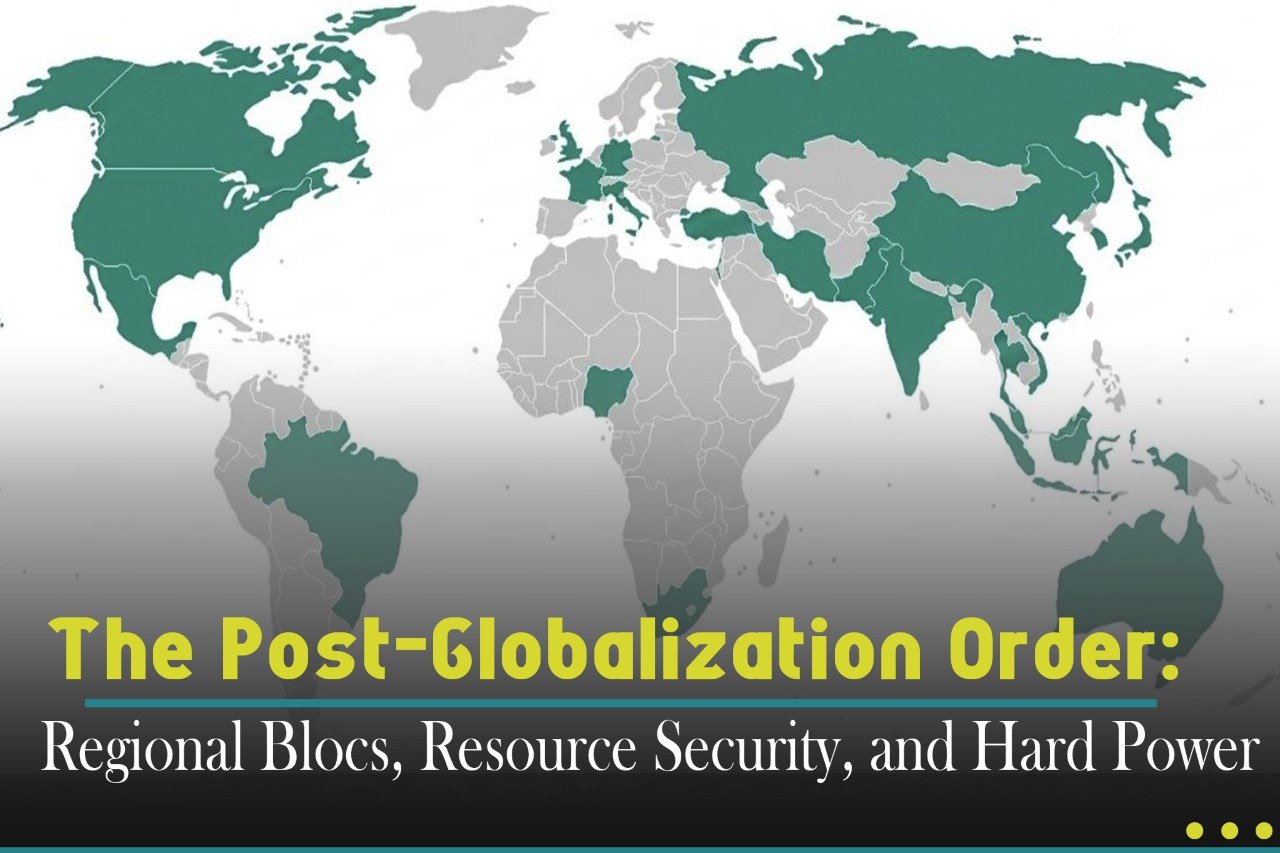
For much of the post-Cold War era, the guiding assumption of the world economy was that markets would tame geopolitics. The deeper the integration, the lower the friction. Supply chains could stretch across continents because efficiency, not strategic distrust, set the terms. Finance could move faster than diplomacy because openness was treated as a good in itself. That assumption has broken down. The issue is not that trade has disappeared. The issue is that openness is no longer politically neutral. It is increasingly judged through the language of vulnerability, coercion, and resilience.[1][2]
The world is therefore not entering full deglobalization. It is entering a system of selective openness. States still need trade, capital, technology, and transport networks. But they increasingly seek them on controlled terms: through trusted partners, protected sectors, strategic reserves, and regional corridors they believe can survive a shock. The governing logic has shifted from frictionless efficiency to managed exposure. The question is no longer how open a state is in the abstract. The question is whether its openness can withstand disruption.[2][3]
That shift matters, it changes how power is measured. In the earlier phase of globalization, strength was often read through financial depth, market access, and integration into global value chains. Those indicators still matter. But they are no longer enough. A state can be commercially sophisticated and still remain one shipping disruption away from a fuel squeeze, one fertilizer shock away from agricultural stress, or one contested chokepoint away from strategic paralysis. The emerging hierarchy of power depends increasingly on whether governments can secure the physical foundations of national resilience: food, energy, logistics, industrial inputs, and the routes that carry them.[2][4]
The first tension driving this reordering is the tension between interdependence and security. Interdependence once appeared to be a stabilizer because it raised the cost of conflict. Now it is just as often seen as an instrument of pressure. Supply chains can be rerouted, inputs withheld, shipping lanes disrupted, and payments systems weaponized. The same networks that once symbolized prosperity now reveal points of leverage. That is why governments increasingly treat dependence not merely as an economic condition but as a national-security risk.[2][5]
This is not because trade stopped working. WTO data make the opposite clear: world merchandise trade volume grew by 4.6 percent in 2025.[1] The persistence of trade, however, does not mean the old order remains intact. It means the content of globalization has changed. Trade now continues under heavier political filtering. States still buy and sell across borders, but they do so while screening investment, subsidizing preferred industries, diversifying suppliers, building stockpiles, and shifting sensitive sectors toward friend-shoring and regional concentration. The survival of exchange under strategic management is not continuity. It is transformation.[1][2][5]
The second tension is between financial power and material power. For years, the commanding heights of globalization seemed financial: reserve currencies, deep capital markets, payment systems, and investment flows. That architecture remains central. But crisis after crisis has exposed its limits. Finance can price a disruption. It cannot by itself move grain through a closed corridor, replace a missing energy shipment, or stabilize a fertilizer market hit by export restrictions and conflict spillovers. In moments of systemic stress, physical control over essential flows matters more than elegance in abstraction.[2][6]
A vivid example came through the Red Sea. UNCTAD warned in early 2024 that the disruption to shipping in the Red Sea, on top of problems in the Black Sea and Panama Canal, was putting at risk “the free movement of goods and interwoven global supply chains.”[7] Its 2024 Review of Maritime Transport then showed how the shock spread through the real economy: freight rates rose and became more volatile, sailing speeds increased by roughly 25 percent, and bunker consumption tripled as vessels diverted onto longer routes around the Cape of Good Hope.[8] The point was not merely that one chokepoint had become dangerous. It was that a security disruption in one corridor quickly translated into higher costs across the trading system.[7][8]
The transmission did not stop at shipping. It moved into food and input markets. The World Bank’s Commodity Markets Outlook reported that the fertilizer price index rose more than 10 percent year-on-year in the first quarter of 2025, with risks tied to higher input costs and trade barriers.[4] By March 2026, the World Bank’s food-security update reported that urea prices had surged by nearly 46 percent month-on-month.[9] That is how the post-globalization order works in practice: a maritime security shock affects energy costs, energy costs hit fertilizer, fertilizer shapes food production, and states far from the original crisis absorb the consequences. Material security is no longer a sectoral issue. It is the core of strategic resilience.[4][9]
For the Horn of Africa and the wider Red Sea basin, this shift is even starker because geography converts trade routes into political leverage. Djibouti’s economy grew by 6.6 percent in 2024 despite continuing Red Sea tensions, a reminder that corridor states can gain strategic importance in turbulent times.[10] But the same geography also creates concentration risk. The World Bank describes the Djibouti-Addis corridor as Ethiopia’s primary gateway, handling more than 90 percent of its import and export trade, while the IMF notes that Ethiopia accounts for over 90 percent of Djibouti’s goods exports.[11][12] In other words, chokepoint politics increase the value of ports, corridors, and logistics hubs across the Horn, but they also expose import-dependent and corridor-dependent states to disruptions they cannot fully control.[10][11][12]
This is why financial centrality, while still powerful, is no longer sufficient as a measure of state capacity. Money can cushion a shock, but it cannot always substitute for physical availability. A liquid financial system does not guarantee diesel in storage, spare transmission capacity, functioning port infrastructure, or diversified access to key inputs. States that lack those buffers may remain formally integrated while becoming substantively fragile. The new order rewards not openness alone but the ability to combine openness with control, redundancy, and reserves.[2][4][8]
The third tension is between global efficiency and regional resilience. The old model optimized for scale and cost. Firms minimized inventories, stretched supplier networks, and assumed that logistical reliability would hold. That assumption is now harder to defend. As geopolitical risk has risen, governments and firms have looked for insurance in proximity, political familiarity, and manageable dependence. Regional blocs, near-shoring arrangements, and preferred trade corridors are attractive not because they eliminate risk, but because they can make risk more governable.[2][3]
This is where selective openness acquires institutional form. Regionalization is not the end of global trade. It is a way of structuring trade under duress. IMF research on geoeconomic fragmentation shows that policy-driven fragmentation can reshape trade, capital flows, and technology diffusion, while Michele Ruta’s work on “discriminatory regionalism” argues that rising geopolitical tensions are pushing countries toward more exclusive regional arrangements.[2][3] That does not mean every regional bloc will succeed, or that every supply chain can be localized. It means states increasingly trust smaller circles of economic cooperation more than universal openness. In a world of chokepoints, sanctions, and contested standards, the region becomes a buffer.[2][3]
There is, of course, a powerful counterargument. One can say that the language of post-globalization exaggerates a correction that remains partial. Trade still expands. Capital still moves. Digital services still leap borders. That is true. But the counterargument misses the real change. The issue is not whether exchange continues. The issue is under what governing assumptions it continues. Once states begin to treat supply dependence as strategic exposure, openness changes character even if aggregate trade volumes remain high.[1][2]
That also means the risks of the new order should be stated plainly. Selective openness can become a euphemism for exclusion. Regional resilience can harden into discriminatory regionalism. Richer blocs may secure trusted supply networks while poorer, import-dependent states face higher barriers to entry, tougher standards, and greater exposure to price shocks they did not cause. IMF analysis warns that fragmentation can redirect trade and investment toward geopolitical partners while narrowing development space for more exposed economies.[2][3] So the emerging order is not simply more realistic. It is also more uneven.
Still, nostalgia for the previous model is not a strategy. The post-Cold War order rested on the belief that openness would, by itself, generate stability. The current environment suggests the reverse: stability must now be built into openness. That requires reserves, infrastructure with geopolitical logic, diversified supply, and regional arrangements strong enough to absorb external shock without collapsing into siege economics. The states best positioned in this harder system will not be those that are merely most connected. They will be the ones that can keep essential systems functioning when connectivity itself becomes fragile.[2][7][8]
The post-globalization order, then, is not a world without trade. It is a world in which trade, finance, and production are increasingly subordinated to strategy. Universal openness is giving way to filtered interdependence; abstract market efficiency is yielding ground to material security; and global reach is being hedged by regional insurance. The decisive question for states is no longer how open they are. It is whether the dependencies that sustain that openness remain secure when the system around them turns hostile.[1][2][7]
Footnotes
- World Trade Organization, Global Trade Outlook and Statistics, March 2026.
- Shekhar Aiyar et al., Geoeconomic Fragmentation and the Future of Multilateralism, IMF Staff Discussion Note No. SDN/2023/001, International Monetary Fund, January 2023.
- Michele Ruta, “The Rise of Discriminatory Regionalism,” Finance & Development, International Monetary Fund, June 2023.
- World Bank, Commodity Markets Outlook, April 2025.
- International Monetary Fund, “The Price of De-Risking: Reshoring, Friend-Shoring, and Quality Downgrading,” IMF Working Paper, June 2024.
- United Nations Conference on Trade and Development, Review of Maritime Transport 2024: Navigating Maritime Chokepoints, 2024.
- United Nations Conference on Trade and Development, Navigating Troubled Waters: Impact to Global Trade of Disruption of Shipping Routes in the Red Sea, Black Sea and Panama Canal, February 2024.
- United Nations Conference on Trade and Development, Review of Maritime Transport 2024: Navigating Maritime Chokepoints, 2024.
- World Bank, Food and Nutrition Security Update, March 27, 2026.
- African Development Bank, “Djibouti Economic Outlook,” 2025.
- World Bank, Djibouti Regional Economic Corridor Project, November 2021.
- International Monetary Fund, Djibouti: 2025 Article IV Consultation—Press Release; Staff Report; and Statement by the Executive Director for Djibouti, August 2025.
By Fikirite Adugna, IFA
Disclaimer:
The content disseminated by the Institute of Foreign Affairs (IFA) – including, but not limited to, publications, public statements, events, media appearances, and digital communications – reflects the views of individual contributors and does not necessarily represent the official positions or policies of the Institute, its partners, or any affiliated governmental or non-governmental entities.
While the IFA endeavors to ensure the accuracy, integrity, and timeliness of the information presented, it makes no representations or warranties, express or implied, regarding the completeness, reliability, or suitability of such content for any purpose. The Institute expressly disclaims any liability for errors or omissions, as well as for any actions taken or decisions made based on the information provided.
The inclusion of external links, references, or third-party resources does not constitute an endorsement by the Institute. Additionally, engagement on social media platforms – including, but not limited to, likes, shares, retweets (RTs), or reposts – shall not be interpreted as an endorsement or validation of the views expressed therein.
Readers and audiences are encouraged to exercise critical judgment and seek independent verification when interpreting or relying upon any information disseminated through publications and posts on the Institute’s platforms or representatives.