

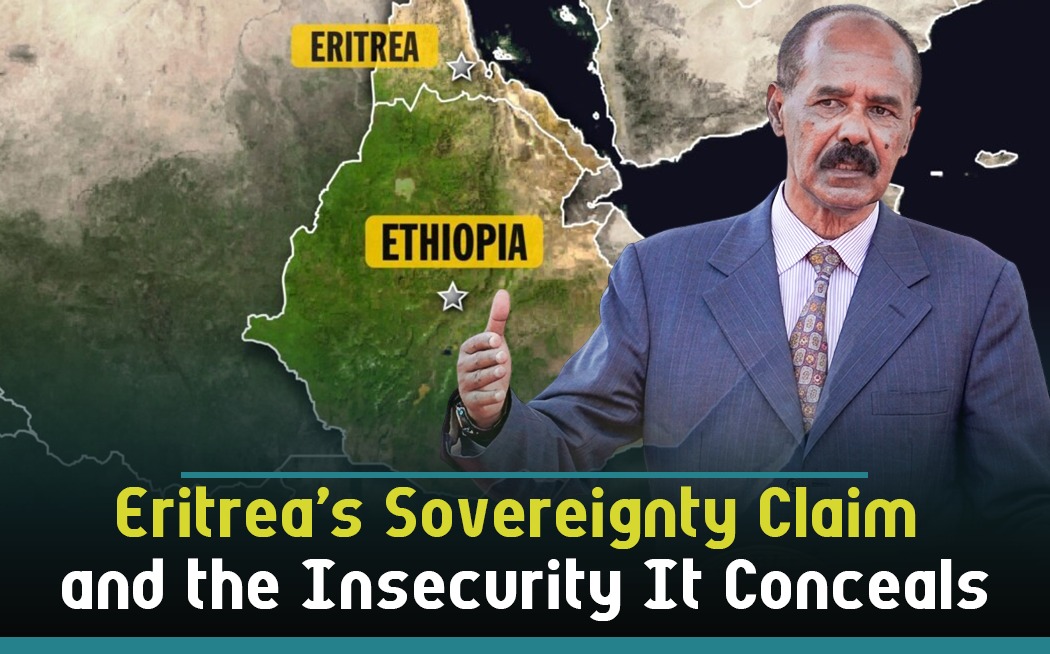
Asmara’s recent charge that Ethiopia is violating Eritrean sovereignty through its pursuit of Red Sea access deserves careful scrutiny. Eritrea’s Ministry of Information has framed Ethiopia’s maritime agenda as an “expansionist quest,” linking Ethiopian rhetoric, military movements, and the 2024 Somaliland memorandum of understanding to a supposed threat against Eritrea’s territorial integrity.1 The claim is politically useful for Asmara. It recasts Eritrea as a besieged small state and Ethiopia as a revisionist power.
But the claim is analytically weak. Under international law, a sovereignty violation is not established by a landlocked state articulating a strategic need for maritime access, pursuing diplomatic arrangements, or calling for negotiated economic corridors. The relevant legal threshold is the threat or use of force against another state’s territorial integrity or political independence.2 Ethiopia’s pursuit of port access, if conducted through negotiation, treaty, lease, commercial arrangement, or regional integration framework, does not by itself violate Eritrean sovereignty. It becomes unlawful only if tied to coercive force or an explicit threat of force.
Asmara’s argument therefore depends on collapsing three different categories into one: political rhetoric, diplomatic maneuver, and armed aggression. That conflation obscures the more consequential pattern in the Horn: Eritrea’s long record of converting regional insecurity into strategic leverage.
The contemporary evidence is not limited to Ethiopian official claims. In February 2026, Reuters reported that Ethiopia’s foreign minister accused Eritrea of military aggression, occupation of Ethiopian territory along parts of the border, and material support to militant groups operating inside Ethiopia.3 Eritrea denied the accusations as “false and fabricated,” but the denial does not erase the broader pattern.4 The issue is not a single exchange of accusations. It is whether Eritrea’s conduct over time supports its current posture as a defender of sovereignty. It does not.
The historical record is damaging for Asmara. The Eritrea-Ethiopia Claims Commission found that Eritrea violated Article 2(4) of the UN Charter by resorting to armed force on May 12, 1998, to attack and occupy Badme, then under peaceful Ethiopian administration.5 That finding matters because Eritrea now invokes sovereignty against Ethiopia while carrying the legal legacy of having initiated a major interstate war through unlawful force.
The same pattern appeared beyond Ethiopia. In 2009, the UN Security Council imposed sanctions on Eritrea for supporting armed groups seeking to destabilize Somalia and for failing to withdraw troops from the disputed border with Djibouti.6 The Council lifted those sanctions in 2018 amid the Ethiopia-Eritrea rapprochement, but the lifting of sanctions did not rewrite the record that led to them.7 It showed that Eritrea’s destabilizing behavior had already become a regional concern before the current maritime debate.
This is the central policy point: Eritrea’s sovereignty narrative functions as strategic camouflage. It shifts attention from Asmara’s behavior to Ethiopia’s intentions. It asks observers to judge Addis Ababa by hypothetical future coercion while judging Asmara without reference to past and present destabilization.
A serious assessment must separate Ethiopia’s legitimate strategic problem from Eritrea’s securitized propaganda. Ethiopia is a landlocked country of continental scale. Its need for diversified, secure, and affordable maritime access is a structural economic question, not an inherently expansionist project. The Horn’s long-term stability will require negotiated port access, trade corridors, customs cooperation, infrastructure integration, and security guarantees. None of these mechanisms requires the violation of Eritrean sovereignty. In fact, durable access arrangements require the opposite: predictable sovereignty, enforceable agreements, and mutual restraint.
Eritrea’s governing model works against that logic. The Asmara regime has built a state organized around permanent mobilization. Human Rights Watch reported in 2025 that Eritrea maintained severe repression, forced much of its adult population into indefinite military or national service, and that Eritrean forces continued abuses in Ethiopia’s Tigray region.8 Its 2026 chapter again reported that Eritrean forces still occupied parts of Tigray and committed serious abuses, while indefinite national service continued beyond the legal 18-month limit.9
This domestic order matters for regional policy. A regime that rules through indefinite conscription, closed politics, and militarized discipline has few incentives to normalize its neighborhood. Peaceful integration would expose the failure of Eritrea’s internal model. Cross-border commerce, labor mobility, legal transparency, and institutional cooperation would undermine the siege logic on which Asmara depends. For that reason, Eritrea’s foreign policy repeatedly privileges suspicion over settlement and disruption over integration.
Eritrea’s doctrine of insecurity cannot be allowed to become a license for destabilization. Fear does not justify supporting armed groups inside neighboring states. It does not justify territorial encroachment. It does not justify keeping the northern Horn in a permanent state of militarized uncertainty. Sovereignty is a reciprocal norm. A state cannot demand absolute respect for its own territorial integrity while undermining the territorial security of others.
For policymakers, three implications follow: First, regional and external actors should avoid treating Ethiopia’s port-access agenda as inherently unlawful. The correct policy test is method, not ambition. Negotiated access is legitimate; coercive annexation is not. Blurring that distinction rewards Eritrea’s attempt to criminalize Ethiopia’s economic geography.
Second, Eritrea’s behavior should be assessed through pattern analysis, not episodic statements. The 1998 Badme finding, the 2009 UN sanctions, the reported presence of Eritrean forces in Ethiopia, and recurring allegations of support to armed groups point to a durable method of regional disruption.10
Third, any future Ethiopia-Eritrea settlement must link de-escalation to verifiable conduct: withdrawal from Ethiopian territory, cessation of support to armed actors, border-security mechanisms, and a framework for negotiated economic access. Dialogue without verification will only reproduce the old cycle in which Asmara uses talks to manage pressure while preserving destabilizing capacity.
Eritrea’s recent sovereignty claim should therefore be read less as a legal argument than as a political instrument. It is designed to put Ethiopia on the defensive while concealing Asmara’s own record as a producer of insecurity. Ethiopia’s maritime question is real and must be handled with legal discipline. But the greater threat to the Horn’s stability is not the existence of Ethiopia’s economic need. It is Eritrea’s long-standing strategy of turning regional instability into regime leverage.
The Horn does not need another rhetorical contest over sovereignty. It needs a clearer distinction between sovereignty as a legal norm and sovereignty as a shield for destabilizing behavior. On that distinction, Asmara’s case fails.
Footnotes
- Eritrea Ministry of Information, “Sovereignty vs. Hegemonic Ambition: Ethiopia’s Expansionist Quest for Outlet to the Sea,” 29 April 2026. (Eritrea Ministry Of Information) ↩
- UN Charter, Article 2(4), prohibits the threat or use of force against the territorial integrity or political independence of any state. (United Nations) ↩
- Reuters, “Ethiopia accuses Eritrea of military aggression, backing armed groups,” 8 February 2026. (Reuters) ↩
- Reuters, “Eritrea calls Ethiopia’s accusations of military aggression ‘deplorable,’” 9 February 2026. (Reuters) ↩
- Eritrea-Ethiopia Claims Commission, Partial Award: Jus Ad Bellum — Ethiopia’s Claims 1–8, 19 December 2005. (United Nations Legal Affairs) ↩
- UN Security Council Resolution 1907, 2009. (UNSCR) ↩
- UN Security Council Resolution 2444, 2018. (United Nations) ↩
- Human Rights Watch, “World Report 2025: Eritrea.” (Human Rights Watch) ↩
- Human Rights Watch, “World Report 2026: Eritrea.” (Human Rights Watch) ↩
- Reuters, UN Security Council, and Eritrea-Ethiopia Claims Commission records collectively support this pattern. (Reuters) ↩
By Gelila Alemu, IFA
Disclaimer:
The content disseminated by the Institute of Foreign Affairs (IFA) – including, but not limited to, publications, public statements, events, media appearances, and digital communications – reflects the views of individual contributors and does not necessarily represent the official positions or policies of the Institute, its partners, or any affiliated governmental or non-governmental entities.
While the IFA endeavors to ensure the accuracy, integrity, and timeliness of the information presented, it makes no representations or warranties, express or implied, regarding the completeness, reliability, or suitability of such content for any purpose. The Institute expressly disclaims any liability for errors or omissions, as well as for any actions taken or decisions made based on the information provided.
The inclusion of external links, references, or third-party resources does not constitute an endorsement by the Institute. Additionally, engagement on social media platforms – including, but not limited to, likes, shares, retweets (RTs), or reposts – shall not be interpreted as an endorsement or validation of the views expressed therein.
Readers and audiences are encouraged to exercise critical judgment and seek independent verification when interpreting or relying upon any information disseminated through publications and posts on the Institute’s platforms or representatives.