

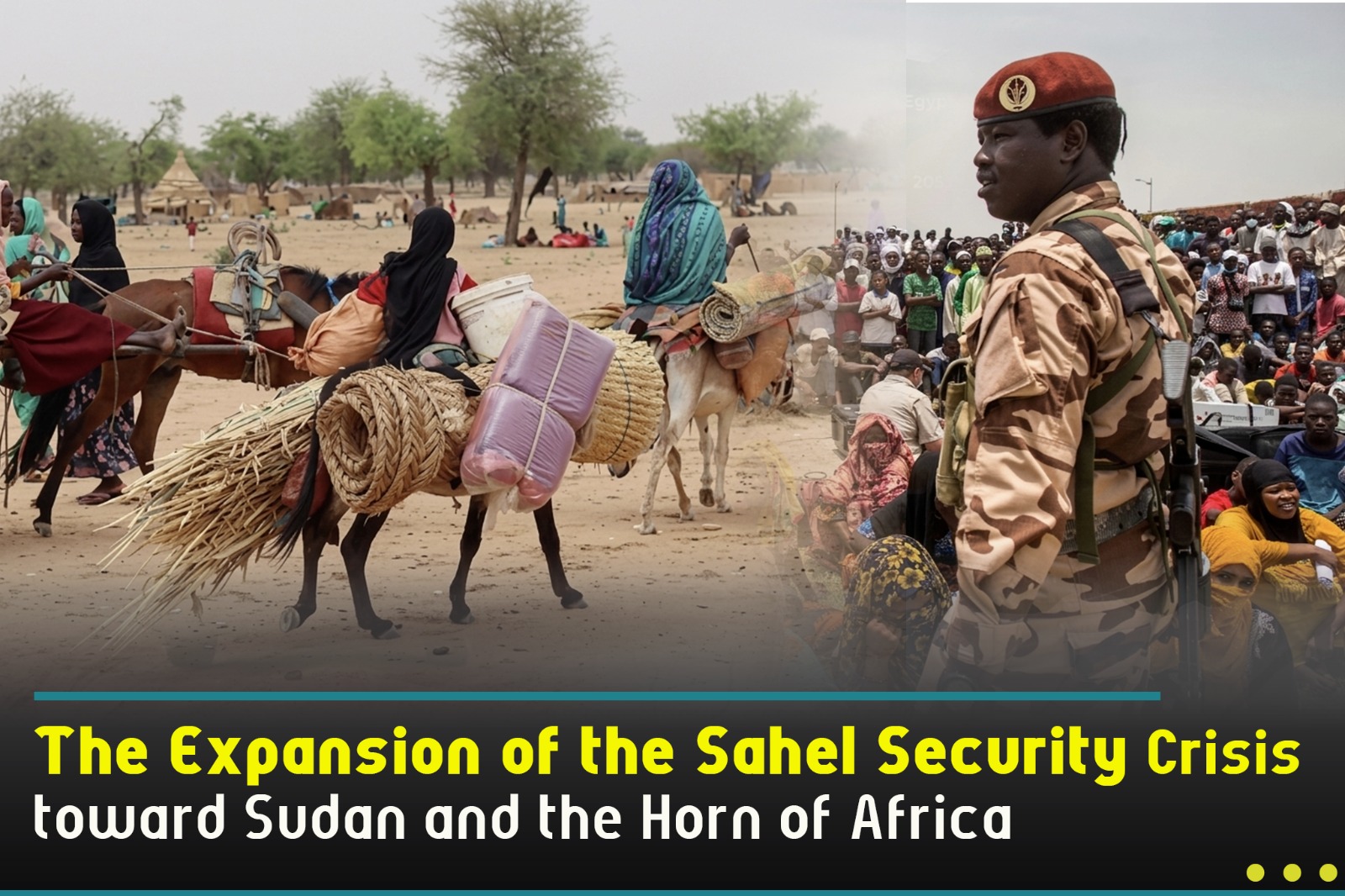
The security crisis in the Sahel has evolved from a localized insurgency into one of the most significant transregional security threats facing Africa. What initially emerged as militant violence concentrated in Mali and neighboring Sahelian states has progressively expanded eastward through fragile border regions, trafficking corridors, armed smuggling routes, and interconnected extremist movements. Today, insecurity stretches from the western Sahel through Niger, Chad, and Sudan toward the Horn of Africa, raising concerns regarding the emergence of an interconnected corridor of conflict linking West Africa and East Africa.¹
This expansion should no longer be understood as a sequence of isolated regional crises. Instead, it increasingly reflects a broader transregional security environment shaped by militant mobility, political fragmentation, trafficking systems, geopolitical competition, and fragile state institutions. The convergence of these dynamics threatens regional stability, humanitarian conditions, economic development, and strategic trade routes extending from the Sahara to the Red Sea.
According to the Armed Conflict Location & Event Data Project (ACLED), conflict-related violence in the central Sahel increased significantly between 2018 and 2024, particularly in Mali, Burkina Faso, and Niger, where extremist organizations expanded operations across poorly governed rural territories.² The deterioration of governance structures and recurring military coups weakened regional coordination efforts, allowing armed organizations to exploit institutional fragility and security vacuums across multiple borders.
The Sahel Crisis and the Expansion of Extremist Networks
The Sahel region, particularly Mali, Niger, and Burkina Faso, has become one of the world’s most active theaters of violent extremism. Armed organizations affiliated with transnational jihadist movements have expanded their operational reach by exploiting poverty, limited state presence, communal tensions, and ineffective governance systems in remote regions.
The military coup in Mali in 2020, followed by coups in Burkina Faso in 2022 and Niger in 2023, significantly disrupted regional security cooperation and accelerated political fragmentation across the Sahel.³ These coup cycles weakened already fragile institutions while creating political environments that extremist organizations used to consolidate territorial influence and expand recruitment activities.
Research on militant activity in the Sahel-Sahara region shows that extremist organizations increasingly operate through flexible transnational logistical systems rather than fixed territorial strongholds.⁴ Armed groups continue to exploit long-standing trade and smuggling routes stretching across the Sahara, facilitating the movement of weapons, fighters, narcotics, fuel, and financial resources between North, West, and increasingly East Africa.
This adaptability has transformed insecurity in the Sahel into a wider continental challenge. Rather than remaining confined within national borders, militant organizations increasingly function within interconnected systems characterized by trafficking corridors, displacement flows, and declining administrative control in peripheral territories.
Niger as a Strategic Corridor within the Sahel
Niger occupies a strategically important geographic position within the Sahel and increasingly serves as a major transit corridor connecting West Africa to Chad, Libya, and Sudan. Sharing borders with seven countries, Niger links several major commercial and movement routes extending across the Sahara and Sahel.
The weakening of state authority in northern and border regions has contributed to the expansion of transnational smuggling systems involving weapons trafficking, fuel smuggling, human trafficking, and extremist mobility. Following successive coups and rising militant violence, Niger’s role as a logistical corridor has become increasingly significant within broader regional conflict dynamics.
Geographically, Niger also forms a critical bridge between instability in the western Sahel and emerging security pressures further east. Arms flows, displacement patterns, and armed mobility increasingly move through interconnected borderlands linking Niger to Chad and western Sudan.
Sudan and the Eastward Expansion of Insecurity
Sudan occupies a critical geopolitical position connecting the Sahel, North Africa, the Red Sea, and the Horn of Africa. The ongoing conflict between rival armed factions has accelerated state fragmentation, weakened border governance, and intensified arms trafficking across western and eastern regions of the country.⁵
International monitoring reports indicate that armed networks associated with the Sudan conflict have facilitated the movement of weapons and illicit goods across Darfur and neighboring border areas. The deterioration of central authority has created opportunities for criminal organizations and armed groups to exploit remote territories connecting Sudan to Chad, Libya, and the broader Sahel region.
The conflict has also generated large-scale humanitarian displacement affecting neighboring countries throughout the Horn of Africa. According to the United Nations High Commissioner for Refugees (UNHCR), millions of civilians have been displaced internally and externally since the escalation of fighting in Sudan, placing additional pressure on already fragile regional systems.⁶ Refugee flows, economic disruption, and cross-border insecurity continue to strain state capacity across the region.
Sudan’s position along Red Sea access routes further elevates the geopolitical stakes of the conflict. Competition over maritime access, trade corridors, and regional influence has intensified the international dimensions of insecurity across both Sudan and its neighbouring regions.
External Involvement and Geopolitical Competition
An increasingly important dimension of this evolving crisis is the growing involvement of external actors across the Sahel, Sudan, and the Horn of Africa. Strategic competition over maritime access, natural resources, trade corridors, and regional influence has deepened the complexity of conflicts across these regions.
Russian-linked security actors, including Wagner and its successor structures, have expanded their presence in parts of the Sahel following the withdrawal of certain Western military partnerships in Mali, Burkina Faso, and Niger.⁷ At the same time, Gulf states, Turkey, China, and other regional powers have increased their engagement through infrastructure investment, port development, security partnerships, and diplomatic positioning linked to the Red Sea corridor.
External involvement has contributed to the militarization of fragile political environments through arms transfers, security alliances, and economic leverage. In several cases, domestic conflicts are increasingly shaped not only by internal grievances but also by wider geopolitical competition embedded in regional transition zones.
The Red Sea corridor has become a particularly contested space within this broader strategic environment. As insecurity expands eastward from the Sahel toward Sudan and the Horn of Africa, external interests are becoming increasingly embedded within local conflict systems, complicating stabilization efforts.
The Horn of Africa Security Environment
The Horn of Africa continues to face a major extremist threat through Al-Shabaab in Somalia, one of the most resilient jihadist organizations on the continent.⁸ The group has maintained operational capacity despite sustained regional and international counterterrorism efforts, conducting cross-border attacks and sustaining influence in rural territories.
Although the Sahel and Horn of Africa remain geographically distinct, growing overlaps in trafficking systems, illicit economies, and militant mobility patterns raise broader concerns about transregional insecurity. These linkages are not uniform or operationally coordinated, but they reflect converging structural vulnerabilities across multiple regions.
Ethiopia’s Strategic Position and Regional Security Role
Ethiopia occupies one of the most strategically significant positions in Africa, functioning as a bridge between East Africa, the Red Sea region, and the Nile Basin. The country also serves as a central diplomatic and security actor within the Horn of Africa.
Beyond geography, Ethiopia plays a key role in continental diplomacy as the headquarters of the African Union and as a major contributor to regional peacekeeping and mediation efforts.⁹ Its political and institutional weight makes it a critical stakeholder in broader regional stability.
The conflict in Sudan carries direct implications for Ethiopia through refugee flows, border insecurity, and economic disruption affecting regional trade routes. Tensions along the al-Fashaga border area and broader Nile Basin dynamics, particularly surrounding the Grand Ethiopian Renaissance Dam (GERD), further demonstrate how instability in Sudan intersects with wider regional geopolitics.
Ethiopia’s interest in Red Sea access and maritime connectivity further increases the strategic importance of stability in Sudan and neighbouring coastal regions. As a result, insecurity along the Sudan–Horn corridor carries implications not only for humanitarian conditions but also for regional economic integration and geopolitical balance in East Africa.
Addressing the expanding corridor of insecurity linking the Sahel, Sudan, and the Horn of Africa requires a multidimensional approach combining regional security cooperation, governance reform, diplomatic engagement, and long-term socioeconomic stabilization. Military responses alone are unlikely to address the structural drivers of conflict.¹⁰
Regional governments must strengthen intelligence sharing, border surveillance, and joint security coordination to limit the movement of extremist groups and illicit networks across fragile border regions. Institutions such as the African Union and subregional bodies should expand coordinated counterterrorism and border management frameworks.
At the same time, improving governance in peripheral border areas remains essential. Weak infrastructure, limited public services, and absent state authority continue to create conditions exploited by armed groups and criminal networks.
Diplomatic initiatives and political stabilization efforts require sustained international support, particularly in Sudan and the wider Sahel, where conflict dynamics remain fluid. Maritime security cooperation in the Red Sea must also be strengthened given the growing strategic importance of global shipping routes.
Finally, humanitarian coordination remains central. Displacement, food insecurity, and economic disruption continue to place pressure on neighbouring states and regional institutions.
Conclusion
The Sahel security crisis has evolved into a broader transregional challenge affecting both West Africa and the Horn of Africa. Political fragmentation, armed conflict, trafficking networks, extremist mobility, and geopolitical competition have contributed to the emergence of interconnected zones of insecurity stretching from Mali and the western Sahel through Niger, Chad, and Sudan toward East Africa.
What is emerging is not a single unified conflict, but a system of mutually reinforcing insecurities that increasingly shape the political geography of the continent. Without stronger regional coordination, governance reform, and long-term political stabilization, this corridor of instability may continue to deepen.
Strengthening institutions, improving cross-border cooperation, addressing structural vulnerabilities, and supporting inclusive political settlements will be essential to preventing further regional destabilization across one of the world’s most strategically significant spaces.
Source
1. Olivier Walther, Christian Leuprecht, and David Skillicorn, “Wars Without Beginning or End: Violent Political Organizations and Irregular Warfare in the Sahel-Sahara,” arXiv, 2016.
2. Armed Conflict Location & Event Data Project (ACLED), “Conflict Trends in the Sahel,” ACLED Regional Analysis, 2024.
3. International Crisis Group, The Risks of Coups and Regional Instability in the Sahel (Brussels: International Crisis Group, 2023).
4. Walther, Leuprecht, and Skillicorn, “Wars Without Beginning or End.”
5. United Nations Security Council, Final Report of the Panel of Experts on the Sudan Sanctions Regime (New York: United Nations, 2024).
6. United Nations High Commissioner for Refugees (UNHCR), Regional Displacement Trends in the Horn of Africa and Sudan (Geneva: UNHCR, 2024).
7. International Crisis Group, The Sahel: Regional Spillover and Geopolitical Competition in Africa (Brussels: International Crisis Group, 2024).
8. Institute for Security Studies Africa, “Al-Shabaab and Regional Security Threats in the Horn of Africa,” ISS Africa Report, 2024.
9. African Union Peace and Security Council, Communiqué on the Situation in Sudan and the Sahel Region (Addis Ababa: African Union, 2024).
10. United Nations Office on Drugs and Crime (UNODC), Transnational Organized Crime and Instability in the Sahel (Vienna: United Nations, 2023).
By 𝐁𝐞𝐦𝐧𝐞𝐭 𝐀𝐥𝐞𝐦𝐚𝐲𝐞𝐡𝐮 @IFA
Disclaimer:
The content disseminated by the Institute of Foreign Affairs (IFA) – including, but not limited to, publications, public statements, events, media appearances, and digital communications – reflects the views of individual contributors and does not necessarily represent the official positions or policies of the Institute, its partners, or any affiliated governmental or non-governmental entities.
While the IFA endeavors to ensure the accuracy, integrity, and timeliness of the information presented, it makes no representations or warranties, express or implied, regarding the completeness, reliability, or suitability of such content for any purpose. The Institute expressly disclaims any liability for errors or omissions, as well as for any actions taken or decisions made based on the information provided.
The inclusion of external links, references, or third-party resources does not constitute an endorsement by the Institute. Additionally, engagement on social media platforms – including, but not limited to, likes, shares, retweets (RTs), or reposts – shall not be interpreted as an endorsement or validation of the views expressed therein.
Readers and audiences are encouraged to exercise critical judgment and seek independent verification when interpreting or relying upon any information disseminated through publications and posts on the Institute’s platforms or representatives.