

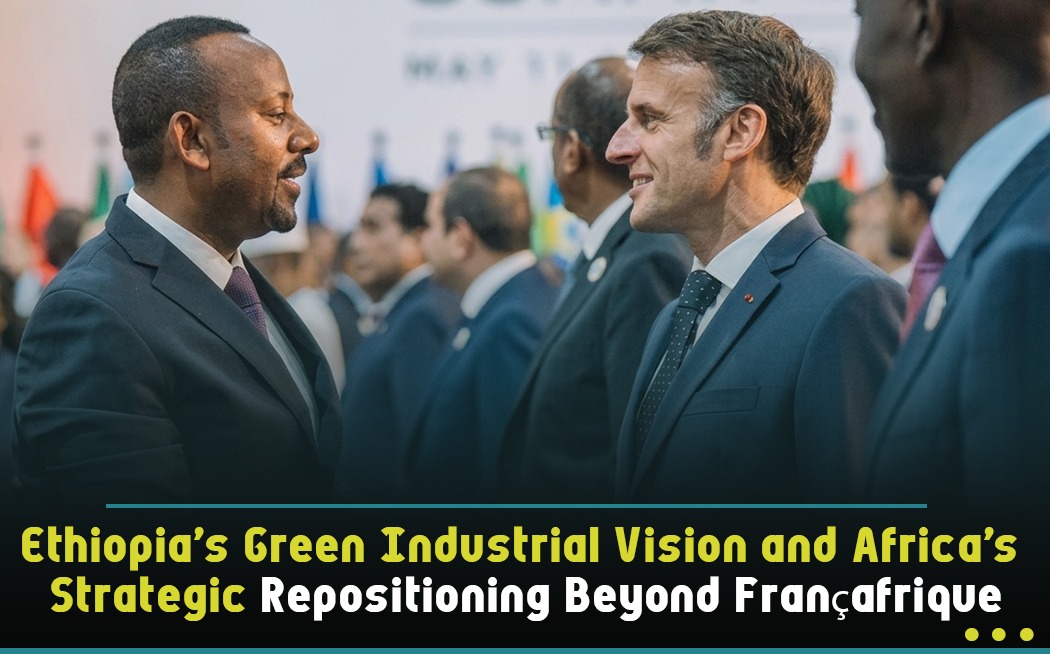
The Africa Forward Summit convened in Nairobi on 11–12 May 2026 represented more than a diplomatic gathering between France and African states. Co-hosted by William Ruto and Emmanuel Macron, the summit reflected an emerging transformation in Europe–Africa relations: a gradual departure from paternalistic frameworks toward a model centered on strategic partnership, economic interdependence, technological cooperation, and mutual geopolitical interests.[1]
Held at a moment of intensifying global competition over supply chains, critical minerals, digital infrastructure, maritime security, and demographic transformation, the summit signaled France’s attempt to reposition itself within a rapidly changing African geopolitical landscape. More broadly, it reflected a wider international recalibration in which advanced economies increasingly view Africa not as a peripheral aid recipient but as a central actor in the future architecture of the global economy and international security.
For Ethiopia, however, the summit also highlighted a parallel and increasingly consequential development: the emergence of African states seeking not merely integration into global economic systems, but leadership within the transition toward green industrialization and sustainable development.
During the summit, Abiy Ahmed emphasized Ethiopia’s growing role in advancing green industrialization and the global energy transition. Speaking during a session focused on clean energy and industrial transformation, the Prime Minister argued that Ethiopia is actively contributing to Africa’s broader efforts in renewable energy development and sustainable industrial growth.[2] He further stressed that Ethiopia continues to play an important role in shaping continental discussions surrounding green industrialization and energy transition agendas.
This intervention was strategically significant. It positioned Ethiopia not simply as a participant within Africa’s development debates, but as a state attempting to align industrial policy, energy infrastructure, climate adaptation, and regional diplomacy within a broader long-term developmental vision.
From Françafrique to Strategic Partnership
For decades, relations between France and many African countries were shaped by the legacy of Françafrique—a post-colonial system characterized by political patronage, military influence, elite networks, and asymmetrical economic relations.[3] While France maintained deep political, military, and economic ties across Francophone Africa, criticism of the model steadily intensified over time.
African political leaders, intellectuals, and younger generations increasingly challenged arrangements perceived as hierarchical, externally managed, and insufficiently responsive to Africa’s aspirations for sovereignty and economic transformation. Simultaneously, France’s influence across the continent faced growing competition from China, Türkiye, Gulf states, India, Russia, and other emerging actors.
President Macron has repeatedly acknowledged the limits of the old framework. At the Nairobi summit, he argued that traditional approaches to Africa policy were no longer sustainable and emphasized the need for partnerships based on mutual interests rather than dependency.[4]
This rhetorical shift reflects recognition within French strategic thinking that the future of Europe–Africa relations cannot be built upon historical nostalgia or unequal political structures. Instead, the emerging framework increasingly prioritizes innovation, entrepreneurship, infrastructure, digital transformation, education, and private-sector engagement.
The summit’s structure itself reflected this recalibration. Rather than centering exclusively on state diplomacy, the event elevated entrepreneurs, technology innovators, diaspora professionals, and youth leaders. The symbolic message was clear: Africa’s future is increasingly being shaped by economic and technological transformation rather than traditional patron-client political relationships.
Ethiopia and the Politics of Green Industrialization
Ethiopia’s intervention at the summit underscored a broader continental trend in which industrial policy is increasingly being linked to climate resilience, renewable energy, and technological modernization.
Over the past decade, Addis Ababa has attempted to position itself as one of Africa’s principal advocates of green development. Hydropower expansion, renewable energy investments, electric mobility initiatives, climate adaptation programs, and industrial park development have collectively formed part of Ethiopia’s long-term developmental strategy.
Prime Minister Abiy’s remarks in Nairobi reflected this broader policy orientation. By framing Ethiopia’s developmental trajectory within the language of green industrialization and energy transition, Addis Ababa appears increasingly focused on integrating environmental sustainability with economic modernization and regional influence.[5]
This matters geopolitically for several reasons.
First, the global transition toward renewable energy is reshaping patterns of industrial competition and investment flows. Countries capable of producing renewable power at scale may acquire significant advantages in manufacturing, digital infrastructure, and industrial production.
Second, climate policy is becoming increasingly intertwined with geopolitical influence. Access to green financing, carbon markets, sustainable supply chains, and clean technology partnerships is likely to shape future diplomatic alignments.
Third, Africa’s energy transition is no longer viewed solely as a developmental issue. It is increasingly understood as central to questions of industrial competitiveness, demographic management, urbanization, and strategic autonomy.
Ethiopia’s effort to present itself as a leader in this domain therefore reflects more than environmental diplomacy. It represents an attempt to position the country within the emerging geoeconomic architecture of the twenty-first century.
Africa’s Strategic Centrality in the Emerging Global Order
The Nairobi summit occurred amid a broader transformation in global perceptions of Africa’s strategic importance. The continent is increasingly recognized as central to multiple dimensions of the international system.
Demographically, Africa represents the world’s youngest and fastest-growing population. By 2050, one in four people globally is projected to be African.[6] This demographic trajectory carries profound implications for labor markets, consumption patterns, migration, innovation ecosystems, and geopolitical influence.
Economically, Africa possesses some of the world’s most significant reserves of strategic minerals necessary for advanced technologies, renewable energy systems, electric vehicles, artificial intelligence infrastructure, and defense industries.[7]
Strategically, the continent also occupies critical maritime and logistical corridors connecting the Atlantic, Mediterranean, Red Sea, Indian Ocean, Middle East, and Indo-Pacific systems. Stability in Africa increasingly affects global trade, energy security, migration governance, and supply-chain resilience.
These realities are reshaping the calculations of advanced economies. Europe, the United States, China, Gulf states, and Asian powers increasingly recognize that long-term economic competitiveness and geopolitical influence cannot be secured without meaningful engagement with Africa.
The Africa Forward Summit therefore reflected not merely French diplomatic repositioning, but a broader international recognition that Africa is becoming indispensable to the future global order.
Technology, Energy Transition, and Strategic Competition
A defining feature of the summit was its emphasis on technological sovereignty, digital infrastructure, and industrial modernization. This reflected one of the most consequential transformations underway across Africa: the continent’s accelerating integration into the global digital economy.
Discussions surrounding artificial intelligence, computing infrastructure, renewable energy systems, and industrial manufacturing underscored an emerging geopolitical reality: technological capacity is now inseparable from sovereignty and economic power.
Africa currently accounts for a disproportionately small share of global computing infrastructure despite its demographic scale.[8] This imbalance carries major implications for data governance, cybersecurity, AI development, and technological dependency.
Consequently, investments in data centers, fiber-optic systems, renewable energy corridors, semiconductor ecosystems, and digital education increasingly carry strategic significance comparable to traditional infrastructure projects.
France’s attempt to position itself as a partner in Africa’s digital and industrial transformation reflects broader European concerns about maintaining competitiveness amid intensifying technological rivalry between the United States and China.
At the same time, African governments increasingly seek to ensure that external engagement supports local industrialization, employment generation, value addition, and sovereign development priorities.
The emphasis placed by Ethiopia and other African states on green industrialization suggests that future partnerships may increasingly revolve around co-production, industrial upgrading, and sustainable infrastructure rather than traditional aid-centered frameworks.
Conclusion
The Africa Forward Summit in Nairobi represented an important moment in the evolving relationship between Africa and advanced economies. France’s effort to move beyond the historical framework of Françafrique reflects broader structural changes occurring across the international system.
For Ethiopia, however, the summit also provided an opportunity to project a wider strategic narrative centered on green industrialization, renewable energy leadership, and long-term economic transformation.
Prime Minister Abiy Ahmed’s intervention demonstrated how African states increasingly seek not merely participation within global systems, but influence over the emerging rules governing industrial transition, climate policy, and technological modernization.
Africa is no longer viewed solely through the lens of aid, extraction, or humanitarian intervention. It is increasingly recognized as central to demographic growth, strategic minerals, maritime connectivity, renewable energy development, and geopolitical competition.
The Nairobi summit therefore symbolized more than a diplomatic recalibration between France and Africa. It reflected the gradual emergence of a new international landscape in which African states—including Ethiopia—are seeking greater agency in shaping the future architecture of global economics, energy transition, and geopolitical order.
Footnotes
[1] “Africa Forward Summit Takes Place in Nairobi, May 11–12, 2026,” French Embassy in Kenya.
[2] “PM Abiy Highlights Ethiopia’s Role in Green Industrialization, Energy Transition at Africa Forward Summit,” Ethiopian News Agency.
[3] “Macron Seeks to Move Beyond France’s Francophone Past at Africa Summit,” The Guardian.
[4] Ibid.
[5] “PM Abiy Highlights Ethiopia’s Role in Green Industrialization, Energy Transition at Africa Forward Summit,” Ethiopian News Agency.
[6] “World Population Prospects 2024,” United Nations Department of Economic and Social Affairs.
[7] “Critical Raw Materials Resilience: Charting a Path Towards Greater Security and Sustainability,” European Commission.
[8] “Macron Opens Africa Summit in Kenya with Push for New France-Africa Partnership,” France 24.
By Emracle Sileshe, IFA
Disclaimer:
The content disseminated by the Institute of Foreign Affairs (IFA) – including, but not limited to, publications, public statements, events, media appearances, and digital communications – reflects the views of individual contributors and does not necessarily represent the official positions or policies of the Institute, its partners, or any affiliated governmental or non-governmental entities.
While the IFA endeavors to ensure the accuracy, integrity, and timeliness of the information presented, it makes no representations or warranties, express or implied, regarding the completeness, reliability, or suitability of such content for any purpose. The Institute expressly disclaims any liability for errors or omissions, as well as for any actions taken or decisions made based on the information provided.
The inclusion of external links, references, or third-party resources does not constitute an endorsement by the Institute. Additionally, engagement on social media platforms – including, but not limited to, likes, shares, retweets (RTs), or reposts – shall not be interpreted as an endorsement or validation of the views expressed therein.
Readers and audiences are encouraged to exercise critical judgment and seek independent verification when interpreting or relying upon any information disseminated through publications and posts on the Institute’s platforms or representatives.