

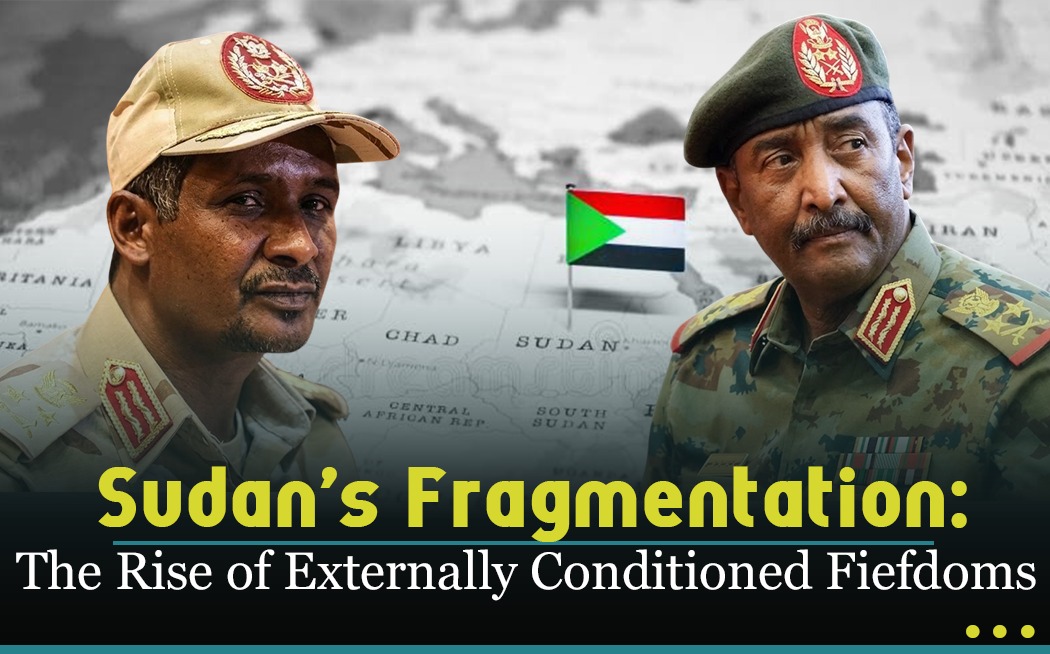
Sudan’s war is still often treated as a contest between two armed centers: the Sudanese Armed Forces and the Rapid Support Forces. That frame captures the military rivalry, but it no longer explains the political geography the war has produced. Sudan is not simply experiencing a prolonged civil war or a conventional proxy conflict. It is entering a more durable phase of externally conditioned fragmentation, where armed territorial zones survive through access to cross-border weapons, gold markets, logistics corridors, ports, diplomatic cover, and regional patronage.
The central unit of analysis should therefore shift from “the war” to the armed fiefdom. These fiefdoms are not states, but they are more than temporary zones of battlefield control. They tax movement, control checkpoints, regulate access to resources, mobilize fighters, negotiate with external actors, and embed themselves in transnational supply chains. The result is a fragmented Sudan whose internal divisions are increasingly sustained by external systems.
From State Rupture to Rival Sovereignties
The April 2023 rupture between SAF and RSF did not create Sudan’s fragmentation from nothing. It exposed a deeper crisis in the Sudanese state. For decades, Khartoum governed its peripheries through selective coercion, militia outsourcing, tribal brokerage, and patronage. Darfur, Kordofan, eastern Sudan, Blue Nile, and the borderlands with Chad, Libya, South Sudan, Eritrea, and Ethiopia were never fully integrated into a stable national compact. They were managed as security frontiers.
The RSF emerged from that architecture. What began as counterinsurgency outsourcing in Darfur gradually became a parallel military-economic structure with its own commanders, revenue streams, foreign relationships, and territorial base. When the SAF–RSF confrontation became open war, the Sudanese state did not merely split into two camps. It began producing rival sovereignties.
International Crisis Group’s April 2026 assessment described Sudan as effectively divided between an army holding Khartoum and the east, and the RSF entrenched in the west.[1] Reports indicated that the war had displaced around 14 million people and left 19.5 million facing acute hunger, with famine risks concentrated in parts of Darfur and Kordofan.[2] These figures capture the scale of collapse. Yet the deeper transformation is institutional: armed control is becoming routinized, territorialized, and externally supplied.
The Western Borderland Fiefdom
Western Sudan represents the clearest expression of the fiefdom arrangement. Darfur and parts of Kordofan are no longer only battlefields; they are nodes in a wider Sahelian conflict economy. Gold, livestock, fuel, vehicles, weapons, recruitment networks, and informal taxation routes connect local armed authority to Chad, Libya, South Sudan, the Central African Republic, and Gulf-linked commercial circuits.
Gold is central to this architecture. Chatham House has shown that Sudan’s gold sector is not merely an economic resource but a war-sustaining system that connects armed actors to regional markets and external financing.[3] Control over gold sites, transport routes, and export channels gives armed formations access to liquidity even when formal state institutions collapse. In practical terms, the fiefdom survives because it can convert territory into revenue and revenue into coercive power.
The Global Initiative Against Transnational Organized Crime has similarly documented how Sudan’s war is sustained by illicit and semi-formal transnational supply chains, including aviation routes, border corridors, gold extraction sites, and logistics networks that extend beyond Sudan’s formal borders.[4] This is the operational core of externally conditioned fragmentation. A commander does not need full sovereignty if he controls a route, a mine, an airstrip, a market, or a border passage. A militia zone becomes durable when it is connected outward.
This makes western Sudan less a rebel-held periphery than a networked borderland enterprise. Its power does not come from isolation, but from circulation. When one corridor is blocked, another can be activated. When one patron becomes exposed, another intermediary can emerge. This flexibility makes the fragmentation more resilient than conventional mediation frameworks assume.
The Eastern State-Continuity Fiefdom
Eastern Sudan reflects a different form of externally conditioned authority. Unlike the western militia economy, the army-aligned east draws strength from formal state continuity, diplomatic recognition, Port Sudan’s strategic position, and control over remaining national institutions. Port Sudan has become more than a wartime administrative refuge. It is the army’s diplomatic gateway, humanitarian entry point, fiscal node, and claim to international legitimacy.
This eastern fiefdom is not informal in the same way as the western one. It speaks the language of state survival. It controls embassies, ministries, ports, and official channels. It can claim continuity with the Sudanese state even while large parts of the country remain outside effective central control. International diplomacy still privileges recognized institutions, even when those institutions no longer govern the national territory in any meaningful sense.
The distinction is therefore critical. The RSF’s western project is sustained through mobility, commodity flows, informal trade, and armed borderland entrepreneurship. The SAF’s eastern project is sustained through ports, diplomatic recognition, formal state assets, and the residual legitimacy of sovereignty. Both are externally conditioned, but they depend on different external systems. One survives through illicit and hybrid networks; the other through institutional recognition and strategic geography.
External Weapons and the Hardening of Fragmentation
The military balance is also being reshaped by foreign-sourced equipment. Human Rights Watch reported in 2024 that both SAF and RSF had acquired modern foreign-made weapons and military equipment, including drones, drone jammers, anti-tank guided missiles, rockets, and mortars.[5] This externalization of military capacity hardens fragmentation by allowing armed actors to project power across distance, strike infrastructure, and sustain operations without relying solely on conventional front lines.
Drone warfare has become particularly important. Drones had targeted markets, hospitals, and power stations, killing hundreds of civilians in that year alone.[2] The strategic effect is not simply battlefield escalation. It is the normalization of dispersed coercion. Armed fiefdoms can defend territory, punish rivals, disrupt supply routes, and signal external backing without having to govern like states.
Why Mediation Is Too Narrow
Sudan’s diplomatic problem is therefore not only the absence of a ceasefire. It is the mismatch between mediation design and conflict structure. Most peace efforts still treat the war as a bargaining problem between SAF and RSF leadership. Even if the two principals sign a ceasefire, the economic and logistical architecture of fragmentation may remain intact.
A national settlement cannot automatically dismantle checkpoint economies, gold networks, external arms channels, air corridors, border brokers, and political-military entrepreneurs who now benefit from fragmentation. Without addressing those systems, a ceasefire could freeze territorial division rather than reverse it. Sudan may then move toward a condition where armed enclaves accept a nominal national framework while preserving their own coercive and economic autonomy.
A peace process focused only on elite command structures may reproduce the same error that helped create the RSF: treating armed autonomy as manageable so long as it is politically useful. The war has shown that outsourced coercion eventually becomes rival sovereignty.
Regional Stakes
For the Horn of Africa, Sudan’s fragmentation is not a distant crisis. It directly affects Ethiopia’s western frontier, Red Sea security, Nile politics, refugee flows, arms circulation, and the strategic balance between the Horn, Gulf, and Sahel. Sudan sits between multiple regional systems. Its collapse does not remain contained inside its borders; it travels through corridors, markets, militias, and ports.
The policy challenge is therefore to target the architecture of fragmentation, not only its commanders. Mediation must link ceasefire diplomacy to border management, resource governance, humanitarian access, and regional enforcement. The AU should remain central, but it must be backed by a sharper understanding of how external patronage and conflict economies reproduce armed authority.
Sudan’s war will not be resolved by treating fragmentation as a temporary battlefield condition. Its fiefdoms are becoming political economies. Unless the external systems sustaining them are disrupted, Sudan’s collapse will not remain a domestic breakdown; it will become a trans-regional security crisis.
References
[1] International Crisis Group, Divided Sudan, Elusive Peace, April 13, 2026. (Crisis Group)
[2] Reuters, “Almost 20 million people in Sudan still face acute hunger, monitors say,” May 14, 2026. (Reuters)
[3] Chatham House, Gold and the War in Sudan, March 26, 2025. (Chatham House)
[4] Global Initiative Against Transnational Organized Crime, “The illicit transnational supply chains sustaining Sudan’s conflict,” November 20, 2025. (Global Initiative)
[5] Human Rights Watch, “Sudan: Abusive Warring Parties Acquire New Weapons,” September 9, 2024. (hrw.org)
By Sifan Tadesse, IFA
Disclaimer:
The content disseminated by the Institute of Foreign Affairs (IFA) – including, but not limited to, publications, public statements, events, media appearances, and digital communications – reflects the views of individual contributors and does not necessarily represent the official positions or policies of the Institute, its partners, or any affiliated governmental or non-governmental entities.
While the IFA endeavors to ensure the accuracy, integrity, and timeliness of the information presented, it makes no representations or warranties, express or implied, regarding the completeness, reliability, or suitability of such content for any purpose. The Institute expressly disclaims any liability for errors or omissions, as well as for any actions taken or decisions made based on the information provided.
The inclusion of external links, references, or third-party resources does not constitute an endorsement by the Institute. Additionally, engagement on social media platforms – including, but not limited to, likes, shares, retweets (RTs), or reposts – shall not be interpreted as an endorsement or validation of the views expressed therein.
Readers and audiences are encouraged to exercise critical judgment and seek independent verification when interpreting or relying upon any information disseminated through publications and posts on the Institute’s platforms or representatives.