

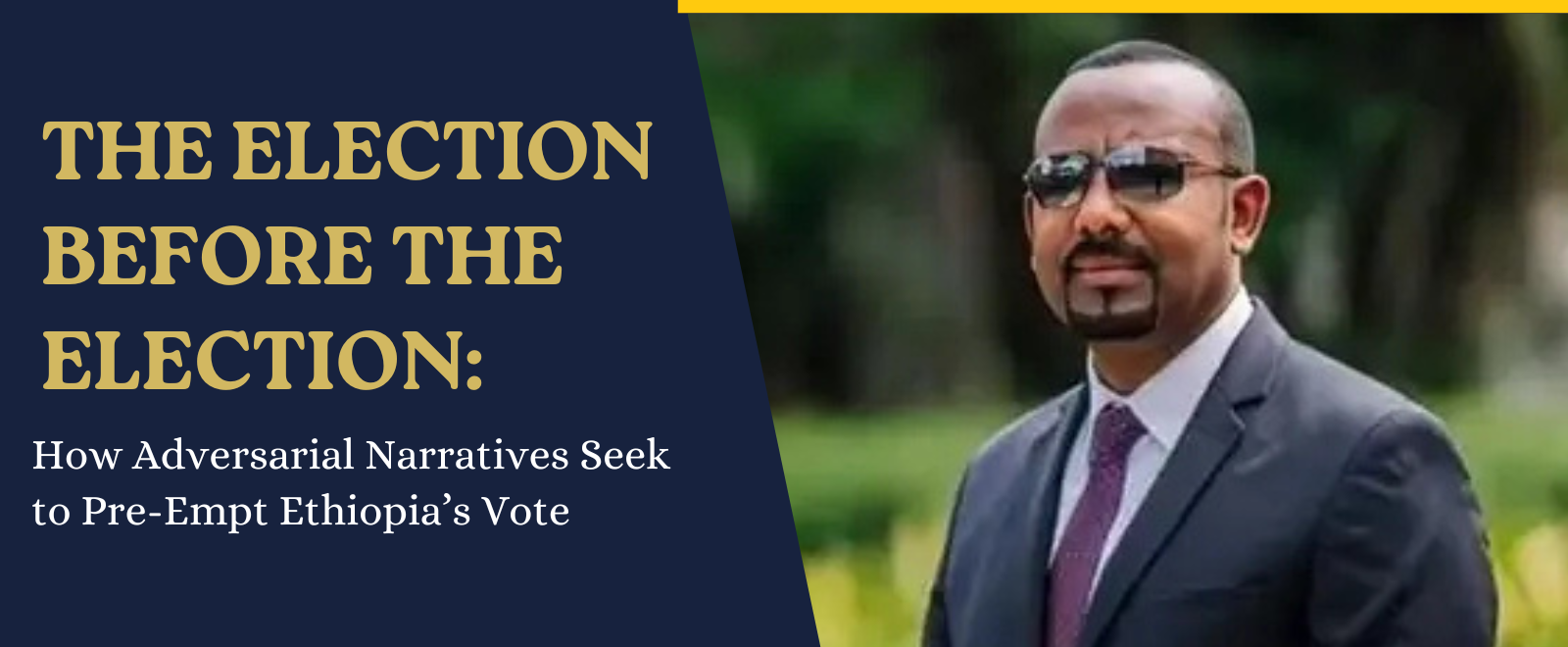
Ethiopia’s 1 June election is being contested before the first ballot is counted. The central vulnerability is not that geopolitical rivals can easily alter the numerical result. It is that they can make the result politically contestable at near-zero cost. In the contemporary grey-zone environment, adversarial state powers and aligned networks do not need to control polling stations, hack vote totals, or prove fraud. They only need to flood the information space with enough doubt to weaken public confidence before the electoral process produces a factual record.
This is the logic of electoral grey-zone warfare: the manipulation of the information, security, and perception environment around an election to weaken legitimacy without openly attacking the state. Ethiopia’s case is particularly sensitive because the vote is unfolding amid insecurity, regional rivalry, fragmented media ecosystems, and heightened external scrutiny.
The strategic objective of such a campaign is not necessarily to change who wins. It is to make the winner’s mandate appear procedurally compromised, internationally doubtful, and domestically fragile. Altering vote totals is difficult, risky, and attributable. Contesting legitimacy is cheaper, deniable, and scalable.
The Vulnerability Is Credibility
Election legitimacy is more exposed than the vote count because legitimacy rests on a chain of confidence. International election observation standards assess not only voting day, but the wider electoral cycle: registration, campaigning, media access, polling, counting, complaints, and certification.[2]
Each link in that chain offers an entry point for hostile targeting. A delayed count can be framed as manipulation. A postponed constituency can be described as mass exclusion. A localized attack can be inflated into national collapse. A critical article can be recycled as external proof. A party complaint can be detached from procedure and turned into evidence of systemic fraud.
This is why the most visible attack vector appears to be pre-vote defamation: the effort to portray the election as illegitimate before votes are cast and before results are declared. The campaign’s most effective claims do not need to be entirely fabricated. They often combine partial facts, political grievances, and unverified allegations into a single predetermined verdict: that the election is unfair, unsafe, exclusionary, and therefore unusable as a mandate.
The documented scale of the process complicates that narrative. Ethiopia’s National Election Board has announced more than 50.5 million registered voters, and official election materials list polling stations, constituencies, and political-party participation across the country.[3] These facts do not eliminate legitimate questions over political space, security, or fairness. But they do expose the weakness of sweeping claims that the process is empty, nationwide voting is broadly impossible, or opposition participation is absent.
Grey-zone warfare thrives in precisely this space between reality and exaggeration. It does not invent every grievance. It weaponizes ambiguity.
The Information-Warfare Architecture
The first layer is coordinated disinformation. Ethiopia’s digital environment has already become more active and contested ahead of the election. MultiFactCheck reported that the online space became visibly more complex in April 2026, shaped by social and political debate, identity-based mobilization, and organized disinformation as the general election approached.[4] This suggests that the electoral information environment is not merely noisy; it is vulnerable to structured narrative operations.
The second layer is narrative saturation. Negative articles, hostile social media threads, attacks on national leadership, claims of authoritarianism, and allegations of unfair campaigning can all exist as legitimate political discourse when grounded in evidence. The grey-zone problem begins when these claims are synchronized with false or exaggerated reports: that elections will not occur in many districts, that polling centers are being attacked without verification, that civilians are being targeted for voting, or that the opposition has been erased despite documented party participation.
The third layer is synthetic or manipulated evidence. Foreign threat actors have increasingly used false narratives, impersonation, and AI-enabled media to undermine confidence in election procedures. U.S. security agencies warned in 2024 that such tactics can be used before and after voting to cast doubt on the legitimacy of an election.[5] OpenAI has also reported disrupting covert influence operations that attempted to use AI systems for deceptive online activity, while noting that such tools do not automatically guarantee reach or persuasion.[6]
For Ethiopia, the most plausible danger is not only deepfake spectacle. It is mundane forgery at scale: fake election-board notices, fabricated polling-station closure messages, forged security alerts, manipulated casualty reports, edited videos, and screenshots designed to circulate faster than correction. These artifacts do not need to survive forensic scrutiny. They only need to shape perception during the narrow window when voters decide whether participation is safe and when external audiences form early judgments.
The fourth layer is proxy disruption. In a hybrid campaign, localized violence does not need to alter the national result. It needs only to generate narrative triggers. An armed clash, a road attack, a rumor near a polling center, or an unverified report of violence against civilians can be amplified into a national story of instability. Physical incidents produce images and fear; digital networks magnify them; foreign-aligned media translate them into claims of democratic breakdown.
This is violence-information fusion. The event creates the content. The content creates the rumor. The rumor suppresses participation. Suppressed participation then becomes evidence for the claim that the election lacked credibility.
How Doubt Becomes Damage
The political damage emerges through sequencing. A foreign or diaspora outlet questions the fairness of the election. Social media accounts translate the claim into multiple languages. Anonymous pages circulate alleged evidence. A local security incident provides visual material. Diaspora influencers frame the incident as proof of national collapse. International commentators cite “growing concern.” Diplomatic actors call for restraint, investigation, or accountability. By the time election authorities or observers issue verified information, the narrative has moved from fact to political reality.
This is the asymmetric advantage of grey-zone contestation. Ethiopian institutions must demonstrate credibility across thousands of polling stations and administrative procedures. Adversarial actors need only identify a few ambiguous incidents and present them as representative of the whole. They do not need to win an evidentiary case. They need only to make certainty difficult.
The incentives are clear. For geopolitical rivals, direct interference would carry diplomatic costs and attribution risks. Legitimacy contestation offers a cheaper pathway. It can reduce turnout, weaken confidence in institutions, complicate international recognition of the result, and constrain Ethiopia’s diplomatic posture without requiring proof that the vote count was changed.
The danger is not simply that false stories will circulate. It is that scattered facts, fabricated claims, selective reporting, proxy violence, and diplomatic language may converge into a single perception of instability. Once that perception hardens, the election becomes less a procedural outcome than a contested geopolitical object.
Securing the Mandate
Ethiopia’s response should begin with one principle: credibility is protected by transparency, not by denial. The answer to information warfare is not broad censorship, rhetorical counterattack, or indiscriminate securitization. Such measures can validate the adversary’s narrative. The stronger response is procedural visibility under pressure.
The first requirement is a live credibility architecture. Election authorities should publish clear, frequently updated information on where voting is taking place, where it is postponed, why postponement occurred, and what legal procedure governs each affected constituency. Claims that voting will not occur across large parts of the country should be answered with maps, polling-station lists, constituency data, and time-stamped corrections.
The second requirement is rapid evidence publication. Allegations of attacks on civilians, voting centers, party offices, or election officials should trigger verified incident logs. These should specify location, time, type of incident, responsible institution, available evidence, remedial action, and effect on voting. Silence gives rumor operational space. Vague reassurance is insufficient. Credibility requires records that journalists, observers, parties, and citizens can test.
The third requirement is disciplined security communication. Security institutions must distinguish between localized violence and national conditions. Overstatement can suppress turnout; understatement can feed panic. The security apparatus should communicate with precision, avoid partisan language, and ensure that lawful security responses are documented rather than merely announced.
The fourth requirement is a verification coalition. Election authorities, the cybersecurity agency, telecom operators, public broadcasters, independent fact-checkers, civil society monitors, and major platforms should maintain escalation channels for impersonation, synthetic media, forged documents, and coordinated inauthentic behavior. Ethiopia already has local fact-checking capacity tracking election-related disinformation, and that capacity should be integrated into a broader public rumor-control architecture without compromising editorial independence.[4]
The fifth requirement is observer engagement. IGAD has deployed an election observation mission to Ethiopia at the invitation of the government and the election board.[7] Such missions are most useful when they receive structured access to complaint procedures, incident reports, polling information, and result-transmission rules. Ethiopia does not protect legitimacy by insulating the process from scrutiny. It protects legitimacy by making scrutiny evidence-based.
The sixth requirement is pre-bunking. Authorities and civil society should warn the public in advance about likely falsehoods: fake polling closures, forged election-board letters, fabricated attacks, invented party withdrawals, manipulated turnout figures, and false observer statements. In an information war, debunking after virality is often too late. Voters must know what manipulation will look like before they encounter it.
The Strategic Center of Gravity
Ethiopia’s election will be contested in polling stations, but its legitimacy will be fought over in the information environment where those polling stations acquire meaning. Geopolitical rivals may not be able to change the result. They may not need to. If they can make citizens fear voting, make observers doubt procedure, make diplomats hesitate, and make the final count appear politically tainted before it is declared, they can extract strategic value from uncertainty itself.
The election’s defense therefore requires more than ballot logistics. It requires institutional speed, public evidence, disciplined security, credible observation, and a national capacity to separate fact from fiction. In this contest, the most important result is not only the number announced after voting. It is whether that number can withstand the campaign designed to empty it of credibility.
Footnotes
- Reuters, “Ethiopian leader Abiy’s party set to dominate elections despite insecurity,” May 28, 2026.
- ACE Electoral Knowledge Network, “Election Observation Handbook,” full-cycle election observation methodology.
- Ethiopian News Agency, “Over 50.5 Million Voters Registered for 7th General Election, NEBE Announces,” April 23, 2026; National Election Board of Ethiopia, “The 7th General Election,” official election information page.
- MultiFactCheck, “Monthly Report: Disinformation Trends and Social Media Monitoring in Ethiopia, April 1–30, 2026,” May 11, 2026.
- Federal Bureau of Investigation and Cybersecurity and Infrastructure Security Agency, “Foreign Threat Actors Likely to Use a Variety of Tactics to Develop and Spread Disinformation During the 2024 U.S. General Election Cycle,” October 18, 2024.
- OpenAI, “Disrupting deceptive uses of AI by covert influence operations,” May 30, 2024.
- IGAD, “Arrival Statement: Intergovernmental Authority on Development Election Observation Mission to the 7th General Election in the Federal Democratic Republic of Ethiopia,” May 27, 2026.
By IFA Staff writer
Disclaimer:
The content disseminated by the Institute of Foreign Affairs (IFA) – including, but not limited to, publications, public statements, events, media appearances, and digital communications – reflects the views of individual contributors and does not necessarily represent the official positions or policies of the Institute, its partners, or any affiliated governmental or non-governmental entities.
While the IFA endeavors to ensure the accuracy, integrity, and timeliness of the information presented, it makes no representations or warranties, express or implied, regarding the completeness, reliability, or suitability of such content for any purpose. The Institute expressly disclaims any liability for errors or omissions, as well as for any actions taken or decisions made based on the information provided.
The inclusion of external links, references, or third-party resources does not constitute an endorsement by the Institute. Additionally, engagement on social media platforms – including, but not limited to, likes, shares, retweets (RTs), or reposts – shall not be interpreted as an endorsement or validation of the views expressed therein.Readers and audiences are encouraged to exercise critical judgment and seek independent verification when interpreting or relying upon any information disseminated through publications and posts on the Institute’s platforms or representatives.