

A Warning Beyond the Barracks
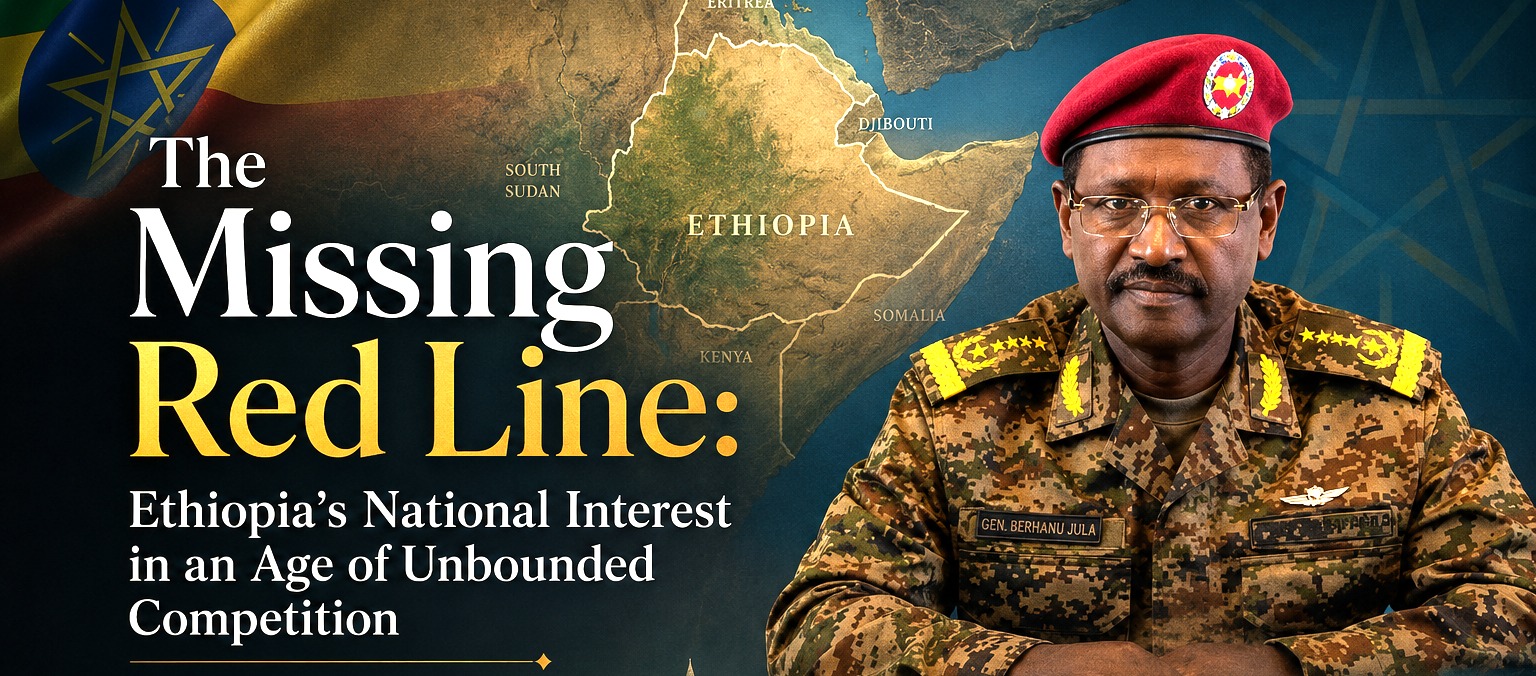
The recent warning by Ethiopia’s military chief of staff about political actors working with strategically hostile states should not be read merely as a security official’s frustration with domestic disagreements. Its deeper significance lies in what it exposes about Ethiopia’s political culture: the absence of a settled boundary between legitimate competition for power and the protection of the national interest. In a mature political order, elites may disagree fiercely over leadership, ideology, federal design, economic policy, and diplomatic tactics. What they do not normally do is turn the state’s survival questions into instruments of factional bargaining.
Ethiopia’s national-security predicament is therefore not only external. Eritrea’s posture, Egypt’s pressure over the Nile and the Red Sea, and Sudan’s military fragmentation matter. Yet these external pressures become more dangerous when they find internal brokers, rhetorical amplifiers, or political actors willing to treat hostile leverage as a domestic asset. The problem is not opposition. The problem is unbounded elite competition: a political culture in which rivalry has no strategic red line.
The State as Arena, Not Spoil
A functioning national political culture distinguishes between opposing a government and weakening the state’s strategic position. That distinction remains fragile in Ethiopia. Too often, the Ethiopian state is treated not as the permanent institutional platform within which elites compete, but as the prize to be captured, denied, weakened, or inherited. Once the ruling party and the state are collapsed into one object, external pressure on the state can be misread as political pressure on the ruling faction. That is the point where elite rivalry becomes strategic exposure.
This does not mean that criticism of foreign policy, military conduct, or national-security institutions is illegitimate. On the contrary, strategic debate is necessary. Ethiopia needs vigorous argument over diplomacy, defense priorities, maritime vulnerability, the Nile Basin, federal cohesion, and regional partnerships. But there is a difference between debating national strategy and collaborating with adversarial designs that seek to constrain Ethiopia’s bargaining position.
The national interest is not a slogan. It is the protected domain of state survival. It includes territorial integrity, military sovereignty, water security, critical infrastructure, diplomatic autonomy, maritime access, and the ability of the state to negotiate with external actors from a position of coherence. When these domains become available for factional exchange, the state does not merely face political instability. It loses strategic depth.
Comparative Discipline and Ethiopian Exception
Most states are not free of polarization. The old American doctrine that politics should “stop at the water’s edge” has always been imperfect, and contemporary U.S. politics shows that foreign policy can become deeply partisan.Yet the norm remains politically important. It reflected the idea that domestic rivalry should not invite foreign adversaries into the core of national-security decision-making. Even where that consensus has weakened, collaboration with hostile external actors against the state’s core security interests remains normatively stigmatized.
Egypt offers a more immediate regional comparison. Egyptian elites may disagree over economic management, political legitimacy, civil-military relations, or the distribution of state resources. But the Nile has been constructed as an existential issue around which elite fragmentation is tightly contained. Egypt’s legal and political claims over Nile waters remain disputed by upstream states, but its elite consensus is not in doubt: the Nile is treated as a survival issue, not an ordinary partisan instrument. That coherence strengthens Egypt’s strategic posture even when its substantive position is contested.
India provides another benchmark. Its politics is noisy, polarized, and ideologically divided. Yet sovereignty, territorial integrity, nuclear deterrence, and resistance to adversarial coercion are broadly protected from factional collaboration with hostile powers. China, though politically different, demonstrates another version of elite discipline: internal bargaining exists, but national rejuvenation, territorial claims, and strategic autonomy are treated as non-negotiable pillars of state doctrine.
Ethiopia’s exception is not that its elites disagree. All elites disagree. Ethiopia’s exception is that disagreements are unbounded, too many disagreements can become tools for external malign actors. Domestic actors unable to prevail through institutions, elections, negotiation, or coalition-building seek leverage from outside patrons. Foreign states do not need ideological loyalty from Ethiopian factions. They need access, narratives, pressure points, plausible deniability, and internal supporters for their strategic designs.
Externalization as Political Method
This is the mechanism through which elite rivalry becomes national-security vulnerability. External adversaries do not manufacture Ethiopia’s fragmentation from nothing; they monetize existing divisions. They identify factions with grievances, armed actors with power ambitions, diaspora networks with media reach, business groups with resource interests, and political entrepreneurs with weakened domestic constituencies. Through these networks, pressure against Ethiopia can be repackaged as pressure against a government.
Ethiopia’s recent regional environment has made this pattern especially dangerous. Relations with Eritrea have again deteriorated amid Eritrean military aggression and support for armed groups inside Ethiopian territory. Egypt continues to internationalize the Nile dispute and treat Ethiopia’s development of the GERD as a strategic threat rather than a legitimate upstream development project. Sudan’s war has fragmented authority across Ethiopia’s western frontier, creating overlapping security, refugee, arms-flow, and alignment risks. In such an environment, internal actors who normalize and become instruments for external pressure against the Ethiopian state do not simply weaken a ruling party. They narrow Ethiopia’s strategic room for maneuver.
This pattern also explains why the elite question cannot be reduced to ethnicity, ideology, or constitutional disagreement. Ethiopia’s political conflicts are shaped by identity, but they are not exhausted by identity. They are also shaped by a deeper culture of power in which elite competition frequently moves toward totalizing victory, historical revenge, and control of the state rather than negotiated coexistence within it. The result is a cyclical political condition: elites contest the legitimacy of the state when they do not control it.
The Cost of Strategic Indiscipline
Strategic indiscipline carries three costs.
First, it weakens Ethiopia’s external bargaining position. A state facing coordinated pressure over water, ports, borders, armed groups, and regional alignments cannot negotiate effectively if its internal elite ecosystem sends conflicting signals about what is negotiable and what is not.
Second, it invites adversarial penetration. Where elite competition has no protected boundary, foreign actors need not defeat Ethiopia directly. They can rent division, sponsor narratives, cultivate proxies, and wait for domestic actors to convert national vulnerability into factional leverage.
Third, it corrodes citizenship itself. When elites treat the state as a temporary possession of whoever governs, ordinary citizens lose confidence that national institutions serve a durable public interest. The army becomes politicized in perception, diplomacy becomes factionalized in language, and national interest becomes a slogan invoked selectively rather than a doctrine defended consistently.
This is why Ethiopia’s national-interest debate must move beyond patriotic sentiment. Ethiopia has no shortage of patriotic language. It has a shortage of enforceable elite discipline. The GERD showed that broad national mobilization is possible when a strategic project is framed as civilizational, developmental, and sovereign. But one project cannot substitute for a wider elite compact. A state cannot rely on episodic unity when it faces permanent strategic competition.
Toward a National-Interest Compact
Ethiopia needs a new elite compact that defines the boundary between legitimate political competition and impermissible strategic sabotage. Such a compact should not be a partisan manifesto. It should be a state doctrine negotiated across political parties, regional elites, military institutions, religious authorities, academics, business networks, civil society, and diaspora platforms.
The compact should protect political pluralism while hardening the national-security floor. Government performance, corruption, economic policy, constitutional reform, federal arrangements, public finance, elections, rights, and diplomatic tactics must remain open to contestation. But territorial integrity, military sovereignty, foreign-backed armed mobilization, critical infrastructure, water security, maritime vulnerability, and diplomatic campaigns designed to weaken Ethiopia’s bargaining position should be placed outside factional exchange.
This requires institutional mechanisms, not moral appeals alone. Parliament should develop a cross-party national-security code. Political parties should be required to commit publicly to non-collaboration with hostile external actors. Strategic files such as the Nile, maritime access, the national defense, and border security should be debated through structured national forums rather than rumor, propaganda, and diaspora media wars. Former officials, opposition leaders, military veterans, and intellectuals should have channels to criticize policy without becoming assets in external pressure campaigns.
Ethiopia does not need less politics. It needs a higher form of politics. A strong state is not one where all elites agree, but one where disagreement operates inside a protected national framework. Without such a framework, Ethiopia will continue to face not only external pressure, but the more dangerous condition of internal actors making that pressure strategically usable.
References
- Fana Broadcasting Corporate, “ENDF Chief of Staff Reaffirms Modern Military Capability in Safeguarding Ethiopia’s Sovereignty and National Security,” June 2026.
- Leslie H. Gelb, “Water’s Edge,” Democracy: A Journal of Ideas, 2008; Elizabeth N. Saunders, “Politics Can’t Stop at the Water’s Edge,” Foreign Affairs, February 2024; Dina Smeltz et al., “Are We Drowning at the Water’s Edge? Foreign Policy Polarization Among the U.S. Public,” International Politics, 2022.
- Institute Affari Internazionali, “The Nile River Dispute: Fostering a Human Security Approach,” 2023; International Crisis Group, “Bridging the Gap in the Nile Waters Dispute,” 2019.
- Reuters, “Ethiopia Accuses Eritrea of Military Aggression, Backing Armed Groups,” February 2026.
- Reuters, “Egypt’s Sisi Says He Values Offer by Trump to Mediate Egypt-Ethiopia Dispute on Nile,” January 2026.
- Sarah Vaughan and Kjetil Tronvoll, The Culture of Power in Contemporary Ethiopian Political Life, Swedish International Development Cooperation Agency, 2003; Dereje Feyissa, “Political Culture and Cyclical Conflict in Ethiopia,” Journal of Asian and African Studies, 2024; Asnake Kefale, “Identity Politics, Democratisation and State Building in Ethiopia’s Federal Arrangement,” African Journal on Conflict Resolution, 2010.
By IFA Staff writer
Disclaimer:
The content disseminated by the Institute of Foreign Affairs (IFA) – including, but not limited to, publications, public statements, events, media appearances, and digital communications – reflects the views of individual contributors and does not necessarily represent the official positions or policies of the Institute, its partners, or any affiliated governmental or non-governmental entities.
While the IFA endeavors to ensure the accuracy, integrity, and timeliness of the information presented, it makes no representations or warranties, express or implied, regarding the completeness, reliability, or suitability of such content for any purpose. The Institute expressly disclaims any liability for errors or omissions, as well as for any actions taken or decisions made based on the information provided.
The inclusion of external links, references, or third-party resources does not constitute an endorsement by the Institute. Additionally, engagement on social media platforms – including, but not limited to, likes, shares, retweets (RTs), or reposts – shall not be interpreted as an endorsement or validation of the views expressed therein.
Readers and audiences are encouraged to exercise critical judgment and seek independent verification when interpreting or relying upon any information disseminated through publications and posts on the Institute’s platforms or representative