

Somalia’s electoral crisis is not mainly about election timing; it is about a federal center attempting to manufacture legitimacy through constitutional reform while lacking the territorial reach, federal consensus, and coercive capacity that a national vote requires. Under the original timetable, the mandates of the central institutions had already moved into dispute; the government’s answer was to rely on constitutional amendments that extend federal terms and push the electoral horizon forward. The reform is framed as the architecture for one-person, one-vote politics. Its contradiction is that it is being advanced by a center whose authority is openly rejected by key federal member states and whose control over national territory remains partial.
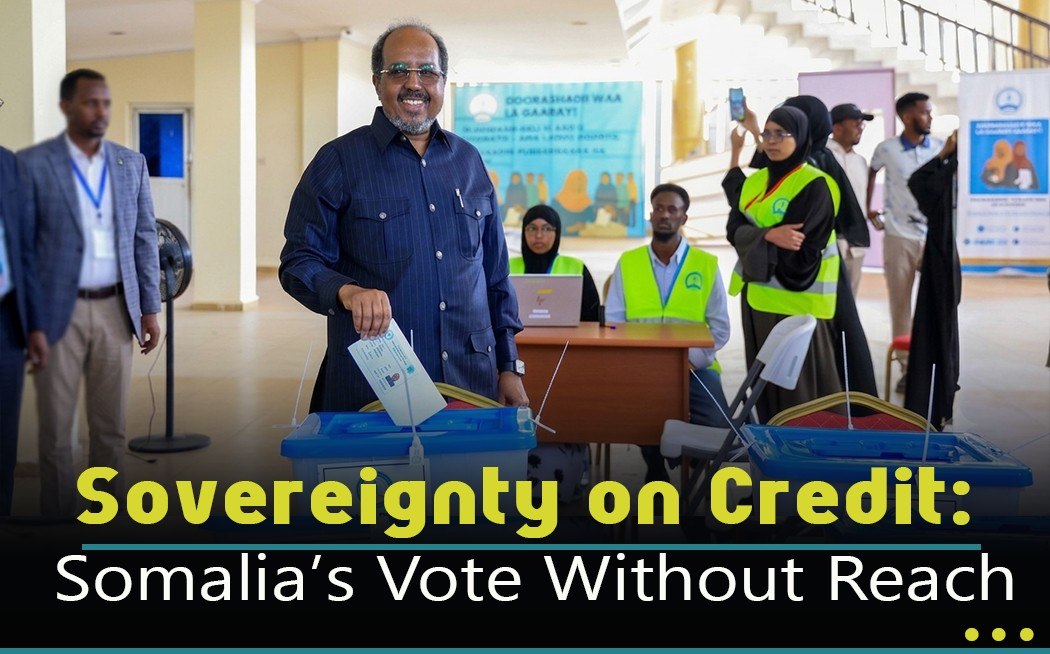
Read at face value, this is a quarrel over electoral mechanics. Read structurally, it is a vote without reach: a government claiming a future popular mandate while lacking the administrative geography needed to administer that mandate across the country. The recent local vote in the capital city of Mogadishu showed that direct elections can be staged in controlled urban space under heavy security deployment. But a municipal pilot is not a national architecture. It cannot resolve the harder question of whether voting can be credibly extended into districts where federal authority is thin, federal-member consent is absent, or al-Shabaab retains coercive reach.
The latest constitutional amendments therefore did not close Somalia’s transition. They converted it into a legitimacy contest. A constitutional assessment of the process noted that the review had formally reached a long-awaited milestone, but also recorded that some federal member states had withdrawn cooperation, opposition groups had threatened parallel political processes, and disputes over legitimacy and regional autonomy remained unresolved. The relevant question is no longer whether one-person, one-vote is normatively desirable. It is whether a democratizing form can carry democratic legitimacy when the bargaining architecture beneath it has fractured.
Transactional Fragmentation
The deeper mechanism is transactional fragmentation. Federal legitimacy decays; federal member states convert non-cooperation into bargaining power; outside actors price their patronage against a weaker center; counterterrorism coordination fragments; and Ethiopia inherits a wider exposure along its most sensitive eastern security frontier.
That sequence is already visible. Punt land rejected federal authority after disputed constitutional changes and tied its position to a referendum-based settlement. Juba land suspended relations with the federal government after a regional election dispute. South West state later suspended cooperation and accused the federal government of attempting to displace its leadership. These moves are not isolated acts of regional defiance. They are a federal bargaining pattern in which the center’s claim to legality is met by the regions’ claim to autonomy, and every missed deadline increases the price of bringing them back into a common process.
External actors then enter not as neutral supporters of Somali stability but as patrons operating in a market created by internal fracture. Turkey has embedded itself in Somalia’s security, maritime, and energy architecture through defence cooperation, maritime-security support, military training, and offshore energy engagement. Egypt has expanded its security relationship with Somalia through arms transfers, a security pact, and a declared plan to participate in the continental mission. The United Arab Emirates remains tied to Berbera commercial logistics and wider port-security relationships, while federal and regional actors have taken opposing positions over the status of those arrangements. Saudi Arabia’s role sits within the broader Red Sea and Gulf competition over corridors, influence, and security alignments.
This is the patronage market produced by weak sovereignty. When a federal center cannot bind its own members, outside powers do not merely support Somalia; they bargain with fragments of Somalia. The result is not immediate partition but externally priced sovereignty: regions, security institutions, ports, and political factions become nodes through which external actors acquire leverage.
The Insurgency Dividend
Al-Shabaab benefits from this fragmentation without needing to win the constitutional argument. The group’s advantage lies in the governance vacuum created when federal forces, regional forces, clan militias, opposition blocs, and external security sponsors operate on different political timetables. One country assessment recorded that al-Shabaab retained control over large rural areas in southern and central Somalia, while the arming of clan militias altered local power balances and contributed to deadly clashes. A separate rights assessment noted that the group had regained territory previously recovered by the government, especially in central Somalia and areas south of the capital city of Mogadishu.
This makes the election crisis more than a constitutional dispute. It is a counterterrorism sequencing problem. A direct national vote requires security coverage, district administration, political consent, and credible dispute resolution. A counterinsurgency campaign requires command coherence, predictable external support, and alignment between federal and regional actors. Somalia’s crisis weakens both at once. The center needs elections to renew legitimacy, but the security architecture needed for elections is itself weakened by the legitimacy dispute.
The later clashes in the capital city of Mogadishu exposed that convergence. Fighting between government troops and militias aligned with opposition figures erupted ahead of planned anti-government protests, after opponents rejected the president’s continued tenure under the amended constitutional time table. The government later said order had been restored, while residents reported that mediation by clan elders helped stop the fighting. That distinction matters. If armed confrontation is defused by clan mediation rather than institutional authority, the state has not demonstrated command; it has demonstrated dependency on social arbitration outside its formal chain of control.
The Dialogue Illusion
International partners are correct to call for dialogue, but dialogue alone misdiagnoses the crisis if it treats the problem as a failure of communication rather than a failure of architecture. A joint international statement called on Somali actors to resume talks, reach consensus on an election roadmap, and avoid actions that could escalate tensions. Regional and continental institutions repeated similar restraint language after the violence. These interventions are necessary because armed escalation would narrow the political space further. They are not sufficient because the dispute is no longer only about who talks to whom.
The required bargain must bind elections, security sequencing, and external-security commitments into one federal-consensus mechanism. That means the roadmap cannot simply name a date for voting. It must settle who validates the constitutional order, how Punt land, Juba land, and South West state are brought back into the process, how election management is insulated from unilateral control, how security responsibilities are allocated between federal and regional forces, and which external security arrangements are compatible with a unified Somali architecture. Without those elements, a dialogue process may lower the temperature while preserving the structural contradiction that created the crisis.
One policy analysis framed Somalia’s recurring election crisis as a tension between clan-based power sharing and direct elections, aggravated by unresolved disputes over the federal compact. That diagnosis is closer to the core. Somalia is not simply failing to schedule a vote. It is trying to move from negotiated elite legitimacy to mass electoral legitimacy without first settling the federal distribution of authority that makes either model credible.
The Democratic Objection
The strongest objection is that Somalia cannot remain indefinitely trapped in indirect clan-mediated selection. One-person, one-vote has democratic force precisely because the post-transition model has repeatedly turned elections into elite bargaining, delayed transitions, and lowered public trust. The recent local vote in the capital city of Mogadishu showed that popular voting is not technically impossible, and the aspiration to restore universal suffrage after decades of indirect politics is legitimate.
But sequencing is not obstruction. A direct-election project that bypasses federal consensus can centralize power before it democratizes authority. Somalia’s federal settlement has survived sharper crises, so this is not a forecast of imminent collapse. The sharper point is that each unresolved cycle lowers the threshold at which a federal member state can transact independently with an outside power, and that threshold does not reset. Punt land, Juba land, and South West state do not need to defeat the federal government. They only need to make themselves indispensable to any credible election, security deployment, port negotiation, or counterterrorism arrangement.
Ethiopia’s Strategic Exposure
For Ethiopia, the hazard is not one Somali collapse but the slow conversion of Somalia into a patchwork of externally sponsored fiefs along a long and sensitive frontier. Ethiopia has carried direct costs in Somalia’s stabilization architecture for nearly two decades, including through continental peace operations against al-Shabaab; Ethiopian troops serving under the continental mission have been formally recognized for degrading al-Shabaab and protecting local communities in South West state. That record gives Ethiopia more than proximity. It gives Ethiopia standing.
The required Ethiopian posture should be defined, not merely reactive. Ethiopia should support an African-backed federal-consensus mechanism that binds three tracks into one architecture: an agreed election roadmap, a security-sequencing plan for districts where voting is contested or insurgent pressure remains high, and a rule that external-security commitments must reinforce rather than bypass Somalia’s federal bargain. This position does not require Ethiopia to choose a Somali faction. It requires Ethiopia to oppose transactional fragmentation when that fragmentation creates corridors for hostile leverage, counterterrorism incoherence, and external military insertion along Ethiopia’s border.
The distinction is important. Generic facilitation would treat Ethiopia as one more regional helper. A calibrated posture recognizes Ethiopia as the actor with the most to lose from Somalia’s fragmentation and the most standing, after years of cost in continental peace operations, to insist that both the federal center and the member states bargain inside a common architecture before they bargain externally.
Fragmentation Without Collapse
The most plausible near-term scenario is not clean state failure but fragmentation without formal collapse. The federal government will continue to invoke the amended constitutional order; opposition actors and federal member states will continue to invoke the earlier mandate timeline and the provisional federal settlement; international partners will continue to call for talks; al-Shabaab will continue to exploit the operational vacuum; and outside actors will continue to price their influence according to how weak the center becomes.
That is the logic of transactional fragmentation. It does not require Somalia’s formal disintegration. It requires only enough institutional ambiguity for legitimacy to be claimed at the center, traded in the regions, financed by external patrons, and harvested by armed actors. The vote-without-reach contradiction will persist until electoral reform is tied to territorial control, federal consent, and a security architecture that cannot be outsourced faction by faction. If that bargain is not reached before the next electoral deadline is improvised, Somalia will not simply postpone another vote. It will normalize a political order in which sovereignty is continuously brokered below the state and above it.
References
- Demissie, S. T. (2026, May 20). More instability for Somalia as another election deadline lapses. Institute for Security Studies. https://issafrica.org/iss-today/more-instability-for-somalia-as-another-election-deadline-lapses; Reuters. (2026, March 5). Somali parliament backs constitutional changes that could extend president’s term. https://www.reuters.com/world/africa/somali-parliament-approves-constitution-change-extend-presidents-term-delay-2026-03-05/
- Bertelsmann Stiftung. (2026). BTI 2026 country report: Somalia. BTI Transformation Index. https://bti-project.org/en/reports/country-report/SOM
- Sheikh, A. (2025, December 25). Somalia’s capital votes in first step to restoring universal suffrage. Reuters. https://www.reuters.com/world/africa/somalias-capital-votes-first-step-toward-restoring-universal-suffrage-2025-12-25/
- Schmidt, J. A. (2026, April 7). From provisional to permanent constitution? Assessing the end of Somalia’s constitutional review process. ConstitutionNet. https://constitutionnet.org/news/voices/provisional-permanent-constitution-assessing-end-somalias-constitutional-review-process
- Reuters. (2024, March 31). Somalia’s Puntland refuses to recognise federal government after disputed constitutional changes. https://www.reuters.com/world/africa/somalias-puntland-refuses-recognise-federal-government-after-disputed-2024-03-31/
- Reuters. (2024, November 28). Somalia’s Jubbaland government suspends ties with federal administration. https://www.reuters.com/world/africa/somalias-jubbaland-government-suspends-ties-with-federal-administration-2024-11-28/
- Reuters. (2026, March 17). Somalia’s South West state says it has severed ties with the federal government. https://www.reuters.com/world/africa/somalias-south-west-state-says-it-has-severed-ties-with-federal-government-2026-03-17/
- Reuters. (2024, February 22). Turkey to provide maritime security support to Somalia — official. https://www.reuters.com/world/turkey-provide-maritime-security-support-somalia-official-2024-02-22/; Sezer, C. (2024, March 7). Turkey signs energy cooperation deal with Somalia. Reuters. https://www.reuters.com/business/energy/turkey-signs-energy-cooperation-deal-with-somalia-2024-03-07/
- Reuters. (2024, August 28). Egypt sends arms to Somalia following security pact, sources say. https://www.reuters.com/world/africa/egypt-sends-arms-somalia-following-security-pact-sources-say-2024-08-28/; Reuters. (2024, December 23). Egypt troops to join African Union Somalia mission — foreign minister says. https://www.reuters.com/world/africa/egypt-troops-join-african-union-somalia-mission-foreign-minister-says-2024-12-23/
- Reuters. (2026, January 12). Somalia ends port deals and security cooperation with UAE. https://www.reuters.com/world/africa/somalia-annuls-all-agreements-with-uae-including-port-deals-2026-01-12/; Reuters. (2026, January 13). Somali regions reject Mogadishu’s move to cut ties with UAE. https://www.reuters.com/world/middle-east/somali-regions-reject-mogadishus-move-cut-ties-with-uae-2026-01-13/
- Hudson, J., & Mekhennet, S. (2026, January 20). After Yemen rift, Saudi Arabia aims to quash UAE’s power in wider region. The Washington Post. https://www.washingtonpost.com/world/2026/01/20/saudi-arabia-uae-yemen-red-sea/
- Human Rights Watch. (2026). World report 2026: Somalia. https://www.hrw.org/world-report/2026/country-chapters/somalia
- Sheikh, A. (2026, June 4). Somali military and opposition-allied militias trade fire ahead of anti-government protests. Reuters. https://www.reuters.com/world/africa/somali-military-opposition-allied-militias-trade-fire-ahead-anti-government-2026-06-04/
- Reuters. (2026, June 5). Somalia government says it has restored order after fighting in the capital. https://www.reuters.com/world/africa/somalia-government-says-it-has-restored-order-after-fighting-capital-2026-06-05/
- United Nations Transitional Mission in Somalia. (2026, June 1). Joint statement of the international community on the political situation in Somalia. https://untmis.unmissions.org/en/press-releases/joint-statement-of-the-international-community-on-the-political-situation-in
- Kithumbu, A. (2024, December 17). ATMIS honours Ethiopian troops for contributions to Somalia. African Union Transition Mission in Somalia. https://atmis-au.org/atmis-honours-ethiopian-troops-for-contributions-to-somalia/
By Kuchim Silesh, IFA
Disclaimer:
The content disseminated by the Institute of Foreign Affairs (IFA) – including, but not limited to, publications, public statements, events, media appearances, and digital communications – reflects the views of individual contributors and does not necessarily represent the official positions or policies of the Institute, its partners, or any affiliated governmental or non-governmental entities.
While the IFA endeavors to ensure the accuracy, integrity, and timeliness of the information presented, it makes no representations or warranties, express or implied, regarding the completeness, reliability, or suitability of such content for any purpose. The Institute expressly disclaims any liability for errors or omissions, as well as for any actions taken or decisions made based on the information provided.
The inclusion of external links, references, or third-party resources does not constitute an endorsement by the Institute. Additionally, engagement on social media platforms – including, but not limited to, likes, shares, retweets (RTs), or reposts – shall not be interpreted as an endorsement or validation of the views expressed therein.
Readers and audiences are encouraged to exercise critical judgment and seek independent verification when interpreting or relying upon any information disseminated through publications and posts on the Institute’s platforms or representative