

Executive Summary
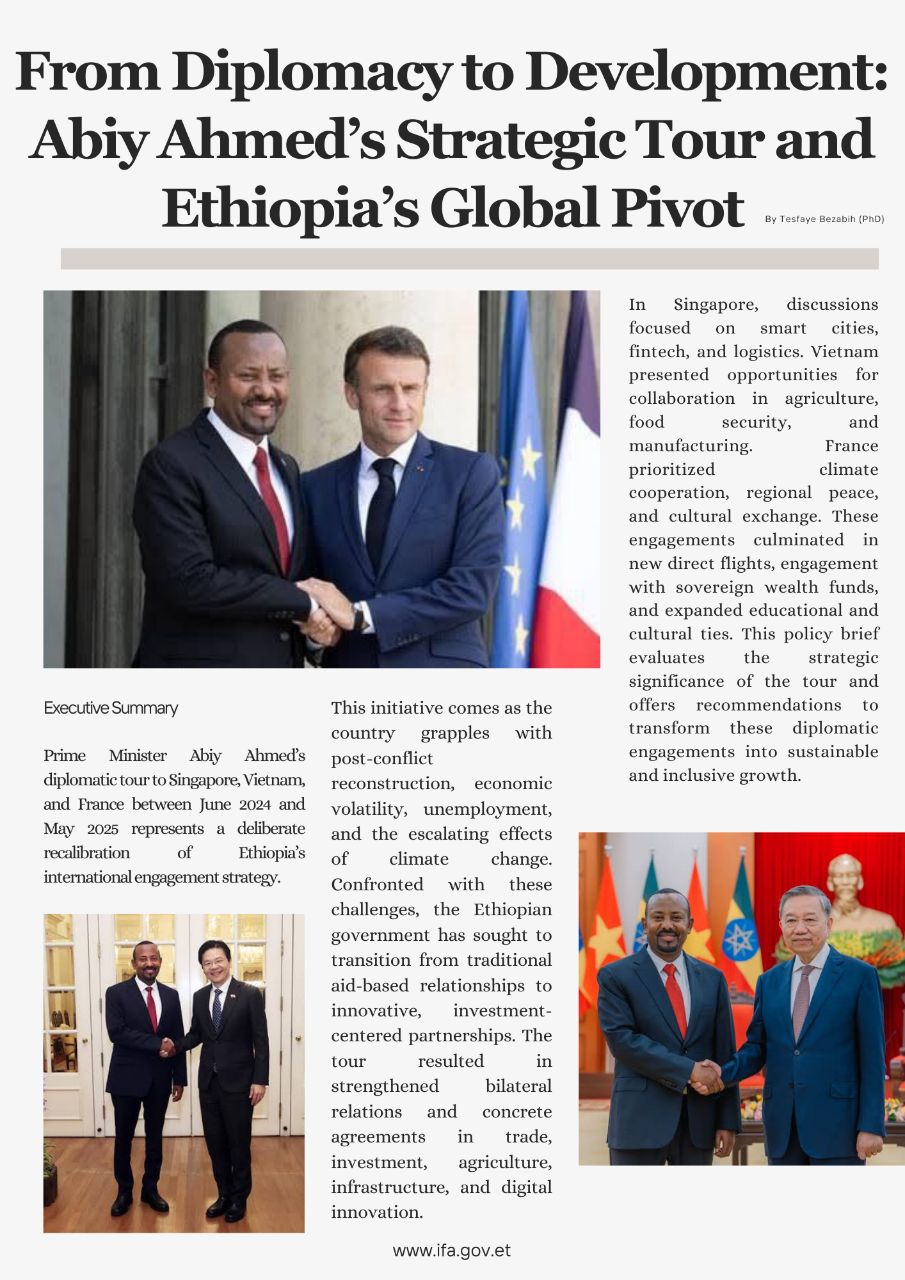
Prime Minister Abiy Ahmed’s diplomatic tour to Singapore, Vietnam, and France between June 2024 and May 2025 represents a deliberate recalibration of Ethiopia’s international engagement strategy. This initiative comes as the country grapples with post-conflict reconstruction, economic volatility, unemployment, and the escalating effects of climate change. Confronted with these challenges, the Ethiopian government has sought to transition from traditional aid-based relationships to innovative, investment-centered partnerships. The tour resulted in strengthened bilateral relations and concrete agreements in trade, investment, agriculture, infrastructure, and digital innovation.
In Singapore, discussions focused on smart cities, fintech, and logistics. Vietnam presented opportunities for collaboration in agriculture, food security, and manufacturing. France prioritized climate cooperation, regional peace, and cultural exchange. These engagements culminated in new direct flights, engagement with sovereign wealth funds, and expanded educational and cultural ties. This policy brief evaluates the strategic significance of the tour and offers recommendations to transform these diplomatic engagements into sustainable and inclusive growth.
Background and Context
Ethiopia is navigating a complex phase of economic reform and post-war recovery while simultaneously facing rising unemployment and increasing climate-related challenges. In response, the government has made it a strategic priority to expand global partnerships and study fast-growing nations that have transitioned from instability to development. The diplomatic missions to Singapore, Vietnam, and France were designed to forge new relationships that could provide substantial foreign direct investment, informed policy approaches, and technological innovations aligned with Ethiopia’s national objectives of industrialization, food production, and green development. These visits also reflect Ethiopia’s aspiration to become a more connected and forward-looking nation.
Strategic Objectives of the Prime Minister’s Tours
The primary objective of the Prime Minister’s foreign trips is to stimulate economic development, modernize infrastructure, and reposition Ethiopia on the international stage. A central aim is to attract foreign enterprises and investors to sectors including manufacturing, agriculture, infrastructure, and renewable resources, while simultaneously positioning Ethiopia as a hub for innovation and logistics.
Through its engagement with Singapore, Ethiopia aimed to draw lessons from its success in smart city development, financial technology, and efficient, state-led investment. In Vietnam, the delegation studied how the country transitioned from a post-war economy to one of the world’s leading exporters of rice and coffee, sectors of significant importance to Ethiopia’s food security (https://allafrica.com/stories/202505010116.html). In France, the emphasis was on reinforcing existing friendly ties, jointly advancing climate initiatives, and contributing to regional peace and security. The tour also promoted cultural and educational exchanges and reiterated Ethiopia’s role in regional stability. Collectively, the visits demonstrated the government’s strategy to use international partnerships to reinforce domestic reforms and support national development.
Key Outcomes and Agreements
The diplomatic tour led to concrete achievements across multiple sectors. In Singapore, the celebration of 55 years of diplomatic ties underscored longstanding relations, and discussions resulted in a mutual commitment to enhance trade, investment, and industrial collaboration. Ethiopian Investment Holdings entered dialogue with Temasek Holdings on potential partnerships in strategic sectors. Ethiopia and Singapore also agreed to collaborate in digital innovation, fintech, and smart city development, aligning with Ethiopia’s reform agenda (https://www.pmo.gov.sg/Photos/Visit-by-Ethiopian-Prime-Minister-Abiy-Ahmed-Ali—June-2024).
In Vietnam, a key milestone was the inauguration of direct Ethiopian Airlines flights to Hanoi, which improves air connectivity and affirms Ethiopia’s position as a gateway to Africa. Discussions emphasized strengthening agricultural collaboration, particularly Vietnam’s assistance in rice and coffee production, leveraging its globally recognized expertise. Vietnamese investors were encouraged to explore opportunities in Ethiopia’s manufacturing and agro-processing sectors, with mutual interest expressed in joint ventures.
In France, attention centered on climate partnerships, with renewed support for Ethiopia’s Green Legacy Initiative and dialogue on expanding cooperation in renewable energy. Educational and cultural ties were also a focal point, with both nations exploring enhanced academic exchanges and technical training programs. High-level talks reaffirmed Ethiopia’s commitment to regional peacebuilding and its leadership in fostering security in the Horn of Africa (https://www.ebc.et/english/newsdetails.aspx?newsid=11180). These agreements demonstrated how strategic diplomacy could yield multifaceted benefits, from increased investment to stronger regional ties.
Policy Implications and Opportunities
The Prime Minister’s tour presents Ethiopia with critical policy implications and opportunities. First, it confirms a transition toward investment-driven diplomacy. Ethiopian policymakers must now focus on translating diplomatic engagements into actionable domestic reforms by improving the ease of doing business, enhancing regulatory frameworks, and creating competitive investment incentives.
Second, the collaboration with Vietnam presents an opportunity to strengthen Ethiopia’s food sovereignty and boost agricultural exports. This can be achieved by investing in public-private partnerships for agricultural research, irrigation systems, and mechanization, alongside building robust value chains.
Third, Singapore’s experience offers a pathway for Ethiopia to leapfrog development stages through digital transformation. By fostering innovation ecosystems, expanding digital public services, and establishing effective data governance, Ethiopia can position itself at the forefront of technological advancement in Africa.
Fourth, Ethiopia’s alignment with France on environmental sustainability reinforces the need to embed green development within its national strategy. Accessing climate finance, promoting renewable energy, and scaling up reforestation initiatives should be prioritized to advance the Green Legacy and similar programs.
Finally, the tour has strengthened Ethiopia’s geopolitical position. Its emerging role as a connector between Africa, Asia, and Europe and as a promoter of regional peace underscores the importance of active engagement in multilateral institutions. Ethiopia’s foreign policy must now be matched with institutional readiness and strategic coherence to turn global cooperation into lasting developmental gains.
Conclusion
Prime Minister Abiy Ahmed’s diplomatic tour to Singapore, Vietnam, and France marks a pivotal moment in Ethiopia’s foreign policy evolution. Amid pressing domestic challenges, the tour reflects a shift from traditional diplomacy to a proactive and purposeful approach focused on investment, innovation, and sustainable development. The results – ranging from trade deals and investment commitments to climate partnerships and educational collaborations – highlight Ethiopia’s growing credibility and attractiveness on the global stage.
To capitalize on these gains, the government must ensure that international partnerships are accompanied by institutional reform, policy consistency, and robust implementation mechanisms. Only by effectively connecting its global outreach with internal transformation can Ethiopia fulfill its vision of becoming a resilient, inclusive, and influential nation in the global order.
About the author
Tesfaye Bezabih (PhD), lead researcher Europe and America Affairs department at the Institute of Foreign Affairs
Disclaimer:
The content disseminated by the Institute of Foreign Affairs (IFA) – including, but not limited to, publications, public statements, events, media appearances, and digital communications – reflects the views of individual contributors and does not necessarily represent the official positions or policies of the Institute, its partners, or any affiliated governmental or non-governmental entities.
While the IFA endeavors to ensure the accuracy, integrity, and timeliness of the information presented, it makes no representations or warranties, express or implied, regarding the completeness, reliability, or suitability of such content for any purpose. The Institute expressly disclaims any liability for errors or omissions, as well as for any actions taken or decisions made based on the information provided.
The inclusion of external links, references, or third-party resources does not constitute an endorsement by the Institute. Additionally, engagement on social media platforms – including, but not limited to, likes, shares, retweets (RTs), or reposts – shall not be interpreted as an endorsement or validation of the views expressed therein.
Readers and audiences are encouraged to exercise critical judgment and seek independent verification when interpreting or relying upon any information disseminated through publications and posts on the Institute’s platforms or representatives.