

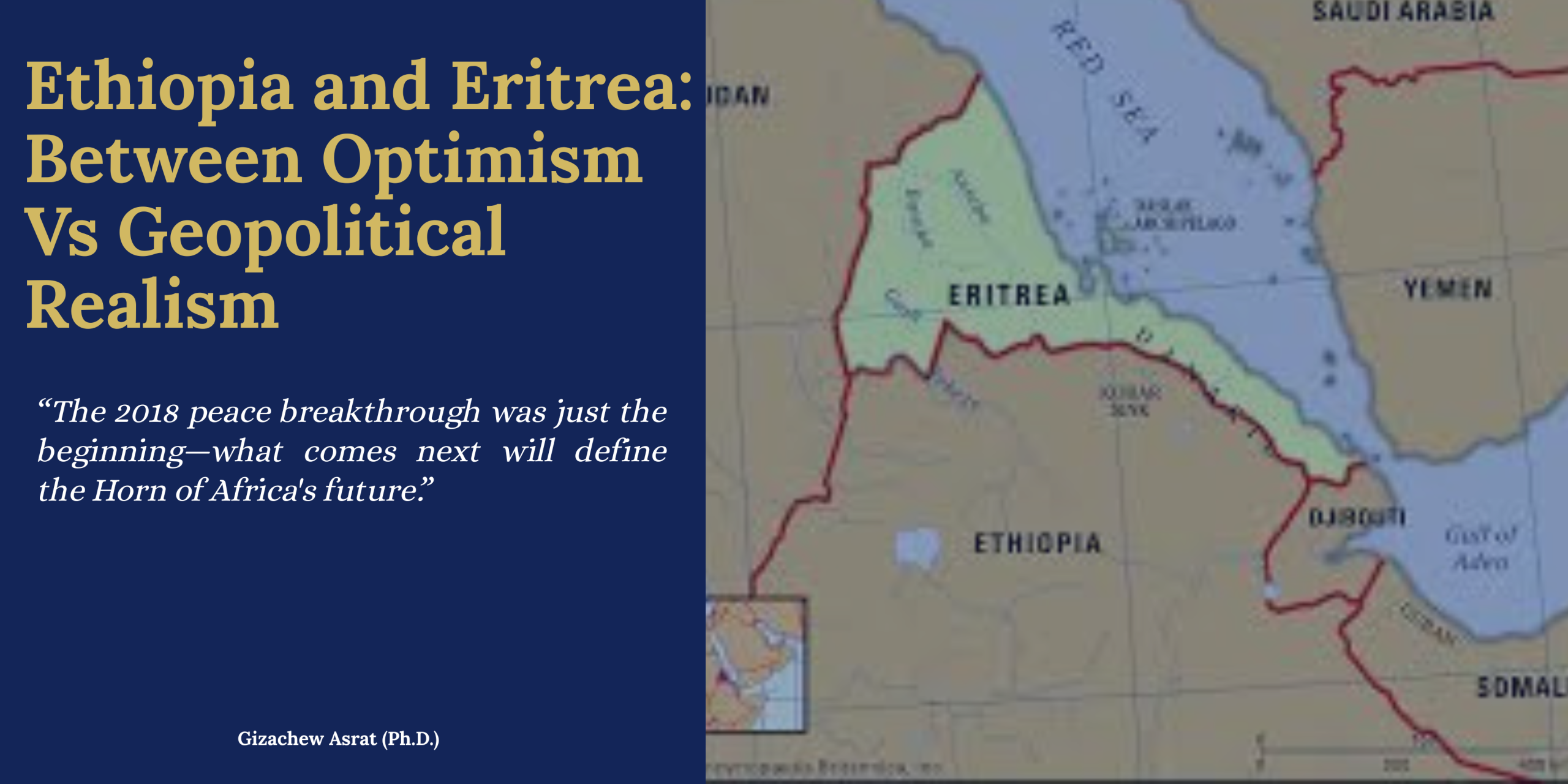
The 2018 political transition in Ethiopia marked a historic turning point, not only for its internal politics but also for its foreign relations. Prime Minister Abiy Ahmed’s reformist agenda dismantled the status quo and opened the door for renewed engagement with Eritrea, culminating in the Joint Declaration of Peace and Friendship signed on July 9, 2018 (Joint Declaration of Peace and Friendship, 2018). The symbolic gestures that followed – public celebrations, border reopenings, and diplomatic visits – ignited hopes of a new era between the two countries (Tronvoll, 2019).
For Eritrea, the fall of the Tigray People’s Liberation Front (TPLF) from power was especially significant. President Isaias Afwerki saw in it the vindication of his long-standing criticism of the TPLF and seized the moment to re-enter the regional stage after decades of isolation (International Crisis Group, 2020). Ethiopia’s acceptance of the Eritrea-Ethiopia Boundary Commission’s ruling and subsequent peace overtures led to international acclaim, bolstered further by the Jeddah Agreement mediated by Saudi Arabia and the UAE (Eritrea-Ethiopia Boundary Commission, 2002; Jeddah Agreement, 2018).
The peace agreements promised normalization of relations, reopening of embassies, air links, and joint economic and security initiatives. Ethiopia anticipated renewed access to Red Sea ports like Assab and Massawa (de Waal, 2018). Yet beneath the surface, the rapprochement lacked institutional mechanisms. The peace remained highly personalized, with little systemic follow-through. As the initial enthusiasm waned, border reopenings were reversed, bilateral initiatives slowed, and scheduled meetings became erratic.
The outbreak of conflict in Ethiopia’s Tigray region in late 2020 further complicated matters. Eritrea’s military involvement drew widespread condemnation, with reports of atrocities intensifying scrutiny of the peace (Human Rights Watch, 2021). Though the TPLF was a common adversary, divergent political philosophies and national interests resurfaced. Eritrea’s suspicion of Ethiopia’s evolving federalism and growing geopolitical autonomy added friction to the relationship.
Ethiopia’s post-2018 foreign policy – branded under the “Horn First” doctrine – sought to build regional integration through trade, connectivity, and mutual development (Ethiopia Ministry of Foreign Affairs, 2019). Eritrea, however, remained committed to a statist, self-reliant model rooted in its liberation-era ideology. Isaias’ firm rejection of liberal democratic norms – most notably in a 2008 interview where he dismissed democracy as inherently divisive – further undermined the long-term feasibility of strategic alignment (Al Jazeera Interview, 2008).
Asmara’s political stagnation is evident not only in governance but also in demography and economy. Visitors to the capital describe a city frozen in time, with an aging population and limited economic vibrancy (Kibreab, 2009). Eritrea’s closed civic space, mandatory conscription, and centralized decision-making have made it difficult to sustain foreign partnerships. Even shared history and cultural ties have not fully bridged the mistrust.
Eritrea’s recent deepening of ties with Egypt, including several meetings in late 2024 and early 2025, has raised strategic alarms in Ethiopia. With tensions around the Nile and Red Sea corridors growing, the alignment adds another layer of complexity to an already delicate relationship (Carnegie Endowment for International Peace, 2025).
Despite increased defense spending and a more assertive regional posture, Ethiopia still faces the challenge of transforming symbolic peace into institutional normalcy. A sustainable Ethiopia-Eritrea relationship requires de-personalization and formalization. People-to-people diplomacy, civil society engagement, trade corridors, and predictable channels of communication are essential.
The state of hostility may have ended, but true peace demands more than political handshake moments. Ethiopia must recognize not only the leadership of Eritrea but also the aspirations of its people. While historical grievances endure, war is not inevitable. With realism, mutual respect, and strategic patience, a more durable partnership can be forged.
The Horn of Africa’s long-term stability hinges on countries learning to resolve legacy disputes through contemporary, inclusive tools. The 2018 breakthrough was a beginning, not a resolution. The real test lies in what follows – in crafting diplomacy that lasts beyond leaders and into the institutions and people they represent.
References:
- International Crisis Group, “Averting War in Northern Ethiopia,” Report No. 177, 2020.
- Kjetil Tronvoll, The Eritrean–Ethiopian Peace Agreement: Triumph and Limitations, 2019.
- Joint Declaration of Peace and Friendship, July 9, 2018.
- Eritrea–Ethiopia Boundary Commission Decision, April 13, 2002.
- Jeddah Agreement, signed on September 16, 2018, under the auspices of Saudi Arabia and the UAE.
- Alex de Waal, “Beyond the Red Sea: A New Driving Force in the Politics of the Horn,” World Peace Foundation, 2018.
- Human Rights Watch, “Eritrean Troops Kill, Rape in Tigray,” March 5, 2021.
- Ethiopia Ministry of Foreign Affairs, “Horn First: Regional Integration and Diplomacy,” Policy Brief, 2019.
- Isaias Afwerki, Al Jazeera Interview, 2008: “Democracy is not a panacea. It’s divisive.”
- Bereket Habte Selassie, “The Horn’s Historical Fault Lines,” African Affairs, 2010.
- Tesfagiorgis, Gaim Kibreab, Eritrea: A Dream Deferred, James Currey, 2009.
- Carnegie Endowment for International Peace, “The Egypt-Eritrea Alignment,” Briefing, February 2025.
About the authors
Gizachew Asrat (Ph.D.), Senior Researcher, African Affairs Research Department Director General, IFA
Disclaimer:
The content disseminated by the Institute of Foreign Affairs (IFA) – including, but not limited to, publications, public statements, events, media appearances, and digital communications – reflects the views of individual contributors and does not necessarily represent the official positions or policies of the Institute, its partners, or any affiliated governmental or non-governmental entities.
While the IFA endeavors to ensure the accuracy, integrity, and timeliness of the information presented, it makes no representations or warranties, express or implied, regarding the completeness, reliability, or suitability of such content for any purpose. The Institute expressly disclaims any liability for errors or omissions, as well as for any actions taken or decisions made based on the information provided.
The inclusion of external links, references, or third-party resources does not constitute an endorsement by the Institute. Additionally, engagement on social media platforms – including, but not limited to, likes, shares, retweets (RTs), or reposts – shall not be interpreted as an endorsement or validation of the views expressed therein.
Readers and audiences are encouraged to exercise critical judgment and seek independent verification when interpreting or relying upon any information disseminated through publications and posts on the Institute’s platforms or representatives.