

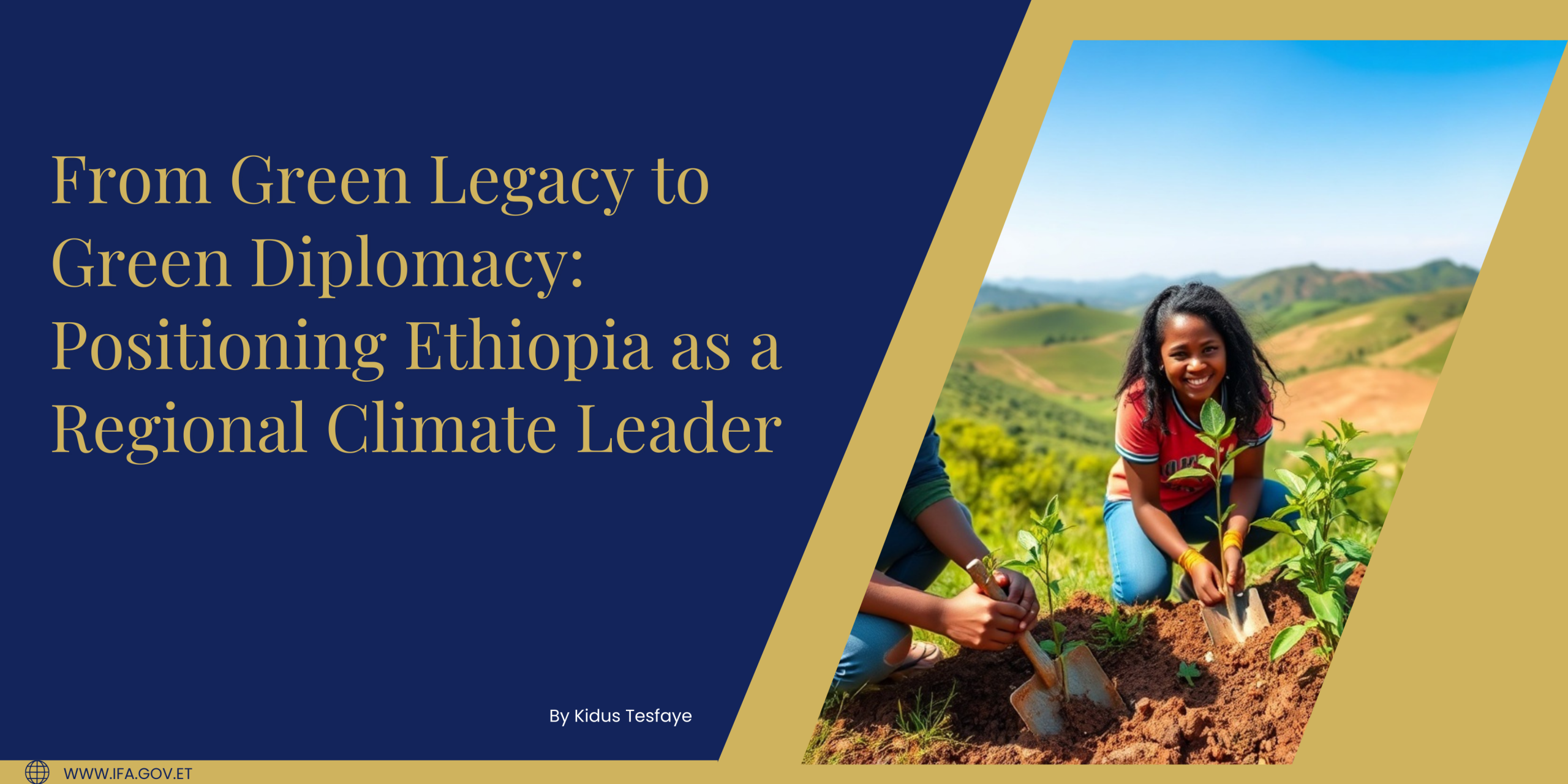
When Ethiopia presented its Youth Declaration at the 2023 African Climate Summit, it highlighted more than a set of demands. It reflected the country’s ambition to extend the success of the Green Legacy Initiative beyond its borders. In six short years GLI has placed 25 billion seedlings in Ethiopian soil and generated some 767,000 green jobs many filled by young people searching for work that matters as much as it pays[1]. However, at regional climate negotiations, youth participation remains largely symbolic, appearing more in media coverage than in decision-making rooms. This gap represents a missed opportunity, especially in a region where the majority of the population is under 30.
Ethiopia’s central position in the IGAD region gives it a unique chance to lead by example in both climate action and diplomacy. The Green Legacy Initiative has proven the nation can mobilize large-scale efforts effectively; the next step is to channel that energy into regional influence. By embedding young people more fully into climate diplomacy, Ethiopia can strengthen its voice internationally while modeling inclusive leadership that neighboring countries could emulate.
Beyond the Trees
The Green Legacy Initiative is one of Ethiopia’s most ambitious efforts to fight climate change and restore the environment. Ethiopian PM H.E. Abiy Ahmed (PhD) has emerged as a prominent advocate for environmental stewardship and climate-conscious leadership through the bold launch and implementation of Ethiopia’s Green Legacy Initiative (GLI)[2]. Launched as a nationwide movement, it has helped plant billions of trees and raised public awareness about sustainability. More importantly, it has shown that Ethiopia can lead by example using its own resources and people to shape a greener future. This kind of leadership gives Ethiopia a stronger voice in climate diplomacy across Africa and on the global stage. It shows how environmental action at home can support respect and recognition abroad.
To make this legacy stronger and sustainable, young people must move to the front row. They are already the driving force in technology, innovation and social change. And now, they must be equipped to lead in climate negotiations too. Programs that combine local knowledge, environmental training and diplomatic skills can prepare a new generation of climate ambassadors. Just as the Green Legacy united communities across the country, youth-centered green diplomacy can help Ethiopia speak with clarity and confidence at events like COP29 and others.
As a young professional observing both environmental efforts on the ground and climate discussions in regional forums, I believe Ethiopia can and should connect the two by turning GLI into a Youth-led Climate-Diplomacy Drive. Below I make the case, draw on current data and lay out three pragmatic steps that could put Ethiopia at the forefront of what I call Green Diplomacy 2.0.
Why should youth move to the front row of climate diplomacy in the IGAD region? The answer lies not only in numbers but in the undeniable force that young people already represent. The demographic weight of the youth is more than a statistic. It is a living, breathing social power shaping markets, driving technology and shaping public debates. If these voices are excluded from the climate negotiation tables, decisions risk becoming irrelevant to the very public whose lives are most directly tied to the outcomes.
Climate security, after all is youth security. The IGAD Climate Adaptation Strategy (2023–2030) itself recognizes that young people are among the populations most disproportionately affected by floods, droughts and displacement[3]. To sideline them is to transform direct victims into passive bystanders, when in truth they should be positioned as first responders and problem-solvers.
At the heart of this issue also lies the matter of jobs. Recent studies by FSD Africa and the Boston Consulting Group reveal that Africa could create up to 3.3 million green jobs by 2030, with Ethiopia positioned to secure around 720,000 of these opportunities[4]. However, without deliberately training young people in both technical green skills and the diplomatic knowledge necessary to negotiate cross-border deals, the promise of these jobs risks slipping away to other countries that act faster. This is the hinge moment prepare now or lose the chance to transform youth potential into economic strength.
So the question is how can Ethiopia turn its green legacy into a form of green diplomacy that elevates young people to the roles they deserve? The first step is to establish a Youth Climate-Diplomacy Corps (Y-CDC), a bold program modeled after the Peace Corps but focused squarely on climate diplomacy. This corps would recruit Ethiopians aged 18 to 30 for a one-year program blending local and global experiences. Fellows would work hands-on at Green Legacy Initiative seedling nursery sites to connect with grassroots climate action. They would undergo short, intensive training at the Foreign Service Institute to gain the tools of negotiation and diplomacy. Ethiopia could launch a program to train significant number of young climate diplomats over three years, equipping them with the skills and exposure needed to represent the country at major global events like COP29.
The second step is to thread climate diplomacy into Ethiopia’s education system, particularly in Technical and Vocational Education and Training (TVET) colleges and universities. While many TVET programs currently focus on practical skills like solar-panel wiring or drip-irrigation design, they overlook the diplomatic and policy dimensions that unlock real transformation whether in cross-border power trade or shared water governance. Updating curricula to include modules on international climate finance, negotiation simulations and IGAD legal frameworks would close the green-skills gap that analysts often highlight. The students who emerge with both engineering know-how and diplomatic insight will not only find themselves at the front of the job wave but also in positions of leadership across borders.
The final step is to convene an annual IGAD Youth Climate Summit in Addis Ababa, not as a symbolic gesture but as a platform with real institutional weight. Unlike the countless youth forums that fade into the noise of social media, this summit would be strategically aligned with the IGAD Council of Ministers’ meetings. Youth statements and demands would feed directly into binding declarations, giving them a direct line of influence. The logistics would not require building new structures; they could ride on the back of existing IGAD gatherings. Sponsorship could come from regional banks and global initiatives such as the UNFCCC’s Youth Climate Champion Programme, which has already been institutionalized[5]. Ethiopia, by hosting such a summit, would make sure that youth voices are not peripheral but embedded in the very mechanisms of regional decision-making.
Ethiopia’s upcoming role as host of the Second Africa Climate Summit in September 2025 offers the perfect stage to put these ideas into action. With over twenty thousand delegates expected, including heads of state, policymakers and civil society leaders, the summit will spotlight African-led solutions to the climate crisis. For Ethiopia, it is not only a chance to showcase its national green initiatives but also to elevate youth as central actors in climate diplomacy. Programs such as a Youth Climate-Diplomacy Corps or new university curricula on green diplomacy could gain international visibility at this gathering, ensuring that Ethiopian youth are seen not as participants on the sidelines but as shapers of global negotiations.
In short, moving youth to the front row is not a favor to the younger generation; it is an imperative for the survival and advancement of Ethiopia and the wider IGAD region. Climate change is already shaping the future and the youth are both its first victims and its most promising agents of change. Ignoring them is a mistake we cannot afford. Empowering them is a choice we must make now.
A Personal Closing Reflection
As someone deeply committed to youth empowerment, sustainable development and the future of Ethiopia; I believe we are at a defining moment. The Green Legacy Initiative has laid a strong foundation, but its true success depends on how we build upon it especially by involving young people in meaningful ways. Youth are not just future leaders; they are current change-makers who deserve the tools, training and trust to represent our country in global climate discussions.
On the other hand, Green Diplomacy is no longer a luxury side-project for environment ministries; it is fast becoming the currency of security, trade and regional prestige. Ethiopia has the resources, the public goodwill and most importantly the youth to mint that currency first. The only question is whether we will hand them the pen before the next agreement is signed in our absence.
Hence, this policy brief is not just a call to action rather it is a reflection of my hope that Ethiopia can lead with both wisdom and vision. By investing in young diplomats, we can ensure that our national efforts take root on the international stage. Climate diplomacy must grow beyond government halls and into the hands of well-prepared young citizens ready to serve the planet. The time to prepare them is now!
[1]United Nations Department of Economic and Social Affairs. 2023. “Green Legacy Initiative.” United Nations Partnerships for SDGs Platform. https://sdgs.un.org/partnerships/green-legacy-initiative.
[2] Ethio Eyewitness News, “Ethiopian Green Legacy: A Visionary Environmental Initiative,” 2024, Ethio Eyewitness News, https://www.ethioeyewitness.com/ethiopian-green-legacy-a-visionary-environmental-initiative/
[3] IGAD, Climate Adaptation Strategy 2023-2030, December 2023, IGAD, https://igad.int/download/the-igad-climate-adaptation-strategy-2023-2030/
[4] FSD Africa and Boston Consulting Group, Forecasting Green Jobs in Africa, July 24, 2024, FSD Africa, https://fsdafrica.org/publication/forecasting-green-jobs-in-africa FSD Africa.
[5] IGAD, “Harnessing Youth Potential for Climate Resilience in the IGAD Region,” 2025, IGAD, https://igad.int/harnessing-youth-potential-for-climate-resilience-in-the-igad-region/
About the Author
Kidus Tesfaye is a PhD candidate at Addis Ababa University with a multidisciplinary understanding of sustainable development, including infrastructure, water systems and public services. He previously worked on technical systems such as energy and water, exploring their roles in fostering inclusive and resilient growth across the continent. Currently focuses on exploring the intersection of education, youth empowerment and regional cooperation, particularly how curriculum development, higher education and vocational training can drive inclusive economic growth and soft power in Africa. He also brings experience in project management, business consulting and diplomacy-related initiatives that contribute to Ethiopia’s development agenda.
Disclaimer:
The content disseminated by the Institute of Foreign Affairs (IFA) – including, but not limited to, publications, public statements, events, media appearances, and digital communications – reflects the views of individual contributors and does not necessarily represent the official positions or policies of the Institute, its partners, or any affiliated governmental or non-governmental entities.
While the IFA endeavors to ensure the accuracy, integrity, and timeliness of the information presented, it makes no representations or warranties, express or implied, regarding the completeness, reliability, or suitability of such content for any purpose. The Institute expressly disclaims any liability for errors or omissions, as well as for any actions taken or decisions made based on the information provided.
The inclusion of external links, references, or third-party resources does not constitute an endorsement by the Institute. Additionally, engagement on social media platforms – including, but not limited to, likes, shares, retweets (RTs), or reposts – shall not be interpreted as an endorsement or validation of the views expressed therein.
Readers and audiences are encouraged to exercise critical judgment and seek independent verification when interpreting or relying upon any information disseminated through publications and posts on the Institute’s platforms or representatives.