

Context and Background
Established by Japan in 1993, the Tokyo International Conference on African Development (TICAD) reignited global interest in Africa during the post-Cold War period. Serving as a platform for dynamic discussions on various themes relevant to Africa’s development needs, TICAD transitioned from a five-year schedule to a three-year interval following its sixth edition. The conference is orchestrated by several international and regional bodies, including the United Nations, UNDP, World Bank, and the African Union Commission, and sees participation from African nations, international organizations, private sectors, and civil society, fostering a diverse exchange of knowledge to advance development in Africa. Given Africa’s rich natural resources and its population exceeding 1.4 billion, particularly the growing youth demography, which presents considerable business prospects, Japan aims to bolster its diplomatic framework by augmenting ties with African nations. Furthermore, as a global citizen, Japan is pursuing solutions to prevalent challenges such as poverty, conflict, terrorism, and natural disasters faced by African countries.
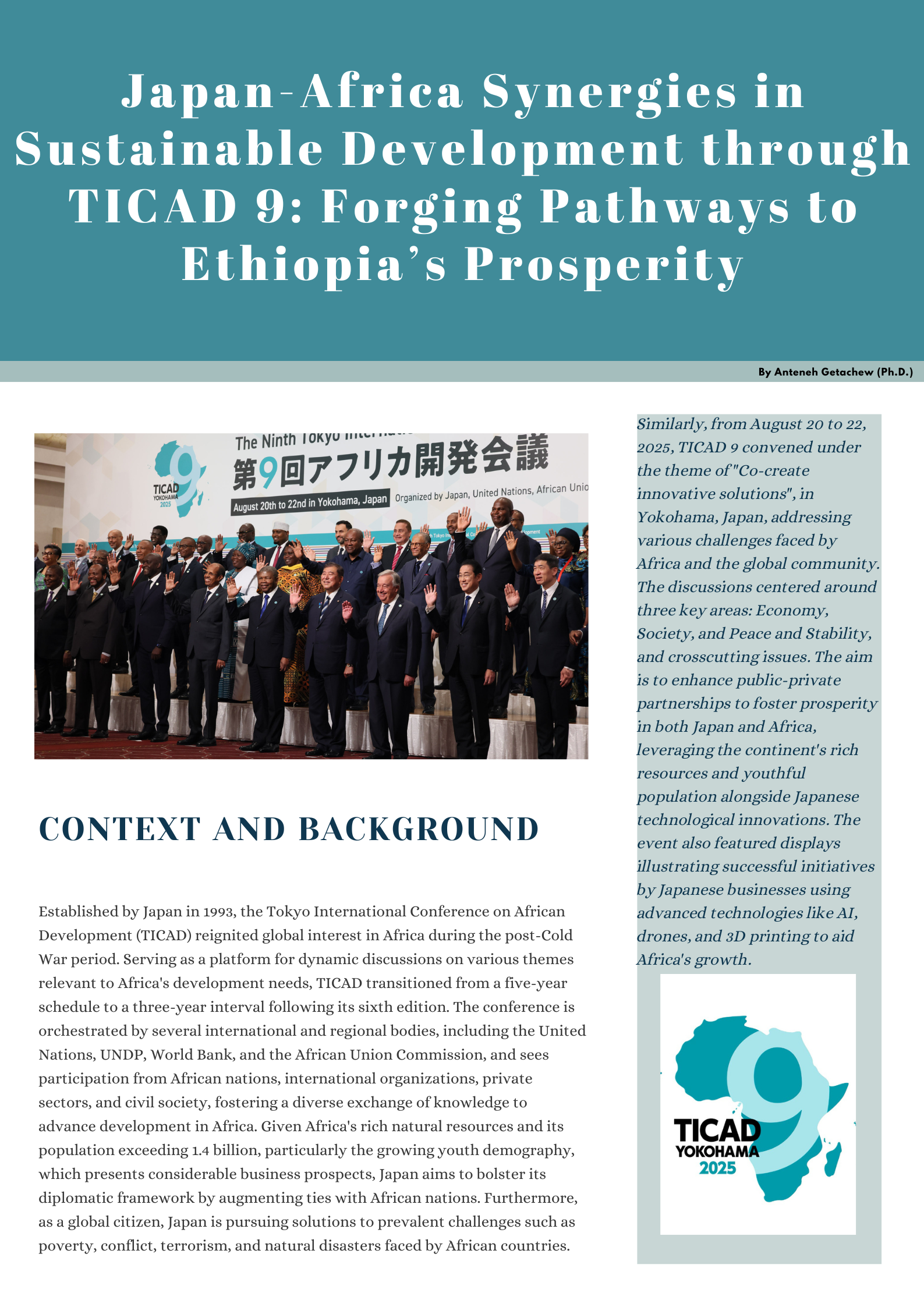
Similarly, from August 20 to 22, 2025, TICAD 9 convened under the theme of “Co-create innovative solutions”, in Yokohama, Japan, addressing various challenges faced by Africa and the global community. The discussions centered around three key areas: Economy, Society, and Peace and Stability, and crosscutting issues. The aim is to enhance public-private partnerships to foster prosperity in both Japan and Africa, leveraging the continent’s rich resources and youthful population alongside Japanese technological innovations. The event also featured displays illustrating successful initiatives by Japanese businesses using advanced technologies like AI, drones, and 3D printing to aid Africa’s growth.
Current Geo-strategic Shifts Shaping the Outcome of TICAD 9
The IMF’s April 2025 World Economic Outlook presents a gloomy picture of the global economy, highlighting slow GDP growth, persistent high debt levels, increased protectionism that hampers international trade, and growing inequality. Furthermore, rising inflation could jeopardize macroeconomic stability. One of the key issues highlighted is that poverty persists across various dimensions, particularly in Africa, making its elimination indispensable for achieving sustainable development. Recent changes in global geo-strategy indicate a decline in multilateralism and the effectiveness of multilateral organizations. Although Africa is projected to have GDP growth rates exceeding global averages for 2025 and 2026, these rates are insufficient to effectively combat poverty, generate quality jobs, and manage debt. The continent, rich in resources and growth potential, remains exposed to external challenges and must create supportive environments to enhance innovation across all sectors to drive socio-economic development. Against all the odds, there is a substantial opportunity for private sector involvement in Africa.
Notwithstanding the recent strides made in democracy across various African nations, there still are significant concerns regarding ongoing conflicts and terrorism that lead to severe humanitarian crises. This instability threatens economic growth, impacts human development negatively, drains essential resources, heightens perceived risks, and burdens public finances more heavily. It is crucial to implement coordinated, gradual, and context-specific measures to address these challenges effectively and seize new opportunities. Recognizing the pressing necessity to tackle both ongoing and new challenges in a comprehensive and interconnected way, TICAD 9 has tabled both pillar and cross-cutting issues in its deliberation to remain crucial for fostering inclusive growth and sustainable development in Africa. Similar to the 1993’s, TICAD once again has the opportunity to serve as a dynamic platform for promoting inclusive growth and sustainable development in Africa by introducing innovative solutions tailored to address both current and future global challenges. By the looks of this, the theme for TICAD 9, “Co-create innovative solutions with Africa,” declares the importance of building stronger and more strategic partnerships that enrich the collaborative and mutually beneficial aspects of TICAD, while also nurturing homegrown solutions within Africa.
Despite the presence of a youthful population and rich resources that offer significant potential, achieving a sustainable economic growth, inclusive society, and enduring peace and stability presents various hurdles to Africa. The conference, thus, underscores the importance of enhancing access to technology, fostering trade and investment, encouraging economic diversification, and investing on infrastructure, human capital, and local innovation. Equally, TICAD 9 intends to promote public-private partnerships, empower youth and women, encourage regional integration, and advocate for responsible global governance, thereby to ensure Africa’s prominent role in international affairs.
Fundamental Discussion Themes of TICAD 9
Deliberations were held regarding economy, society, and peace and stability, under the general theme “Co-create innovative solutions with Africa”. The talks emphasized key areas such as sustainable growth led by the private sector, focusing on youth and women as well as regional integration and connectivity. Prime Minister Ishiba outlined Japan’s commitment to augmenting its efforts in seven specific areas: boosting investment in Africa, encouraging the mobilization of private capital, strengthening industrial partnerships with a focus on AI and digital transformation while ensuring the resilience of mineral supply chains, improving connectivity within and beyond Africa, advancing health policies, promoting human resource development and exchanges with an emphasis on youth and women, and supporting peace and stability initiatives across Africa.
To realize these, the Japanese Prime Minister introduced several initiatives aimed at fostering economic cooperation between Japan and Africa, including the Economic Region Initiative connecting the Indian Ocean and Africa; Region-wide co-creation for common agenda initiative through Nacala Corridor Development; the Public-Private-Academia Joint Study Group focusing on strengthening Japan-Africa economic ties, reflecting a commitment to collaborative development; African Healthcare Investment Promotion Package. Finally, the TICAD 9 was concluded by adopting the Yokohama Declaration, leading to the signing of 324 cooperation agreements between public and private sectors in Japan and Africa, alongside numerous thematic events were held highlighting diverse partnerships.
TICAD 9 Outcomes and Africa’s Development Priorities
The TICAD platform has evolved in response to the shifting global and African priorities while fostering innovation and resilience throughout Africa to mitigate the effects of various crises, such as pandemics and climate change as well as to address governance and security issues in certain regions of the continent. By the same manner, TICAD 9 is closely aligned with Africa’s development goals as outlined in the AU’s Agenda 2063 and the Sustainable Development Goals for 2030. While TICAD 9 intends to foster substantial partnerships between Africa and Japan through concrete programs, the event is strategically positioned within global initiatives like the Pact for the Future and the G20, signifying a collaborative approach towards sustainable development and climate resilience in Africa. The prominence of TICAD 9 lies on enhancing national efforts for sustainable development while ensuring long-term climate resilience and accessibility. Thus, the Yokohama reunion of Japan and Africa transpose itself to develop innovative and sustainable strategies that assist diverse and vibrant African nations in achieving fundamental change and tackling issues of economic insecurity, human rights, and inequality, thereby to facilitate the progress of the AU Agenda 2063’s Second Ten Year Implementation Plan for a peaceful and prosperous Africa. The two parties also accentuate the need for TICAD results to mirror a balanced integration of the shared aspirations and mutual interests between AU Member States and Japan, nurturing an equitable partnership.
Along with attesting the alignment of TICAD’s initiatives and Africa’s development priorities, the Yokohama joint declaration has proclaimed the fundamental outcomes on three pillar sectors -Economy, Society, and Peace and Stability, and cross-cutting issues, such as fostering public-private partnerships, empowering youth and women, and enhancing regional integration and connectivity.
On the economy sector, the Yokohama declaration underscores to take good note of the Free and Open Indo-Pacific (FOIP) Initiative, strengthen regional integration and connectivity, particularly through partnerships like the African Continental Free Trade Area (AfCFTA), and promote the application of digital technologies, artificial intelligence and satellite data for enhanced governance and development. Besides, the declaration calls for strengthening Agricultural Systems to tackle poverty and food insecurity, ensuring a stable supply chain of critical minerals, and enhancing local value creation through initiatives like the World Bank RISE partnership. The declaration also determines to foster Public-Private Partnerships and Resource Mobilization, highlighting the importance of bolstering domestic resource mobilization, effective debt management, and improving electricity access, aligned with the Enhanced Private Sector Assistance for Africa (EPSA). A strong emphasis on the multilateral trading framework provided by the World Trade Organization (WTO) is also featured to be critical.
Concerning society, strengthening healthcare has been announced for improving health systems to ensure everyone gets the necessary healthcare services, and thereby to contributing to the goal of Universal Health Coverage (UHC). Education development is the other initiative meant to transform African society so that the declaration emphasizes on working on the growth of human resources through various educational levels to support industrial and societal progress. Environmental Awareness issue has made a part of the outcomes in relation to society, highlighting the significance of effective waste management and the collaborative efforts between African and Japanese youth as well as Japan’s role in disaster risk reduction.
In the realm of peace and stability, the declaration outlined three initiatives: human security, role of governance and commitment to global peace. First, it noted the significance of promoting human security as crucial for maintaining peace and stability. The connection between humanitarian efforts and development, termed the Humanitarian Development-Peace Nexus, highlights this necessity. Second, the declaration attested that good governance, democratic practices, and adherence to the rule of law are vital for building a stable society. These elements support the implementation of Women, Peace, and Security (WPS) initiatives. Third, the declaration calls for member’s commitment to Global Peace, and affirms that there is a confirmed commitment to cooperate on reforming the UN Security Council and a shared dedication to achieving a world free from nuclear weapons.
Finally, the Yokohama declaration indicates the next steps of the TICAD. First, it was agreed to convene TICAD 10 in Africa to strengthen partnerships and cooperation tailored to the continent’s needs. Second, the declaration endorsed a commitment to consistently enhance and reevaluate TICAD initiatives to keep pace with Africa’s rapidly evolving priorities. Moreover, both parties dedicated to ongoing enhancements and evaluations of TICAD to better align with the evolving development needs of Africa. Third, both parties agreed for inclusive implementation of TICAD outcomes. They acknowledged and appreciated the consistent progress on various initiatives related to the Tunis Declaration of TICAD 8, while urging members to strive for the inclusive implementation of the initiatives from TICAD 9. Fourth, the joint declaration restated to follow-up that TICAD’s initiatives will closely follow African and global development frameworks, including the AU’s Agenda 2063 and the 2030 Sustainable Development Goals (SDGs).
Implication and Recommendations for Ethiopia
Ethiopia is at a pivotal point in its economic growth, grappling with issues like domestic conflicts, inflation, food insecurity, climate change, and the need for economic diversification. Following its Home-Grown Economic reform, the country is committed to open up and liberalize its economy as well as repositioned to attract foreign investment and trade partnerships. Amid this, the TICAD 9 brings significant opportunities of collaboration between Japan and Ethiopia, aiming at sustainable development initiatives that help tackle pressing challenges while fostering economic progress and social fairness. Leveraging its economic reforms and utilizing Japan’s strengths in technology, infrastructure, and education, Ethiopia can boost its economic resilience, ensure food security and pursue sustainable growth. In light of the outcomes of TICAD 9, Ethiopia and Japan can collaborate on infrastructure development, technology and innovation, capacity-building, agricultural development, and peace-building. Japan’s expertise in infrastructure can greatly assist Ethiopia in building robust transportation, digital economy and energy systems. Strategic investments in renewable energy, including solar and wind projects, align with Ethiopia’s ambition of achieving a carbon-neutral economy by 2050. Given its digital 2025 vision, Ethiopia can leverage the technological advancements of Japan to harness its journey towards digital transformation. By adopting Japanese innovations in areas like fintech, e-governance, and agricultural tech, Ethiopia’s productivity and service delivery capacity can be greatly improved. By enhancing educational connections with Japan through scholarships, training initiatives, and exchange programs, Ethiopia can nurture a proficient workforce that supports sustainable development. In post-2018, Ethiopia is diligently working to ensure its food sovereignty, so working together with Japan in agro-technology can back its effort to food security and support eco-friendly farming methods. Japan’s advancements in precision agriculture could play a crucial role in boosting outputs while minimizing environmental effects. Ethiopia can also collaborate with Japan on peace-building efforts and aggrandize ongoing tasks in War-torn areas, thus far.
To properly exploit the potential in these areas of collaborations with Japan, be it under the TICAD framework or the bilateral modality, Ethiopia needs to take some strategic actions. First, it has to establish bilateral working groups that specifically focus on sectors such as infrastructure, technology, health, education and peace-building so that more effective follow-up and evaluation can be done. Second, Ethiopia shall promote Public-Private Partnerships (PPTs) to encourage partnerships between Japanese and Ethiopian private sectors and leverage joint investments and expertise. The PPTs help mobilize resources and knowledge effectively from both parties, thereby to ensure project sustainability. Third, Ethiopia needs to establish monitoring and evaluation mechanism as well as framework of operations that serve to follow-up and evaluate the implementation of the outcomes of TICAD 9. By employing actionable strategies to oversee and assess the effects of TICAD initiatives, Ethiopia can ensure responsible and transparent use of resources.
Sources
- TICAD 9 Yokohama Declaration, 22nd August 2025.
https://www.mofa.go.jp/files/100893431.pdf
- TICAD 9 in Yokohama August 20–22. Policy-Related News. https://www.gov-online.go.jp/en/assets/hj_august_2025_p24-25.pdf
- Overview of TICAD 9 (in Yokohama on 20th -22nd August), August 2025, Ministry of Foreign Affairs of Japan. https://www.mofa.go.jp/files/100896828.pdf
About the author
Anteneh Getachew (Ph.D.), Senior Researcher and Director General at Asia Pacific Affairs in the Institute of Foreign Affairs.
Disclaimer:
The content disseminated by the Institute of Foreign Affairs (IFA) – including, but not limited to, publications, public statements, events, media appearances, and digital communications – reflects the views of individual contributors and does not necessarily represent the official positions or policies of the Institute, its partners, or any affiliated governmental or non-governmental entities.
While the IFA endeavors to ensure the accuracy, integrity, and timeliness of the information presented, it makes no representations or warranties, express or implied, regarding the completeness, reliability, or suitability of such content for any purpose. The Institute expressly disclaims any liability for errors or omissions, as well as for any actions taken or decisions made based on the information provided.
The inclusion of external links, references, or third-party resources does not constitute an endorsement by the Institute. Additionally, engagement on social media platforms – including, but not limited to, likes, shares, retweets (RTs), or reposts – shall not be interpreted as an endorsement or validation of the views expressed therein.
Readers and audiences are encouraged to exercise critical judgment and seek independent verification when interpreting or relying upon any information disseminated through publications and posts on the Institute’s platforms or representatives.