

Introduction
The September 9, 2025, Israeli attack targeting exiled Hamas leaders in Qatar shocked not only the Arabs but also the whole Muslim world. Countries from super and sub identities gathered in solidarity in Doha, where they condemned the Israeli attack as barbaric and provocative. Arab and Muslim leaders in the conference and in their side talks discussed the next steps to defend countries in the region from any future regional threats. Participants of the summit proposed many alternative measures to tackle future threats, including the formation of a Muslim/Arab NATO style security alliance, banning Israel from the United Nations General Assembly, and cutting diplomatic and economic ties with Israel.
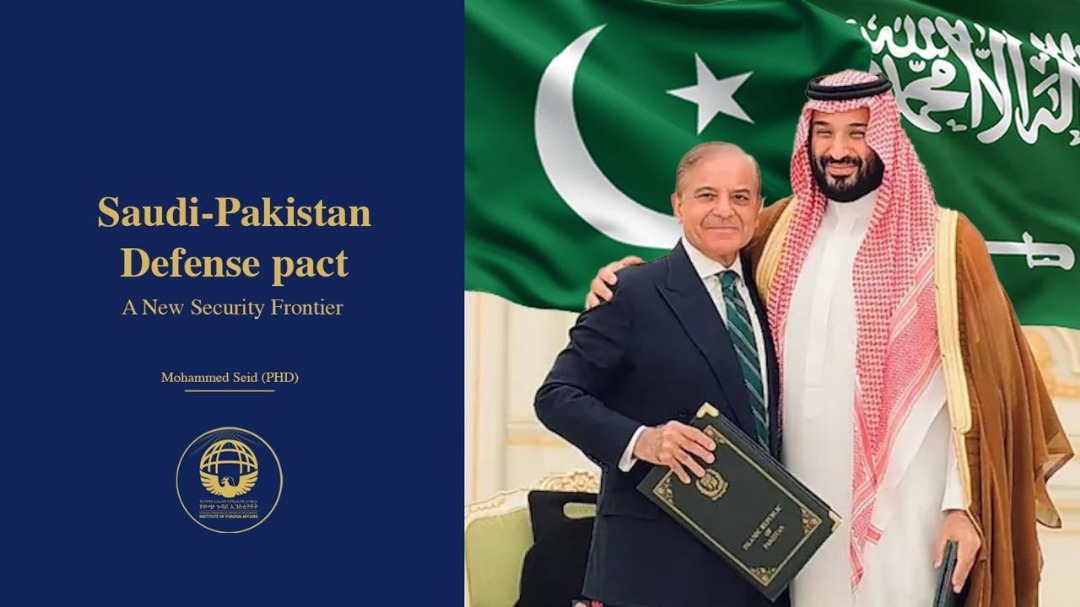
The reverberation of the Doha conference culminated in the historic Saudi-Pakistan Defense Pact, signed on 17 September 2025, a pact typically signed when two friendly nations reach the zenith of their diplomatic relationship. The agreement was signed between Pakistani Prime Minister Shehbaz Sharif and Saudi Crown Prince Mohammed bin Salman. Saudi Arabia and Pakistan are the most powerful nations in the Muslim world, Pakistan being the only nuclear nation in the Muslim world, while Saudi Arabia is the ideological and economic hub.
According to the Pakistani Prime Minister,
This agreement, which reflects the shared commitment of both nations to enhance their security and to achieving security and peace in the region and the world, aims to develop aspects of defense cooperation between the two countries and strengthen joint deterrence against any aggression. The agreement states that any aggression against either country shall be considered an aggression against both.
The Prime Minister’s speech indicated that the scope of the pact extends beyond regional commitment, potentially enabling the two countries to engage in broader global peace and security initiatives. The remarks also alluded to the potential exchange of the latest military technologies, such as nuclear warheads and the latest fighter jets. Most significantly, the Prime Minister unequivocally underscored that any attack on Saudi Arabia is considered an attack on Pakistan, and vice versa.
Saudi officials, meanwhile, dismissed the unfounded narrative linking the pact to regional events or adversaries. This is best captured in the saying of one Saudi official: “This agreement is a culmination of years of discussions. This is not a response to specific countries or specific events but an institutionalization of longstanding and deep cooperation between our two countries.” However, scholars and analysts have already begun to debate the scope, limitations, and implications of the Saudi-Iran Defense Pact. As this backdrop, this policy brief will examine the context, commitments, and potential scenarios of the pact vis-à-vis Ethiopia’s strategic interest in Saudi Arabia.
Strategic Context
The Saudi-Pakistani relations began right after the independence of the latter from British colonialism in 1947. The relation is characterized by consistency with a high level of trust from both sides. This is due to the fact that Pakistan believed in Saudi Arabia’s de facto leadership of Islam and portrayed itself as the guardian of Saudi Arabia. The level of trust can be evidenced by the presence of Pakistani soldiers (1500-2000) stationed in Saudi Arabia for decades as protectors of the kingdom, advisor, and trainer of the Saudi Armed forces. So far, Pakistan has reported having trained over 8000 Saudi military personnel. Beyond these, the kingdom frequently summoned additional Pakistani military forces whenever Saudi Arabia was threatened by external threats. The Al-Wadiah War between Saudi Arabia and Yemen in 1969, and the deployment of 20,000 Pakistani Soldiers in Saudi Arabia during the Iraq-Iran War in the 1970s and 1980s were cases in point. Furthermore, Saudi Arabia has also been a major importer of Pakistani arms, purchasing $81 million worth in 2016 alone. Although the relations between the two states at the strategic level have been harmonious, Pakistan’s rejection of contributing troops to the Saudi-led intervention against Houthiss remained exceptional (Rabia, 2025; Anwar et al, 2025).
Theoretical Framework: Understanding the Saudi-Pakistan Defense Pact
The Saudi Pakistani Defense pact seems to be best explained by alliance theory. Two distinct theories are very important to explain this Pact. The first is balance of threat theory which was developed by Walt (1987) while the second one was alliance dependency theory which was developed by Snyder (1997).
The balance of threat theory contends that states primarily form alliance for balancing threat but it is determined by the level of threat perception. Walt identified four sources of threat: aggregate power of a rival state (population, economy and military capability), geographical proximity (neighboring states are more threatening than distant states), offensive capability of a rival state (power projection and advanced weapon) and perceived intentions of a rival state (aggressiveness and hostility). All these determinants changes the behavior of states on why and how to form alliance. Most states form alliance against the strongest threat to protect themselves while others align with a threatening power. Alliance are flexible depending on the threat perception. This is to mean that credibility of alliance rests on shared threat perception—alliance strengthened if perception converges (Walt, 1987).
The alliance dependency theory, on the other hand, argues that alliance is formed for mutual dependency, but this dependency is often asymmetrical. This determines the bargaining power, influence, and durability of the alliance. The state that is less dependent on the alliance will have more bargaining power. This imbalance creates opportunities for exploitation in which the stronger power urges more concessions, while the weaker power fears abandonment. States manage alliance dependency paradox through assuring credibility, adjusting commitments, and striking a balance between autonomy and alliance cohesion (Snyder, 1997).
The Pact: Cause and Commitments
Causes of the Alliance
Although the triggering factor for the signing of the Defense pact between Saudi and Pakistan is Israeli aggression of Qatar on 9 September 2025, the balance threat theory seems to explain why the alliance is formed. On the side of Saudi Arabia, the geographical proximity of the Houthis, Iran’s growing regional influence, and the United States’ failure to provide a reliable security guarantee were the main driving factors behind the alliance (Rabia, 2025). The Houthis has been the most formidable threat for Saudi Arabia, the geographical proximity of the threat just in its immediate neighborhood seem to have forced Saudi Arabia to form alliance with a nuclear state of Pakistan. The level of the threat can be evidenced by the 2018 Houthis rocket and drone attack on the Saudi cities and oil infrastructures. It should be noted that Saudi Arabia fought bloodiest war with Houthis between the years 2014 and 2023. Although peace agreement was signed in 2023, Houthis and Iran are still the primary security concern in comparison to Israel. The alliance with nuclear-armed Pakistan enhances Saudi Arabia’s deterrence posture. It signals that aggression from the Houthis—or indirectly from Iran—will be met with a strengthened security guarantee. The pact therefore serves both as an immediate hedge against local threats and a broader balancing mechanism against Iran’s regional influence (Al-Madhaji, 2016). The Saudi-Pakistan defense pact reflects a strategic choice to balance threats rather than merely respond to crises. By deepening its alliance with Pakistan, Saudi Arabia seeks to deter hostile actors like Houthis, Iran and Israel hoping an aggregate outcome of greater regional stability.
On the other hand, Pakistan is the closest non-Arab ally to Saudi Arabia. Although Pakistan is the only nuclear state in the Muslim world, it is the most politically unstable and economically impoverished state. Since 1949 Pakistan has been struck by military coups, no civil government completed five year of terms. The military regularly intervened in the civilian politics notably using military coup, judicial rulings and presidential decrees. For example, the military directly took over power three times in 1958, 1977 and 1999. Economically, Pakistan frequently suffered from chronic inflation, currency depreciation, low productivity and export. In addressing these, the country is highly dependent on foreign loans and financial support especially from Saudi Arabia and IMF. Saudi Arabia is the main economic backer when Pakistan faced macroeconomic instability. The kingdom often supported Pakistan in terms of grants, loans and provision of oil in credits. For instance, it is worth mentioning Saudi’s $ 6 billion financial support to stabilize the Pakistani financial crisis in 2018(Ibid). It is fair to conclude that Pakistan signed the Defense Pact primarily driven by economic aspirations particularly aiming at increasing the cash inflow and steady oil supply from Saudi Arabia.
Commitments of the Pact
When countries signed a defense pact, there are certain commitments that need to be observed. However, commitments differ depending on the scope and depth of the agreement. Saudi and Pakistan signed a historical defense pact on 17 September 2025. According to the statement of the agreement, both countries pledged a “joint deterrence against aggression”. Although the details of commitment is not clear whether it will follow a NATO style Article-5 framework or not, it is crystal clear that both countries declare that any attack on Saudi is an attack on Pakistan, and the vice versa. Although Pakistan involved in training and advising the Saudi Armed forces for decades, formalizing strategic cooperation in terms of Defense Pact potentially enhance all military assistance including the provision of a “nuclear umbrella” to the kingdom (Rabia, 2025). Beyond these, joint military exercise, sharing of intelligence and defense technology, supply and sales of weaponry are some of the commitments which are expected from both nations, particularly from Pakistan.
Since the two powers have asymmetrical independence in their commitment, their relation will be more of symbiotic. Saudi Arabia is economically the most prosperous nation in the Muslim world while Pakistan is among the poorest. Riyadh is expected to provide financial support in terms of loans, grants, credit facilities. Saudi Arabia is also expected to expand its oil supply on preferential terms. Beyond these, the kingdom is anticipated to invest in Pakistani military industrial complex particularly in “Project Azem”, a research and development program aimed at building a fifth-generation stealth fighter air craft. Saudi Arabia’s strong economic and financial leverage increases Pakistan’s dependence on Saudi Arabia. On the contrary, Pakistan holds the most powerful military, and the only nuclear state in the Muslim world. This provides a more bargaining power for Pakistan to influence the new Defense Pact, while Saudi Arabia remains dependent on Pakistani military capability. Given Ethiopia’s strategic interest (remittance, hundreds thousands of immigrant workers, Red Sea security and energy security) rests more in the stability of Saudi Arabia, the next section will assess scenarios whether the pact will provide effective protection to the latter.
Scenarios: Will the Pact Defend Saudi Arabia?
The Saudi–Pakistan Defense Pact could provide Saudi Arabia with enhanced security, but the extent of its effectiveness depends on how both sides operationalize their commitments. Given the long-standing diplomatic relations between the two states, three possible scenarios can be developed whether the pact will effectively defend Saudi Arabia.
Scenario 1: Partial or Symbolic Defense
The pact will most likely have partial or symbolic defense for the kingdom of Saudi Arabia. There are many reasons for this scenario to happen. Firstly, the ambiguity of terms in the agreement, whether it could provide a NATO-style Article 5 guarantee for Saudi Arabia. Secondly, Saudi Arabia’s dependency syndrome on the US security protection. It is unlikely for the Saudi leaders to break the security alliance with the US. Although there were a few cases of security impasse, the kingdom has not been totally detached from the US security enclave for the last many decades. The signing of the pact with Pakistan seems an act of Saudi Arabia’s tactical move to bring the US back to its traditional service. Thirdly, Saudi Arabia’s complete withdrawal from the US Middle East security architecture might expose the kingdom to strategic vulnerability. In response to the pact, the US might shift its alliance with the traditional enemies of the kingdom, such as Iran, the Houthis, and Israel. Beyond this, the US might undermine the role of Pakistan in Saudi Arabia through economic sanctions and a strategic alliance with its traditional enemy, India. Lastly, Pakistan’s technological incapability to sufficiently deter threats to Saudi Arabia. How far is Pakistan potentially capable of defending against Houthi, Iranian, or Israeli missiles, drones, and aerial attacks? These are some of the puzzles that need to be addressed in relation to the effectiveness of the defense pact. In such a case, the pact would act more as a political signal of solidarity than a binding operational defense arrangement. While Saudi Arabia would gain some reassurance, its hard security would continue to depend on U.S. military systems and Western partnerships.
Scenario 2: Effective Defense of Saudi Arabia
The pact will likely serve as an effective Defense mechanism for Saudi Arabia. There are some reasons for this to happen. Firstly, the pact most importantly might provide a “nuclear umbrella” to Saudi Arabia, which is a powerful deterrence for the threats coming from the region and beyond. Secondly, excessive petro-dollar inflow from the kingdom will keep Pakistan committed and stable. Lastly, Pakistan is anticipated to provide more military manpower and advanced training to the Saudi armed forces. All these provisions could reduce dependency on the US for hard power and boost protection of vital infrastructure such as oil fields, ports, cities, and borders.
Scenario 3: Ineffective Defense of Saudi Arabia
The pact will unlikely provide meaningful defense for Saudi Arabia. Some of the reasons for this scenario to occur are: Firstly, the entrenched political instability between civilian politics and the military might undermine Pakistan’s capability to project power abroad. Secondly, the incompatible threat perception might hamper cooperation between the two signatories. Saudi Arabia might prioritize Iran (a neighbor to Pakistan), Houthis, and Israel, while Pakistan might prioritize India. Thirdly, Pakistan might hesitate to intervene militarily in times of real crisis if Iran/Houthis attack or an Israeli strike occurs. All these factors might have led the kingdom to abandon the pact and be forced to fall back on the US security arrangement.
Conclusion
Saudi Arabia and Pakistan signed the defense pact, aiming at balancing threats. The former joined the pact primarily threatened by Iran, the Houthis, the expansionist policy of Israel, and the US failure to provide a security guarantee. The latter was primarily motivated to ensure economic and political stability through securing economic assistance from Saudi Arabia. Although many writers portrayed Saudi Arabia’s confrontation with the Houthis and Pakistan’s Indian-centric nuclear doctrine as potential challenges, the two nations are supposed to set balancing mechanisms to align their national interests. The defense pact seems to have shown that there is asymmetrical commitment in which Pakistan, with higher bargaining power, is entrusted to provide military assistance such as advisory, training, arms supply, including the provision of “nuclear umbrella”, while Saudi Arabia with strong economic commitment is anticipated to provide loans, grants, credit facilities and investment for Pakistani military industrial complex. However, the presence of mutual dependency between the two nations strengthens the durability of the defense pact, as it reduces the risk of entrapment and abandonment. Given that Ethiopia’s strategic interest rests more in the stability of Saudi Arabia, the effective protection of the latter either through this defense pact or the US security arrangement will ensure the uninterrupted flow of remittance, communal security of hundreds of thousands of Ethiopian immigrant workers, stability of the Red sea region, and safeguard energy security.
References
Haider, Mateen (May 6, 2016). “Saudi Arabia largest importer of Pakistani arms”. Dawn (newspaper).
Rabia, A(1995) “ Beyond the Hype: Pakistan-Saudi Defense Pact Is Not a Saudi Nuclear Umbrella” Available at : https://www.belfercenter.org/research-analysis/beyond-hype-pakistan-saudi-defense-pact-not-saudi nuclearumbrella0#:~:text=On%2017%20September%202025%2C%20Saudi%20Arabia%20and%20Pakistan%2C,country%20shall%20be%20considered%20an%20aggression%20against%20both%E2%80%D
Snyder, G. H. (1997). Alliance politics. Cornell University Press.
Walt, S. M. (1987). The origins of alliances. Cornell University Press
About the author
Mohammed Seid (Ph.D.) Senior Researchers of the Middle East Affairs Department at the Institute of Foreign Affairs (IFA)
Disclaimer:
The content disseminated by the Institute of Foreign Affairs (IFA) – including, but not limited to, publications, public statements, events, media appearances, and digital communications – reflects the views of individual contributors and does not necessarily represent the official positions or policies of the Institute, its partners, or any affiliated governmental or non-governmental entities.
While the IFA endeavors to ensure the accuracy, integrity, and timeliness of the information presented, it makes no representations or warranties, express or implied, regarding the completeness, reliability, or suitability of such content for any purpose. The Institute expressly disclaims any liability for errors or omissions, as well as for any actions taken or decisions made based on the information provided.
The inclusion of external links, references, or third-party resources does not constitute an endorsement by the Institute. Additionally, engagement on social media platforms – including, but not limited to, likes, shares, retweets (RTs), or reposts – shall not be interpreted as an endorsement or validation of the views expressed therein.
Readers and audiences are encouraged to exercise critical judgment and seek independent verification when interpreting or relying upon any information disseminated through publications and posts on the Institute’s platforms or representatives.