

Introduction
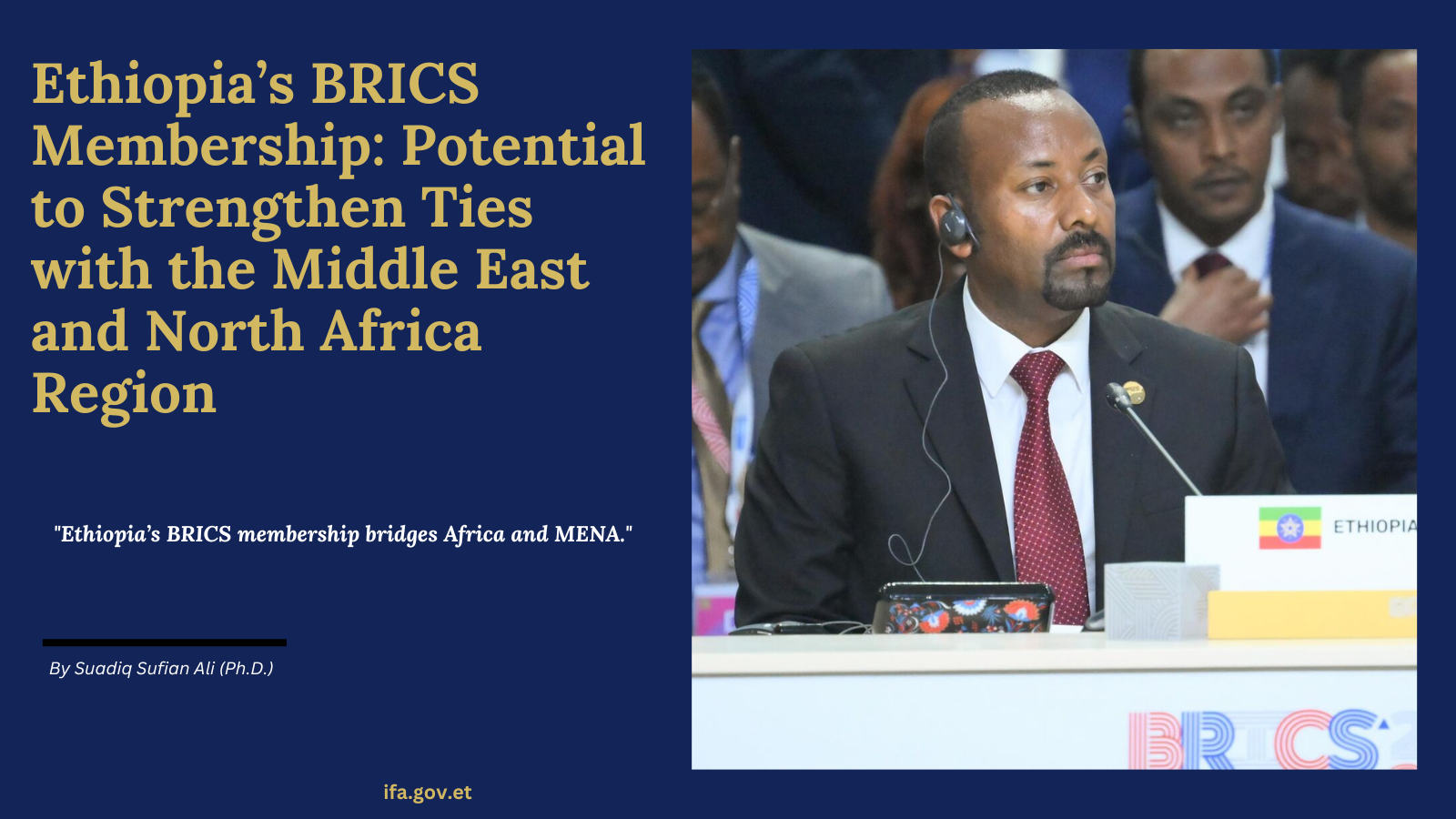
The founding members of BRICS assert that the group represents the interests of “the global majority.” In this light, undoubtedly, Ethiopia’s membership in such a group would enhance its posture on the global stage. Among others, its accession helps the country to raise its critical concerns in a multilateral forum, advocate for Africa’s interests, and accelerate the realization of its Sustainable Development Goals (Horn Review, 2023). Prior to the Johannesburg Summit, over 40 countries including Ethiopia expressed their interest in joining the bloc (Reuters, 2023). Yet, the summit adopted the request of only six countries where Ethiopia was one of them. Succeeding membership in such an intense competition, therefore, means a lot for Ethiopia’s global visibility, particularly after the outbreak of the Northern conflict, which had previously cast a shadow over the country’s international image.
Traditionally, Ethiopia has been known for its non-aligned movement and supporter of independence struggles in Africa. It has also considered itself as the champion of Pan-Africanism, promoter of African Solutions for African Problems, and to some extent, pioneer of Afrabia frameworks. On the top of these achievements, Ethiopia’s admission to the BRICS bloc provided a platform to show its remarkable potential and engage with major superpowers, including China and Russia. Apart from that, its accession opens a new window of opportunity for the country to approach the Middle East and North Africa (MENA) region through the BRICS framework.
While approving the request of several MENA countries, in relative terms, the Johannesburg summit enabled more homogenous countries to join the group. From a geo-economic perspective, the newly joining BRICS members are predominantly Oil Producing Countries with the exception of Ethiopia. Consequently, in statistical terms, following the Johannesburg Summit, the representation of the MENA region in the BRICS BLOC rose from Zero to nearly one-third. In fact, some analysts criticized such BRICS expansion as “very middle East Centric” and “OPEC dominated” while others preferred to call it “BRICS plus OPEC” (Ismael, 2023). Notwithstanding, Ethiopia’s entry into the BRICS bloc, together with several MENA countries, is believed to create a strategic opening to engage the MENA region more closely, thereby emboldening its diplomatic relationship with member states.
Ethiopia and the MENA Region
Ethiopia occupies a geopolitically strategic location in the Horn of Africa, located near to the Red Sea Region. According to Professor Brook Hailu, such a geographical position gives BRICS a gateway to project influence in Africa and the Middle East (Ethiopian News Agency, 2024). In particular, the inclusion of Ethiopia in the BRICS club paves the way to cooperate on important matters with MENA countries. It is unfortunate, hitherto institutional-based cooperation between Ethiopia and the MENA region seemed to have been less promising, hindering the country from effectively utilizing those existing geopolitical and geostrategic advantages in the region. Meanwhile, sadly, Ethiopia’s arch-foe rival in the region, Egypt, has recklessly exploited most of those MENA related organizations to downgrade Ethiopia’s national interest.
One of the most troubling aspects of Ethiopia’s exclusion from MENA regional platforms is its denial of opportunity for sharing its views in the MENA regional stage. This marginalization has been demonstrated during the GERD dispute, for instance, when the Arab League expressed its concern over the water security of Egypt. The League passed a resolution against Ethiopia several times. In one of the resolutions, it informed the UN Security Council to take “necessary measures”, claiming the presence of “a United Arab Position” (Aljazeera, 2021). In response, Ethiopia slammed the resolution, blaming the downstream countries for unreasonable politicization of the GERD’s negotiations. In a similar vein, most of the MENA regional organizations expressed their partisan concern. Principally, upon Somalia’s call, the Arab League and the Organizations of Islamic Cooperation rejected the Memorandum of Understanding, arguing it violates Somalia’s sovereignty and territorial integrity though the intention of Ethiopia is totally contradict to such accusations. Importantly, had Ethiopia been a member of MANA based regional organizations, the afore–stated baseless accusations, and many others, would likely not have been directed at Ethiopia, at least with the tone they have been communicated. Hence, Ethiopia’s inclusion in the BRICS bloc, which comprises several MENA countries, can provide a valuable platform for articulating its interests and fostering strategic engagement through constructive dialogue.
Conclusion and Policy Recommendations
Ethiopia’s accession to BRICS together with MENA countries could enhance its connectivity with the MENA region, positioning it as a bridge between Sub-Saharan Africa and the Arab world. Hence, its BRICS membership could create a new diplomatic space, enabling the voice of Ethiopia to be heard equally with others, such as Egypt. It should be noted that Ethiopia’s exclusion from the MENA dominated regional organizations would hinder any potential cooperation, affecting both parties. Being the only non-MENA country joined BRICS at the Johannesburg Summit, Ethiopia needs to step on the following strategic action. First, it should navigate the Golden-Mean when engaging potentially rival new BRICS members, if any, while remaining mindful of the relative homogeneity among MENA countries. Secondly, Ethiopia should also proactively engage existing MENA affiliated regional organizations, seeking their neutrality or potential mediation role, whenever appropriate.
References
Aljazeera. (2021). Ethiopia rejects Arab League resolution on Renaissance Dam https://www.aljazeera.com/news/2021/6/16/ethiopia-rejects-arab-league-resolution-on-renaissance-dam
Ethiopian News Agency. (2023). Ethiopia’s Membership in BRICS Would Contribute Significantly to Realizing South-South Cooperation. Available at https://www.ena.et/web.
Ismael, S. (2023). A wall of BRICS: The significance of adding six new members to the bloc. Available at https://www.aljazeera.com/news.
Silk Road Briefing. (2023). BRICS & MENA: China’s Growing Influence in the Middle East.
The Economist. (2023). What is BRICS? Available at https://economictimes.indiatimes.com
United States Institute of Peace. (2023). As China Looks to Reform Global Governance, How Does It Approach the U.N.?
About the author
Suadiq Sufian (Ph.D.), Senior Researcher at the Institute of Foreign Affairs He can be reached at Sufiansuadiq8@gmail.com
Disclaimer:
The content disseminated by the Institute of Foreign Affairs (IFA)—including, but not limited to, publications, public statements, events, media appearances, and digital communications—reflects the views of individual contributors and does not necessarily represent the official positions or policies of the Institute, its partners, or any affiliated governmental or non-governmental entities.
While the IFA endeavors to ensure the accuracy, integrity, and timeliness of the information presented, it makes no representations or warranties, express or implied, regarding the completeness, reliability, or suitability of such content for any purpose. The Institute expressly disclaims any liability for errors or omissions, as well as for any actions taken or decisions made based on the information provided.
The inclusion of external links, references, or third-party resources does not constitute an endorsement by the Institute. Additionally, engagement on social media platforms—including, but not limited to, likes, shares, retweets (RTs), or reposts—shall not be interpreted as an endorsement or validation of the views expressed therein.
Readers and audiences are encouraged to exercise critical judgment and seek independent verification when interpreting or relying upon any information disseminated through publications and posts on the Institute’s platforms or representatives.