

Last year, in late April 2024, Iraq and Türkiye signed several agreements and memoranda of understanding, where a framework agreement on water policy cooperation was particularly worth to be mentioned. This original framework marked a new phase of better relations between the two neighboring countries after years of strained ties. More recently, in line with the framework, a few days ago, the two countries signed a landmark deal based on the principle of “give and take”, putting oil and water on the transaction table. In this perspective, Baghdad and Ankara agreed on the “oil-for-water” deal, containing several details and specific mechanisms on the implementation of water cooperation framework between the two countries. Among others, these mechanisms include channeling oil-based petro-dollars from Iraq to Turkiye, which in turn, serves as a means to execute water related projects in Iraq. The agreement also gives opportunity for Turkish companies to build Iraq’s water infrastructure.
During the signing ceremony, representing the downstream country, Iraqi Foreign Minister Fuad Hussen praised the deal, describing it as the “first-of-its-kind cooperation on water management” between neighboring countries. This reflects the potential of the deal to be served as a bench-mark for other countries, seeking the same suit. Similarly, his Turkish counterpart, Hakan Fidan said: “After long years, Turkiye and Iraq are cooperating on water.” Beyond the signatory countries, several countries including the United States of America congratulated Baghdad and Ankara on their success – reaching an agreement.
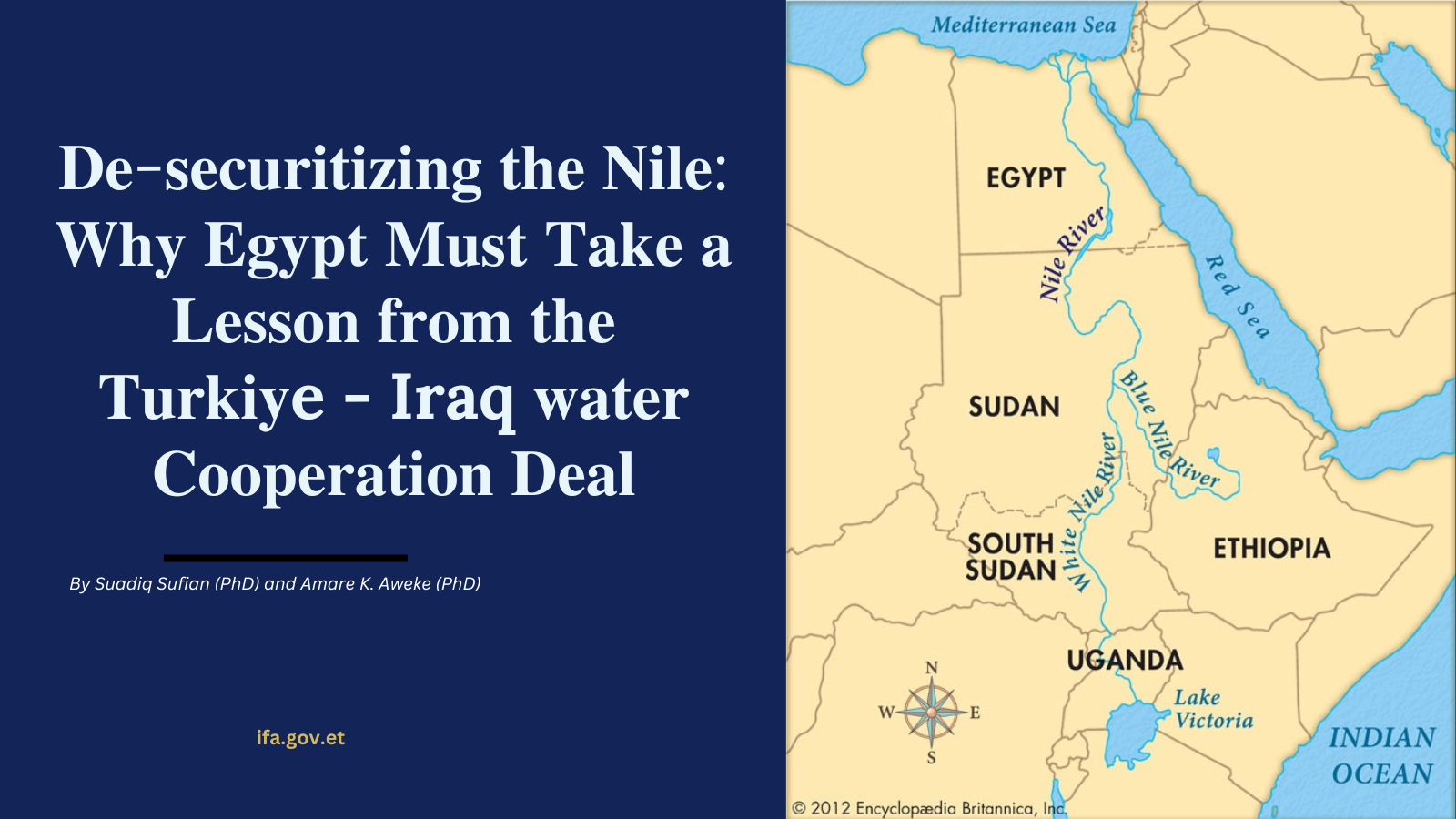
In light of the prevailing context, we firmly believe that no recent agreement has contributed more to effective water management than the cooperation framework introduced by Iraq and Türkiye. Undoubtedly, it stands as a timely and pragmatic model of regional water cooperation, allowing the flow of Trans-boundary water resources, Euphrates and Tigris, in a manner that benefits both the upper and downstream countries. In this connection, the Nile River presents no obstacle to the implementation of the same path the Iraqi-Türkiye Model—except for Egypt’s excessive self-interest, which is heavily dependent on outdated colonial agreements. It is, therefore, vitally important for Egypt to draw constructive lessons from the Model, thereby prioritizing cooperative framework to the GERD dispute. As Ethiopia repeatedly reiterated, Egypt’s long-term water security will be best achieved through a win-win approach rooted in genuine water diplomacy, not through conspiracy or meddling in the internal affairs of riparian states, especially Ethiopia. Egypt’s traditional reliance on intimidations and subversive tactics has proved nothing more than the reality that such attempts have no habitat in today’s geopolitical landscape. Otherwise, Egypt will remain a downstream country forever and cannot have more rights than Ethiopia with respect to the Nile River – strikingly, this is a divine fate, not decided by Ethiopia or other upper riparian countries.
Possible Scenarios for Egypt
Despite the realities outlined above, it remains challenging to predict whether Egypt will take a lesson from the Turkey–Iraq water cooperation deal. The outcome, however, hinges on whether Egypt de-securitizes the Nile, its long-serving position. The following are probable scenarios that can be discerned from the existing dynamics.
De-securitization of the Nile – the Most Highly-unlikely Scenario
Egypt has long “securitized” negotiations regarding the Nile waters, embedding this issue in the Constitution of the Arab Republic of Egypt as part of its national security priorities. The preamble, for instance, states, Egypt is the gift of the Nile and the gift of Egyptians to humanity. Article 44 which is devoted entirely to the Nile, guarantees every citizen’s right to enjoy the River Nile and prohibits encroachment on the riverbank reserve or harm to the riverine environment, implicitly recognizing the Nile as Egypt’s primary water source. The article further asserts that the Nile is a historic right of Egypt. Given these constitutional principles, it is highly unlikely that Egypt would engage in negotiable deals with any of the riparian states, particularly Ethiopia, regarding Nile waters. De-securitizing the Nile would require removing certain principles embedded in the Constitution, a prospect that seems improbable due to Egypt’s recent internal political instability and fears of public backlash. Consequently, it appears impossible for Egypt to pursue negotiable agreements concerning the Nile in the foreseeable future, which explains its frequent withdrawal from successive dialogues and formal discussions centered on the equitable share and reasonable utilization of the Nile waters.
Enhanced Security Cooperation in the Red Sea region – the Best Scenario
If Egypt were to de-securitize the Nile and open negotiations, though this is highly unlikely due to constitutional and legal constraints, it could facilitate security cooperation between Egypt and Ethiopia in the Red Sea region. Such cooperation would serve the interests of both Ethiopia and Egypt in relation to the Nile and the Red Sea. Egypt has repeatedly made unfounded claims that Ethiopia has violated international watercourse regulations and jeopardized Egypt’s historical rights by constructing development projects on the Nile, such as the Grand Ethiopian Renaissance Dam (GERD). Meanwhile, Ethiopia has asserted that Egypt incessantly employed diplomatic maneuvers to isolate it from accessing the Red Sea and has excluded it from any Red Sea related security cooperation, notably the “Red Sea Council,” by skillfully establishing exclusionary criteria. Therefore, Egypt’s de-securitization could have benefited both nations and the entire region offering enhanced security cooperation.
Continue with the Status quo – the Most-likely Scenario
De-securitizing the Nile in Egypt’s national security and foreign policy could increase public pressure against the faltering regime. Therefore, it seems likely that Egypt will maintain the status quo, continuing to frame the Nile as a critical national security priority. In this context, Egypt will portray its traditional diplomatic stance, arguing that any negotiations regarding the Nile waters will benefit neither the staggering regime nor the Egyptian public. This is the most plausible scenario for Egypt, which is unlikely to accept any deal regarding the Nile waters. Securitizing transnational resources, however, lacks international legal grounds and fails to produce constructive outcomes. Consequently, if no agreement is reached, Egypt will remain a downstream country indefinitely, unable to claim more rights than Ethiopia regarding the Nile – an outcome determined not by Ethiopia or other upstream nations, but by an inherent reality.
Concluding Remarks
The bilateral agreement initiated by Turkiye and Iraq based on the principle of “oil for water” could have served as a pivotal example for managing similar transnational water resources, such as the Nile. This could potentially ease the intransigent position that Egypt has historically maintained regarding Nile waters and foster greater security cooperation in both the Nile and Red Sea regions. However, since issues concerning the Nile waters have long been “securitized” by Egypt and backed by national normative grounds, it is highly unlikely that Egypt will adopt a similar approach regarding Nile-related issues in the foreseeable future.
About the author
Suadiq Sufian (Ph.D.), Senior Researcher at the Institute of Foreign Affairs. He can be reached at Sufiansuadiq8@gmail.com
Amare Kenaw (Ph.D.), Lead researcher, and Middle East Research Affairs Director General, Institute of Foreign Affairs
Disclaimer:
The content disseminated by the Institute of Foreign Affairs (IFA) – including, but not limited to, publications, public statements, events, media appearances, and digital communications – reflects the views of individual contributors and does not necessarily represent the official positions or policies of the Institute, its partners, or any affiliated governmental or non-governmental entities.
While the IFA endeavors to ensure the accuracy, integrity, and timeliness of the information presented, it makes no representations or warranties, express or implied, regarding the completeness, reliability, or suitability of such content for any purpose. The Institute expressly disclaims any liability for errors or omissions, as well as for any actions taken or decisions made based on the information provided.
The inclusion of external links, references, or third-party resources does not constitute an endorsement by the Institute. Additionally, engagement on social media platforms – including, but not limited to, likes, shares, retweets (RTs), or reposts – shall not be interpreted as an endorsement or validation of the views expressed therein.Readers and audiences are encouraged to exercise critical judgment and seek independent verification when interpreting or relying upon any information disseminated through publications and posts on the Institute’s platforms or representatives.