

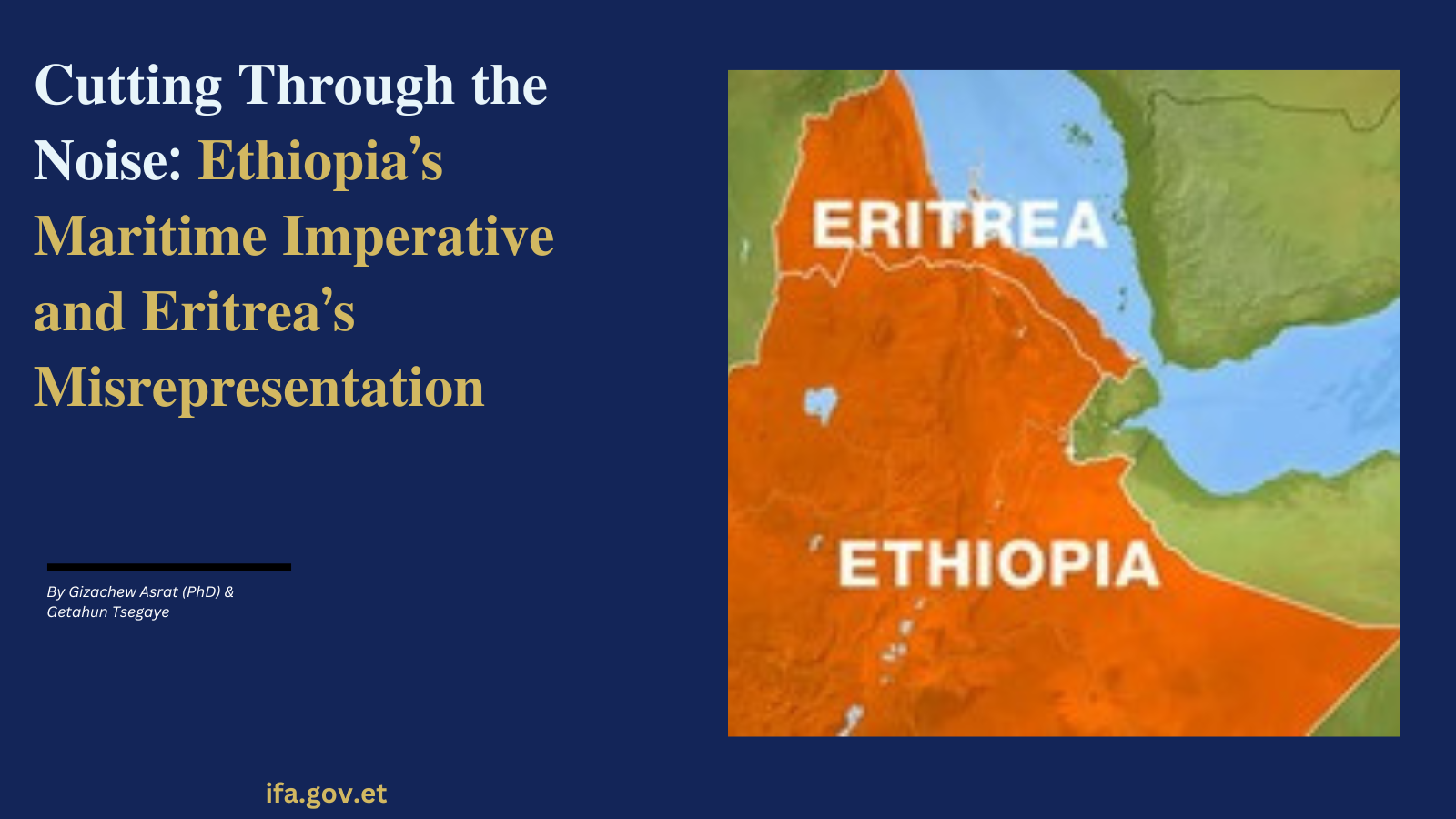
In November 23, 2025, the Eritrean Ministry of Information seeks to portray Ethiopia’s legitimate quest for Red Sea access as a reckless, expansionist ambition cloaked in historical nostalgia, economic urgency, and security anxieties. Ethiopia’s aspiration for reliable maritime access is rooted in legitimate legal, economic, and historical concerns not in coercion, revisionism, or threats. Ethiopia has been committed to regional cooperation over confrontation a stark contrast to Eritrea’s baseless allegation.
Historically and economically, the stakes are existential: being cut off from the sea has constrained Ethiopia’s trade capacity, raised transportation costs, and impeded its long-term development prospects. Quoted from an article written by the Institute of Foreign Affairs, “landlocked developing countries (Ethiopia) engage in 30% less trade, on average, compared to their coastal counterparts, leading to slower economic growth, which is 1.5% lower due to their landlocked status. […] issues such as lengthy transit times (averaging around 50 days), high logistics costs for imports, inconsistent customs practices, and delays at the port all contribute to Ethiopia’s elevated logistics expenses for bulk imports’’.
As outlined by FM Gedion Timothewos, Ethiopia’s request is for “durable and secure access to the sea, including Assab, in ways mutually beneficial to both countries.” A cooperative arrangement built on mutual benefit, respect for sovereignty, and shared prosperity. With decades of Ethiopia’s role as a cornerstone of peace and security in Africa. Over the years, Ethiopia has contributed significantly to numerous international peacekeeping missions across the continent a record of service and sacrifice for collective stability. Far from exporting instability, Ethiopia has consistently acted as a force for regional cooperation a reality that cannot be ignored when painting broad-brush accusations.
While the Eritrean political elites accuses Ethiopia of destabilizing the region, recent public declarations by Ethiopia offer a different and more troubling narrative: that Eritrea itself has engaged in interference within Ethiopia. At the November 2025 Foreign Policy Forum, FM Gedion clearly accused Eritrea of supporting armed groups operating within Ethiopian territory. He asserted that Eritrean troops now control “several local administration units in northern Ethiopia,” and warned that such violations of sovereignty cannot be ignored indefinitely. Eritrean regime supported armed groups who are operated against the Ethiopia governments across different regimes as its instrument of foreign policy and tool uses historically and today.
Eritrea’s characterization of Ethiopia’s foreign policy as driven by “imperial dreams” stands in stark contradiction to Ethiopia’s declared ideology since 2018 the Medemer philosophy, which emphasizes cooperation, harmony, and mutual prosperity. Under Medemer, Ethiopia rejects a siege-mentality that treats neighboring countries as adversaries. Instead, it frames neighbors as partners in a shared future.
In his November 2025 address, FM Gedion described the Horn of Africa as “a geo-economic and cultural space with a shared history and a common destiny.” He proposed a phased model of regional integration beginning with a Free Trade Area, then economic policy harmonization, joint infrastructure investments and free movement of goods and people. The aspiration for maritime access is thus embedded in a broader vision of regional cooperation not conquest.
Casting this vision as a veil for territorial ambition misunderstands or purposely misrepresents the philosophical and strategic trajectory Ethiopia has articulated. Eritrea’s claim that Ethiopia’s aspiration for access to the sea threatens Eritrea’s sovereignty or existence is unsubstantiated. Ethiopia has not asserted any claim over Eritrean territorial sovereignty or title to its coastline. Rather, its request is confined to securing a legitimatelygrounded and negotiated maritime access arrangement designed to benefit both sovereign parties.
The United Nations Convention on the Law of the Sea (UNCLOS) and general international law affirm the right of landlocked states to secure access to the sea through arrangements and agreements with coastal states. Hence, Ethiopia’s position is not only legitimate but also consistent with established global legal norms. Eritrea’s assertion that Ethiopia is the primary driver of instability in the Horn of Africa is similarly unfounded. In fact, Ethiopia is a key factor in regional stability, notably demonstrated by its significant contributions of peacekeeping forces to various missions across Africa countries in past and current. Additionally, Ethiopia is taking the lead for mediation in Sudan, South Sudan, even with Eritrea by 2018 as peace and stability is understands essential and necessary for the region and Ethiopia itself though the structural factors the region had challenges though initiatives.
The internal challenges and conflicts that have affected Ethiopia over the past few years are largely attributable to the interference of external powers including Eritrea and are not the result of an aggressive or expansionist foreign policy by Ethiopia itself. Ethiopia is not an exporter of instability; instead, it consistently prioritizes peace, security, and cooperation within the region.
Finally, the argument that Ethiopia’s present claims are merely a reflection of imperial nostalgia is a distortion of the country’s contemporary foreign policy direction. Ethiopia’s current approach is forward-looking, pragmatic, and deeply committed to fostering regional integration and mutual economic prosperity. Unlike others who look to the past and talk about old grievances, Ethiopia is all about building a new future with its neighbors through mutually beneficial arrangements, cooperation, and development.
As FM Gedion declared: “Assab is a strategic imperative, not an option.” He further emphasized that Ethiopia’s pursuit of sea access is “fair, reasonable, and legitimate,” grounded in demographic realities, historic continuity, and national development needs. Yet, he balanced that assertion with a commitment to diplomacy and dialogue. He made clear that Ethiopia seeks peaceful, negotiated arrangements not coercive imposition. “We are in charge of Plan A,” he said, “diplomacy.”
In light of these statements, fueling alarmist narratives or evoking “sovereignty fears” serves only to derail honest, urgent negotiation and to deprive both peoples of the shared growth and regional integration they deserve.
The 23 November 2025 Eritrean Ministry of Information statement is rhetorically charged but substantively hollow. It recycles alarmist tropes and straw-man arguments, rather than engaging with the legitimate legal, economic, and historical basis for Ethiopia’s sea-access quest.
The path forward lies not in recrimination or rhetoric, but in sincere, good-faith negotiation which pursues regional integration and shared prosperity. The Horn of Africa with its interwoven histories, cultures, and economic destinies deserves nothing less than honest dialogue, mutual respect and a shared future.
Gizachew Asrat (PhD), Chief of Staff and Senior Researcher, & Getahun Tsegaye, Associate Researcher, IFA.
Disclaimer:
The content disseminated by the Institute of Foreign Affairs (IFA) – including, but not limited to, publications, public statements, events, media appearances, and digital communications – reflects the views of individual contributors and does not necessarily represent the official positions or policies of the Institute, its partners, or any affiliated governmental or non-governmental entities.
While the IFA endeavors to ensure the accuracy, integrity, and timeliness of the information presented, it makes no representations or warranties, express or implied, regarding the completeness, reliability, or suitability of such content for any purpose. The Institute expressly disclaims any liability for errors or omissions, as well as for any actions taken or decisions made based on the information provided.
The inclusion of external links, references, or third-party resources does not constitute an endorsement by the Institute. Additionally, engagement on social media platforms – including, but not limited to, likes, shares, retweets (RTs), or reposts – shall not be interpreted as an endorsement or validation of the views expressed therein.Readers and audiences are encouraged to exercise critical judgment and seek independent verification when interpreting or relying upon any information disseminated through publications and posts on the Institute’s platforms or representatives.