

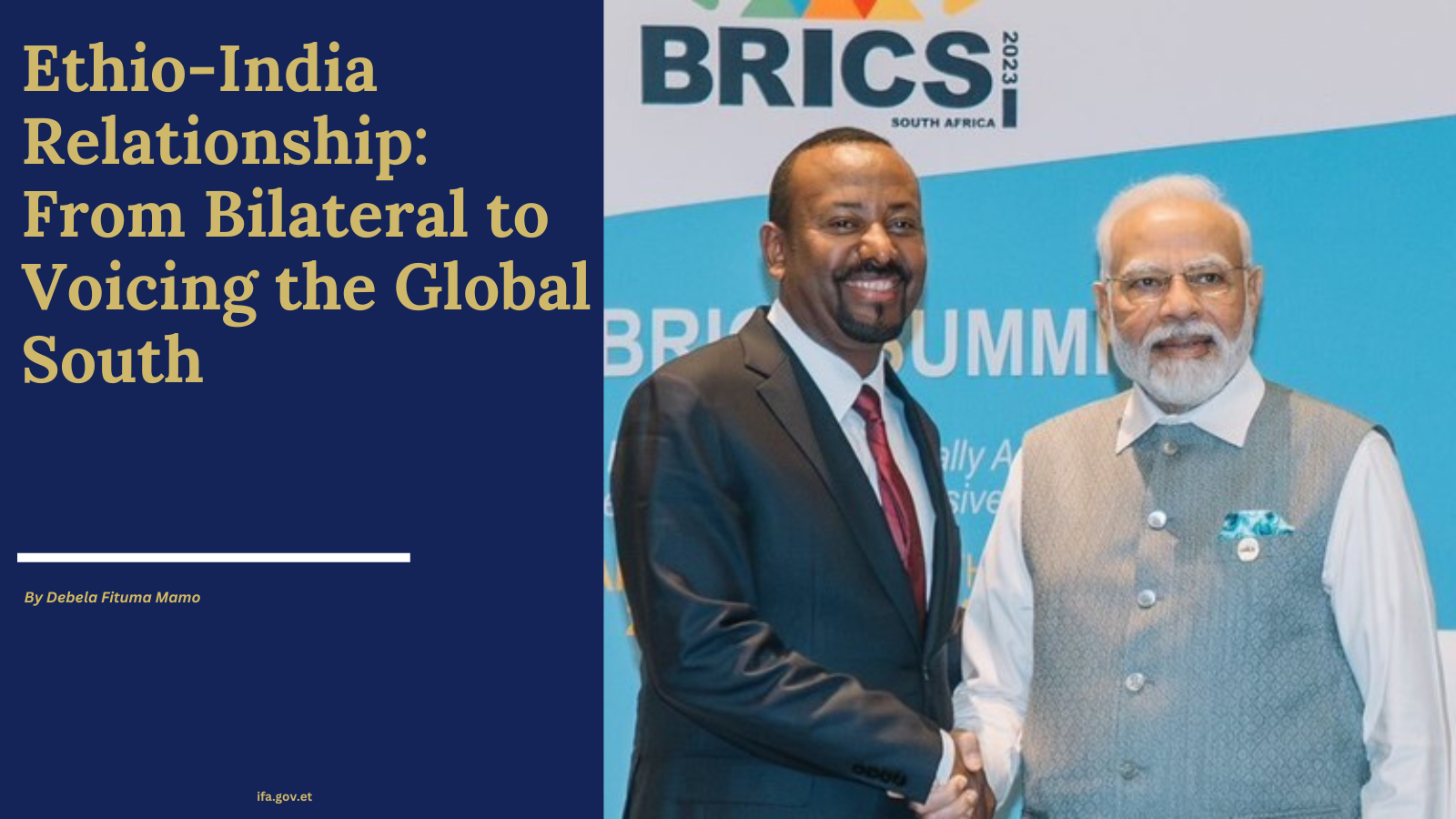
At a time when geopolitical alliances are shifting swiftly, New Delhi is reassessing its foreign relationships with newfound determination. The current Prime Minister Narendra Modi’s diplomatic sprint across three regions from December 15-18, encompassing West Asia, the Horn of Africa, and the Gulf regions, represents this, among others. PM Modi sets out on a three-state visit to Jordan, Ethiopia, and Oman, marking a turning point in India’s developing global engagement. This is a purposeful message rather than just another multi-country tour: India is expanding its influence where strategy, history, and the future converge. India’s intention to strengthen political, economic, and cultural links throughout the Middle East and Africa is more than just a standard diplomatic tour; it carries human connections, strategic significance, long-term goals, and increasing diplomatic confidence.[1]
These visits could be an indication of India’s growing concern about its role in the contentious but interrelated geopolitical, geoeconomic, and geo-security landscapes of the Horn of Africa, Middle East, and Indo-Pacific region. First, as the geopolitics of the twenty-first century are expected to be determined in the Indo-Pacific region, India’s growing geo-economic, industrial, maritime, and military power plays a significant role, particularly in collaboration with its strategic partners and regional allies, in the geopolitics of the region.[2] Second, the enormity of overlapping and interlinked conflicts in West Asia, Northern, and Eastern Africa characterized one of the most tumultuous years in the global political scene, disrupting the lives and livelihoods of millions and threatening peace and stability in the area and beyond.[3] This, along with increased global turbulence—from Middle Eastern tensions to disruptions in global supply chains—demands deeper collaboration. Furthermore, at a time when big powers are growing their influence in Africa, India’s outreach reflects an effort to regain diplomatic space and solidify long-standing connections.[4]
As a result, PM Modi’s visit has an important pillar that explains its context and backdrop in a vital period in ongoing global diplomacy. Thus, this commentary attempts to explain the fundamental reasons for PM Modi’s first visit to Ethiopia, which took place from December 16 to 17, as well as the consequences and potential results of bilateral relations. These include three mutual benefits that Ethiopia and India could gain, such as leveraging the geographic importance of the Red Sea and the Horn of Africa for common security interests, amplifying South-South cooperation to strengthen the voices of the Global South, and enhancing their bilateral relationship for mutual goals.
Leveraging the geographic importance of the Red Sea and the Horn of Africa: The status and roles of the Horn of Africa and the Red Sea have changed dramatically since the beginning of the twenty-first century. Since then, both have continued to have intricate infrastructural interdependence, and the fall and formation of trade corridors that continue to influence economic and political ties within and between several states. These regions are increasing in geostrategic importance for countries like Ethiopia and India. The Red Sea is increasingly viewed as a vital alternative sea line of communication, with any conflict in these regions endangering not only regional peace but also maritime security along this critical corridor, further destabilizing the already volatile region, particularly considering the ongoing Israel-Iran conflict.[5] Furthermore, the presence of extra-regional powers has transformed the region into a strategic hub for the Indian Ocean, although India’s engagement with the Horn of Africa has been limited to peacekeeping operations and anti-piracy patrols.[6] Thus, PM Modi’s visit to Addis Ababa, the African Union’s (AU) capital and a key player in the Horn of Africa, signals its intention to increase political engagement and regain strategic space in a region critical to global governance, connectivity, and maritime security. Ethiopia, with its large population, longstanding leadership role in African multilateralism, and strategic location at the intersection of the Red Sea and the Gulf of Aden, has emerged as a suitable anchor for India in the region.[7]
As a result, the complex and interlinked conflicts in the Western Indian Ocean (WIO), which covers the Indo-Pacific, Red Sea, and Horn of Africa, pose a challenge to governance and security systems that Ethiopia and India may work together to address. Persistent volatility in these regions underscores Ethiopia and India’s need for strategic balancing to safeguard their economic and geopolitical interests in the wider maritime vicinity. As the Red Sea and Horn of Africa are critical to both Ethiopia’s and India’s strategic orientation, a balanced strategy allows them to maintain their reputation as a preferred security partner in the region and beyond. Thus, PM Modi’s strategic visit to Ethiopia demonstrates how India is repositioning itself in African geopolitics while simultaneously boosting multilateral connections.
Amplifying South-South Cooperation: At the heart of India’s Africa strategy lies the principle of South-South cooperation, which seeks to unite developing nations in the Global South for mutual benefit and shared prosperity. India wants to deepen Africa-focused engagement through Ethiopia as a gateway to Africa’s global representation. Besides, this current Modi visit to Ethiopia will mark a significant push in India’s Africa outreach at a time when major powers are stepping up influence across the continent. As Ethiopia holds a unique place in Africa’s political and economic landscape, and is one of the continent’s fastest-growing economies and a key diplomatic hub, diplomatic ties with Ethiopia represent India’s broader engagement with Africa’s strategic journey. For example, Samir Bhattacharya, Associate Fellow at the Observer Research Foundation think tank in New Delhi, views Modi’s visit to Ethiopia as significant in terms of India-Africa ties. He stated that India is eager to host the next India-Africa Forum Summit (IAFS) in Ethiopia, given that the AU’s headquarters are in Addis Ababa.[8] This, Modi’s visit results in new economic pledges, improved political coordination, and broader development partnerships, not just reviving India-Ethiopia relations but also assisting New Delhi in carving out a sustained position across Africa. PM Modi’s visit to Ethiopia represents not only India’s efforts to strengthen development cooperation, commerce, and strategic engagement with Africa but also an effort to strengthen South-South cooperation and explore new opportunities.
Strengthening bilateral relationship: Ethiopia is not only the host of the AU but is also an important country in the Horn of Africa region. This has made Ethiopia significant to India for numerous years, since the two countries have worked in areas such as agriculture, healthcare, education, and infrastructure. Therefore, the current PM Modi’s visit to Ethiopia marked the first Indian Prime Minister since 2011, which comes at the invitation of Ethiopian Prime Minister Abiy Ahmed Ali, and could be intended to establish a broadened long-term bilateral relationship structure. With trade talks taking center stage, the bilateral visit might focus on diversifying commerce, security cooperation, expanding investment opportunities, and boosting people-to-people connections.
As a conclusion, PM Modi’s diplomatic visit to Jordan, Ethiopia, and Oman is expected to redefine India’s global engagement, potentially enhancing India’s West Asia strategy, reinforcing India-Africa ties, increasing India’s Global South leadership, and gaining long-term strategic influence. Engagement along these axes will influence India’s long-term foreign policy direction, which could strengthen India’s trade and security ties with the three countries. It is also a strategic assertion of India’s growing global confidence—an effort to renew old friendships while forging new ones in regions that will shape the coming decades.
Specifically, PM Modi’s visit to Ethiopia is anticipated to strengthen India’s strategic outreach in the Horn of Africa, an increasingly vital region for trade, security, and connectivity. As Ethiopia is home to the AU’s headquarters, the visit symbolizes India’s rising engagement with the African continent and the larger Global South. Besides, this visit to Ethiopia could be a significant milestone in India-Africa interaction, particularly within the Africa-India Forum Summit framework.
Ethiopia’s strategic position, along with India’s developmental commitments, offers the potential to foster collaboration in several areas of cooperation for both. Ethiopia remains critical to India’s goal of a stronger Global South in the main areas that could include strengthening development partnerships, expanding trade, agriculture, and technology collaboration, and enhancing education and capacity-building initiatives that reinforce India’s role as a reliable partner in Africa’s aspired prosperity. Additionally, PM Modi’s trip to Ethiopia may strengthen India’s position as a supporter of the Global South agenda, which includes advancing fair global governance, multilateralism, and climate change. In general, Ethiopia and India should improve their standing as bridge-builders who are crucial to expanding their alliances and speaking for the future of the Global South in a moment of growing volatility.
[1] PM Modi’s Three-Nation Tour Signals Strong Global Leadership Momentum 2025
[2] Khan, Z., Khan, Z. (2021). India’s Maritime Strategic Outreach in the Indian Ocean Region: Power Projection and Escalation Dominance. In: India’s Evolving Deterrent Force Posturing in South Asia. Palgrave Macmillan, Singapore. https://doi.org/10.1007/978-981-15-6961-6_4
[3] India’s Strategic Balancing in Navigating the Arc of Instability and Conflict in the Western Indian Ocean | Vivekananda International Foundation
[4] A Strategic Stop In Addis Ababa: How India Is Repositioning Itself In African Geopolitics
[5] Red Sea Ambitions: Ethiopia’s Assertive Posturing and Its Geopolitical Consequences – Modern Diplomacy
[6] Banerjee, S. (2021). Horn of Africa Emerging as a strategic pivot of the Indian Ocean Region: need for repackaging SAGAR 2.0. Journal of the Indian Ocean Region, 17(2), 161–177. https://doi.org/10.1080/19480881.2021.1963913
[7] A Strategic Stop In Addis Ababa: How India Is Repositioning Itself In African Geopolitics
[8] A Strategic Stop In Addis Ababa: How India Is Repositioning Itself In African Geopolitics
About the author
Mr. Debela Fituma Mamo is a researcher in the Institute of Foreign Affairs’ middle Easet and Asian Affairs Department.
He is reachable at debela.f.mamo@ifa.gov.et
Disclaimer:
The content disseminated by the Institute of Foreign Affairs (IFA) – including, but not limited to, publications, public statements, events, media appearances, and digital communications – reflects the views of individual contributors and does not necessarily represent the official positions or policies of the Institute, its partners, or any affiliated governmental or non-governmental entities.
While the IFA endeavors to ensure the accuracy, integrity, and timeliness of the information presented, it makes no representations or warranties, express or implied, regarding the completeness, reliability, or suitability of such content for any purpose. The Institute expressly disclaims any liability for errors or omissions, as well as for any actions taken or decisions made based on the information provided.
The inclusion of external links, references, or third-party resources does not constitute an endorsement by the Institute. Additionally, engagement on social media platforms – including, but not limited to, likes, shares, retweets (RTs), or reposts – shall not be interpreted as an endorsement or validation of the views expressed therein.Readers and audiences are encouraged to exercise critical judgment and seek independent verification when interpreting or relying upon any information disseminated through publications and posts on the Institute’s platforms or representatives.